That's exactly the wrong approach — and employees notice.
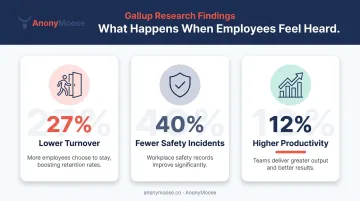
A hotline isn't just a compliance mechanism. Every time an employee decides whether to report a concern, they're also deciding whether the organization is worth trusting. According to Gallup, only 3 in 10 U.S. workers strongly agree their opinions count at work. Doubling that share is associated with 27% lower turnover, 40% fewer safety incidents, and 12% higher productivity.
The gap between a hotline that improves culture and one that quietly destroys it comes down to three things: anonymity, responsiveness, and visible follow-through.
Key Takeaways
- Whistleblower hotlines send a daily signal about whether leadership values accountability — not just compliance.
- When reports go unanswered, trust erodes faster than if no channel existed at all.
- Psychological safety, DEI outcomes, and retention all hinge on how organizations respond to reports — not just whether a channel exists.
- Anonymous, mobile-accessible reporting keeps internal grievances from becoming public ones on Glassdoor or Blind.
- True anonymity and two-way follow-up are what separate a hotline employees actually use from one they ignore.
Beyond the Compliance Checkbox: What Hotlines Actually Do for Culture
From Regulatory Requirement to Cultural Signal
Whistleblower hotlines entered corporate life largely through regulation. The Sarbanes-Oxley Act of 2002 required publicly traded companies to establish confidential, anonymous channels for employees to report accounting and auditing concerns. The EU's Directive 2019/1937 extended similar requirements to private-sector organizations with 50 or more workers, explicitly framing internal reporting as contributing to "a culture of good communication and corporate social responsibility."
What regulators understood — and many organizations still underestimate — is that the existence of a reporting channel communicates values. A functioning, well-maintained hotline reads as evidence that leadership is willing to be held accountable. A number that goes nowhere sends exactly the opposite message.
The Cultural Functions a Hotline Performs
Beyond catching misconduct, a well-designed hotline:
- Lets employees report without confronting a manager or being seen walking into HR
- Signals that raising concerns is responsible behavior, not disloyalty
- Communicates that rules apply at every level, not just to junior staff
- Gives lower-seniority and marginalized employees access to leadership that hierarchy typically blocks
The equity issue is concrete. According to the Deloitte Women @ Work 2024 report, only 10% of women believed they could report non-inclusive behaviors without career impact or reprisals. When anonymous reporting channels are genuinely protected, employees who face the highest structural barriers to speaking up — those in vulnerable roles, marginalized groups, lower-seniority positions — gain access to the same voice as everyone else.
Hotlines as an Early-Warning System
Patterns across reports reveal what surveys often miss. Consider what patterns can surface:
- A cluster of harassment complaints concentrated in one department
- A spike in bias-related reports following a leadership change
- Recurring safety concerns from a single site over several months
Together, these signals give leadership a ground-level view of where culture is breaking down — one that engagement surveys rarely capture.
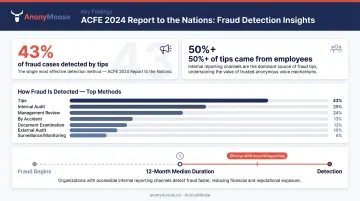
The ACFE's 2024 Report to the Nations found that 43% of occupational fraud cases were detected by tips, with more than half of those tips coming from employees. The median fraud case ran 12 months before detection — but organizations with active internal reporting systems shortened that window considerably.
AnonyMoose's Insights Dashboard is built around this use case. Its AI analyzes patterns across all reported incidents on a specific Hotline, surfacing themes across the workforce without exposing individual identities — giving leadership an organization-level view of cultural dysfunction, not just a log of individual complaints.
The Cultural Fallout When Hotlines Fail
When Reports Disappear
When employees file a report and hear nothing back, they draw one conclusion: the organization was never serious about accountability. The anxiety, vulnerability, and professional risk of speaking up delivered no benefit — and that lesson spreads.
This isn't speculation. The ECI's 2023 Global Business Ethics Survey found that 65% of global employees observed misconduct in the prior 12 months. Of those, 72% reported it. But 46% of those who reported experienced retaliation — unchanged from 2020. When employees see that reporting leads to consequences, word travels through the workforce fast. The APA (2021) found that employees are 70% more likely to disclose unethical practices in anonymous settings compared to traditional feedback methods — a figure that reflects precisely how much the retaliation risk calculus changes when structural anonymity is genuinely in place.
How Retaliation Silences the Whole Workforce
Retaliation — real or perceived — doesn't just affect the individual who experienced it. It becomes the dominant story about what happens when someone speaks up. Issues that should surface early instead compound until they become a crisis.
Even in organizations with formal anti-retaliation policies, employees observe informal retaliation: being passed over for projects, excluded from meetings, receiving subtly downgraded performance reviews. According to Gartner research, only 41% of observed workplace misconduct gets reported at all — and fear of retaliation is consistently cited as the primary reason employees stay silent.
The downstream effects are predictable:
- Issues that could have been resolved internally escalate
- Regulatory and legal exposure grows unchecked
- Morale among observers drops, even if they weren't directly involved
When Internal Channels Fail, Employees Go Public
Unresolved grievances don't disappear. They migrate. Employees take concerns to Glassdoor, Blind, labor agencies, or the press — and once that happens, the reputational and legal cost dwarfs whatever internal resolution would have required.
83% of job seekers research company reviews before deciding where to apply, according to Glassdoor's own data. Harvard Business School research has documented that online employee reviews can signal internal factors that raise the risk of misconduct or scandal. A pattern of public complaints doesn't just deter candidates — it draws regulatory attention and signals governance failures to investors.
Organizations that maintain trusted internal channels protect themselves from this compounding exposure. The employees who feel genuinely heard internally rarely feel the need to vent externally.
Psychological Safety, Belonging, and the Hotline Connection
What Psychological Safety Actually Means
Amy Edmondson's foundational research defined psychological safety as "a shared belief held by members of a team that the team is safe for interpersonal risk taking." In practical terms: employees believe they can raise concerns, flag problems, or challenge decisions without being punished or humiliated.
A whistleblower hotline — when designed well — is one of the most direct structural investments an organization can make in psychological safety. It institutionalizes the right to speak. Not a soft cultural benefit. A measurable operational one.
Gallup found that when employees strongly agree their opinions count, organizations see:
- 27% lower turnover
- 40% fewer safety incidents
- 12% higher productivity
McKinsey has identified psychological safety as a direct driver of adaptive, innovative performance — at the individual, team, and organizational level.
The Belonging Dimension
When a hotline is genuinely anonymous and follow-through is visible, something specific happens: employees feel their dignity matters regardless of their title or background. This is the belonging dimension HR leaders often struggle to quantify — but it shapes whether people stay, engage, and trust the organization. Research from Quantum Workplace found that anonymous communication drives a 35% increase in employees' sense of belonging, while the APA found a 30% increase in belonging in organizations that build genuine listening cultures. Both findings confirm that the hotline itself, designed well, is a belonging investment — not just a compliance tool.
Contrast this with the opposite perception: a hotline employees view as a management surveillance tool. That outcome deepens mistrust more than having no hotline at all. The difference comes down to design:
- Anonymity guaranteed by architecture, not just policy
- Responses delivered within a reasonable timeframe
- Visible action following substantiated reports
The Feedback Flywheel
Visible responsiveness creates a self-reinforcing cycle. When employees see that reports lead to action, more employees report. More reports surface issues earlier. Earlier issues are cheaper, faster, and less damaging to resolve.
AnonyMoose's platform is built around this cycle. Persistent conversation threads on Hotlines let the receiving team ask follow-up questions, share policy documents, or provide counseling resources within the same anonymous thread. The conversation doesn't end with submission — it continues until resolution. For employees who've experienced the alternative — submitting a report and hearing nothing — the difference is significant.
What Makes a Hotline a Culture-Building Tool, Not Just a Channel
Design Determines Trust
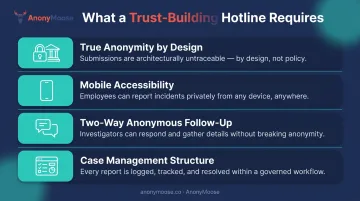
The technical architecture of a hotline either builds or destroys employee trust. Key features that matter:
- True anonymity by design — not by policy. Employees need to know that neither the platform nor the employer can technically identify who submitted a report. "We promise not to look" is not the same as "there is no mechanism to look."
- Mobile accessibility — employees should be able to report from their own device, from anywhere, in real time. Requiring a company device or a specific physical location adds friction that suppresses reporting.
- Two-way anonymous follow-up — investigators need to ask clarifying questions. Reporters need to provide additional context. This has to happen without compromising identity.
- Case management structure — urgency levels, status tracking, internal notes, and activity history give organizations the tools to actually resolve what gets reported.
AnonyMoose's Hotlines feature is built on this model. Anonymity is architectural, not promised: there is no technical mechanism within the platform that can expose who sent a message. Employees report from the app, in real time, from wherever they are, and the conversation thread stays open for follow-up.
On the management side, all cases are tracked through structured tools in AnonyMoose Web, with automated pattern analysis available through the Insights Dashboard.
Response Protocols Matter as Much as the Channel
The best hotline infrastructure fails without response protocols. Organizations should define:
- Acknowledgment timeline — when does the reporter hear that their submission was received?
- Investigation timeline — how long does a standard investigation take, and who is responsible?
- Resolution communication — are anonymized outcomes shared with the broader workforce to demonstrate accountability?
That last step — communicating anonymized outcomes — is where many organizations stop short. Without it, employees have no visibility into whether reporting produces change. Closing the loop, even in aggregate form, is what converts a one-time reporter into someone who trusts the system long-term.
Multiple Paths for Multiple Needs
Not every concern is a formal incident, and not every employee is ready to submit one. That gap — between something feeling wrong and something being reportable — is where culture either holds or fractures.
AnonyMoose addresses this directly. Alongside Hotlines, the platform includes Openlines for ongoing anonymous two-way dialogue, Polls & Surveys for real-time sentiment measurement, and Broadcast for leadership communication. Each channel serves a different level of need: flagging something serious, sharing a suggestion, or simply responding to a pulse check.
Frequently Asked Questions
Frequently Asked Questions
How does whistleblower protection contribute to organizational culture?
Whistleblower protection — both legal and organizational — signals that speaking up is safe and valued. When employees trust they won't face retaliation, accountability becomes a shared norm rather than a top-down mandate, reinforcing transparency at every level.
What is the purpose of a whistleblower hotline?
A whistleblower hotline gives employees a secure, often anonymous channel to report concerns — misconduct, harassment, ethics violations — so organizations can surface and address problems before they create legal or reputational damage.
What happens when employees don't trust a whistleblower hotline?
Distrust leads to silence. Employees stop reporting, issues go undetected, and the hotline stops serving its purpose. Frustrated employees take their concerns to Glassdoor, Blind, or regulators instead.
How does anonymity improve reporting rates?
Anonymity removes the single biggest barrier to reporting: fear of retaliation. When employees know neither the platform nor the employer can identify them, more people come forward — particularly those in vulnerable positions.
Can whistleblower hotlines reduce complaints on public platforms like Glassdoor?
Yes. When employees trust that internal reporting will be handled confidentially and lead to real action, they're far less likely to resort to public venting. A credible internal channel gives grievances a productive outlet before they become reputational risks.
What is the difference between a whistleblower hotline and a speak-up culture?
A hotline is a tool; a speak-up culture is the environment that determines whether anyone uses it. Organizations need both. Psychological safety encourages people to speak up, while a structured channel gives them a consistent, accountable way to do it. Neither works well without the other.