Employee pulse surveys exist to close that gap. They're short, frequent, and designed to give HR and leadership a continuous read on what's actually happening across the organization—not what was happening last winter.
According to Perceptyx research covering 750+ enterprises, 75% of organizations now listen to employees at least quarterly, compared with just 18% surveying more than once a year a decade ago. The shift is real, and it's accelerating.
This guide covers everything you need to run effective pulse surveys: a clear definition, the right questions to ask across key themes, the most common use cases, and free template frameworks you can adapt today.
Key Takeaways
- Pulse surveys are short (3–15 questions), frequent, and designed to track trends—not capture one-time snapshots
- Effective surveys mix engagement/outcome questions, driver questions, and at least one open-text question
- Anonymity is non-negotiable: employees won't answer sensitive questions honestly if they fear identification
- The five main use cases are monitoring, discovering, responding, DEI tracking, and action-plan follow-up
- Surveying without acting on results destroys trust faster than not surveying at all
What Is an Employee Pulse Survey?
A pulse survey is a short, recurring questionnaire—typically 3–15 questions—sent to employees at regular intervals to continuously measure sentiment, engagement, and workplace experience. Annual surveys capture depth; pulse surveys capture frequency.
Three characteristics define a true pulse survey:
- Short: Fewer questions mean less friction and higher completion rates
- Frequent: Sent weekly, monthly, or quarterly rather than once a year
- Consistent: The same core questions repeat across cycles to reveal trends, not isolated data points
Pulse Surveys vs. Annual Engagement Surveys
These tools aren't competing—they're complementary.
| Annual Engagement Survey | Pulse Survey | |
|---|---|---|
| Length | 40–60 questions | 3–15 questions |
| Frequency | Once per year | Weekly, monthly, or quarterly |
| Purpose | Deep baseline measurement | Trend tracking and early detection |
| Strength | Comprehensive, benchmarkable | Fast, actionable, real-time |
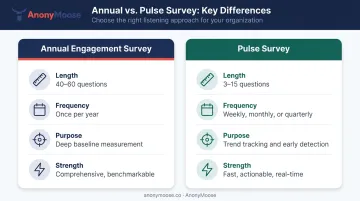
The two approaches work best together. Annual surveys set the strategic baseline; pulse surveys give managers and HR teams the ongoing visibility to catch declining morale or engagement dips before they drive turnover.
Key Benefits of Employee Pulse Surveys
Early Warning System
Because pulses run frequently, HR teams can catch declining morale, communication breakdowns, or manager effectiveness issues before they become expensive. McKinsey's own experience illustrates this directly: during the pandemic, McKinsey ran a weekly pulse check of two or three questions that generated over 1 million responses from 40,000+ employees across 140 offices. That data surfaced immediate concerns around mental health, childcare, and productivity — concerns that would never have appeared in an annual survey cycle.
That speed matters. By the time an annual survey flags a problem, it's often already a crisis.
The Trust and Engagement Loop
Pulse surveys only work if employees believe their feedback leads somewhere. UKG Workforce Institute research found that organizations are 88% more likely to perform well financially when employees feel heard, engaged, and included. The same research revealed that 63% of employees said their voice had been ignored by a manager or employer at some point—and 34% said they'd rather quit or switch teams than voice their real concerns.
Pulse surveys, when paired with visible follow-through, break that pattern. When employees see their input actually shape decisions, participation rates rise and honest responses follow.
Higher Response Rates, Cleaner Data
Shorter surveys also mean better data, not just higher participation. Two benchmarks worth knowing:
- Pulse surveys: 50–60% participation is a reasonable floor
- Full census surveys: 72–88% participation is typical
The gap is real, but a 5-question pulse completed honestly often produces more useful signal than a 50-question annual survey where respondents rush through the final 30 questions.
Frequent surveys also reduce recency bias—the distortion that happens when employees answer annual survey questions based on whatever happened last week rather than their experience across the year.
Employee Pulse Survey Questions to Ask
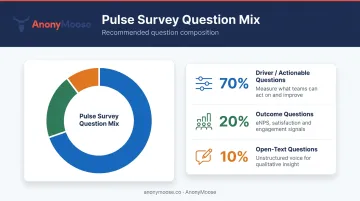
Not all questions are equal. A useful rule of thumb: structure your survey as roughly 70% driver/actionable questions, 20% outcome questions (like eNPS or overall satisfaction), and 10% open-text questions. Every question should connect to something the organization can actually act on.
Engagement & Job Satisfaction Questions
These track overall sentiment and serve as leading indicators of turnover risk:
- "I would recommend this organization as a great place to work." (1–5 scale)
- "I am excited about our organization's future." (1–5 scale)
- "The work I do is meaningful to me." (1–5 scale)
- "Overall, I am satisfied with my experience at this organization." (1–5 scale)
Engagement scores are your outcome measures. When they drop, the driver questions below help explain why.
Manager Effectiveness Questions
Manager data ranks among the most actionable data HR can collect — it pinpoints exactly where coaching or intervention is needed:
- "My manager provides feedback that helps me improve." (1–5 scale)
- "I feel empowered to make decisions in my role." (1–5 scale)
- "I know what I should be focusing on right now." (1–5 scale)
A team where manager scores fall 10+ points below the organization average tells you exactly where to direct attention next.
Belonging, Inclusion & Well-Being Questions
While manager scores reveal individual-level gaps, belonging and well-being questions expose culture-level dynamics that affect everyone. These are especially critical for organizations working to improve psychological safety and DEI outcomes:
- "I feel a sense of belonging at this organization."
- "I am able to successfully balance my work and personal life."
- "I feel comfortable sharing my honest opinion at work without fear of negative consequences."
- "People at this organization are treated fairly, regardless of their background."
BetterUp research links workplace belonging to a 56% increase in job performance and a 50% reduction in turnover risk—making these questions among the highest-ROI items in any pulse program.
The Open-Ended Question
Include at least one open-text question per pulse cycle:
"What is one thing that would most improve your experience at work right now?"
Closed-ended scales tell you scores are declining. This question tells you why. Run responses through thematic coding each cycle — even a rough grouping by topic (management, workload, communication) gives you a prioritized action list that no rating scale alone would produce.
Use Cases for Employee Pulse Surveys
Monitoring
The most common use case. Organizations run quarterly or monthly pulses across the full workforce to track engagement trends, catch early warning signs, and report progress to leadership. This is the continuous temperature check—useful even when nothing specific has changed, because gradual drift is the hardest trend to spot.
Discovering
A targeted pulse sent to a specific team, department, or location to drill down on an issue flagged by broader data. If your all-company engagement score is steady but one region is lagging, a discovery pulse with 4–5 focused questions can reveal whether the problem is communication, recognition, workload, or something else entirely.
Responding to Change Events
A just-in-time pulse launched after a planned or unplanned event. Common triggers include:
- New leadership or restructuring
- Return-to-office or hybrid policy changes
- Acquisitions or mergers
- Layoffs or workforce reductions
The pulse should go out within 1–2 weeks while sentiment is still forming. The goal isn't comprehensive measurement—it's giving leadership the data to communicate more effectively and course-correct early.
DEI and Belonging Tracking
Pulse surveys are one of the most powerful tools for organizations tracking inclusion metrics. Belonging scores often vary sharply by demographic group, location, or tenure—and aggregate scores hide those disparities. Running DEI pulses segmented by team, tenure, or demographic group reveals teams or groups where belonging is lagging before those employees start looking elsewhere.
BetterUp's research shows belonging reduces turnover risk by 50% and cuts employee sick days by 75%. Organizations that track it continuously are better positioned to act on it. The APA further found that sustained listening programs drive a 30% increase in employees' sense of belonging at work — making belonging pulse data one of the highest-ROI measurements HR teams can maintain consistently.
Action Plan Follow-Up
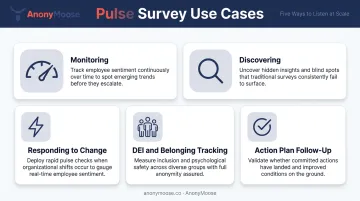
Run a targeted pulse 60–90 days after your annual engagement survey to measure whether the action plans that followed are actually working. This closes the loop—and it demonstrates to employees that survey feedback drives real decisions, not just slide decks. Only 8% of employees strongly agree their organization takes action on surveys. A follow-up pulse, paired with visible communication, is one of the most direct ways to change that perception.
Free Employee Pulse Survey Templates
Use these frameworks as starting points. The most important design principle: keep your core questions consistent across cycles. Trend data is the whole point—and trend data requires asking the same questions over time.
Template 1: Monthly Employee Engagement Pulse (5–7 Questions)
Recommended cadence: Monthly | Audience: Full organization
- Overall, I am satisfied with my experience at this organization. (1–5 scale)
- I feel a sense of belonging at this organization. (1–5 scale)
- I clearly understand what is expected of me in my role. (1–5 scale)
- My manager provides feedback that helps me do my best work. (1–5 scale)
- I would recommend this organization as a great place to work. (1–5 scale)
- I feel recognized for the contributions I make. (1–5 scale)
- What is one thing that would most improve your experience at work right now? (Open text)
Template 2: Post-Change or Event Pulse (3–5 Questions)
Recommended cadence: Within 1–2 weeks of the event | Audience: Affected employees
- I received clear information about [the change/event] and what it means for my role. (1–5 scale)
- I feel confident in leadership's ability to navigate this change effectively. (1–5 scale)
- This change has had a positive impact on my day-to-day work experience. (1–5 scale)
- I know where to go if I have questions or concerns about this change. (Yes/No)
- What concerns, if any, do you have about this change? (Open text)
Keep this survey short. Three focused questions get completed. Seven rushed ones produce noise.
Template 3: DEI & Belonging Pulse (5–6 Questions)
Recommended cadence: Quarterly | Audience: Full organization, segmented for analysis
- I feel a sense of belonging at this organization. (1–5 scale)
- I feel comfortable expressing my opinions at work without fear of negative consequences. (1–5 scale)
- I am included in decisions that affect my work. (1–5 scale)
- I believe opportunities for growth and advancement are available equally to me. (1–5 scale)
- People at this organization are treated fairly, regardless of their background or identity. (1–5 scale)
- What would make this organization a more inclusive place to work? (Open text)
This template is most valuable when segmented by team, tenure, or demographic group. Aggregate scores can look healthy while specific populations tell a very different story. Segmented analysis surfaces those gaps.
On anonymity: DEI and belonging questions require genuine psychological safety to get honest answers. Employees from underrepresented groups need to know their responses cannot be traced back to them. Without that assurance, responses reflect what people feel safe saying — not what they actually think. The SHRM Study (2020) found that 82% of employees are more likely to share critical feedback when anonymity is preserved, and organizations using anonymous pulse programs see a 47% increase in actionable feedback related to management practices — the category most likely to be sanitized in identified formats.
AnonyMoose's Polls & Surveys feature addresses this directly. Neither the employer nor AnonyMoose can identify individual respondents, and the platform supports segmentation by up to five custom criteria from HRMS data — so you can analyze DEI disparities across groups without compromising the anonymity that makes honest responses possible.
Best Practices for Pulse Survey Success
Commit to Acting on Results
Only run a pulse if you have the capacity to review and respond to what it surfaces. Perceptyx data shows 71% of organizations share survey results, but only 51% of employees report seeing tangible improvements from their feedback. That gap—between organizations sharing results and employees seeing change—is where trust erodes.
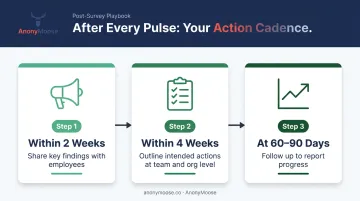
A practical cadence to follow:
- Within 2 weeks: Share key findings with employees
- Within 4 weeks: Outline intended actions at team and organizational level
- At 60–90 days: Follow up to report progress
Guarantee Real Anonymity
Employees won't answer sensitive questions honestly if they don't trust the platform. Two terms get conflated here, and the difference matters:
- Confidential: The employer promises not to share responses
- Anonymous: The system technically cannot identify the respondent
For questions about belonging, psychological safety, manager behavior, or DEI, employees need the latter. UKG research found 34% of employees would rather quit than voice real concerns with management. That's a structural safety issue — and technical anonymity resolves it in a way that policy promises alone cannot.
Match Cadence to Capacity
The more frequently you survey, the shorter each survey must be:
| Cadence | Recommended Length |
|---|---|
| Weekly | 3–5 questions |
| Monthly | 7–10 questions |
| Quarterly | 10–20 questions |
Start with quarterly if you're new to pulse programs. Increase frequency only when you've built the operational muscle to analyze results, communicate findings, and take visible action within each cycle. Consistent question selection across cycles is what makes trend tracking possible — without it, you're comparing apples to different apples each time.
Frequently Asked Questions
What questions should be included in an employee pulse survey?
Effective pulse surveys combine engagement/outcome questions (eNPS, overall satisfaction), driver questions (manager feedback, role clarity, recognition), and at least one open-ended question. Every question should tie to an area the organization can realistically address—if you can't act on the answer, don't ask the question.
Are employee pulse surveys anonymous?
It depends on the platform. Anonymous surveys collect no identifiable data; confidential surveys protect individual identity but may still link responses to demographics. When neither the tool provider nor the employer can identify respondents, employees give more honest feedback — especially on sensitive topics like belonging and psychological safety.
Are employee pulse surveys mandatory?
Most organizations keep participation voluntary to preserve trust. Mandatory surveys yield higher response rates but can reduce candor when employees doubt the platform's anonymity. The real goal is representative and authentic data — which requires a tool that makes honest participation feel genuinely safe.
How often should you run employee pulse surveys?
Start with quarterly and increase frequency only when you have the capacity to act on results. The cadence should match your organization's ability to analyze data, communicate findings, and implement changes—not just your desire to collect more data.
What is the difference between a pulse survey and an employee engagement survey?
Engagement surveys are longer, annual, and built to establish a comprehensive baseline. Pulse surveys are shorter and more frequent, designed to track shifts and surface emerging issues between annual touchpoints. The most effective programs run both.
How long should an employee pulse survey be?
Weekly pulses: 3–5 questions. Monthly pulses: up to 10 questions. Quarterly pulses: up to 20 questions. The shorter the survey, the higher the completion rate—and the more likely employees are to answer every question honestly rather than rushing to finish.