According to Qualtrics, 77% of employees want to provide feedback more than once per year — yet the majority of organizations still treat listening as an annual event. Pulse surveys fix that gap.
This guide covers everything you need to run a pulse survey program: what pulse surveys are, why they work, five real-world use cases, four ready-to-use question templates, and a practical three-step framework for getting started.
Key Takeaways
- Pulse surveys are short (3–15 questions), recurring questionnaires that track employee sentiment in real time
- They complement annual surveys — not replace them — by capturing what's happening right now
- Anonymous pulse surveys produce more candid responses — AnonyMoose ensures neither the employer nor the platform can identify individual respondents
- The biggest driver of survey fatigue isn't frequency — it's failure to act on results and communicate back
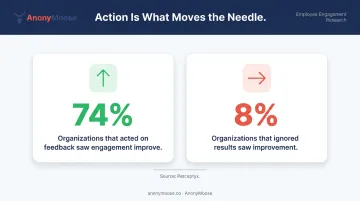
- Acting on feedback makes organizations 74% more likely to improve engagement — compared to just 8% among those that ignore results
What Is a Pulse Survey?
A pulse survey is a short, recurring set of questions sent to employees at regular intervals to continuously measure sentiment, track trends, and catch issues before they escalate. The name fits: like checking a pulse, these surveys give you a frequent, live read on organizational health rather than a once-a-year snapshot.
How Pulse Surveys Differ from Annual Surveys
| Dimension | Pulse Survey | Annual Engagement Survey |
|---|---|---|
| Length | 3–15 questions | 50+ questions |
| Time to complete | Under 5 minutes | 20–30 minutes |
| Frequency | Weekly, monthly, or quarterly | Once per year |
| Purpose | Real-time tracking on specific topics | Comprehensive baseline measurement |
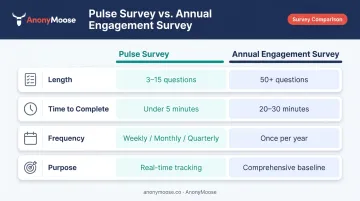
The two formats work together. Annual surveys establish the baseline; pulse surveys tell you whether that baseline is shifting — and in which direction.
What Can a Pulse Survey Measure?
Almost anything the organization wants to track:
- Employee engagement and morale
- Reactions to a policy change or leadership transition
- DEI climate and sense of belonging
- Well-being and workload manageability
- Whether action plans from the last annual survey are making a difference
The topic mix is flexible. What creates value is consistent measurement over time — a single data point shows a moment; repeated measurements reveal whether your initiatives are actually working.
Why Use Pulse Surveys? The Key Benefits
Real-Time Visibility
Annual surveys capture a single snapshot. By the time results are analyzed and shared, the underlying conditions have shifted. Pulse surveys create a continuous stream of data, so HR and leadership can spot declining morale, rising friction, or the impact of a specific event as it unfolds — weeks before it would appear in an annual report.
Better Engagement with the Process
Short surveys drive higher participation. Perceptyx reports that enterprise organizations should target 55–81% participation for pulse surveys. Nobody wants to spend 30 minutes on a questionnaire. Two minutes is a different ask entirely.
Employees Feel Heard — and That Changes Behavior
Regularly asking for feedback sends a signal: your opinion matters here. Qualtrics research found that employees are 12 times more likely to recommend their employer when they feel their feedback is listened to and acted upon. That's not just a morale metric — it's a retention signal. Work Institute estimates employee turnover costs approximately 33% of base salary, so even modest improvements in retention compound quickly.
Agility and Faster Course Correction
Frequent pulse results let organizations test an intervention, measure its effect within weeks, and adjust before resistance hardens. This matters most during organizational change, leadership transitions, or policy rollouts — exactly the moments when traditional annual surveys are least useful.
Anonymity Determines Data Quality
Even well-designed pulse surveys underperform when employees worry their answers can be traced back to them. Anonymous pulse surveys consistently produce more candid responses because psychological safety is the prerequisite for honest feedback. According to the SHRM Study (2020), 82% of employees are more likely to share critical feedback when they know their anonymity is preserved — and research from buildempire.co.uk shows anonymous surveys generate 58% more honest feedback than non-anonymous ones, with participation rates reaching 90% compared to 30% for identified surveys.
AnonyMoose's Polls & Surveys feature addresses this directly. The platform's architecture ensures that neither the employer nor AnonyMoose itself can identify individual respondents — anonymity is enforced at the technical level, not just stated in a policy document.
Submissions are stored without any link to the individual who sent them. The data organizations receive reflects what employees actually think, not what they're willing to sign their name to.
Key Use Cases for Pulse Surveys
Employee Engagement Monitoring
The most common use case: continuous tracking between annual census surveys. A quarterly three-question pulse — including an eNPS item ("How likely are you to recommend this company as a place to work?") plus two driver questions on autonomy or career growth — gives HR a running trendline rather than a once-a-year snapshot.
The key distinction: engagement scores alone aren't actionable. Driver questions reveal why engagement is rising or falling, which is what makes the data useful for managers.
DEI and Belonging
Pulse surveys are one of the most practical tools for measuring whether DEI initiatives are actually landing with employees. Typical questions cover:
- Whether employees feel included in team decisions
- Whether they observe equitable treatment day-to-day
- Whether they have a genuine sense of belonging
This use case demands extra care. Employees from underrepresented groups are often least likely to speak candidly without guaranteed anonymity — not because they don't have opinions, but because the professional risk of being identified feels real.
Platforms where the architecture itself prevents identification (not just policy) generate more honest responses on DEI topics than those relying on trust alone.
AnonyMoose's Polls & Surveys feature supports targeted DEI pulses using Close User Groups — organizations can send surveys to precisely defined subgroups using up to five custom criteria, enabling granular comparison across teams, locations, or demographics.
Change Management and Event-Specific Feedback
Policy rollouts, restructurings, new leadership, remote/hybrid transitions — these are exactly the moments when employee sentiment can shift fastest and HR has the least visibility. A five-question pulse deployed two weeks after introducing a new performance review process reveals whether employees understand it and feel it's fair. That's enough time to adjust communications before resistance becomes entrenched.
AnonyMoose supports targeted event-specific deployments: a survey can be sent to the specific department or team affected by a change, with push notification delivery ensuring near-100% reach regardless of where employees are located.
Onboarding and New-Hire Sentiment
Gallup research shows only 12% of employees strongly agree their organization does a great job onboarding new hires — and SHRM reports that up to 20% of turnover happens within the first 45 days.
Short pulse surveys at day 30, day 60, and day 90 track whether new hires feel supported, whether early expectations match reality, and whether anything needs to be addressed before someone starts quietly looking elsewhere. Given that turnover costs roughly 33% of base salary, catching early attrition signals is high-value work.
Action Plan Follow-Up
Annual engagement surveys lose credibility fast when employees never see what happened with their feedback. A follow-up pulse three to six months after the annual survey closes that loop directly.
A single question does a lot of the work: "To what extent do you agree: I have seen positive changes as a result of our last survey." Tracking that score over time shows whether action plans are visible to employees — and whether HR's efforts are landing.
AnonyMoose's Insights Dashboard allows leadership to compare results over time, giving teams a clear view of whether sentiment is moving in the right direction.
Pulse Survey Questions and Free Templates
Before sending any pulse survey, a few structural principles help:
- Keep it to 5–10 questions for monthly pulses; up to 15 for quarterly
- Aim for roughly 70% driver questions, 20% outcome questions, 10% open-text
- Follow each rating scale with one optional open-ended question to capture the "why"
- Write questions the way a colleague would ask them — no HR jargon
Employee Engagement Template (5–7 Questions)
Use quarterly or monthly. Copy-paste ready:
- On a scale of 1–10, how engaged do you feel at work this week?
- I understand how my work contributes to the company's goals. (1–5 agreement scale)
- My manager gives me the feedback I need to do my best work. (1–5 agreement scale)
- I have opportunities to develop my skills here. (1–5 agreement scale)
- I feel recognized for good work. (1–5 agreement scale)
- (Optional) What is one thing that would improve your experience at work right now? (Open text)
Culture and DEI Template (5 Questions)
Best deployed anonymously — candid answers on belonging and equity require psychological safety:
- I feel I can be my authentic self at work. (1–5 agreement scale)
- People here are treated fairly, regardless of their background. (1–5 agreement scale)
- I feel like I belong on my team. (1–5 agreement scale)
- I feel comfortable raising concerns without fear of retaliation. (1–5 agreement scale)
- What would make this a more inclusive workplace? (Open text)
Well-Being and Workload Template (4–5 Questions)
Run this monthly or whenever workload spikes — burnout signals often appear here before they show up elsewhere.
- My workload is manageable. (1–5 agreement scale)
- I feel stressed at work more often than I should. (1–5 agreement scale)
- I am able to maintain a healthy balance between work and personal life. (1–5 agreement scale)
- I feel supported when I am struggling at work. (1–5 agreement scale)
- (Optional) What would most improve your well-being at work? (Open text)
Change Management Template (4 Questions)
Deploy within two weeks of a significant change — new process, restructure, leadership change:
- I understand why this change is happening. (1–5 agreement scale)
- Leadership has communicated clearly about what to expect. (1–5 agreement scale)
- I feel confident in my ability to adapt to this change. (1–5 agreement scale)
- What questions or concerns do you have about this change? (Open text)
For sensitive templates like Culture/DEI, anonymity is what makes the data usable. AnonyMoose's Polls & Surveys feature delivers these surveys via mobile push notification, and no one — not the employer, not the platform — can trace responses to individual employees.
How to Run a Pulse Survey: Best Practices
Step 1 — Define a Clear Purpose Before Launching
Every pulse survey should start with one question: What business decision will this data inform? Identify who will receive the survey, who owns the analysis, and — critically — what will happen with the results.
Surveys without a follow-up plan erode trust fast. Perceptyx data makes the stakes clear: 74% of organizations that acted on survey feedback saw engagement improve, versus just 8% of organizations that didn't take action. The survey itself doesn't move the needle — the response to it does.
Step 2 — Set the Right Cadence
Match frequency to how quickly the topic evolves and how quickly your organization can respond:
- Monthly pulses: 5–10 questions; works well for tracking engagement or well-being
- Quarterly pulses: 10–15 questions; suited for broader engagement or DEI tracking
- Event-specific pulses: Deploy within 1–2 weeks of a significant change
One important reframe on survey fatigue: Culture Amp argues employees don't get tired of surveys — they get tired of surveys that lead nowhere. The biggest driver of disengagement from the process is the absence of visible follow-up, not the frequency of asking.
Step 3 — Close the Feedback Loop Visibly
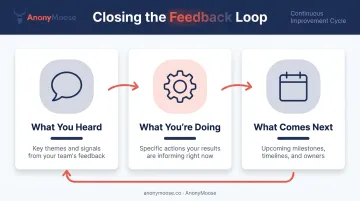
After each pulse, share a high-level summary with employees: what you heard, what you're doing, and when they can expect changes. This step separates a pulse program that builds trust from one that breeds cynicism.
A strong feedback summary covers three things:
- What you heard: Key themes from the data, without overpromising
- What you're doing: Specific actions or decisions the results will inform
- What comes next: Timeline or owner so employees know follow-up is real
AnonyMoose's Broadcast feature makes this easy to execute: leadership can compose an announcement, attach supporting files if needed, and push it to all employees or specific subgroups instantly. Pair that with the Insights Dashboard for tracking trends over time, and you have a complete loop: listen, analyze, act, communicate.
Frequently Asked Questions
What is a pulse survey?
A pulse survey is a short, recurring questionnaire — typically 3–15 questions — sent to employees at regular intervals to continuously track sentiment, engagement, or reactions to specific events. The goal is to give organizations a real-time read on organizational health rather than waiting for an annual survey.
How does a pulse survey work?
An organization defines a question set, sends it to a target group on a set cadence, and analyzes trends over time. Results should always be shared back with employees alongside any actions being taken — that's what closes the feedback loop and builds trust.
What questions are asked in a pulse survey?
Questions vary by goal but typically cover engagement, well-being, manager effectiveness, or reactions to a specific change. Most surveys use 3–10 rating-scale questions plus one optional open-ended item to capture the "why" behind the scores.
Are pulse surveys anonymous?
Anonymity depends on the platform and configuration, but anonymous surveys consistently produce more honest responses. Organizations should communicate this clearly upfront. Platforms like AnonyMoose guarantee true anonymity at the architectural level, meaning neither the employer nor the platform can identify individual respondents.
How long should a pulse survey be?
Short enough to complete in under five minutes. A common guideline is 5–10 questions for monthly surveys and up to 15 questions for quarterly surveys. The more frequently you survey, the shorter each survey should be.
How often should you send pulse surveys?
Most organizations run pulse surveys monthly or quarterly. The right cadence depends on how quickly the topic being measured evolves and how quickly your team can analyze results and take visible action. Avoid surveying more frequently than you can meaningfully respond to the data.