Employees notice. And according to Perceptyx's State of Employee Listening 2026, employees who don't see local changes after a listening event are 2.5x more likely to doubt that senior leaders' actions align with organizational values. That's not a soft finding — that's trust eroding in real time.
This guide covers what employee engagement surveys actually are, how to design them so people respond honestly, why anonymity is non-negotiable, and how to close the feedback loop so surveys create real change rather than just generating data nobody acts on.
Key Takeaways
- Engagement surveys measure commitment and connection — not just daily satisfaction
- Only 51% of employees report seeing real improvements from survey feedback
- True anonymity requires architectural design, not just a policy promise
- Acting on results matters more than the survey itself
- Surveys without visible follow-through damage trust more than no survey at all
What Are Employee Engagement Surveys and Why Do They Matter in 2026?
Engagement vs. Satisfaction: What the Difference Actually Means
An employee engagement survey is a structured tool for measuring how connected, committed, and motivated employees are — relative to their work, their team, leadership, and the organization's goals. That's different from a satisfaction survey, which captures how happy someone feels on a given day.
Satisfaction is a snapshot. Engagement is a sustained pattern of behavior and attitude. Someone can be satisfied with their salary but completely disengaged from their work. Surveys that conflate the two produce misleading scores.
The Business Case
The cost of getting this wrong is significant. Gallup's State of the Global Workplace 2026 reports that global employee engagement fell to 20% in 2025, with low engagement costing roughly $10 trillion — about 9% of global GDP — in lost productivity annually.
The upside is just as clear. Gallup's Q12 Meta-Analysis found that top-quartile engagement business units show 23% higher profitability than bottom-quartile units. Engaged employees are more productive, less absent, less likely to quit, and more likely to deliver quality work — and each of those outcomes reinforces the others.
Why 2026 Demands a Different Approach
The engagement survey landscape has shifted significantly, driven by changes in how and where people work:
- Hybrid and remote work fragmented traditional feedback channels — hallway conversations and informal check-ins vanished, and annual surveys can't compensate
- Younger workforces expect continuous development and regular feedback, not a once-a-year form
- AI-powered analytics now make it possible to act on open-text feedback at scale, turning qualitative responses into actionable patterns faster than manual analysis ever could
Organizations still running the same annual survey they deployed a decade ago are measuring a workplace that no longer exists. Updating your listening strategy isn't a nice-to-have — it's what determines whether survey data actually drives decisions.
Types of Employee Engagement Surveys
Not all surveys serve the same purpose. The most effective organizations use a combination of formats rather than relying on any single approach.
Annual Engagement Surveys
Annual surveys are comprehensive baseline assessments covering all major engagement drivers: leadership trust, recognition, growth opportunities, workload, and belonging. They're useful for identifying organization-wide trends and benchmarking year-over-year progress.
The limitation is obvious — they're too infrequent to catch emerging problems. A team that starts disengaging in March won't show up in the data until the following January.
Pulse Surveys
Pulse surveys are short check-ins — typically 10–15 questions — run monthly or quarterly to track sentiment between annual cycles. Their primary value is early warning: catching the early signs of disengagement before they become turnover.
A well-designed pulse program doesn't replace the annual survey. It tells you where to look when the annual results arrive.
Lifecycle Surveys and eNPS
Unlike time-based surveys, lifecycle surveys and eNPS are triggered by events and moments — which makes them easier to act on.
Lifecycle surveys fire at key transitions: onboarding, the 90-day mark, role changes, and exit. Because sentiment is tied to a specific experience, results are cleaner and less ambiguous than periodic surveys.
eNPS (Employee Net Promoter Score) asks one question: How likely are you to recommend this organization as a place to work? It's simple, benchmarkable, and fast. On its own, it's not a substitute for deeper listening — but it gives you a consistent, comparable signal to track across every survey cycle.
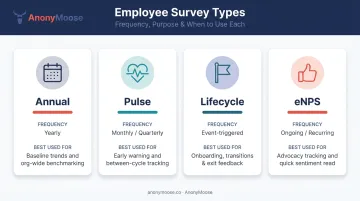
Here's a quick summary of when each format works best:
| Survey Type | Frequency | Best Used For |
|---|---|---|
| Annual | Yearly | Baseline trends, org-wide benchmarking |
| Pulse | Monthly / Quarterly | Early warning, between-cycle tracking |
| Lifecycle | Event-triggered | Onboarding, transitions, exit feedback |
| eNPS | Ongoing / Recurring | Advocacy tracking, quick sentiment read |
How to Design an Effective Employee Engagement Survey
Use the 5 C's as Your Design Framework
Before writing a single question, decide what you're actually measuring. The 5 C's of employee engagement provide a practical framework for organizing survey content around drivers that predict engagement, not just describe it:
- Connection — Does the employee feel part of the team and organization?
- Contribution — Do they feel their work has meaningful impact?
- Clarity — Do they understand their goals and what's expected?
- Confidence — Do they trust leadership?
- Care — Do they feel supported as a person, not just a role?
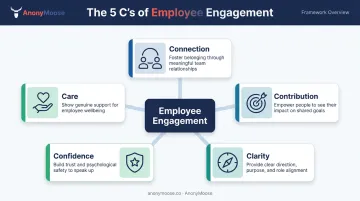
Using these categories means your results point to specific problem areas, not just a number you can't act on.
Question Design Principles
- Write behavior-anchored questions, not vague sentiment questions. "My manager provides feedback that helps me grow" generates actionable data. "Do you like your manager?" generates noise.
- Keep surveys appropriately sized. Culture Amp describes pulse surveys as 10–15 questions under five minutes. For annual surveys, SHRM's engagement service uses 33 questions — a practical reference point for scope.
- Include 1–2 open-text fields to capture the "why" behind the numbers. Quantitative scores tell you what; open text tells you why.
Getting the questions right is only half the equation. When and how often you survey shapes the quality of what you'll hear.
Timing, Frequency, and Segmentation
Survey timing affects the data you collect as much as the questions themselves. Avoid launching surveys immediately after layoffs, leadership changes, or major disruptions — you'll collect fear-influenced data rather than genuine sentiment.
Two timing mistakes to avoid:
- Surveying so rarely that problems go undetected for months
- Surveying so frequently that employees stop responding thoughtfully
On segmentation: a single organization-wide engagement score can mask serious problems in specific teams. Structure surveys to allow breakdowns by department, tenure, location, and role. Set a minimum respondent threshold — typically 5 responses — before surfacing segment-level data. This protects individual anonymity without sacrificing the insight that team-level breakdowns provide.
Solid segmentation structure only pays off if employees actually participate. That starts with communication before the survey launches.
Pre-Survey Communication
Participation rates and response quality both improve when employees understand the purpose in advance. Before launching, communicate:
- What the survey measures and why it's being run
- Who can access the results
- How previous survey results were used
- How anonymity is protected
Employees who've seen feedback ignored before need concrete evidence of follow-through, not just a pledge that things will be different this time.
Why Anonymity Is the Foundation of Honest Employee Feedback
The Self-Censorship Problem
When employees fear identification — even in organizations that publicly value openness — they self-censor. Peer-reviewed research confirms this: employees withhold opinions when they anticipate negative consequences, and this behavior is strongly associated with environments where psychological safety is low.
The result is socially acceptable responses rather than honest ones. Organizations end up making decisions based on data that reflects caution, not reality.
A 2024 report from the Institute of Business Ethics found that 43% of workers feared reprisals if they spoke up. That's not a fringe concern. It's a majority of the workforce staying quiet about things that matter. The SHRM Study (2020) shows just how much is at stake: organizations with guaranteed anonymity see 82% of employees willing to share critical feedback, along with a 47% increase in actionable feedback related to management practices — the exact insights most organizations are currently missing because their channels don't feel structurally safe.
Claimed Anonymity vs. True Anonymity
Many platforms claim anonymity but don't deliver it architecturally. In small teams, aggregated data can still make individuals identifiable. Admins may retain the ability to trace responses. The threshold that prevents this — typically five responses per segment before data is surfaced — matters more than the policy language.
True anonymity means no one can link a response to an individual. Not the employer, and not the platform provider. That distinction has to be built into the system's design, not just its terms of service.
This is where AnonyMoose takes a different approach. Its anonymous Polls & Surveys feature is built so that the employer sees aggregated, anonymized responses — and the platform itself has no technical mechanism to identify individual authors. Anonymity is enforced by architecture, not by trust.
Anonymity as an Equity Issue
Employees from underrepresented groups, those in hierarchical cultures, and those with legitimate concerns about retaliation are simultaneously the least likely to speak up in non-anonymous channels — and the most important voices to hear.
When feedback channels aren't genuinely safe, the voices that disappear first are the ones organizations claim most urgently want to hear. For these employees, a feedback channel is only useful if it's genuinely safe — not just labeled as such.
What Happens Without It
When employees don't trust internal feedback channels, they find external ones. Glassdoor lists reviews for over 2.3 million companies — all posted anonymously. When organizations fail to provide safe internal channels, they don't eliminate negative feedback; they just lose control of where it goes.
When employees have a trusted internal channel that genuinely protects their identity, the motivation to seek external anonymous outlets decreases. AnonyMoose is built around this premise: give employees a credible internal alternative, and they're far less likely to reach for Glassdoor.
Turning Survey Results into Action: The Feedback Loop
The Gap Is the Problem
According to Perceptyx, 71% of employees say their organization shares survey results, 59% say action plans are created — but only 51% report seeing real improvements. That 20-point gap between "we made a plan" and "things actually changed" is where engagement programs fail.
Employees are watching. 69% of organizations see increased engagement when employees report visible behavior changes from that feedback — which means the survey itself is table stakes. The real work starts after results come in.
Share Results Quickly
Best practice is to share high-level findings with all employees within two weeks of survey close. Transparency doesn't mean sharing everything — it means sharing:
- The major themes that emerged
- Areas the organization is committing to address
- Areas that won't change, and why
That last point matters. Telling employees "we heard this, but here's why we can't address it right now" is more trust-building than silence.
Activate Managers at the Team Level
Gallup estimates that managers account for at least 70% of variance in employee engagement scores across business units. That means HR publishing results company-wide is necessary but not sufficient. Organizations that build genuine listening cultures also see broader gains beyond engagement: the APA found a 30% improvement in employee satisfaction within one year for companies that implemented structured, anonymous feedback programs — a return that makes the operational investment in closing the feedback loop concrete and measurable. Team-specific results need to reach the direct manager — with context, not just data.
Organizations using manager-led action plans see ongoing engagement gains 59% of the time, compared to 28% without a structured approach (Perceptyx, 2025). Managers need:
- Their team's specific results, not just the organizational average
- Suggested actions, not just problem identification
- A clear expectation that follow-through is part of their role
The Four-Stage Closed Loop
Putting those manager-level insights to work requires a full cycle. Effective programs move through all four stages — organizations that stop at stage two are wasting the survey investment:
- Listen — Run the survey with genuine anonymity
- Understand — Analyze results, identify themes, share findings
- Act — Assign ownership, set timelines, implement changes
- Confirm — Follow up in the next survey cycle to show what changed
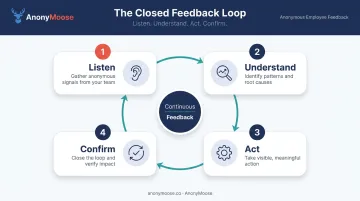
AnonyMoose's Broadcast feature is built for stage four. It allows leadership to send targeted updates to specific employee segments — reaching the teams whose feedback drove those changes directly, without compromising the anonymity of the original submissions.
What to Look for in an Employee Engagement Survey Platform in 2026
Non-Negotiable Features
Any platform worth considering should include:
- True anonymity architecture with threshold-based suppression for small groups
- Mobile-first access — email-only platforms miss frontline and deskless employees entirely
- Pulse and annual survey capability within the same platform
- Real-time analytics with driver-level and segment-level breakdowns
- Manager-facing dashboards with enough context to drive team-level action
Delivery channel is often underweighted in platform evaluations. BCG estimates roughly 2.7 billion workers globally are deskless or frontline — a platform that delivers surveys only via email excludes a significant portion of the workforce before anyone responds.
2026-Specific Capabilities
Gartner's Voice of the Employee market coverage identifies AI-powered sentiment detection, driver analysis, engagement trend tracking, and attrition risk flagging as the capabilities distinguishing leading platforms. Forrester's Q2 2025 analysis of employee experience management platforms noted vendors are expanding natural language processing (NLP) and agentic AI — while maintaining employee anonymity as a non-negotiable constraint.
Look for:
- AI analysis of open-text responses that surfaces themes without exposing individuals
- Predictive signals that flag teams showing early disengagement patterns
- Analytics that prioritize what to act on, not just what to measure
AnonyMoose's Unified Approach
AnonyMoose is purpose-built for organizations that treat psychological safety as a platform requirement, not a nice-to-have. Its unified mobile platform combines four feedback channels in one:
- Polls & Surveys: structured, anonymous employee pulsing with targeting by up to five custom criteria
- Openlines: continuous, unstructured two-way anonymous feedback between formal survey cycles
- Broadcast: targeted one-to-many communication for closing the feedback loop with specific segments
- Hotlines: anonymous incident reporting for safety and ethics concerns
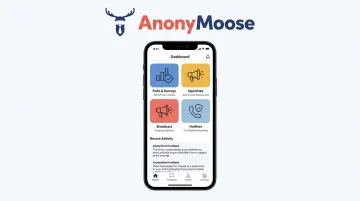
All responses are anonymous by architectural design, and push notifications reach employees without requiring a corporate email address. The Insights Dashboard then surfaces aggregated results and trends for leadership — without ever exposing individual identities.
For distributed, hybrid, or deskless workforces, this combination of mobile delivery and structural anonymity resolves the two gaps most email-based platforms leave open.
Frequently Asked Questions
What is the best employee engagement survey?
The best survey is the one employees will answer honestly — which requires genuine anonymity, manageable length, questions tied to drivers that matter to your workforce, and visible follow-through from previous cycles. Platform choice matters less than design quality and organizational commitment to acting on results.
Are engaged employees 23% more profitable?
Yes. This figure comes from Gallup's Q12 Meta-Analysis (11th Edition, 2024), which found top-quartile engagement business units outperform bottom-quartile units by 23% on profitability. Engaged employees are more productive, less absent, and less likely to leave — effects that compound into measurable financial outcomes.
What are the 5 C's of employee engagement?
The 5 C's (Connection, Contribution, Clarity, Confidence, and Care) are a structured framework for designing surveys around the drivers most predictive of engagement. Using them as survey categories points results toward actionable problem areas rather than a single score with no clear path to improvement.
How often should you conduct employee engagement surveys?
One comprehensive annual survey paired with quarterly pulse surveys is a practical starting cadence for most organizations. Frequency should match the organization's capacity to act on results — over-surveying without follow-through damages trust more than surveying less often.
What questions should be included in an employee engagement survey?
Core categories include: manager support and trust, recognition and appreciation, growth and development, workload and well-being, sense of belonging, and alignment with company mission. Every survey should also include one eNPS question: How likely are you to recommend this organization as a place to work?
How do you improve employee engagement survey response rates?
Three factors consistently drive higher participation: guaranteed anonymity (employees must trust their identity is protected), visible follow-through from previous surveys, and reduced friction in the survey experience through mobile access, shorter surveys, and delivery through channels employees already use.