Introduction
Most organizations have at least one feedback channel. Many have several. Yet only 20% of employees worldwide were engaged in 2025, according to Gallup's State of the Global Workplace report — a figure that hasn't meaningfully moved despite years of survey programs and engagement initiatives.
The problem isn't channel quantity — it's channel effectiveness. Qualtrics research found that 92% of employees believe it's important for their company to listen to feedback, but only 7% say their company acts on it really well. That 85-point gap is where engagement strategies break down.
Channels fail for predictable reasons: employees don't feel safe using them, previous feedback vanished without response, or the channel simply doesn't reach them where they work.
This article covers which feedback channels actually drive engagement, why psychological safety is the prerequisite that makes any channel work, and how closing the feedback loop sustains participation.
Key Takeaways
- Engagement rises when employees see their feedback actually shape decisions — having a channel alone isn't enough
- Anonymous channels consistently surface honest input that attributed ones miss, especially on sensitive issues
- Psychological safety is the prerequisite that determines whether any channel gets used honestly
- Closing the loop with "You said, we did" is the highest-leverage action for sustaining participation over time
- A unified, mobile-first platform reduces friction and reaches deskless workers, not just desk-based ones
Why Employee Feedback Channels Matter for Engagement
The connection between being heard and staying engaged is direct. The Workforce Institute's Employee Voice Study found that 92% of highly engaged employees feel heard — compared with just 30% of employees with low engagement. A 62-point gap in feeling heard is nearly impossible to close without the right channels in place. Communication failures compound these stakes: research from Axios HQ, based on LinkedIn studies, found that 42% of employees left an organization due to poor internal communication — a retention cost that proper feedback channels are specifically designed to prevent.
When feedback channels fail, employees don't go silent. They go elsewhere. They vent on Glassdoor, post on Blind, or quietly disengage while remaining on the payroll. The goal of an internal feedback channel isn't just data collection — it's providing a trusted internal outlet before frustrations find an external one.
Done well, feedback channels function as an early warning system for the business. They surface broken processes and innovation ideas that would never reach leadership through normal reporting structures — before either becomes a crisis or a missed opportunity.
The business case is concrete:
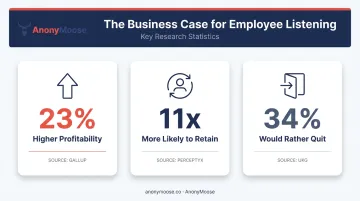
- 23% higher profitability in highly engaged teams vs. peers, per Gallup
- 11x more likely to have high retention in organizations that regularly listen and act on feedback, per Perceptyx
- 34% of employees would rather quit or switch teams than voice true concerns to management, per UKG — meaning silence has a turnover cost
- 42% of employees have left an organization due to poor internal communication, according to Axios HQ (based on LinkedIn studies) — a figure that frames feedback channel failure not just as a culture issue but as a direct retention cost
Why Most Feedback Channels Fail to Drive Real Change
Most organizations have feedback channels. Few have feedback cultures. The gap between the two comes down to three recurring failures.
The Suggestion Box Problem
Passive channels — forms, inboxes, suggestion boxes — create the illusion of listening without the infrastructure to act. When no response follows, employees learn quickly that the channel is ceremonial. Qualtrics identifies "lack of action fatigue" as the primary reason employees stop responding. The issue isn't survey frequency; 77% of employees actually want to give feedback more than once a year. The issue is perceived futility.
The Psychological Barrier
Fear of retaliation — direct or subtle — causes systematic self-censorship. The Institute of Business Ethics found that 46% of employees who raised concerns experienced personal disadvantage or retaliation afterward. Even in channels that technically offer anonymity, employees in small teams or minority groups often assume they can be identified. That assumption, even when wrong, produces sanitized, low-signal responses.
34% of employees who witnessed misconduct didn't report it because they feared losing their job. Another 34% believed corrective action wouldn't be taken anyway. Both groups opted out not because the channel was hard to use — but because they had no reason to trust it would matter.
The Loop-Closing Failure
The most common pattern: feedback is collected, shared with leadership, and then nothing changes within a visible timeframe. Harvard Business Review reported in 2024 that a persistent gap between collecting feedback and acting on it leads employees to stop responding — and they notice when that gap persists. Once that trust is lost, it takes multiple positive cycles to rebuild participation.
6 Employee Feedback Channels That Actually Drive Engagement
Pulse Surveys
Short, frequent, theme-specific surveys — run weekly to monthly — track sentiment movement over time rather than trying to measure everything at once. Their value comes from cadence and consistent follow-through, not data volume.
Key design considerations:
- Keep them to 3-5 questions maximum per cycle
- Deliver via push notification, not email links — completion rates drop sharply when employees have to navigate to an external form
- Rotate themes (workload, manager trust, belonging, career growth) rather than repeating the same questions
- Share results back to employees within days, not quarters
AnonyMoose's Polls & Surveys feature delivers surveys directly to employees' phones via push notification, enabling single-tap responses — a design that's particularly effective for reaching deskless workers who don't sit at a desk with regular email access.
Anonymous Open Channels (Openlines)
Always-open, anonymous submission channels allow employees to raise concerns, share ideas, or flag issues between formal survey cycles — at any time, from any device. Unlike periodic surveys, these channels create continuous dialogue.
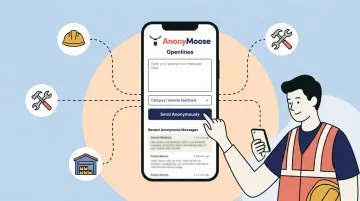
The differentiator is genuine anonymity. Platforms that claim anonymity without technically enforcing it produce the same self-censorship as attributed channels. AnonyMoose's Openlines feature is built on an architectural guarantee: neither the employer nor AnonyMoose itself can identify the author of any submission. Anonymity is embedded in system design, not policy — no technical mechanism within the platform can trace a message back to its sender. Employees can initiate a conversation from a warehouse floor, a construction site, or a home office — via the mobile app or web interface — whenever the need arises.
Anonymous Hotlines for Sensitive Issues
Hotlines serve a different purpose than general feedback channels. They're purpose-built for reporting ethics violations, safety concerns, harassment, discrimination, or misconduct — situations where the stakes of identification are highest.
Traditional hotlines create real friction: employees must find physical privacy, call a stranger, speak out loud, and hope their voice isn't recognized. That barrier keeps most people silent. AnonyMoose's Hotlines remove those friction points — employees open the app, select the relevant hotline, and type from wherever they are. The conversation thread stays open for follow-up questions, policy documents, and resources, with the employee remaining anonymous throughout.
When no trusted internal channel exists, employees escalate externally — to regulators, media, or review platforms like Glassdoor. That outcome carries far greater reputational and legal exposure than the original concern ever would have.
Targeted Polls on Specific Decisions
Two-to-three question polls, deployed before a decision is made rather than after, signal something important: that employee perspective is sought as input, not just collected as record. That distinction drives meaningful buy-in.
These work particularly well via mobile for distributed or deskless workforces. A logistics company rolling out a new scheduling system, for instance, gets far better adoption when frontline workers are consulted during the design phase — not after the rollout is announced.
Manager 1:1s and Skip-Level Conversations
Where structured polls measure sentiment, conversational feedback captures the qualitative nuance behind it. A manager who asks "what's one thing that would make your work easier this month?" — and actually acts on the answer — builds trust faster than any formal survey program.
These channels have real limits, though:
- They only work when employees trust the manager
- Feedback about the manager themselves rarely surfaces in attributed conversations
- Sensitive cultural dynamics — belonging, bias, equity concerns — are consistently underreported in 1:1 settings
- Organizations relying exclusively on 1:1s systematically miss the feedback they most need to hear
Facilitated Listening Sessions
Small-group sessions of 5-8 people, moderated externally, work well for exploring the "why" behind quantitative data. When pulse surveys reveal a dip in belonging scores, a facilitated session can surface what's driving it.
One non-negotiable: for sensitive topics — leadership behavior, DEI concerns, psychological safety — the facilitator must be external and organizationally neutral. Employees will not speak candidly when the person moderating the room has a stake in the outcome.
Psychological Safety: The Prerequisite No Channel Can Replace
Amy Edmondson defines psychological safety as a shared belief that a team is safe for interpersonal risk-taking. In a feedback context, it means employees believe they can raise a concern, share an unpopular idea, or report a problem without facing humiliation, retaliation, or career consequences.
McKinsey reported in 2023 that 89% of employees say psychological safety is essential in the workplace. Yet IBE data shows nearly half of those who actually raised concerns faced retaliation. The gap between "essential" and "experienced" is where feedback channels break down.
Anonymity as Structural Solution
When organizational trust is low, anonymity isn't a workaround — it's the only design that works. It must be stated explicitly and technically guaranteed, not merely implied by policy.
UKG found that 47% of employees say underrepresented voices are not effectively heard in their organizations. Deloitte's 2025 Women @ Work report found that only 1 in 10 women believes action would be taken if she reported non-inclusive behavior. Research by Quantum Workplace found that implementing anonymous communication channels produces a 35% increase in employees' sense of belonging at work — one of the strongest outcome signals that channel design choices have real equity consequences, not just data quality ones.
Underrepresented employees face higher perceived retaliation risk. Non-anonymous channels systematically under-represent the voices organizations most need to hear.
AnonyMoose addresses this directly: neither the employer nor the platform can identify individual authors. The platform records that a submission belongs to an organization, but does not link it to any individual identity — making honest feedback architecturally possible, not just policy-permitted. The impact is substantial: according to buildempire.co.uk, anonymous surveys produce 58% more honest feedback than non-anonymous alternatives, and participation rates reach 90% versus just 30% for identified surveys — a difference that determines whether feedback programs generate real organizational intelligence or surface-level noise.
The Partial Anonymity Problem
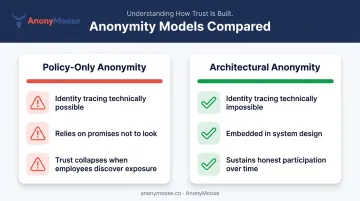
That architectural distinction matters because the alternative is worse than having no anonymous channel at all. Organizations that claim anonymity without delivering it damage trust faster than silence does. Small team size, writing style, or submission timing can expose an author's identity in partially anonymous systems. When employees discover this — and they do — participation collapses and takes years to recover.
The practical test is simple: can the platform technically prevent identification, or does it just promise not to look? Policy-only anonymity creates the appearance of safety without the substance — and employees learn the difference quickly.
How to Close the Feedback Loop and Turn Listening Into Action
Qualtrics found that engagement levels can drop by half when organizations fail to respond to feedback. The culprit is rarely the survey tool or the process design. It's follow-through.
The "you said, we did" principle is simple: show employees a visible, direct connection between their input and a change that was made. This is the single highest-leverage action for sustaining participation over time. The action doesn't have to be large. A process clarification or a commitment to investigate something with a specific timeline is enough to maintain trust.
A Three-Step Response Framework
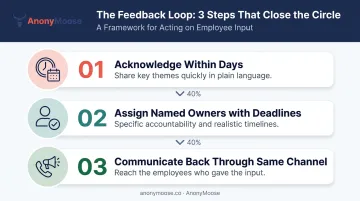
Acknowledge within days — Share key themes from the feedback cycle in plain language. Don't wait for the next all-hands or quarterly review. Speed signals that the feedback was actually read.
Assign named owners with deadlines — Every priority action gets a specific person accountable and a realistic timeline. "We're looking into it" is not a commitment. "Maria from Operations will review the shift scheduling process by March 15th" is.
Communicate back through the same channel — If feedback came through a pulse survey, close the loop there too. Responses buried in a company intranet won't reach the employees who actually gave the input.
AnonyMoose's Broadcast feature supports this directly: leadership can compose a targeted message and push it to every eligible employee's phone, reaching the people who gave the feedback — not just whoever checks the intranet that week.
When You Can't Act on Feedback
The three-step framework covers what happens when you can act. But not every piece of feedback leads to a change — and that's where transparency matters most.
"We heard you on X. Here's why we can't change it right now, and what we're doing instead" is a credible response. Silence after collecting feedback is what erodes trust.
The pattern compounds over time. Each cycle where employees see their input acknowledged — even with a "not yet" — raises participation in the next round. Each cycle where nothing is communicated does the opposite. Consistent follow-through is what separates a functioning feedback culture from an expensive survey habit.
Frequently Asked Questions
What are the most effective employee feedback channels for driving engagement?
No single channel works for every organization. The strongest combinations pair always-on anonymous channels with pulse surveys and manager conversations. What separates effective systems from ignored ones is psychological safety and visible follow-through — not channel design.
How does anonymous feedback improve employee engagement?
Anonymous channels remove the fear of retaliation that drives self-censorship, allowing employees — especially those in underrepresented groups — to share honest input that attributed channels consistently miss. More accurate data and higher trust follow, sustaining participation over time.
What is the difference between a pulse survey and an annual engagement survey?
Pulse surveys are short and frequent (weekly to monthly), tracking sentiment on specific themes as conditions change. Annual surveys try to measure everything at once. The two work best together — pulses provide timely signals, while deeper periodic assessments provide broader context.
How do you get employees to actually use feedback channels?
Two factors drive participation: employees must believe their responses are genuinely confidential, and they must have seen previous feedback lead to visible change. Consistent loop-closing builds that trust — channel design alone cannot.
What happens when employees don't feel safe giving feedback at work?
Employees either disengage entirely or take their concerns to platforms like Glassdoor or Blind. The reputational and cultural damage from public venting is far harder to manage than addressing those concerns internally would have been.
How do you close the employee feedback loop effectively?
Respond to feedback quickly, assign named owners to priority actions with realistic deadlines, and report outcomes through the same channels used to collect input. Small, visible actions sustain participation more reliably than large ones that go uncommunicated.