Introduction
Most employees have opinions about how their workplace could improve. Most of those opinions never reach the people with the power to act on them.
According to Visier's 2024 research, 47% of employees feel pressured to withhold feedback in engagement surveys, and 37% doubt their surveys are actually anonymous. Gallup puts the cost of disengaged employees at roughly $1.9 trillion in lost US productivity annually, much of it traceable to problems that went unspoken.
When internal channels feel unsafe, employees don't go quiet. They vent on Glassdoor, post on Blind, or simply start updating their résumés. That feedback still surfaces. It just doesn't reach the people who can act on it.
This post covers 16 concrete strategies organized into three action areas: building psychological safety, designing conversations and channels employees actually trust, and deploying structured feedback systems. Each strategy targets a real reason employees hold back — not just the mechanics of asking better questions.
Key Takeaways
- Psychological safety is the foundation — no feedback strategy works without it
- Open-ended questions and deliberate silence unlock more honesty than formal requests
- Anonymous channels remove the fear barrier blocking candid feedback on sensitive topics
- Acting visibly on feedback converts a one-time survey into a lasting culture of honest communication
Why Employees Hold Back: The Honest Feedback Gap
The Power Dynamic Problem
Even when a manager genuinely means "my door is open," the authority gap between boss and employee creates a chilling effect. Employees self-censor to protect job security, project assignments, and working relationships — particularly when the feedback is negative or directed upward.
This isn't irrational. Retaliation takes many forms beyond termination. The Institute of Business Ethics found in 2024 that 36% of employees aware of misconduct chose not to speak up — 29% cited fear of retaliation and 28% doubted corrective action would follow. Being labeled a complainer, passed over for promotion, or quietly sidelined are all real possibilities employees weigh before speaking up.
What Silence Actually Costs
When honest feedback doesn't flow inward, the consequences compound:
- Front-line employees spot process inefficiencies daily but rarely get a safe channel to report them
- Small grievances that could be resolved early become resignations when culture problems go unaddressed
- Gallup found 42% of voluntary leavers said their departure could have been prevented, yet 36% never told anyone they were considering leaving
- Employees who can't speak internally turn to Glassdoor or Blind, creating brand and recruiting risks that a functioning feedback culture would prevent
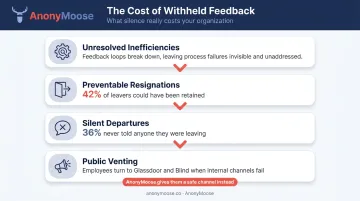
Asking more frequently doesn't close this gap. What changes the equation is building conditions where employees believe honesty carries no personal cost — which is exactly what the strategies below address.
Strategies 1–5: Build a Foundation of Psychological Safety
Strategy 1: Establish Trust Before You Ask for Anything
Trust accumulates through consistent behavior, not through a single feedback request. Leaders who acknowledge their own mistakes publicly, credit employees when they were right, and visibly act on past feedback earn the right to receive candid input.
Reciprocity works both ways: when leaders give honest feedback generously — including about their own performance — employees are far more likely to return it.
Practical signals that build the foundation:
- Share your own 360-degree review results with your team
- Name a decision you made that turned out to be wrong
- Reference specific feedback you received and changed your behavior based on
Strategy 2: Model the Behavior You Want to See
Leaders who say they want feedback but react defensively when they receive it train employees to stop offering it. The message employees receive is behavioral, not verbal.
The most effective technique: after asking for feedback, stop talking. Count silently to seven. Employees fill silence, and what surfaces in that pause is almost always more honest than what emerges when a leader rushes to soften the moment.
Publicly acknowledging when an employee was right — "You pushed back on this and you were correct" — signals to the entire team that candor is rewarded, not just tolerated. Apple's organizational model under Steve Jobs institutionalized exactly this: leaders were expected to engage in collaborative debate and back down when they couldn't defend their position, not when they lost seniority.
Strategy 3: Ask Questions That Actually Open the Door
Yes/no questions produce yes/no answers. Open-ended questions produce thinking.
Go-to questions leaders can adapt:
- "What's one thing I could stop doing that would make your job easier?"
- "What are you not getting from me that you want?"
- "If you could change one thing about how this team works, what would it be?"
- "What's something you've been reluctant to bring up?"
Having a prepared question removes the awkwardness from the ask. When soliciting feedback feels natural rather than forced, employees respond more honestly.
Strategy 4: Show You Care Personally
Employees who believe their manager genuinely cares about them as people — not just as output — are far more likely to share what they really think. This is the principle behind Kim Scott's "caring personally" framework: treating feedback conversations as two-way rather than transactional.
In practice, this looks like:
- Following up on things employees mention outside of work
- Recognizing when someone is visibly struggling
- Remembering details from previous conversations
None of this requires significant time. It requires attention.
Strategy 5: Make Criticism Safe — Publicly
Building trust one-on-one is necessary — but it's not sufficient. What really shifts team behavior is making candor visible to everyone at once.
Ask a trusted team member who is comfortable challenging you to do so in front of the group. When a leader receives criticism visibly and responds with curiosity rather than defensiveness, every observer updates their mental model of what candor costs at this organization.
That single public moment does more to normalize honest feedback than weeks of private reassurance ever could.
Strategies 6–10: Create the Right Conversations and Channels
Strategy 6: Hold One-on-Ones That Go Beyond Status Updates
Most one-on-ones default to project updates. The result is that only 16% of employees in a Gallup study of nearly 15,000 workers said their last manager conversation was "extremely meaningful" — even though employees who received meaningful feedback in the past week were four times more engaged than those who hadn't.
Questions that surface real feedback in a 1:1:
- "What part of your work has felt most frustrating lately?"
- "Is there anything you've been hesitant to bring up?"
- "What would make you feel more supported right now?"
Ask two or three of these consistently over time. One great question asked repeatedly builds more trust than six questions asked once.
When an employee answers, resist the urge to explain, justify, or interrupt. Reflect back what you heard before responding. That discipline alone changes the quality of what employees are willing to share next time.
Strategy 7: Conduct Regular Skip-Level Conversations
A skip-level conversation is when a senior leader meets directly with employees two or more levels down, without the intermediate manager present. This creates a direct line to concerns that often never make it past a middle manager.
To run them productively:
- Use structured prompts ("What do you wish leadership understood about your day-to-day?")
- Approach with genuine curiosity, not investigation
- Don't report back individual comments — synthesize themes at the group level
Strategy 8: Use Stay Interviews, Not Just Exit Interviews
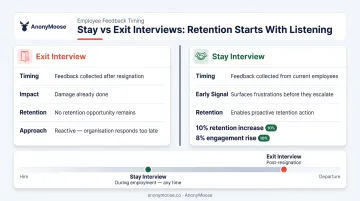
Exit interviews collect feedback after the damage is done. Stay interviews are structured conversations with current employees designed to surface what keeps them, what frustrates them, and what they wish were different — before those frustrations become departures.
Sample stay interview questions:
- "What's keeping you here?"
- "What would make you consider leaving?"
- "What part of your role do you wish were different?"
- "Is there a skill or project you want to pursue that you're not getting access to?"
SHRM reported that after isolved implemented stay interviews, they saw a 10% increase in annual retention over two years and an 8% rise in engagement scores. That kind of retention gain compounds alongside the broader impact of anonymous feedback tools: research finds organizations that deploy them see a 30% decrease in employee turnover — a figure that makes the case for investing in the right listening infrastructure before talent begins to leave.
Strategy 9: Run Small-Group Listening Sessions
A leader meets informally with six to eight employees, commits to listening only, and asks them to share something leadership doesn't know but should.
A few ground rules make these sessions work:
- Listen without defending or explaining
- Thank participants genuinely and follow up on what you heard
- Avoid note-taking that feels like surveillance
The goal is to actually hear people, not to perform openness.
Strategy 10: Ask Employees to Identify Challenges and Suggest Solutions
Framing feedback requests around problem-solving produces more constructive, usable input than open-ended complaint prompts.
Try: "What are your top three frustrations this quarter, and what would you suggest we do about each one?"
This positions employees as contributors rather than complainers, reduces defensiveness on both sides, and produces feedback that leadership can actually act on.
Strategies 11–16: Structured and Anonymous Feedback Systems
Strategy 11: Deploy Anonymous Feedback Channels
For sensitive topics — leadership behavior, DEI concerns, workplace safety — anonymity is the primary condition for honest feedback. Visier's research shows that 37% of employees hold back because they don't believe surveys are truly anonymous.
True anonymity means more than a policy promise. It means employees cannot be identified by the platform or the employer, even in principle. The SHRM Study (2020) quantified the difference: 82% of employees are more likely to share critical feedback when they know their anonymity is preserved, and organizations using anonymous channels see a 47% increase in actionable feedback related to management practices — precisely the category employees are most likely to soften in attributed formats.
AnonyMoose is built specifically for this. The platform's architecture ensures that neither the platform nor the employer can trace submissions back to individual users — anonymity is guaranteed by design, not by policy. Employees submit through a mobile-first app across four structured paths:
| Path | Purpose |
|---|---|
| Openlines | Anonymous two-way channels between employees and specific leaders or departments |
| Polls & Surveys | Real-time employee pulsing on any topic, sent to all employees or targeted subgroups |
| Broadcast | Leadership sends announcements and "you said, we did" updates back to employees |
| Hotlines | Secure incident reporting for harassment, discrimination, bias, and ethics violations |
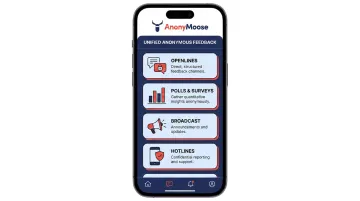
This replaces fragmented methods — suggestion boxes, anonymous email lines, walk-ins, and town halls — with a single unified mobile channel accessible from anywhere.
Strategy 12: Run Pulse Surveys on a Regular Cadence
Annual engagement surveys are broad, infrequent, and hard to act on quickly. Organizations that shift to regular anonymous pulse surveys also report meaningful retention improvements — Vantage Circle research found a 30% decrease in employee turnover among organizations that adopted anonymous feedback tools, reflecting how consistent listening directly reduces the attrition that goes undetected until it's too late. Pulse surveys — short, focused, sent on a predictable schedule — track movement over time and allow faster response.
What makes a pulse survey effective:
- One theme per send
- A consistent rating scale employees recognize
- At least one open-text question
- A cadence employees come to expect (monthly or quarterly works well)
Perceptyx benchmarks show large enterprises average 55–81% response rates on pulse surveys. Keep them under five minutes. Employees who can respond with a single tap are far more likely to respond at all.
Strategy 13: Give Employees Control Over the Survey Process
When employees have a stake in what is being asked, they trust the process more and respond more honestly. Involve employees in creating or approving the feedback questions — HR sets guardrails, employees draft or vote on the questions, and results are shared with the whole group.
This isn't just procedurally fairer — it produces better data. Employees who helped shape the questions have more reason to answer them honestly.
Consider a simple format:
- HR defines the topic areas and off-limits questions
- Employees submit or vote on the specific questions asked
- Results go back to the full group, not just leadership
Strategy 14: Use Theatrical Rituals to Normalize Feedback
Visible, recurring practices signal that feedback is a cultural priority — not a quarterly exercise.
Examples that work:
- "You were right, I was wrong" recognition — publicly acknowledge employees who successfully challenged a leadership decision
- Toyota's "red box" method — new employees stand in a marked zone and must give at least one improvement suggestion before leaving their first week
- Michael Dearing's "orange box" — a physical drop box for questions answered publicly and openly at all-hands meetings
- Management Fix-It Weeks — teams log and vote on "management bugs" (process inefficiencies, fairness concerns), and managers spend a dedicated period addressing the top items
Fix-It Weeks in particular make feedback tangible. Employees who see their input translated into visible changes are far more likely to keep sharing.
Strategy 15: Bring In Third Parties for Sensitive Topics
Some topics — leadership behavior, psychological safety, cultural issues — require an external facilitator. Employees have no reason to trust that internal collection will remain confidential when the subject involves the people doing the collecting.
What makes third-party feedback effective:
- No organizational stake in the outcome
- Professional facilitation
- Reports findings at the theme level, not tied to individual comments
This is particularly relevant for cultural assessments, DEI audits, or post-incident reviews where internal credibility is compromised.
Strategy 16: Close the Loop — Every Time
Most organizations collect feedback. Far fewer do anything visible with it. Perceptyx found that only 29% of organizations act on survey feedback within four weeks. Visier found that only 27% of employees believe HR always takes meaningful action based on engagement surveys.
When employees don't see their feedback lead to change, participation drops, answers become safer and more generic, and the process hollows out.
What to Do After You Collect Feedback
Collecting feedback is step one. What happens next determines whether employees share honestly again.
The "You Said, We Did" Model
After every feedback cycle, publish a short, plain-language update that connects employee themes to specific actions — with named changes, named owners, and clear timelines.
A simple post-feedback sequence:
- Summarize themes — not question-by-question results; synthesize what employees were really saying
- Identify one or two high-impact priorities — assign a named owner and a specific timeline
- Communicate progress publicly — through the same channels used to collect feedback
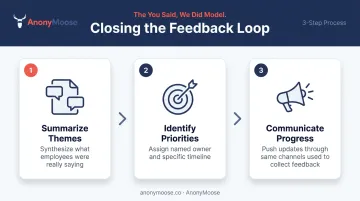
AnonyMoose's Broadcast feature is built for this step. Leadership can push "you said, we did" updates directly to employees' phones as soon as they're ready — on the same platform where feedback was collected, so the loop closes visibly.
The change doesn't have to be dramatic. A policy clarification or a process adjustment is enough — as long as it's visible and explicitly tied to what employees said. When employees see their input reflected in a real decision, even a small one, they're more likely to speak up the next time you ask.
Frequently Asked Questions
How do you get employees to give honest feedback?
Two conditions matter most: psychological safety (employees need to believe candor won't cost them) and demonstrated follow-through (employees share more when past feedback led to visible change). Use both direct conversations and anonymous channels — they serve different purposes and complement each other.
What are the 5 R's of receiving feedback?
Commonly defined as Request, Receive, Reflect, Respond, and Resolve. The framework guides managers to seek feedback actively, listen without interrupting, process before reacting, communicate a clear response, and follow through on commitments.
What are the 3 C's of feedback?
UNC Professor Elad Sherf's framework defines them as Clarity, Contextual Meaning, and Composure. Applied consistently — when asking for feedback and when reporting results back — these principles improve input quality and build employee trust in the process.
Why are employees afraid to give honest feedback?
The main reasons: fear of retaliation, fear of being labeled a complainer, the inherent power imbalance between employee and manager, and a lack of evidence that feedback leads to change rather than consequences. All four are addressable, but none disappear without deliberate effort.
Should employee feedback always be anonymous?
Anonymous feedback is most critical when trust is low or topics are sensitive. A healthy feedback culture uses both: anonymity removes the fear barrier for issues employees won't raise directly, while direct conversations build the trust that sustains ongoing openness. Neither channel alone is enough.