Gallup's 2026 State of the Global Workplace report found that only 20% of employees worldwide were engaged in 2025 — meaning 80% are either quietly coasting or actively working against their organization's goals. The productivity cost: $10 trillion annually, equal to 9% of global GDP.
The core problem isn't that HR isn't trying. It's that most engagement efforts are treated as standalone programs — a survey here, a town hall there, a new perk — rather than embedded into how the organization actually operates. That gap is where improvement stalls.
This guide covers why engagement programs fail, six HR strategies that actually move the needle, the non-negotiable role of psychological safety, and the KPIs worth tracking.
Key Takeaways
- 80% of employees globally are not engaged or actively disengaged — engagement is a systemic problem, not a morale problem
- Managers drive at least 70% of team engagement variance; equipping them is HR's highest-leverage move
- Psychological safety is a prerequisite for honest data — without it, engagement programs produce filtered, unreliable results
- Anonymous feedback channels surface what surveys and town halls miss — before frustrations reach Glassdoor or Blind
- Measuring engagement requires leading indicators like eNPS and pulse participation — not just lagging ones like turnover
Why Employee Engagement Still Falls Short
What Engagement Actually Means
Employee engagement is the emotional investment and commitment employees bring to their work. It's not the same as job satisfaction (being content) or happiness (liking the perks). An employee can be satisfied with their salary and still be completely checked out.
Gallup's 2026 research defines the three categories clearly:
| Category | Behavior |
|---|---|
| Engaged (20%) | Thriving, enthusiastic, driving performance and innovation |
| Not Engaged (64%) | "Quietly quitting" — present but not contributing energy or passion |
| Actively Disengaged (16%) | "Loudly quitting" — unhappy, resentful, and often undermining others |
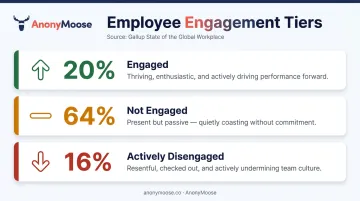
Actively disengaged employees are easy to spot. The not-engaged majority — nearly two-thirds of the workforce — are far harder to identify, and collectively account for most of the productivity loss organizations can't trace to a single cause.
Why Programs Fail
Knowing engagement matters isn't the same as building systems that improve it. Most programs fall short for predictable reasons:
- Annual-only surveys create data lag — by the time results are analyzed, the issues have worsened or the employees have left
- Surface-level metrics like aggregate "percent favorable" scores hide the root causes of disengagement
- No visible follow-through destroys trust faster than not surveying at all; SHRM reports that employees distrust engagement surveys when they doubt anonymity or see no follow-up action
- HR-only ownership lets managers off the hook — which matters because managers are the primary driver of how engaged any given team actually is
How Workforce Optimization Gives HR a Smarter Path Forward
Workforce management is operational: scheduling, time tracking, attendance, compliance. Workforce optimization is strategic — using data, analytics, and structured feedback to continuously align people with the right roles, workloads, and goals.
The distinction matters because HR leaders building the case for investment need to frame it correctly. Optimization handles a fundamentally different function than management — one that management tools weren't designed to address.
Three pillars make workforce optimization relevant to engagement:
- Skills and role alignment — people who do work that matches their strengths disengage less frequently
- Workload balance — burnout is one of the top drivers of disengagement; monitoring workload is a preventive measure, not a reactive one
- Continuous feedback loops — problems caught at the pulse survey stage are far cheaper to fix than problems caught at the exit interview stage
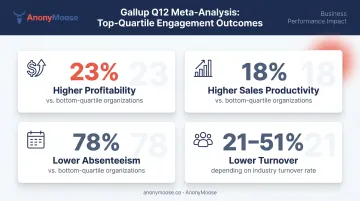
Gallup's Q12 Meta-Analysis puts concrete numbers behind this. Top-quartile engagement organizations report:
- 23% higher profitability
- 18% higher sales productivity
- 78% lower absenteeism
- 21%–51% lower turnover (depending on industry)
6 Proven HR Strategies to Improve Employee Engagement
Strategy 1 — Redefine Manager Accountability
Gallup's research is unambiguous: managers account for at least 70% of variance in team engagement scores. Yet most organizations still measure managers primarily on output metrics. The SHRM Study (2020) makes the cost of that blind spot concrete: organizations with genuine anonymity in their feedback systems see a 47% increase in actionable feedback related to management practices — the very data most engagement programs are structurally failing to collect because employees don't trust named channels with concerns about their direct managers.
HR's move: shift manager KPIs to include team engagement scores and train managers on coaching frameworks and meaningful one-on-ones. Give them access to team-level feedback data. Performance reviews are not the same as engagement conversations.
Strategy 2 — Build Clarity Around Role and Purpose
Employees disengage when they don't know what success looks like or how their work connects to anything larger. Structured onboarding, role clarity workshops, and regular goal alignment conversations aren't HR overhead — they're engagement infrastructure.
The question to ask: can every employee on your team articulate how their role connects to the company's goals? If the answer is unclear, engagement scores will reflect that.
Strategy 3 — Invest in Development and Strengths-Based Work
Role clarity sets the foundation — but employees also need to see a path forward. LinkedIn's 2024 Workplace Learning Report found 90% of organizations are concerned about retention and identified learning opportunities as the #1 retention strategy.
Practical steps:
- Conduct regular skills gap analyses
- Build personalized development paths, not generic training menus
- Where possible, align task assignments to individual strengths rather than rigid job descriptions
- Encourage goal-setting — learners who set career goals engage with learning four times more than those who don't
Strategy 4 — Make Recognition Consistent, Not Ceremonial
Recognition reserved for annual reviews or major milestones creates long stretches of invisibility. Build peer-to-peer and manager-led recognition into everyday workflows — through team channels, brief callouts in meetings, or digital tools that make acknowledgment visible.
For distributed or hybrid teams, this requires intentional design. Recognition doesn't happen by accident when people aren't in the same room.
Strategy 5 — Treat Well-Being as a Business Strategy
76% of employees experience burnout at least sometimes, and 28% say they experience it very often or always, according to Gallup. McKinsey research confirms burnout correlates directly with intent to leave.
Wellness programs alone won't fix this. The root cause is workload and systems design. HR should monitor workload distribution, build structural recovery time into schedules, and frame flexible work arrangements as productivity investments rather than perks.
Strategy 6 — Build Continuous Listening, Not Annual Check-Ins
Annual surveys produce stale data and, when nothing visibly changes afterward, erode the trust HR is trying to build. Replace or supplement them with a layered listening infrastructure:
- Short, frequent pulse surveys targeting emerging issues before they escalate
- Always-open feedback channels employees can access any time — not just when a survey is live
- Anonymous submission pathways for concerns employees won't raise on the record
- Broadcast messaging so leadership can close the loop and show what actually changed
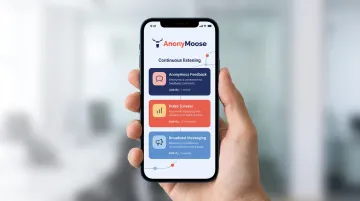
Platforms like AnonyMoose combine these listening channels — anonymous feedback, pulse surveys, and broadcast messaging — in a single mobile-accessible tool, making it easier for HR teams to act on feedback without losing signal in disconnected systems.
The Role of Psychological Safety and Anonymous Feedback
Why Psychological Safety Is Non-Negotiable
Psychological safety — defined by Amy Edmondson's foundational research as the shared belief that a team is safe for interpersonal risk-taking — is not a nice-to-have cultural quality. It's the prerequisite for getting honest data from any engagement initiative.
Google's Project Aristotle found psychological safety was the single most important factor in team effectiveness. Teams with high psychological safety were more likely to stay, better at applying diverse ideas, and twice as often rated effective by executives.
Without it, engagement surveys produce filtered, politically safe answers. Employees respond to what they think is appropriate, not what's true.
The Fear-Silence Cycle
When employees anticipate consequences for candid feedback, they don't say nothing — they say it somewhere else. Frustrations surface on Glassdoor, Blind, or in exit interviews. By then, the organizational damage is already done.
Breaking this cycle requires creating trusted, safe internal pathways for communication — not just asking employees to trust an open-door policy.
How Anonymous Channels Fill the Gap
Employees who won't raise concerns in a town hall, a one-on-one, or even a named survey will share honest input when anonymity is genuinely guaranteed — not promised by policy, but guaranteed by design. The SHRM Study (2020) found a 34% boost in productivity through improved employee morale and trust as organizations build genuine anonymous listening cultures, and Vantage Circle research found a 30% decrease in employee turnover among organizations that adopted anonymous feedback tools — two outcomes that reframe anonymous channels from an HR nicety into a core business performance investment.
AnonyMoose builds anonymity into the architecture itself: neither the platform nor the employer organization can identify the individual behind any submission. There's no technical mechanism to trace a message back to a specific employee. That's a meaningfully different proposition than "we promise we won't look."
The platform's four communication pathways each serve a distinct function in an engagement strategy:
| Feature | Function |
|---|---|
| Openlines | Always-open, two-way anonymous channels between employees and specific leaders, managers, or departments — replacing walk-ins and one-on-ones |
| Polls & Surveys | Anonymous pulse surveys delivered via push notification for rapid, authentic sentiment capture |
| Broadcast | One-to-many leadership communications with guaranteed delivery to every employee's device |
| Hotlines | Structured, anonymous incident reporting for sensitive issues: harassment, discrimination, ethics violations, microaggressions |
Openlines stands out for solving the "always-open" problem. Unlike surveys that open and close on a schedule, Openlines are permanently available — an employee on a warehouse floor at 11pm has the same access as someone at a desk at 9am.
The DEI Dimension
That always-on access matters most for underrepresented employees. When the fear of retaliation is highest, honest feedback is least likely — which means DEI data collected through named surveys is often unreliable. Platforms built around genuine anonymity give underrepresented employees a practical path to share their experiences, making DEI measurement more accurate and equity gaps more visible.
KPIs and Metrics HR Should Track
Core Quantitative Metrics
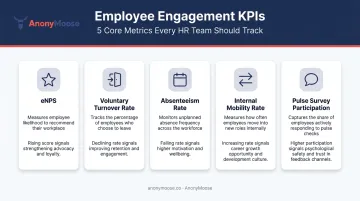
| KPI | What It Measures | What Movement Signals |
|---|---|---|
| eNPS (employee Net Promoter Score) | Likelihood employees would recommend the organization as a workplace | Declining scores predict retention risk before attrition appears |
| Voluntary turnover rate | Employees choosing to leave | High rates signal systemic disengagement or management issues |
| Absenteeism rate | Unplanned absence frequency | Gallup links top-quartile engagement to 78% lower absenteeism |
| Internal mobility rate | Employees moving into new roles internally vs. leaving | Low rates suggest development and growth gaps |
| Pulse survey participation | Percentage of employees responding to feedback requests | Low participation often reflects distrust, not apathy |
Qualitative and Leading Indicators
Quantitative KPIs capture what happened. Leading indicators help HR predict what's about to happen:
- Manager effectiveness scores — given that managers drive at least 70% of engagement variance, these are upstream indicators of team health
- Psychological safety survey results — direct measures of whether the conditions for honest engagement exist
- Anonymous feedback submission frequency — volume and themes surfaced through anonymous channels like AnonyMoose's Openlines and Hotlines
- Sentiment trends across pulse surveys over time
None of these indicators matter without action tied to them. That's where follow-through becomes the deciding factor.
The Follow-Through Rule
KPI tracking only works when HR closes the loop. Share survey results with employees, communicate what actions will follow, and review progress on a consistent cadence. Organizations that collect engagement data without visible follow-through see participation drop in future surveys — employees stop responding when they see no evidence their input changed anything.
Frequently Asked Questions
What are the 5 C's of employee engagement?
The 5 C's — Care, Connect, Coach, Contribute, and Congratulate — is a practitioner checklist for evaluating engagement program health. HR teams use it to confirm their people practices cover the full range of employee needs, from basic well-being to recognition and development.
What strategies can HR use to improve employee engagement?
The most effective strategies include building manager accountability into KPIs, creating role clarity and purpose alignment, investing in skills development, building consistent recognition practices, monitoring well-being, and establishing continuous listening mechanisms — including anonymous feedback channels that capture what named surveys miss.
How does psychological safety impact employee engagement?
Psychological safety is a prerequisite for honest engagement data. When employees feel safe speaking up, organizations get more accurate survey results, fewer silent disengagement problems, and stronger team-level trust — closing the gap between measured sentiment and what employees actually feel.
How do you measure employee engagement effectively?
Effective measurement combines lagging indicators (turnover, absenteeism) with leading indicators (eNPS, pulse survey participation, manager effectiveness scores). The critical discipline is acting visibly on the data — organizations that collect engagement metrics without communicating follow-through actions see participation and trust drop over time.
What is the difference between workforce optimization and workforce management?
Workforce management is operational: scheduling, time tracking, compliance. Workforce optimization is the strategic layer above it — using data, analytics, and employee feedback to continuously improve performance, engagement, and role alignment. The distinction matters because operational efficiency alone won't address the engagement and retention problems that workforce optimization is designed to solve.
How can anonymous feedback improve employee engagement?
Anonymous feedback removes the fear barrier that prevents employees from sharing honest input. HR gets more accurate data on real issues, and problems can be addressed before they become attrition or compliance risks. It also keeps internal frustrations off external review platforms, building the foundation of trust that makes future engagement programs effective.