U.S. employee engagement fell to 31% in 2024, the lowest level in a decade, with 17% actively disengaged. That number didn't materialize overnight — it built gradually, through unheard concerns and unanswered feedback.
This article covers what continuous employee listening actually means, why the business case is compelling, how to build a strategy that works, and the pitfalls that quietly kill most programs before they gain traction.
The core framing: continuous listening isn't about surveying more. It's about creating an always-on feedback culture where employees feel safe to speak up — and leaders are actually equipped to act.
Key Takeaways
- Annual surveys are too slow — disengagement spreads long before results land
- Employees who feel heard are 4.6x more likely to feel empowered to do their best work
- A working listening strategy maps feedback to the employee lifecycle, not around calendar quarters
- The biggest reason listening programs fail is the gap between collecting feedback and acting on it
- Structural anonymity, not just promised confidentiality, is what drives honest and diverse input
What Is Continuous Employee Listening — And Why Annual Surveys Fall Short
Most organizations measure employee sentiment once a year — then act surprised when people leave. Continuous employee listening fixes that by collecting, analyzing, and acting on feedback across multiple touchpoints throughout the employee lifecycle. The result is a real-time picture of how people feel at work, not a year-old snapshot.
Why the Annual Model Breaks Down
The traditional annual survey was designed for a slower-moving workplace. By the time data is collected, processed, and shared with managers, the concerns employees flagged months earlier may have already driven resignations or quiet quitting.
Sentiment moves fast. Engagement can shift dramatically within weeks during leadership changes, workload spikes, or cultural friction. Annual cycles don't just lag behind — they miss the window where intervention would have mattered.
What Continuous Listening Actually Means
A common misconception is that continuous listening means surveying employees constantly. It doesn't. Frequency without the capacity to act on feedback erodes trust faster than no listening at all.
The distinction lies in two complementary approaches:
- Active listening — intentional surveys, polls, focus groups, one-on-ones, open feedback channels
- Passive listening — monitoring patterns in behavioral data, exit trends, absenteeism signals, and platform usage
Used together, active and passive listening create a feedback system that catches both what employees say and what their behavior signals — often catching problems before they surface in a conversation at all.
The Evolution of Listening
Moving from annual census surveys to pulse surveys to true continuous listening reflects a fundamental shift in how organizations treat feedback — from an annual report card to an ongoing conversation. The latest generation is defined by:
- Real-time data, not quarterly reports
- Multi-channel collection (mobile, anonymous lines, structured surveys, open text)
- Lifecycle mapping — feedback tied to specific employee journey stages
- Action orientation — the system prompts response, not just documentation
The Business Case for Continuous Listening
Salesforce Research found that employees who feel heard are 4.6x more likely to feel empowered to do their best work. Gallup links highly engaged teams to 23% higher profitability and 14–18% higher productivity than their less engaged counterparts.
The Retention and Cost Argument
Voluntary turnover costs U.S. businesses roughly $1 trillion annually. Replacing a single employee can cost between half and twice their annual salary. 52% of voluntarily exiting employees said their organization could have done something to prevent them from leaving — and 51% said no one spoke with them about job satisfaction in the three months before they quit.
Continuous listening catches those signals early — before an employee mentally checks out or updates their résumé.
Agility and Inclusion
Organizations with ongoing feedback loops respond faster to emerging issues — a sudden leadership change, a DEI concern building below the surface, or a workload imbalance that's quietly driving burnout.
The inclusion dimension matters more than most organizations acknowledge. Research from the Employee Voice Study makes the stakes clear:
- 86% of employees feel people at their organization are not heard fairly or equally
- 47% say underrepresented voices remain undervalued
Continuous listening — especially when anonymized — directly closes this gap. Research from Quantum Workplace found that anonymous communication programs drive a 35% increase in employees' sense of belonging, while the APA found a 30% increase in employees' sense of belonging when organizations embed genuine listening channels into their culture. Both findings point to the same conclusion: continuous listening is not just an engagement strategy — it is how belonging gets built at scale.
How to Build a Continuous Employee Listening Strategy
Step 1: Define Your Listening Goals
Before selecting any tool, identify the specific business or people challenges you're trying to understand. "How do employees feel?" is too broad to act on. It generates noise, not direction.
Better starting points:
- Why are we seeing higher-than-usual turnover in one department?
- How is the new hybrid policy landing with frontline teams?
- Are employees in our new acquisition feeling included?
Specific questions produce specific, usable data.
Step 2: Map Feedback to the Employee Lifecycle
Listening should be designed around key moments in the employee journey, not just calendar quarters. Each stage surfaces fundamentally different concerns:
| Lifecycle Stage | Key Listening Focus |
|---|---|
| Onboarding (Day 1–30) | Clarity, culture fit, support quality |
| 90-Day Check-In | Role expectations, team dynamics |
| Performance Cycles | Manager effectiveness, growth clarity |
| Role Transitions | Support during change, workload impact |
| Exit | Real reasons for leaving, preventable factors |
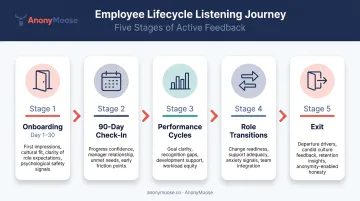
Point-in-time annual surveys miss most of these moments entirely.
Step 3: Choose Your Listening Channels and Cadence
No single channel captures the full picture. Effective programs combine quantitative and qualitative inputs:
- Quantitative tools — pulse surveys, polls (measure attitudes on known topics)
- Qualitative channels — open-text submissions, focus groups, anonymous idea boards (surface concerns no one has yet framed as a survey question)
Cadence should match your capacity to act. Survey monthly if you can respond monthly. If analysis and follow-up take six weeks, bi-weekly surveys will only breed fatigue.
Step 4: Act on the Feedback — and Close the Loop
The single biggest reason listening programs fail: employees submit concerns, see nothing change, and stop participating.
A realistic feedback-to-action cycle looks like this:
- Collect responses across all active channels
- Analyze for themes — not just aggregate scores
- Communicate what was heard, including what you can't fix and the reason why
- Implement visible changes where feasible
- Measure whether the change actually moved the needle on the original concern
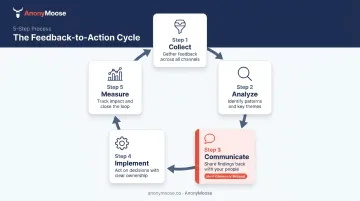
Skipping step 3 — the communication step — is the most common and most damaging mistake.
Step 5: Measure and Iterate
Closing loops on individual feedback is only half the work. The strategy itself needs to evolve. Track:
- Participation rates over time (declining rates signal survey fatigue or distrust)
- Sentiment trends — are scores moving after you act?
- Whether actions taken after feedback actually shifted the needle
Key Listening Channels and Tools
A continuous listening program typically combines four channel types:
- Always-open feedback lines — for ongoing, unprompted submissions employees can send anytime
- Targeted pulse surveys and polls — for specific, time-bound questions on defined topics
- Broadcasts — leadership-to-employee communications that keep teams informed
- Hotlines — for sensitive reports, ethics concerns, or incident documentation
Platforms like AnonyMoose consolidate all four into a single mobile-first tool, replacing the disconnected mix of emails, HR portals, suggestion boxes, and phone lines that most organizations currently rely on.
AnonyMoose's Openlines, for example, create permanent anonymous two-way channels between employees and specific leaders or departments. They function as a mobile replacement for the open-door policy — accessible from a warehouse floor or a remote job site, without scheduling overhead or psychological friction.
Qualitative vs. Quantitative: When to Use Which
Choosing the right channel type depends on what you already know about the issue at hand:
- Surveys and polls work well when you already know what to ask — measuring attitudes on a known topic, tracking a metric over time
- Open-text channels and focus groups work better when you don't yet know the shape of the concern — surfacing emerging issues before they're visible enough to become a survey question
Mobile Accessibility Matters
Deskless and field-based employees make up a substantial portion of most workforces — warehouse workers, hospitality staff, construction crews, delivery drivers. If your listening channels require a laptop or corporate email, you're only hearing from employees who sit at desks. AnonyMoose's push-notification delivery model addresses this directly: surveys and feedback prompts land on employees' personal devices in real time, regardless of location.
Why Psychological Safety and Anonymity Are Non-Negotiable
The best listening infrastructure in the world doesn't work if employees don't trust it.
The IBE's 2024 Ethics at Work survey found that among employees aware of misconduct, one in three did not report it. The top reasons: fear of jeopardizing their job (34%) and concern the organization wouldn't take action anyway (34%). Of those who did speak up, 46% experienced personal disadvantage or retaliation. The APA (2021) found that employees are 70% more likely to disclose unethical practices in anonymous settings compared to traditional methods — making structural anonymity the single most effective intervention for closing the gap between what employees observe and what organizations actually hear.
Structural Anonymity vs. Promised Confidentiality
The difference between "we won't share your name" and a system designed so that even the platform cannot identify who submitted a response is not subtle — it's the difference between a policy and a guarantee.
AnonyMoose is built on the latter principle. When an employee's account is linked to an organization at registration, AnonyMoose stores that association anonymously. The system records that a submission belongs to a given organization, but cannot link it to the individual's identity. There is no technical mechanism within the platform capable of exposing authorship. Employees don't have to trust a policy — the architecture makes identification impossible.
This matters most for the employees who are statistically least likely to speak up through conventional channels: underrepresented groups, junior employees, and anyone who has previously experienced retaliation.
The Feedback Quality Connection
That architectural safety directly shapes what organizations hear. When employees trust the process, they share candid, actionable, and diverse input. Without it, listening programs collect what employees think leadership wants to hear, which is precisely the data least useful for making real decisions.
Common Pitfalls to Avoid
Most listening programs don't fail dramatically. They fade — participation drops, insights get stale, and the whole exercise becomes a compliance checkbox.
The three most common failure modes:
Over-polling without acting on results — employees don't tire of surveys; they tire of surveys that go nowhere. Culture Amp's research is direct about this: it's lack-of-action fatigue, not survey fatigue.
No defined owner for follow-through — HR teams collect data but leave unanswered who analyzes themes, who decides what changes, and who communicates results back. Without that accountability, feedback accumulates and goes unread.
Running surveys to satisfy governance, not to act — deploying annual or quarterly pulses with no real intent to follow through. Employees recognize this pattern fast, and participation reflects it.
The Action Gap in Practice
Qualtrics XM Institute found a 41-percentage-point perception gap: 84% of HR leaders rated their organization's use of employee feedback as effective, while only 43% of employees said they saw positive change as a result of previous surveys.
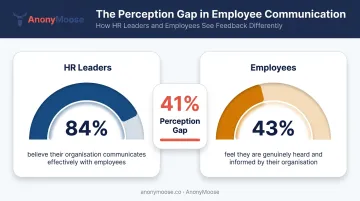
Closing that gap is a communication and accountability challenge, not a data or technology one. It requires naming a feedback owner, committing to a response timeline, and telling employees — specifically — what changed because of what they shared.
Frequently Asked Questions
What is the continuous listening approach?
Continuous listening is an ongoing, multi-channel approach to gathering employee feedback throughout the entire employee lifecycle. Unlike a one-time annual survey, it creates always-on feedback loops that capture how employees feel in real time — not just at year-end review.
What is the 80/20 rule of active listening?
The 80/20 rule holds that effective listeners spend 80% of the time listening and 20% speaking. In an organizational context, this means leaders should invest far more effort understanding employee perspectives than broadcasting messages — reversing the typical communication ratio in most workplaces.
What are the 3 R's of active listening?
The 3 R's are Receive (give full attention without interrupting), Reflect (demonstrate understanding before responding), and Respond (reply thoughtfully to what was actually said). For HR leaders, this maps directly onto feedback data: acknowledge it, interpret it honestly, and act on it visibly.
How is continuous listening different from a pulse survey?
Pulse surveys are one tool within a continuous listening strategy. Continuous listening encompasses multiple channels — open feedback lines, lifecycle surveys, passive signals, focus groups — and is defined by an always-on feedback culture rather than any particular survey frequency.
How often should organizations run employee listening surveys?
There's no universal cadence. Frequency should match the organization's capacity to act on results. Over-surveying without follow-through causes more disengagement than under-surveying. A monthly pulse means nothing if feedback sits unreviewed for six weeks.
How do you encourage employees to give honest feedback?
Honest feedback requires structural trust: channels that are anonymous by design (not just by policy), visible action on past feedback, and leadership that responds without blame or retaliation. Promised confidentiality matters, but architectural anonymity — where neither the platform nor the employer can identify who submitted — is what drives honest participation.