Key Takeaways
- Annual surveys create an "action gap" — Qualtrics data shows employees who feel feedback is ignored are 4x more likely to quit
- Pulse surveys, check-ins, and always-on channels each solve different problems at different time horizons
- 46% of employees who reported misconduct experienced retaliation — structural anonymity, not just policy, is what makes honest feedback possible
- The right listening mix depends on workforce type, trust levels, and your HR team's capacity to act on results
Why Annual Engagement Surveys Are No Longer Enough
Annual surveys were built for a slower workplace. Running one comprehensive diagnostic per year made sense when organizational conditions shifted gradually. That's rarely true now — teams restructure, managers change, and morale can swing significantly within a single quarter.
The structural problems are well-documented:
- Long question sets cause fatigue before employees reach the final page
- Low completion rates — census surveys average 72–88% participation per Perceptyx benchmarks, but quality of responses drops when employees are checked out
- Aggregated results that mask team-level problems — a 7.2 out of 10 company average tells a manager nothing about the one team that scored 4.1
- Lagged findings that arrive months after the events that caused them
The most damaging issue, though, is what researchers call the action gap. Qualtrics reports employees who feel their feedback isn't acted on are 4x more likely to intend to quit. When employees complete a survey in October, receive results in January, and see no visible change by April, they draw a rational conclusion: participating isn't worth their time. That erosion of trust compounds with every survey cycle.
That trust deficit is what's pushing organizations toward continuous listening models. WTW notes the shift away from annual census surveys is driven by one core reality: a once-a-year snapshot can't capture how employee sentiment actually moves through the year.
The Modern Pulse Alternatives: An Overview
The shift away from annual-only listening doesn't mean abandoning structured surveys — it means adding faster, lighter methods that serve different purposes. Each tool in the modern listening toolkit has a specific job.
Before getting into the specifics, one important distinction: a pulse survey is not a shorter annual survey. Pulse surveys are designed to track specific themes over time with small question sets, run frequently enough to catch emerging issues before they become retention problems. Annual surveys are comprehensive diagnostics. The tradeoff is depth versus timeliness, and most organizations need both.
Pulse Surveys and eNPS
Short, recurring pulse surveys — typically 3–10 questions per Perceptyx's definition, run monthly or quarterly — give HR teams a near-real-time read on sentiment without asking employees to commit to a 45-minute form.
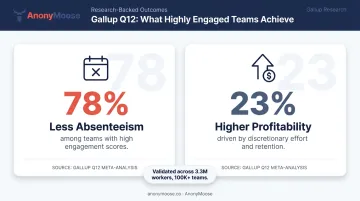
Gallup's Q12, validated across 3.3 million workers and more than 100,000 teams, uses just 12 items and recommends a six-month survey cadence. Teams with high engagement show 78% less absenteeism and 23% higher profitability in Gallup's research — not because running a survey causes those outcomes, but because the organizations tracking engagement closely enough to use the data tend to act on it.
The Employee Net Promoter Score (eNPS) is a lightweight variant: one question asking employees how likely they are to recommend the organization as a place to work, scored on a 0–10 scale. Promoters score 9–10, Passives 7–8, Detractors 0–6. It's useful as a directional signal but too thin to diagnose root causes on its own.
One real risk with pulse surveys: over-surveying. Frequency should match action capacity. If you survey weekly but can only meaningfully respond to results monthly, you're training employees to see surveys as performative rather than useful. That's worse than surveying less often.
Employee Check-Ins
Check-ins are two-way, structured conversations between a manager and employee, combining wellbeing questions with goal tracking and space for open-ended input. Unlike surveys, they invite genuine dialogue rather than just collecting responses.
The Gallup evidence here is striking: 80% of employees who receive meaningful feedback weekly are fully engaged — but only 16% of 15,000 surveyed employees described their most recent manager conversation as extremely meaningful. Most organizations are leaving significant engagement gains on the table.
For managers, check-ins serve as an early-warning system. A team member who starts giving terse, minimal responses in check-ins is signaling something weeks before it shows up in a pulse score.
Always-On Feedback Channels
Scheduled surveys — even monthly ones — have a structural blind spot: they only capture what employees are willing to say when prompted, at the moment the survey lands. Always-on channels fill the gap.
These platforms allow employees to submit ideas, concerns, or observations at any time, rather than waiting for an invitation. Always-on channels complement pulse surveys by capturing feedback that would otherwise disappear between cycles.
AnonyMoose's Openlines feature works on this model. Employees initiate conversations through the mobile app at any time, without being prompted, and receive a genuine two-way response. Key design details that make it work in practice:
- Full-exchange anonymity: identity is protected throughout the conversation, not just at submission
- Manager workflow: a web interface lets managers assign urgency levels, track status, and respond
- No identity exposure: managers engage with the content of the message, never the identity behind it
The Missing Piece: Psychological Safety in Feedback Systems
Here's the problem with most listening infrastructure: it doesn't matter how frequently you survey if employees don't believe they can answer honestly.
The ECI's 2023 Global Business Ethics Survey, reported by NAVEX, found that 46% of employees globally who reported misconduct experienced retaliation. When that's the baseline expectation, no survey — annual or pulse — will produce candid responses without structural protections in place. The SHRM Study (2020) quantifies the upside of closing that gap: 82% of employees are more likely to share critical feedback when anonymity is guaranteed, and organizations see a 47% increase in actionable feedback related to management practices — the precise category that erodes most in the absence of structural safety.
Why Most Tools Don't Solve This
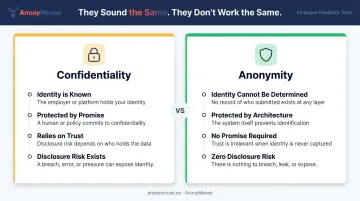
Many standard pulse tools offer confidentiality, not anonymity. These sound similar but function very differently:
- Confidentiality means someone knows who you are and promises not to disclose it
- Anonymity means no one can identify you — regardless of promises or intent
In practice, responses in small teams (fewer than 10 people) can often be inferred from context. Submission timing, role, or the specificity of a comment narrows the field quickly. Employees in underrepresented groups or raising sensitive concerns are right to be skeptical, even when a vendor claims anonymity.
Many widely-used engagement surveys are confidential rather than truly anonymous — a distinction that directly undermines whether employees trust the channel enough to use it honestly. Research from buildempire.co.uk shows that genuinely anonymous surveys achieve 90% participation compared to 30% for identified surveys and generate 58% more honest feedback — a difference that represents the gap between data that actually reflects organizational reality and data shaped by what employees feel safe saying.
Anonymity as Architecture, Not Policy
The organizations serious about DEI and psychological safety need to ask a specific question of their listening tools: Can individual respondents be identified by the platform or the employer — even theoretically?
Few tools meet that bar. AnonyMoose was built around it. The platform's anonymity operates at the infrastructure level — submissions cannot be traced to individual users by either AnonyMoose or the employing organization, by design rather than by promise. This isn't a trust claim; it's an architectural one.
This matters most for the employees whose voices organizations most need to hear: underrepresented employees, frontline workers without institutional power, and anyone raising concerns about their direct manager. Anonymous-by-design channels are how those voices actually reach leadership.
AnonyMoose's Polls & Surveys feature brings pulse-style listening into this framework. Key capabilities include:
- Push notification delivery directly to employees' phones
- Trend tracking over time via the Insights Dashboard
- Targeted reach by role, tenure, or location — without compromising individual anonymity
People Analytics and Passive Listening Signals
Not all engagement data requires asking employees anything. Operational data that already exists within HR systems — voluntary turnover by department, absenteeism trends, internal transfer request rates, participation in optional programs — functions as a passive early-warning layer.
SHRM Labs reports that 82% of organizations use people analytics most frequently for retention and turnover analysis. Mercer frames modern listening as combining surveys with human capital metrics to understand the gap between what employees say and what they actually do.
The strongest case for combining passive signals with active feedback is signal convergence. When an anonymous pulse shows low morale in a specific team and HR analytics simultaneously show elevated absenteeism in that same group, that overlap gives HR teams much stronger grounds for intervention than either signal alone.
Two caveats to keep in mind:
- Passive analytics should supplement employee voice, not replace it. Observing behavior tells you that something is wrong — it rarely tells you why.
- Organizations should be transparent about what operational data is being analyzed and for what purpose. Using aggregate data to support employees is defensible; covert individual surveillance is not.
Building a Continuous Listening Strategy
Choosing a listening method is only half the work. The real value comes from layering multiple methods into a coordinated system where each one serves a distinct purpose.
The Listening Cadence
| Method | Frequency | Purpose |
|---|---|---|
| Annual engagement survey | Once per year | Baseline, benchmarking, strategic themes |
| Pulse surveys | Monthly or quarterly | Current stressors, initiative tracking |
| Manager check-ins | Weekly or bi-weekly | Early warning, local action |
| Always-on channels | Continuous | Unprompted input, sensitive concerns |
| People analytics | Ongoing | Passive engagement signals |
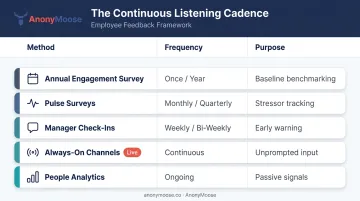
No single row in that table replaces the others. The annual survey provides comparability over time. Pulse surveys catch what's shifted since the last census. Check-ins surface what individuals won't say in any survey. Always-on channels capture what employees would only say if they could pick the moment.
Closing the Loop
The most common reason employees disengage from feedback tools is seeing no response to their input. Closing the loop isn't complicated, but it requires deliberate effort:
- Share topline results with employees, not just leadership
- Explain what actions will be taken — and what won't, and why
- Track whether subsequent pulse scores reflect improvement
- Set a timeline for follow-up so employees know when to expect a response
Getting results and updates to every employee — not just those with a company inbox — is where the mechanics matter. AnonyMoose's Broadcast feature lets leadership push survey results, action plans, or policy updates directly to employees' phones as targeted push notifications, by team or group. For distributed or frontline workforces, that reach gap closes without requiring company email access.
AnonyMoose's Hotlines feature sits alongside these channels as a dedicated path for incident reporting — purpose-built for ethics, compliance, and safety concerns that require structured case management, kept separate from everyday feedback flows.
Choosing the Right Mix for Your Organization
A brief decision framework:
Prioritize anonymous feedback infrastructure first if:
- Your organization has documented psychological safety concerns
- You have DEI commitments that require hearing from underrepresented employees
- You operate in industries with high retaliation risk (healthcare, financial services, manufacturing)
Layer in structured check-ins if:
- Manager-employee trust is reasonably strong
- Managers have the capacity and training to use check-in data constructively
- You need early identification of struggling individuals, not just team-level trends
**All organizations benefit from lightweight pulse instruments** to maintain a real-time read between deeper assessments; the key constraint is matching frequency to action capacity.
Qualtrics' 2026 Employee Experience Trends data highlights a specific gap for frontline workforces: 63% of frontline workers worry about not receiving performance-improving feedback, and only 46% of part-time workers believe they can challenge traditional ways of working. For these employees, mobile-first anonymous channels are often the only listening path that practically reaches them.
That's where consolidating listening infrastructure pays off. AnonyMoose's four listening paths — Openlines, Polls & Surveys, Broadcast, and Hotlines — run in a single mobile-accessible platform, which cuts the complexity of managing multiple tools. For HR teams overseeing distributed or deskless workforces, this means fewer vendor relationships, one data environment, and a consistent employee experience whether someone is in an office or on a factory floor.
Frequently Asked Questions
How do you measure employee engagement without surveys?
People analytics (voluntary turnover rates, absenteeism, internal transfer requests), always-on anonymous feedback channels, and manager check-ins all capture meaningful engagement signals without formal survey instruments. The limitation is that passive signals tell you that something is shifting, not always why — combining multiple approaches gives you a more complete picture.
What is the difference between a pulse survey and an annual engagement survey?
Pulse surveys are shorter (typically 3–10 questions), run more frequently (monthly or quarterly), and focus on specific themes rather than comprehensive diagnostics. Annual surveys provide benchmarkable data over time and deeper organizational insight. Both serve different purposes and work best together in a continuous listening strategy.
How often should pulse surveys be run?
Match frequency to your capacity to act — common cadences run weekly to quarterly. Surveying more often than you can meaningfully respond to trains employees to see the process as performative, which erodes both participation and honesty.
What are the signs that your annual engagement survey isn't working?
Watch for declining participation year over year, scores that stay flat despite reported initiatives, and results that don't match what managers observe on the ground. When employees disengage from the process, data quality deteriorates faster than the participation numbers alone will show.
Can anonymous feedback tools replace engagement surveys entirely?
No — they complement rather than replace structured surveys. Anonymous tools capture real-time, unprompted sentiment and sensitive concerns that surveys miss. Structured surveys still provide benchmarkable, comparable data that tracks organizational health over time. Each serves a different function in the listening system.
What role does psychological safety play in getting honest employee feedback?
Employees only respond candidly when they trust there will be no retaliation — and that trust requires structural anonymity, not just policy assurances. When anonymity is protected at the architecture level, organizations consistently see higher participation rates and more honest, actionable feedback.