Introduction
Global employee engagement dropped to 20% in 2025 — the lowest level since 2020, according to Gallup's State of the Global Workplace report. For HR leaders navigating hybrid work tensions, AI-driven workload disruption, and post-pandemic burnout, that number isn't abstract. It shows up as missed deadlines, quiet departures, and teams that look fine on paper but are quietly checking out.
The core problem is timing. Most organizations still reach for an annual engagement survey when they want to understand how employees are doing. By the time results are analyzed and action is taken, the data is already months old.
The burnout spike that peaked in Q2 doesn't show up until Q4. By then, your best people may have already started looking elsewhere.
This guide offers a practical framework for making pulse surveys the backbone of your wellbeing strategy in 2026. You'll find guidance on what to measure, how to design questions that produce honest data, what cadence works, and how to close the feedback loop so employees see action, not just acknowledgment.
Key Takeaways
- Annual surveys can't detect mid-cycle wellbeing crises; pulse surveys can
- Architecture-level anonymity drives honest wellbeing data — not performative responses
- Five dimensions matter most: psychological safety, burnout risk, belonging, work-life balance, and manager support
- Cadence should match your capacity to act, not an arbitrary schedule
- Closing the feedback loop visibly and specifically determines whether employees keep participating
Why Pulse Surveys Are Central to Employee Wellbeing Strategy in 2026
The Real-Time Advantage
Annual surveys measure where employees were six months ago. Pulse surveys measure where they are now. That distinction matters for wellbeing, because burnout doesn't build on a predictable annual schedule. It spikes during reorganizations. It concentrates in specific teams. It widens belonging gaps during rapid hiring. None of that shows up in time if you're waiting for December to ask.
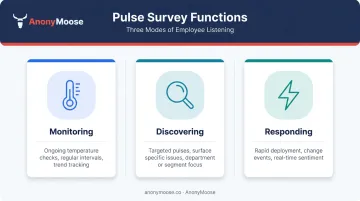
Pulse surveys serve three distinct functions, and knowing which one you're running changes how you design it:
- Monitoring — Ongoing temperature checks on dynamic dimensions like burnout and manager support, run at regular intervals to track trends
- Discovering — Targeted pulses that surface specific issues, such as stress concentrations in certain departments or belonging gaps among newer employees
- Responding — Rapid-deployment surveys during a specific change event (a restructuring, an RTO mandate, an acquisition) to assess sentiment in real time
The Business Case
The WHO estimates that depression and anxiety alone cost the global economy $1 trillion annually in lost productivity, with 12 billion working days lost every year. Meanwhile, Gallup data shows highly engaged teams produce 23% higher profitability and 78% less absenteeism than their disengaged counterparts.
Pulse surveys function as a risk management tool. When you know early that burnout is spiking in your engineering org or that belonging scores are dropping among recently promoted women, you can act before those signals become attrition events:
- Identify burnout hotspots by team or role before turnover accelerates
- Track belonging scores across demographic segments during periods of rapid hiring
- Measure manager support in real time, not six months after the fact
- Deploy targeted interventions while there's still time to change outcomes
The 2026 Context
The stakes have risen. Microsoft's 2025 Work Trend Index surveyed 31,000 workers across 31 countries and found 80% said they lacked enough time or energy to do their work, with employees interrupted an average of 275 times per day. At the same time, 33% of leaders admitted they were considering using AI to reduce headcount — a reality that directly affects employee anxiety and trust.
Organizations that skip active listening between annual cycles leave employees navigating high uncertainty with no visible channel back to leadership. Pulse surveys close that gap — and in 2026, closing it is the baseline, not the differentiator.
The Psychological Safety Problem: Why Employees Won't Tell You How They Really Feel
The Disclosure Gap
Here's the uncomfortable reality: your wellbeing survey data may look better than your actual wellbeing situation. According to Mind Share Partners' 2025 Mental Health at Work Report, 50% of U.S. full-time workers experienced moderate to severe burnout, depression, or anxiety. Yet 46% of those same workers said they feared losing their job if they spoke openly about their mental health at work. The SHRM Study (2020) confirms how much is at stake: 82% of employees are more likely to share critical feedback when they know their anonymity is preserved — a figure that applies with particular force to sensitive wellbeing data, where the perceived cost of honesty is highest.
The APA's 2024 Work in America Survey found 39% of workers worried that disclosing a mental health condition would negatively affect them professionally. And APA found that workers with lower psychological safety were twice as likely to report emotional exhaustion (34% vs. 17%) compared to those with higher safety.
That fear doesn't disappear because you sent a survey.
Performative Honesty
When employees don't trust that a survey is genuinely anonymous, they answer the way they think they're supposed to — not the way they actually feel. The data looks healthy. Leadership makes decisions based on that sanitized picture. Wellbeing programs get designed to fix problems that aren't the real ones, while the actual problems stay buried.
Research consistently shows that most employees distrust surveys because they believe responses can be traced back to them — and no amount of reassuring framing overcomes that fear of retribution. The problem isn't survey design. It's the underlying trust architecture.
Architecture-Level Anonymity
This is where the distinction between policy-level and architecture-level anonymity becomes critical. A policy promise says "your responses are anonymous." An architecture guarantee means the data linkage between an individual and their response was never created — so it cannot be uncovered, compelled, or leaked regardless of circumstance.
AnonyMoose is built on this second model. There is no mechanism within the platform that can expose who submitted a particular response — not to AnonyMoose, not to the employer's HR team, not to anyone.
That distinction matters technically. The system records that a submission belongs to an organization, but never links it to an individual identity within that organization. Identities are architecturally untraceable, not just policy-protected.
In practice, this means:
- No employer admin can query "who submitted this response"
- No data export can reveal individual authorship
- No legal compulsion can surface what was never stored
For wellbeing surveys specifically — where employees are being asked about mental health struggles, feelings of exclusion, or concerns about retaliation — this architectural guarantee isn't a feature. It's a prerequisite for getting honest data. The APA found a 30% improvement in employee satisfaction within one year among organizations that implemented genuine anonymous listening programs — and a 30% increase in employees' sense of belonging — outcomes that reflect what becomes possible when wellbeing data reflects what employees actually experience rather than what they feel safe reporting.
What to Measure: Key Wellbeing Dimensions for Pulse Surveys
Employee wellbeing isn't a single score. It's multidimensional, and your pulse surveys need to be built around specific dimensions that shift at different rates and carry different risks when they deteriorate undetected.
Psychological Safety
Measures whether employees feel safe to speak up, make mistakes, and express concerns without fear of punishment. This dimension has become especially critical as organizations navigate AI adoption, restructuring, and DEI accountability — all contexts where employees may feel exposed.
Sample question approach: "I feel comfortable raising concerns with my manager without worrying about the consequences" (5-point agreement scale), paired with an open-ended: "Is there anything you've wanted to raise at work but haven't felt comfortable doing so?"
Burnout Risk
Tracks emotional exhaustion, workload sustainability, and signs of disengagement — without crossing into clinical assessment. Deloitte's 2024 Global Human Capital Trends report found 48% of workers and 53% of managers reported being burned out. Mind Share Partners found employees at supportive companies were twice as likely to report no burnout or depression. That gap is directly addressable, but only if you catch the early signals.
Burnout builds fast and concentrates unevenly across teams — monthly tracking is the only cadence that catches it in time.
Belonging and Inclusion
For DEI-focused organizations, this dimension reveals whether employees feel their presence and voice genuinely matter. According to McKinsey's Women in the Workplace report, 1 in 5 women report being an "Only" for their gender, and 54% of women experience competence-based microaggressions. Those experiences don't surface in aggregate scores.
Segmented pulse data is especially valuable here. When you can compare belonging scores across departments, tenure bands, or demographic groups, you can see where the gaps are and prioritize accordingly.
Work-Life Balance and Manager Support
These are dynamic drivers — they shift more quickly than structural factors like compensation or role clarity, which makes them well-suited to pulse measurement rather than annual review.
Measure these three areas monthly and segment by team:
- Workload sustainability — whether current demands feel manageable over time
- Flexibility of arrangements — access to remote, hybrid, or schedule options that fit employees' lives
- Manager relationship quality — whether managers actively support wellbeing, not just monitor performance
Manager quality variation often drives the widest wellbeing disparities within an organization. Team-level segmentation makes those gaps visible.
How to Design Effective Wellbeing Pulse Survey Questions
Designing for Honesty and Brevity
The core design principles for wellbeing pulses are straightforward but easy to violate when scope creeps:
- Keep it short — 5 to 10 questions maximum. SIOP research indicates surveys begin losing respondents after 12 minutes; wellbeing topics require even more brevity to reduce defensive responses
- Frame questions neutrally — avoid leading language that implies the "correct" answer is positive
- Use plain language — questions should be accessible to employees across all roles and literacy levels
- Mix question types — combine 5-point Likert scale items for trend tracking with at least one open-ended question per cycle for qualitative context
Likert scale questions tell you how much: they let you compare scores across teams and track movement over time. The open-ended question tells you why, surfacing the specific language employees use to describe their experience. That's where the most useful signal tends to come from.
Avoiding Common Design Pitfalls
| Problem | Example | Better Version |
|---|---|---|
| Double-barreled | "I feel supported by my manager and the company" | "My manager takes my wellbeing seriously" |
| Overly clinical | "Do you experience emotional exhaustion?" | "I feel drained by my work by the end of the day" |
| Too vague | "How are you feeling at work?" | "My current workload feels sustainable" |
| Never changes | Same 10 questions every cycle | Rotate 2–3 questions each cycle to prevent blindness |
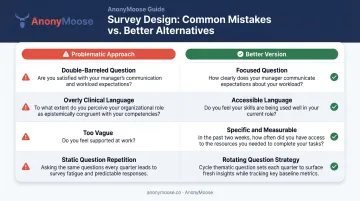
When employees answer from memory rather than reflection, response quality drops fast. Rotating a subset of questions each cycle — while holding your core tracking dimensions steady — keeps responses honest and surfaces trends you'd otherwise miss.
Integrating Pulse Surveys Into Your Wellbeing Strategy: Step-by-Step Framework
Step 1 — Anchor Surveys to Existing Programs
Pulse surveys should not float as a standalone initiative. Connect them explicitly to wellbeing commitments already in place — mental health days, EAP access, manager training programs. When employees can draw a direct line between what they shared in a survey and a specific program adjustment, the feedback loop becomes tangible rather than theoretical.
Step 2 — Define Cadence Based on Purpose
Match frequency to what you're measuring and to your capacity to respond:
- Monthly: Burnout risk, work-life balance, manager support — dynamic dimensions that shift quickly
- Quarterly: Psychological safety, belonging and inclusion — broader dimensions that change more slowly
SIOP recommends 2–4 organizational surveys per year as a general benchmark. The danger isn't running surveys too frequently; it's running them more often than you can act on. Survey fatigue is mostly a symptom of inaction, not survey volume.
AnonyMoose supports configurable cadences — weekly, monthly, or quarterly — within the same organizational account. Different teams or dimensions can run on different schedules without any conflict.
Step 3 — Select a Tool That Supports Anonymity and Access
Key selection criteria for a wellbeing pulse platform:
- Architecture-level anonymity — not a policy promise, but a technical guarantee
- Mobile accessibility — especially for deskless, frontline, and distributed employees who don't access company email
- Segmentation without de-anonymization — the ability to view results by department, tenure, or role while protecting individual respondents
AnonyMoose's mobile-first design tackles the access gap head-on. Surveys reach employees via push notification on their personal phones — no company device, no email required. For organizations with frontline or field-based workforces, removing that friction can push response rates from around 30% to 90% or higher.
Step 4 — Communicate Purpose Before Launch
Employees who understand why a survey is being run — and what will actually happen with the results — are far more likely to respond honestly. Your pre-survey communication should cover:
- What the survey is measuring and why it matters now
- Who will see the results (and at what level of aggregation)
- What the timeline is for acting on findings
- Explicit, specific reassurance about anonymity — ideally explaining the architecture, not just the policy
Step 5 — Build the Results-to-Action Protocol Before You Launch
The most common reason pulse survey programs fail has nothing to do with survey design. It's the absence of a clear internal process for what happens after results come in. Build this before launch:
- Review results within two weeks of survey close
- Assign action items to named owners with specific timelines
- Communicate back to employees within 30 days: specific themes, specific responses, specific next steps
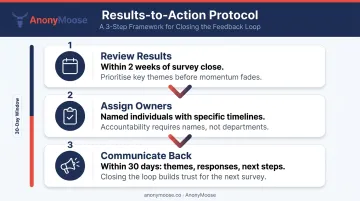
AnonyMoose's Broadcast feature makes step three straightforward. HR leaders can push action summaries to all employees or targeted subgroups via push notification on the same platform where the survey ran. When employees see their feedback translated into visible action, participation holds — and so does trust.
Turning Wellbeing Pulse Data Into Meaningful Action
Closing the Feedback Loop
Harvard Business Review found that employees show a 24% increase in speaking up when they believe managers actually act on their input. Conversely, employees who share wellbeing concerns and see no response will disengage from future surveys — and may escalate concerns through external channels like Glassdoor or public platforms instead.
Closing the loop doesn't mean a generic "thank you for your feedback" email. It means:
- Sharing specific themes the data surfaced — not just "we heard you"
- Naming specific actions being taken in response
- Setting a follow-up timeline and honoring it
- Sharing results at the team level, not just organization-wide, so managers can have real conversations with their direct reports grounded in what their specific group shared
Measuring Whether Wellbeing Initiatives Are Working
Pulse data serves two purposes: detecting problems and proving that interventions work. Comparing scores before and after a program change gives you concrete ROI evidence for continued wellbeing investment. Common examples include:
- A new manager training rollout
- A flexible Friday scheduling policy
- An EAP awareness campaign
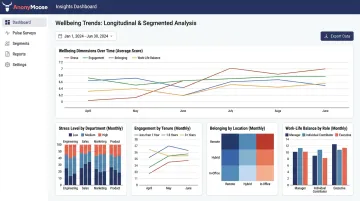
This longitudinal data also strengthens DEI accountability. If belonging scores improve organization-wide but stay flat or decline for specific demographic groups, that signals wellbeing improvements aren't reaching everyone equitably. Segmented trend analysis run through AnonyMoose's Insights Dashboard across multiple pulse cycles makes that kind of precise, group-level accountability visible.
Frequently Asked Questions
What is the difference between a wellbeing pulse survey and a standard employee engagement survey?
Engagement surveys measure broad organizational health across many drivers — strategy, leadership, compensation, development. Wellbeing pulse surveys are shorter, more frequent, and focused specifically on how employees are experiencing stress, belonging, and workload sustainability. The cadence is designed for real-time detection and response, not annual benchmarking.
How often should organizations run employee wellbeing pulse surveys?
Monthly for dynamic indicators like burnout and manager support; quarterly for broader dimensions like belonging and psychological safety. Increase frequency only when you have the capacity to act on results and communicate back. Surveying without responding erodes trust faster than not surveying at all.
What questions should be included in a wellbeing-focused pulse survey?
Cover the five core dimensions: psychological safety, burnout risk, belonging, work-life balance, and manager support. Use 5 to 10 questions per cycle, combining Likert-scale items for trend tracking with at least one open-ended question for direct employee input. Rotate a subset of questions each cycle to prevent survey blindness.
How do you ensure employees feel safe enough to share honest wellbeing feedback?
True anonymity — where no identity-response linkage is ever created — is the foundation. Pair that with clear communication about how results are used and a consistent record of acting visibly on past feedback. Employees trust systems that have already proven trustworthy.
How do you turn wellbeing pulse survey results into actionable programs?
Review data within two weeks of survey close and assign named owners to each action item. Communicate specific themes and planned responses to employees within 30 days, with explicit links to existing wellbeing programs so the connection between feedback and change is visible.
What are the most important employee wellbeing metrics to track through pulse surveys in 2026?
Track the five core dimensions: psychological safety, burnout risk, belonging, work-life balance, and manager support. Segment all five by department, tenure, and demographic group — a healthy average can mask serious issues in specific teams, and that's where investment decisions should be focused.