What makes this worse: 42% of voluntary turnover is entirely preventable. The signals were there. They just weren't being measured.
Most organizations still rely on annual engagement surveys that capture how employees felt months ago. By the time results are analyzed, the employees who were most disengaged have already submitted their notice. Pulse surveys change that equation — not by adding more data collection, but by creating an early-warning system that catches declining sentiment in time to act.
This article covers exactly how that works: the three mechanisms through which pulse surveys reduce turnover, what happens when they're skipped, and how to run them in a way that actually builds trust rather than eroding it.
Key Takeaways
- Pulse surveys are short (2–10 questions), high-frequency feedback tools sent weekly, bi-weekly, or monthly, giving organizations continuous visibility instead of a single annual snapshot.
- Engagement and retention are directly linked: Gallup's Q12 meta-analysis found top-quartile engagement units had 51% lower turnover in low-turnover organizations.
- Retention outcomes improve through early disengagement detection, honest feedback enabled by anonymity, and the trust that forms when leaders visibly act on results.
- Collecting feedback without acting on it accelerates disengagement; pulse surveys only work when results lead to visible change.
- Treated as an ongoing practice, pulse surveys become a retention system that grows more effective over time.
What Are Pulse Surveys?
Pulse surveys are brief, recurring employee feedback tools — typically 2–10 questions — sent on a regular cadence to measure real-time sentiment on topics like workload, manager effectiveness, recognition, or psychological safety.
They sit between one-on-one conversations and annual engagement surveys. Annual surveys produce a single yearly snapshot. Pulse surveys generate continuous data that HR and leadership can act on as conditions change — before nine months pass and the damage is already done.
The distinction matters in practice. Consider what each approach actually tells you:
- Annual survey: How employees felt on a particular Tuesday in November
- Monthly pulse: Whether satisfaction in a specific department dropped after a leadership change in March, stabilized in April, or kept declining into May
That's trend data — not a timestamp.
That trend data is what makes pulse surveys useful for retention. The goal isn't data collection — it's early detection of the conditions that push employees toward the door before they've already decided to walk through it.
Key Advantages of Pulse Surveys for Employee Retention
The three advantages below aren't abstract. Each maps directly to metrics HR teams track: voluntary turnover rate, average tenure, absenteeism, survey response rates, and engagement scores. They also compound — organizations that run pulse surveys consistently see stronger retention outcomes than those that treat them as a one-time initiative.
Advantage 1: Early Detection of Disengagement Before It Becomes Resignation
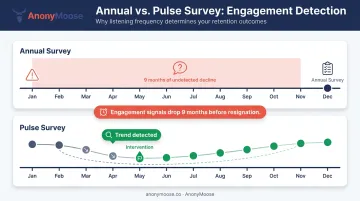
Disengagement isn't sudden. Workday Peakon's analysis of over 34 million employee survey responses found that engagement and loyalty signals begin declining approximately nine months before an employee resigns. By the time the resignation letter lands, the disengagement started nearly a year earlier.
That nine-month window is the opportunity pulse surveys are designed to capture.
Frequent, targeted questions on workload manageability, manager support, and role clarity surface sentiment dips in near-real time. A team showing declining scores in Q2 is a manageable conversation. A wave of Q4 resignations from that same team is a recruitment crisis.
Annual surveys can miss this entirely. Between January and December, months of declining engagement pass without a data point. Pulse surveys create multiple readings across the year, enabling trend analysis rather than a single moment frozen in time.
KPIs most affected:
- Voluntary turnover rate
- Average employee tenure
- Early-stage attrition (departures within 12 months of hire)
- Absenteeism rates
When this matters most:
- High-growth organizations with rapid headcount changes
- Industries with high baseline churn — leisure and hospitality recorded a 3.7% monthly quits rate in April 2026 (BLS JOLTS)
- Periods of organizational change: restructuring, leadership transitions, or policy shifts
Advantage 2: Anonymity Unlocks the Honest Feedback That Drives Real Retention Decisions
Pulse surveys are only as useful as the honesty of their responses. Employees routinely self-censor when they believe their identity can be traced — particularly around manager behavior, workplace fairness, or fear of retaliation.
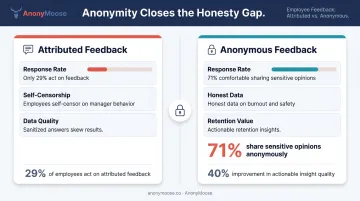
The data on this is clear. Glassdoor research found that 71% of employees would only be comfortable sharing opinions on sensitive topics if anonymous. Gallup separately found that only 40% of employees who witness unethical behavior actually report it, despite 90% saying they intended to. The gap between intent and action is almost entirely explained by fear of consequences. The APA (2021) captures this dynamic precisely: employees are 70% more likely to disclose unethical practices in anonymous settings than through traditional feedback methods — a gap that only grows for sensitive topics like management misconduct and workplace culture.
Anonymous pulse survey platforms close that gap. When employees trust that responses can't be traced to their manager or to the platform itself, they share what actually matters: psychological safety concerns, burnout, bias, and communication breakdowns that never surface in attributed channels.
There's also a systemic gap worth noting: Qualtrics research shows that 60% of U.S. employees have a mechanism to provide feedback, but only 30% say that feedback is actually acted upon. That gap exists because attributed channels produce sanitized answers. Anonymous channels produce real ones.
Platforms like AnonyMoose are built specifically around this principle. The architecture ensures that neither the employer nor the platform can identify who submitted a response — by technical design, not policy commitment. There is no mechanism in the system to trace a submission back to an individual.
That distinction matters. Employees know the difference between "we promise not to look" and "there's genuinely nothing to look at."
Without honest feedback, organizations address symptoms, not causes. They roll out perks when the real issue is a specific manager. Benefits get adjusted when the actual driver is unsustainable workload. Accurate data makes the diagnosis possible.
KPIs most affected:
- Survey response rates
- Employee Net Promoter Score (eNPS)
- Psychological safety index
- External review platform activity (Glassdoor ratings, Blind posts)
When this matters most:
- Organizations with hierarchical management structures
- Industries with historically low psychological safety
- Teams where employees from underrepresented groups may feel pressure to conform rather than speak candidly
Advantage 3: Closing the Feedback Loop Builds Trust and Reduces Flight Risk
Collecting pulse data is step one. What determines whether that data reduces turnover is what happens next.
Employees who see their input lead to visible change are significantly more likely to stay. Employees who feel their feedback disappears into a void don't just remain neutral — they become more disengaged than if no survey had been sent at all. The act of asking and then ignoring is worse than not asking.
The numbers behind this are specific. TINYpulse data shows that 21.5% of employees who don't feel recognized for their work interviewed for a new job in the prior three months, compared to 12.4% of employees who do feel recognized — nearly twice the job-hunting rate. Recognition and feeling heard aren't soft concepts; they're measurable flight-risk variables.
How a structured feedback loop works in practice:
- Pulse surveys generate trend data across recurring cycles
- HR or managers review results and identify recurring themes
- Leadership communicates what was heard and what will change
- Follow-up pulse questions measure whether changes had the intended effect
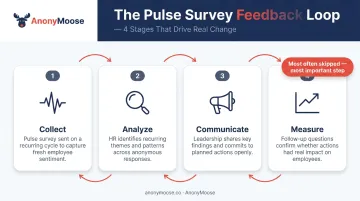
That fourth step is often skipped — and it's the most important one. It closes the loop and demonstrates that the survey wasn't performative.
AnonyMoose's Broadcast feature supports this directly: leadership can send an organization-wide or segmented message immediately after a survey cycle, summarizing themes and communicating planned actions. The Polls & Surveys tool and Insights Dashboard aggregate anonymous results without ever exposing individual respondents.
Together, these tools give organizations the infrastructure to run the full loop — without compromising the anonymity that made employees honest in the first place.
KPIs most affected:
- Employee satisfaction scores
- Manager effectiveness ratings
- Voluntary turnover rate, particularly among pulse survey participants
- Internal promotion rates (indicator of genuine investment in people)
When this matters most:
- The 3–18 month tenure window, when employees are evaluating whether their long-term future is with the organization
- Post-survey periods where inaction causes disproportionate trust damage
What Happens When Pulse Surveys Are Skipped or Ignored
Organizations that rely solely on annual surveys or exit interviews for employee sentiment data tend to encounter the same predictable cascade:
- Disengagement builds silently. Managers lose visibility into declining morale and workload friction until it reaches the point of resignation — at which point prevention is no longer possible.
- Turnover becomes reactive. Organizations cycle through perpetual recruitment instead of addressing root causes. SHRM reports the average cost per hire is nearly $4,700, with an average time-to-fill of 41 days — neither of which includes productivity loss or onboarding ramp time.
- Honest feedback routes externally. Without a trusted internal channel, employee frustrations surface on Glassdoor or Blind. Glassdoor's own research shows 86% of job seekers research company reviews before applying — meaning public complaints directly affect hiring pipelines.
- High performers leave first. Gartner's 2024 research identifies high performers as among the greatest flight-risk groups when workplace conditions deteriorate. They have the most options and use them earliest. Without pulse data to identify and re-engage them, organizations lose outsized institutional knowledge and output with minimal warning.
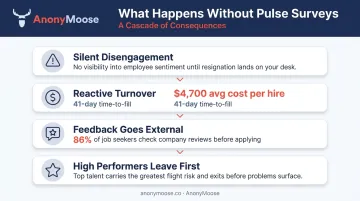
Each of these outcomes shares the same root cause: feedback gaps that make problems invisible until they're already costly.
How to Get the Most from Your Pulse Survey Program
Pulse surveys deliver the strongest retention outcomes when three conditions hold consistently.
Condition 3: Measuring change over time
Single-cycle scores are snapshots. The real retention value comes from tracking trends across multiple cycles and correlating sentiment shifts with actual outcomes — turnover rate reductions, tenure increases, eNPS movement. AnonyMoose's Insights Dashboard delivers that longitudinal view, giving HR teams a running read on direction rather than just a point-in-time result.
Conclusion
Pulse surveys improve employee retention by catching disengagement before it becomes a resignation letter, surfacing the honest feedback that only anonymity unlocks, and building the kind of organizational trust employees actually feel. Each mechanism reinforces the others.
Organizations that treat pulse surveys as an ongoing operating rhythm accumulate retention data and employee trust simultaneously. Over time, that combination makes early intervention faster, more accurate, and more credible to the employees being asked.
Every preventable resignation represents more than a recruitment cost. It's institutional knowledge walking out the door and team continuity quietly eroding. Running regular pulse surveys — with genuine anonymity and visible follow-through — is how organizations catch that signal early enough to act on it. The cumulative effect is significant: Vantage Circle research found a 30% decrease in employee turnover among organizations that adopted anonymous feedback tools, as the insights pulse surveys surface allow leaders to address the root causes of attrition before they compound.
Frequently Asked Questions
How can pulse surveys improve employee retention and reduce turnover?
Pulse surveys surface real-time disengagement signals before they reach the resignation stage. Research shows engagement and loyalty begin declining up to nine months before an employee leaves, so organizations that act on frequent feedback consistently see measurable reductions in voluntary turnover compared to those relying only on annual surveys.
What are the 3 R's of employee retention?
The 3 R's — Respect, Recognition, and Rewards — map directly to what pulse surveys measure. Do employees feel respected in their roles, recognized for their contributions, and fairly rewarded? Pulse surveys give HR continuous data on all three drivers rather than a once-a-year reading.
How often should pulse surveys be sent to employees?
Most organizations benefit from bi-weekly or monthly pulse surveys. The ideal cadence depends on team size, industry pace, and the topics being tracked — but consistency matters more than frequency. Employees need to trust that feedback is ongoing, not reactive.
What is the difference between a pulse survey and an annual engagement survey?
Annual surveys provide a once-a-year sentiment snapshot. Pulse surveys deliver continuous, trend-based data that enables early intervention — before disengagement quietly becomes a departure.
What should HR do with pulse survey results?
Review results for recurring themes, share a summary with employees, and commit to specific action items. Failing to act on feedback is one of the fastest ways to accelerate disengagement rather than prevent it.
Do employees respond more honestly to anonymous pulse surveys?
Yes — anonymity significantly increases both response rates and candor, particularly around sensitive topics like manager behavior or psychological safety. Platforms designed so even the provider cannot identify respondents, like AnonyMoose, yield the most actionable retention data because employees share what they actually think rather than what feels safe to say.