Most organizations claim to value employee input. Few have a reliable, structured mechanism for capturing honest, unfiltered feedback — especially when employees fear being identified.
This guide explains why employee feedback surveys matter in concrete, operational terms: what they prevent, what they enable, and what separates surveys that drive change from surveys that collect data and disappear.
Key Takeaways
- Employee feedback surveys turn subjective workforce experiences into trackable, comparable data leadership can act on
- Credible anonymity is the difference between honest data and curated answers shaped by fear
- Well-run surveys directly reduce turnover costs, lift productivity, and generate measurable DEI progress
- Surveys without follow-through erode trust faster than never asking
- High-performing organizations treat employee feedback as a continuous operational practice, not a one-time HR event
What Are Employee Feedback Surveys?
Employee feedback surveys are structured, repeatable tools for collecting honest employee input on job satisfaction, management effectiveness, culture, workload, growth opportunities, and psychological safety. They convert subjective employee experiences into trackable data points that leadership can act on and compare over time.
Gallup describes employee surveys as giving leaders structured insight into how employees think, feel, and perform — used to track employee experience, measure engagement, give employees a voice, and uncover performance barriers. Around 70% of organizations now survey their employees, according to a 2022 peer-reviewed action-planning study.
The Main Survey Types
| Survey Type | Frequency | Best Used For |
|---|---|---|
| Annual Engagement Survey | Once or twice per year | Deep-dive on engagement, culture, and performance drivers |
| Pulse Survey | Monthly or quarterly | Tracking specific sentiment shifts in near-real time |
| Always-On Feedback Channels | Continuous | Capturing concerns and ideas the moment they arise |
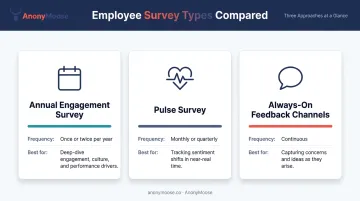
The right approach combines formats. Pulse surveys catch emerging issues between annual cycles. Always-on channels — like AnonyMoose's Openlines feature — give employees an always-available channel to raise concerns rather than waiting for the next scheduled survey.
Regardless of format, surveys are only as useful as the data they produce. Without a credible anonymity layer, that data is compromised. Employees who don't trust their responses are protected will self-censor — a pattern documented across 710 participants in a 2021 study on workplace voice. The result is survey data that looks complete but omits the concerns that matter most.
Key Advantages of Employee Feedback Surveys
Three advantages stand out because they connect directly to metrics organizations already track: retention costs, productivity, culture health, and DEI progress. Each depends on one shared condition — that employees must genuinely believe their feedback is confidential. Surveys administered without credible anonymity systematically underperform.
Advantage 1: Building Psychological Safety and Employee Trust
Anonymous feedback surveys create a structured channel for employees to voice concerns, report problems, and share ideas without fear of retaliation. This matters because the alternatives (one-on-ones, town halls, open-door policies) routinely fail to produce candid responses. Power dynamics and visibility concerns suppress honesty in those formats.
Why this translates to measurable outcomes:
- Google's Project Aristotle studied 180 teams and identified psychological safety as one of five dynamics of effective teams — defined as team members feeling safe to take risks and be vulnerable with one another
- The IBE's 2024 Ethics at Work Survey found that 46% of employees who spoke up about misconduct reported personal disadvantage or retaliation afterward — which explains why internal anonymous channels matter as an alternative
- Glassdoor data shows employers who increase their overall rating by at least 0.5 points see 20% more job application clicks on average — meaning internal psychological safety has direct recruiting consequences when it breaks down publicly
The connection to external reputation is direct. When employees have no trusted internal channel, concerns migrate to Glassdoor, Blind, and LinkedIn : permanent, public, and damaging. AnonyMoose's platform is specifically built to reduce this risk by providing a technically anonymous internal alternative that neither the employer nor the platform vendor can trace back to individual respondents. The SHRM Study (2020) found that organizations with genuine anonymity see 82% of employees willing to share critical feedback — a figure that reflects what becomes possible when the structural fear of identification is removed entirely.
KPIs this advantage influences: survey response rates, Glassdoor employer review scores, employee Net Promoter Score (eNPS), internal incident report volume, and whistleblower complaint rates.
When it matters most: organizations undergoing leadership transitions, companies with historically high turnover, teams with known DEI challenges, and workplaces where HR has had low credibility or past retaliation incidents.
Advantage 2: Reducing Employee Turnover and Its Associated Costs
Employee feedback surveys are among the earliest detection systems for disengagement. They give HR teams the ability to intervene before a dissatisfied employee quietly exits — rather than discovering the problem only in an exit interview, when the cost has already been incurred.
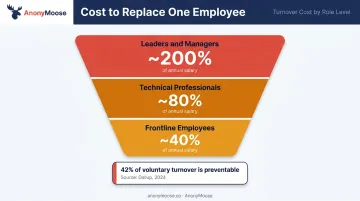
Gallup's 2024 research found that 42% of voluntary turnover was preventable, based on a nationally representative study of 717 people who voluntarily left an employer in the prior 12 months. Replacement costs by role break down as follows:
- ~200% of annual salary for leaders and managers
- ~80% for technical professionals
- ~40% for frontline employees
Surveys surface the specific drivers of dissatisfaction — management style, compensation fairness, growth gaps, workload imbalance — before they become resignation decisions. Research on anonymous employee surveys found that organizations using anonymous feedback tools see a 30% decrease in employee turnover — a result that reflects what happens when employees feel safe enough to surface dissatisfaction early, before it becomes a resignation.
The key is segmentation. When HR breaks down results by department, tenure, or role level, they can identify which employee populations are at highest risk and direct retention efforts precisely rather than applying blanket solutions.
AnonyMoose's Polls & Surveys feature supports targeting using up to five custom criteria (called Close User Groups), drawn directly from existing HRMS data. This allows HR to run pulse checks on specific high-risk segments: post-merger employees, a department with rising absenteeism, or a tenure band showing declining engagement scores.
Acting on results is what separates organizations that improve retention from those that survey and see no change. When feedback is collected but ignored, the problem accelerates — Qualtrics' 2024 research shows employees are 4x more likely to consider leaving when feedback is not acted on. By contrast, organizations that close the loop consistently report a 30% decrease in employee turnover as a direct result of adopting anonymous feedback tools — a powerful illustration of what listening that employees trust actually produces.
KPIs this advantage influences: voluntary turnover rate, time-to-fill open roles, internal promotion rate, absenteeism rate, and employee tenure averages.
When it matters most: high-growth organizations hiring rapidly, high-turnover industries such as retail and healthcare, post-merger or restructuring periods, and organizations where specialized talent is expensive to replace.
Advantage 3: Enabling Data-Driven Culture Improvement and DEI Progress
Culture and DEI remain abstract aspirations in most organizations : stated commitments without measurable infrastructure. Employee feedback surveys change that by generating quantifiable data points that can be tracked over time, segmented by demographic, and benchmarked against internal targets.
The evidence for why this matters is substantial:
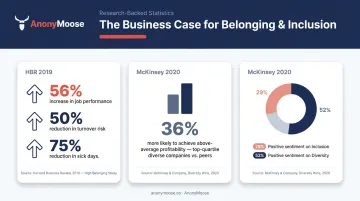
- HBR's 2019 research found that high belonging correlates with a 56% increase in job performance, 50% reduction in turnover risk, and 75% reduction in sick days
- McKinsey's 2020 study of more than 1,000 large companies found that top-quartile ethnic and cultural diversity companies were 36% more likely to achieve above-average profitability
- The same McKinsey research found employee sentiment on inclusion was only 29% positive — far lower than sentiment on diversity (52% positive) — meaning diversity commitments don't automatically produce inclusion experience
Surveys surface these gaps. By capturing how different employee groups — across departments, seniority levels, genders, ethnicities, or tenure — experience the same workplace, surveys make inequities visible that would otherwise remain invisible to leadership.
AnonyMoose's platform supports this through demographic segmentation via Close User Groups, where results can be analyzed by up to five custom attributes without ever exposing individual respondent identities.
A DEI team can compare belonging scores between senior and junior staff, or check whether women in management experience a different workplace than their male counterparts — all without compromising the anonymity that keeps the data honest.
Instead of allocating budget to training programs based on executive intuition, decisions can reflect what employees across different segments actually report experiencing. The SHRM Study (2020) found that the improved morale and trust that comes from genuinely acting on employee feedback produces a 34% boost in productivity — making survey programs not just a culture investment but a measurable performance lever.
KPIs this advantage influences: DEI perception scores by employee segment, internal promotion equity ratios, culture health index scores, innovation suggestion rate, and management effectiveness ratings broken down by team.
When it matters most: organizations with stated DEI commitments needing measurable progress, companies facing culture scrutiny following public incidents, and enterprises operating across multiple regions where a single cultural experience cannot be assumed.
What Happens When Employee Feedback Surveys Are Ignored
Ignoring employee feedback doesn't create one large, obvious failure. The damage builds gradually — and by the time it's visible, it's already expensive to fix.
- Disengagement goes undetected until it becomes turnover. By the time problems surface in exit interviews, the organizational knowledge is already gone and the replacement cost is already incurred.
- Leadership makes decisions on assumptions rather than data. Initiatives miss the mark. Budgets fund low-impact programs. Cultural problems persist beneath the surface because no one has accurate information about what's actually happening.
- Employees without an internal channel take concerns external. Glassdoor, Blind, LinkedIn, and regulators become the venue. The consequences — reputational damage, legal exposure, talent pipeline impact — are far harder to control than internal feedback ever would have been.
- Silence signals indifference. Over time, the absence of a feedback mechanism tells employees their voice doesn't matter. That erodes morale and accelerates turnover, disproportionately among high performers who have options.
HBR's 2024 research found a 24% increase in employee willingness to speak up when employees believe managers act on their input. When surveys are conducted but nothing changes, that dynamic reverses — trust in the process drops, and future participation and honesty both decline with it.
How to Get the Most Value from Employee Feedback Surveys
The survey itself isn't where value is created. Value comes from what happens before, during, and after the cycle: designing for honest responses, enforcing credible anonymity, and following through with visible action.
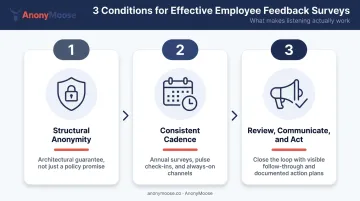
Three conditions determine whether surveys deliver outcomes or just data:
1. Anonymity must be structural, not just promised
Employees who don't genuinely trust that their identity is protected will self-censor. Policy promises alone don't solve this. Employees know that writing style, context clues, and system logs can expose them in most tools.
AnonyMoose is purpose-built around technical anonymity: no individual response can be traced to a specific employee by the employer, by AnonyMoose, or by any subsequent investigator. This architectural guarantee — not a policy — is what produces honest data rather than curated responses.
2. Surveys must run on a consistent, defined cadence
A single data snapshot is nearly useless without context. The most effective organizations combine periodic engagement surveys (deep and comprehensive) with shorter pulse surveys (frequent and focused), creating a comparative baseline that makes changes measurable, not guesswork. AnonyMoose supports weekly, monthly, and quarterly pulse cadences alongside always-on Openlines channels.
3. Results must be reviewed, communicated, and followed by documented action
Closing the loop is what builds survey trust over time. When employees complete a survey and see no change, participation drops and honesty declines further. When leadership acknowledges results — even when not everything can change — it signals that the process is real.
AnonyMoose's Broadcast feature supports this directly: leadership can instantly distribute survey findings, action plans, or follow-up updates to the entire organization or targeted subgroups via push notification on employees' personal devices. For distributed or deskless workforces, this ensures the loop actually closes rather than getting lost in an email no one opens.
Conclusion
Employee feedback surveys matter because leadership has blind spots — and those blind spots have real costs. When designed well, surveys surface what's actually driving or damaging workforce performance, and they give employees an experience of being heard that directly affects whether they stay.
The advantages compound over time. Organizations that run surveys consistently build a historical data baseline. Employees grow to trust the process. Leadership develops the institutional knowledge needed to make better people decisions year over year.
Treat employee feedback as an ongoing operational practice — one that requires careful design, genuine anonymity, and a visible commitment to acting on results. Done consistently, it stops being a survey and starts being the clearest signal you have of where your organization is headed. Platforms like AnonyMoose are built specifically for this: anonymous feedback channels that give employees a real reason to speak up, and give leadership the data to respond.
Frequently Asked Questions
What is the purpose of an employee feedback survey?
The purpose is to give employees a structured, confidential channel to share their experiences, concerns, and ideas, while giving leadership reliable data to improve engagement, culture, retention, and decision-making. Without that structure, leaders operate on assumptions that are often wrong.
How often should employee feedback surveys be conducted?
Most organizations do best with a mix: annual or semi-annual engagement surveys for depth, and quarterly or monthly pulse surveys for timely signals. Add event-based surveys at critical moments — onboarding, leadership transitions, or post-reorganization — to capture feedback when it matters most.
Should employee feedback surveys be anonymous?
Anonymity is not optional if the goal is honest data. When employees don't trust that their responses are confidential, they self-censor or avoid participating altogether. Credible anonymity requires architectural enforcement, not just a policy promise.
What should organizations do after collecting employee survey results?
Analyze results promptly, communicate findings transparently (including what won't change and why), assign ownership of action items, and follow up with progress updates. Without visible follow-through, future participation and honesty both decline.
What types of questions should be included in an employee feedback survey?
Effective surveys use three question types:
- Scaled ratings (1–10) to track measurable trends over time
- Multiple-choice for specific topics like management support or workload
- Open-ended questions so employees can describe issues in their own words
The combination captures both quantitative benchmarks and qualitative context.
How do employee feedback surveys support DEI goals?
Surveys can be segmented by demographic, department, or tenure to reveal whether different employee groups experience the workplace differently, identifying inequities in belonging, opportunity, or inclusion that would otherwise go undetected.