When employees don't trust that their honesty is protected, organizations lose access to the feedback they need most. The result is a workplace where leaders make decisions based on incomplete data while real problems fester beneath the surface.
This guide covers what anonymous employee surveys are, how they differ from confidential surveys, why anonymity matters, how to run them effectively, and what to do with the results. The core argument throughout: anonymity isn't a privacy checkbox — it's the foundation of psychological safety that makes honest feedback possible.
Key Takeaways
- Anonymous surveys collect responses with no personally identifiable information attached — no name, email, employee ID, or IP address — making responses untraceable.
- True anonymity reduces social desirability bias and encourages honest feedback on sensitive topics like harassment, manager behavior, and DEI.
- Technical anonymity protections — not just policy promises — are what make a survey genuinely untraceable.
- Acting on results and communicating those actions back to employees is what converts feedback into lasting change.
What Is an Anonymous Employee Survey?
An anonymous employee survey is a feedback tool where responses are collected with no personally identifiable information (PII) attached. No name, no email, no employee ID, no IP address — and critically, no way to connect any response back to the person who submitted it.
That last point matters more than organizations typically acknowledge. SHRM reports that when employees distrust a survey's anonymity, they answer dishonestly — softening criticism, hiding their tenure or role level, or skipping questions entirely. The survey still runs. The data just doesn't tell the truth.
The core purpose of anonymous surveys is to create a psychologically safe channel for feedback on topics employees won't touch when their name is attached: leadership effectiveness, workplace culture, DEI concerns, workload, and organizational issues that carry retaliation risk.
Anonymous vs. Confidential Surveys — What's the Difference?
These two terms are often used interchangeably, but they describe distinct approaches.
| Dimension | Anonymous Survey | Confidential Survey |
|---|---|---|
| Identity traceability | No identifiers collected; responses cannot be traced | Responses linked to employee records; access restricted |
| Data depth | Aggregate only | Can support longitudinal tracking and HRIS integration |
| Ideal use case | Low trust, sensitive topics, no HRIS access | Analytics-heavy programs requiring demographic segmentation |
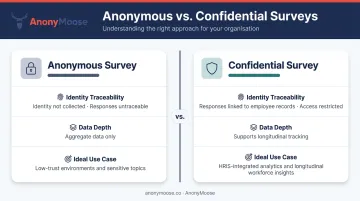
Confidential surveys link responses to individual employees through HRIS data or unique identifiers. Results are reported in aggregate, but identities are technically traceable by administrators. Qualtrics recommends confidential surveys when responses need to map back to integrated systems — useful for longitudinal tracking, demographic cuts, and predictive analytics.
Anonymous surveys, by contrast, collect no identifiers at all. No one — including platform administrators — can connect a response to its author. AnonyMoose's Polls & Surveys feature enforces this at the technical level: neither the employer nor AnonyMoose can identify individual respondents.
When to use each:
- Use confidential when you need HRIS-linked tracking, demographic segmentation, or integration with HR analytics systems
- Use anonymous when trust is low, topics are sensitive (harassment, mental health, ethics), or your respondent pool includes contractors or non-HRIS employees
Why Anonymous Employee Surveys Matter
Anonymity has a measurable effect on what employees are willing to say.
A peer-reviewed randomized controlled trial found that anonymous survey methods produce greater disclosure of sensitive or stigmatizing information compared to non-anonymous methods. A separate 2021 study confirmed that assuring anonymity reduces social desirability bias — the tendency to give answers that seem acceptable rather than truthful. Both findings point to the same conclusion: remove the identity link, and people tell you what they actually think.
The SHRM Study (2020) put specific numbers to this effect: 82% of employees are more likely to share critical feedback when they know their anonymity is preserved, and organizations that switched to genuinely anonymous channels saw a 47% increase in actionable feedback related to management practices. That jump in feedback quality isn't just a participation metric — it translates directly into better management decisions and fewer blind spots at the leadership level. Research from buildempire.co.uk further shows that anonymous surveys generate 58% more honest feedback than non-anonymous alternatives, and the downstream retention impact is concrete: organizations that commit to anonymous feedback tools report a 30% decrease in employee turnover.
Topics That Benefit Most from Anonymity
Some subjects simply don't surface through named channels:
- Manager effectiveness and leadership behavior
- Psychological safety and fear of retaliation
- Harassment, bullying, or misconduct
- DEI concerns and experiences of discrimination
- Burnout, workload, and mental health
These are exactly the topics organizations most need honest data on — and the topics employees are least likely to discuss openly.
The Hierarchy Problem
In high-hierarchy environments — healthcare, manufacturing, logistics — the gap between what employees think and what they say out loud is especially wide. A Swiss healthcare study found that staff withheld voice in 19% to 39% of observed cases. Anonymous channels don't fully solve this, but they remove the single biggest structural barrier: the fear of being identified.
Anonymity as a DEI Tool
Deloitte's Disability Inclusion @ Work 2024 survey found that 41% of respondents experienced microaggressions, harassment, or bullying at work in the previous 12 months. For employees from underrepresented groups, the cost of speaking up through named channels is disproportionately high. Anonymous feedback channels don't eliminate that risk — but they structurally reduce it, making anonymity a design choice with real equity implications.
AnonyMoose's Polls & Surveys feature and dedicated Hotlines for harassment and discrimination reporting give marginalized employees a technically anonymous path to surface concerns. Employees can attach supporting evidence — documents, photos, screenshots — without their identity being traceable to anyone, including the platform itself.
The belonging impact of this kind of structural anonymity is measurable. Research by Quantum Workplace found a 35% increase in employees' sense of belonging at work when organizations implement anonymous communication channels — a signal that anonymity isn't just a data-quality improvement but a culture-building one, particularly for employees from underrepresented groups who face the highest interpersonal risk when speaking up.
How to Create and Run an Anonymous Employee Survey
Step 1 — Define Your Objective
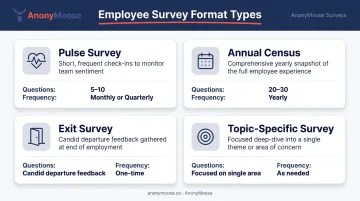
Before writing a single question, decide what you need to learn. Whether you're measuring overall engagement, assessing manager effectiveness, or tracking DEI sentiment after a policy change, the answer determines your survey format:
- Pulse survey: 5–10 questions, monthly or quarterly, for tracking specific metrics over time
- Annual census: Broader engagement measurement, typically 20–30 questions
- Exit survey: Captures candid reasons for departure when employees feel safe being honest
- Topic-specific survey: Focused on one area, such as return-to-office response, post-reorg sentiment, or burnout indicators
Step 2 — Design Questions Carefully
Good survey questions are specific, unambiguous, and written to protect anonymity even in the question itself.
- Use Likert scales (strongly agree to strongly disagree) for quantitative benchmarking
- Include at least one open-ended question for qualitative depth
- Make all demographic questions optional with a "Prefer not to answer" option
- Avoid questions that reference specific projects, clients, or events that could inadvertently identify a respondent
- Keep category groupings broad enough that no single demographic option maps to one person
Step 3 — Protect Anonymity Technically
Survey anonymity depends on technical architecture, not just policy promises.
Key requirements for a genuinely anonymous survey platform:
- No IP address or location data collected
- No personal or individual survey links that carry identifying metadata
- No query strings tied to specific employees
- Minimum group size thresholds before segmented results are displayed — Culture Amp uses a default minimum of 5 respondents; AHRQ recommends at least 10 for sensitive healthcare settings
AnonyMoose is built on an anonymous-by-design architecture, meaning neither HR nor the platform itself can identify individual respondents. This is a technical guarantee, not just a privacy policy setting.
Step 4 — Communicate Before You Launch
Transparency before the survey runs directly affects both response rates and the honesty of answers. Tell employees:
- Why you're running the survey and what you'll do with results
- Which platform you're using and how it protects anonymity technically
- What happens with safety-related feedback
- When the survey closes and when results will be shared
Step 5 — Distribute and Collect
Distribution method matters for anonymity. Anonymous or universal links, QR codes, and push notifications to personal devices all avoid the identity-tracking risk that personal survey links carry. AnonyMoose delivers surveys via push notification directly to employees' personal mobile phones, with no corporate email or device enrollment required. This makes it especially effective for deskless and frontline workforces.
Keep surveys open for at least two weeks and send one or two reminders.
Best Practices for Anonymous Employee Surveys
Knowing what to ask is only half the equation. How you design, time, and follow up on surveys determines whether employees trust the process enough to answer honestly.
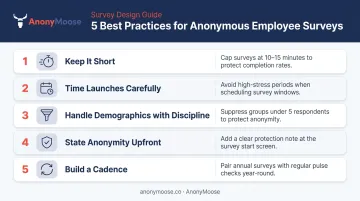
- Keep surveys short. Culture Amp recommends capping engagement surveys at 10–15 minutes; pulse surveys should run under 5 minutes. Completion rates drop as length increases, and so does response quality.
- Time launches carefully. Avoid rolling out surveys during high-stress operational periods, immediately after layoffs, or mid-performance review cycles. Mid-year and end-of-year windows work well for annual surveys. Monthly or quarterly pulses sustain continuous listening momentum.
- Handle demographic data with discipline. Only collect demographic fields (department, tenure, role level) when the analysis requires them. Keep groupings broad, and suppress results for any segment with fewer than 5 respondents to protect anonymity.
- State anonymity protections upfront. Add a brief note at the top of each survey explaining how responses are protected and how safety-critical feedback will be handled. This single step measurably reduces respondent anxiety and increases honest completion.
- Build a cadence, not just an event. One annual survey is a starting point. Pair it with shorter pulse surveys throughout the year to track whether actions have made a difference. Employees notice when listening is continuous — not just a periodic checkbox.
What to Do After the Survey: Turning Results into Action
Analyze for Themes, Not Individuals
Focus on aggregate patterns: score distributions, open-ended comment themes, and cross-tabulation across departments or tenure groups (where group sizes allow). The goal is to identify where specific experiences diverge — which teams are struggling, which managers are receiving consistent concerns, which issues cut across the whole organization.
AnonyMoose's Insights Dashboard supports trend analysis, segmentation by attribute, and longitudinal tracking, with AI-assisted pattern identification across responses — without exposing individual identities at any point.
Close the Feedback Loop
Culture Amp recommends sharing survey results within 1 to 2 weeks after the survey closes and committing to 1 to 3 specific action steps. Organizations that go quiet after a survey typically see participation drop 20–30% in the next cycle — employees conclude their input wasn't worth giving.
Share results organization-wide. Be specific about:
- The key themes that surfaced
- Concrete steps the organization will take in response
- The timeline for delivering on those commitments
AnonyMoose's Broadcast feature supports this directly — push notifications deliver results and action plans to every employee's phone in real time, including deskless workers who would never see an email communication about survey outcomes.
Sustain a Continuous Listening Rhythm
Microsoft Viva Glint's employee engagement research makes this clear: soliciting feedback is only the first step. How the organization responds determines whether employees keep participating.
Build a listening program that alternates between formats:
- Annual surveys to capture broad sentiment across engagement, culture, and leadership
- Quarterly pulse checks to track whether specific actions are having the intended impact
- Ad hoc polls to gather fast input when decisions are in progress, not after the fact
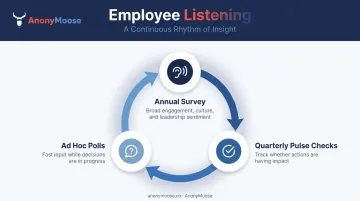
Each cycle should reference the last — show employees that previous feedback shaped what changed.
Frequently Asked Questions
Should employee surveys be anonymous?
Yes — particularly when trust is low, topics are sensitive, or social desirability bias is a concern. Anonymous surveys consistently produce more candid responses on issues like manager behavior, DEI, and workplace misconduct, and typically achieve higher response rates than named alternatives.
Are anonymous employee surveys truly anonymous?
It depends on the platform. Reputable tools remove PII, avoid logging IP addresses, and use universal rather than personal links. AnonyMoose's architecture goes further — neither the employer nor the platform can identify individual respondents, so anonymity is a technical guarantee, not just a policy commitment.
What is the difference between an anonymous and a confidential employee survey?
In an anonymous survey, no identifiers are collected and no one can trace responses. In a confidential survey, responses are linked to individuals but access is restricted and results are reported in aggregate. The key difference is whether identity traceability exists at all.
What questions should you ask in an anonymous employee survey?
A strong survey includes:
- Likert-scale questions covering engagement, satisfaction, manager effectiveness, and culture
- At least one open-ended question for qualitative insight
- No prompts referencing specific projects, clients, or niche situations that could inadvertently identify a respondent
How do you increase response rates for anonymous employee surveys?
Communicate how anonymity is protected before launch, keep pulse surveys under 10 questions, time them well, and send one or two reminders via mobile-friendly access. The participation gap between truly anonymous and non-anonymous surveys is substantial: research on employee feedback shows anonymous surveys achieve 90% participation rates versus 30% for non-anonymous surveys. Platforms that deliver surveys directly to personal devices — like AnonyMoose — are built to sustain those participation levels over repeated cycles.