The stakes are real. Gallup research shows that highly engaged business units generate 23% higher profitability and 14% higher productivity than disengaged ones. Measuring engagement accurately matters. The problem isn't that surveys don't work — it's that avoidable design and process mistakes consistently compromise them.
This article covers the five most damaging mistakes HR leaders and managers make with employee surveys, and the practical fixes for each.
Key Takeaways
- "Anonymous" labels don't guarantee anonymity — technical architecture does
- Surveys without defined goals produce data nobody knows how to act on
- Biased or double-barreled questions corrupt data before responses are collected
- One-time annual surveys miss how sentiment shifts throughout the year
- Silence after survey close is the fastest way to kill future participation
Mistake #1: Claiming Anonymity Without Actually Delivering It
Most employees have heard the phrase "this survey is completely anonymous" — and most don't fully believe it. There's a meaningful difference between a confidential survey and a truly anonymous one.
Confidential surveys protect employee identity from direct managers, but HR may still be able to link responses to individuals. Truly anonymous surveys ensure no one — including HR and the survey platform — can identify who submitted what. Employees pick up on this gap even without being told explicitly, and they adjust their answers accordingly.
Why Employees Don't Trust "Anonymous" Labels
Several common practices signal to employees that anonymity isn't secure:
- Sending follow-up reminders to non-respondents reveals the system tracks who has and hasn't responded
- Asking department + tenure + location together can narrow identity to one or two people on small teams
- Running surveys on internal platforms where IT administrators have back-end access undermines any policy-level promise
When employees suspect they can be identified, they default to safe, inoffensive answers. The resulting data isn't neutral — it's actively misleading, reflecting what people think is acceptable to say rather than what they actually believe.
According to AllVoices research, 56% of employees who withhold honest feedback say they'd be more candid if given a truly anonymous channel. If your surveys aren't trusted, that silence is built into every data point you're acting on.
What True Anonymity Looks Like in Practice
Genuine anonymity requires more than a policy promise. It requires:
- A purpose-built platform where neither HR nor the vendor can link responses to individuals
- Aggregate-only reporting with minimum response thresholds
- Architecture that makes individual identification technically impossible — not just prohibited
AnonyMoose is built specifically around this standard. The platform's anonymous-by-design architecture means no technical mechanism exists to trace a submission to an individual employee — not by HR, not by AnonyMoose itself. The anonymity is enforced at the architecture level, not by a policy that could be overridden. Research on employee feedback shows anonymous surveys achieve 90% participation versus 30% for non-anonymous surveys, and capture 58% more honest critical feedback — a difference that stems directly from whether employees trust their identity is genuinely protected. Separately, the SHRM Study (2020) found that 82% of employees are more likely to share critical feedback when they know their anonymity is preserved, reinforcing that the architecture of the survey matters as much as the questions it contains.
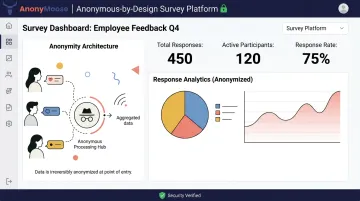
That gap in participation and candor is what separates surveys that drive change from surveys that confirm what leadership already believed.
Mistake #2: Launching a Survey Without a Clear, Actionable Goal
Many surveys get launched because it seems like the right thing to do, not because the organization has defined what decision the data will inform. When there's no clear goal, questions become vague, results are hard to prioritize, and HR teams end up with a spreadsheet they're not sure how to use.
Define the Decision Before Writing the Questions
The most useful framing before any survey: "What decision will this data help us make?"
Common examples of concrete goals:
- Identifying root causes of elevated turnover in a specific department
- Gauging employee response to a new remote work policy
- Measuring morale three months after a restructuring
Each of these produces a different survey. Without specifying which one you're running, you'll likely write questions that partially address all three and adequately address none.
Employees also participate more meaningfully when they understand why they're being asked. A brief explanation like "we're running this survey to understand how the restructuring has affected team communication" signals that results connect to real decisions.
Keep It Short and Focused
Survey length directly affects completion rates and honesty. Paylocity data shows surveys with 1–3 questions achieve an 83% completion rate, while surveys with 9–14 questions drop to 56%. Qualtrics research puts the break-off point at surveys exceeding 12 minutes (9 minutes on mobile).
Define 2–3 core objectives before drafting questions, then cut anything that doesn't serve them. Irrelevant questions waste space and signal to employees that the survey isn't focused, which reduces both trust and response quality.
Mistake #3: Using Biased or Poorly Structured Survey Questions
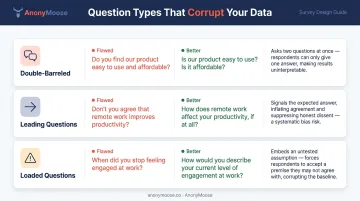
Question design is where surveys frequently fail before a single response is submitted. Three error types cause the most damage:
- Double-barreled questions — "Does your manager support your personal and professional development?" asks two separate things. An employee might answer yes to one and no to the other, making any response uninterpretable.
- Leading questions — "How much did you enjoy the new onboarding program?" presupposes the employee enjoyed it, nudging respondents toward positive answers.
- Loaded questions — Questions that assume a condition that may not apply to the respondent introduce systematic bias regardless of how they answer.
Pew Research Center's questionnaire guidance makes this plain: question wording directly shapes answers. Without neutral, unambiguous language, the data you collect simply can't be trusted.
Balance Question Types
Getting the wording right is only half the equation — question format matters just as much. Surveys that rely entirely on open-ended questions overwhelm both respondents and analysts, while Likert-only surveys miss nuance and context. A practical mix looks like this:
- Use scaled questions (e.g., 1–5 agreement scales) for benchmarkable, trend-trackable data
- Limit open-ended questions to 1–2 that invite specific, focused elaboration
- Avoid question formats that require more than 30 seconds to answer on a mobile device
Pilot Before You Publish
Running the survey with a small internal group before full launch is one of the most skipped — and most valuable — steps in survey design. Pilot testing catches:
- Questions employees interpret differently than intended
- Broken skip logic or conditional formatting
- Wording that reads as leading or accusatory
Without this step, you often discover wording problems only after the data is already corrupted.
Mistake #4: Running Surveys as Isolated, One-Time Events
The classic pattern: a large annual survey, months of analysis, a presentation to leadership, and then silence until the following year. By the time the next survey launches, the organization looks completely different — new leadership, new policies, post-reorg teams — but the data being used to make decisions is nearly a year old.
HR.com's 2025 research found that 43% of organizations measure engagement annually, while only 9% use continuous real-time collection. The same research shows engagement leaders are five times more likely than laggards to measure more frequently than quarterly.
Build a Layered Listening Cadence
A continuous listening strategy uses different survey types for different purposes:
| Survey Type | Cadence | Purpose |
|---|---|---|
| Comprehensive engagement survey | Annually or semi-annually | Deep diagnostic insights |
| Pulse survey (5–15 questions) | Monthly or quarterly | Track sentiment trends in real time |
| Event-triggered survey | After major changes | Measure specific impact immediately |
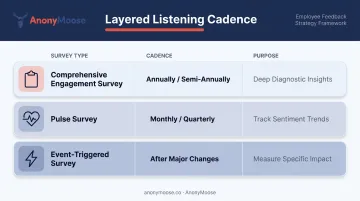
These three types complement rather than replace each other. Annual surveys go deep; pulse surveys keep you current; event-triggered surveys capture the "why" behind specific moments.
AnonyMoose supports all three cadences within the same platform. Its Polls & Surveys feature enables leadership to deploy rapid pulses at weekly, monthly, or quarterly intervals, while the persistent Openlines channel captures unsolicited feedback between survey cycles — creating a continuous picture of employee sentiment rather than periodic snapshots.
Avoid Survey Fatigue
Frequency alone isn't the goal. Over-surveying without acting on results teaches employees that participation is pointless. A sustainable rhythm means closing the loop — gathering feedback, acting on it, and communicating what changed — before the next cycle starts.
Mistake #5: Going Silent After the Survey Closes
Employees complete a survey — investing time and trust — and then hear nothing. No results, no acknowledgment, no timeline. Of all five mistakes, this one does the most lasting damage.
That silence communicates something. Employees interpret it as confirmation that leadership either didn't read the feedback or doesn't intend to act on it. Gartner research quantifies the scale of this problem: only one-third of employees believe their organization will act on their feedback, and 60% don't understand what their organization is currently doing to increase engagement. Gallup finds that when leaders survey but fail to act, engagement decreases and turnover increases.
The Hidden Cost: When Employees Vent Elsewhere
Employees who feel unheard don't simply disengage from future surveys. They find other outlets. Public platforms like Glassdoor and Blind become pressure valves for workplace frustrations that had no functional internal channel.
The reputational impact is measurable. Glassdoor's own data shows that employers who increased their overall rating by just 0.5 points saw 20% more job clicks and 16% more apply starts.
This is where an always-on internal channel matters. AnonyMoose's Openlines feature gives employees a permanent, anonymous way to raise concerns, share suggestions, and communicate with leadership between survey cycles — reducing the buildup of unaddressed sentiment that drives people to public platforms.
Turning Feedback Into a Trust-Building Cycle
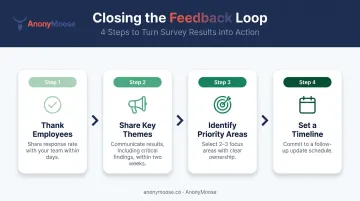
Closing the loop doesn't require solving everything before you communicate. It requires:
- Thank employees for participating and share the response rate within days of survey close
- Share key themes — including the critical ones, not just positive findings — within two weeks (Perceptyx data shows 32% of organizations share results within 1–2 weeks)
- Identify 2–3 priority areas for action with clear ownership
- Set a realistic timeline for follow-up updates, then stick to it
AnonyMoose's Broadcast feature enables HR teams to push summary results and action updates directly to employees' phones via instant notification — so the same platform that collected the feedback delivers proof it was heard.
That's how a single survey becomes the foundation of an ongoing feedback culture.
Frequently Asked Questions
What are the four types of survey errors?
The four standard error types are: coverage error (some employees never had a chance to be included), sampling error (insufficient response volume to represent the full population), measurement error (poorly worded questions that introduce bias or ambiguity), and non-response error (certain groups systematically opt out, skewing results). Awareness of these errors helps HR teams design more reliable surveys from the start.
How do you ensure employee surveys are truly anonymous?
True anonymity requires a purpose-built platform where neither the employer nor the vendor can technically link responses to individuals. Beyond platform choice, set minimum response thresholds before displaying group results, and avoid collecting demographic combinations so specific that identity becomes inferable in small teams.
How often should companies run employee surveys?
A layered approach works best: a comprehensive engagement survey annually or semi-annually, shorter pulse surveys monthly or quarterly, and event-triggered surveys after major organizational changes. Frequency only adds value when feedback is acted on and communicated back before the next cycle begins.
What should companies do immediately after collecting survey results?
Within the first few days, acknowledge participation and share the response rate. Within two weeks, communicate a transparent summary of key themes, including critical ones. Identify 2–3 priority areas, assign clear ownership, and set a realistic timeline so employees know when to expect progress.
What is the difference between an anonymous and a confidential employee survey?
A confidential survey protects employee identity from direct managers, but HR may still retain the ability to link responses to individuals. A truly anonymous survey ensures no one — including HR and the survey platform — can identify who submitted what. For organizations that want unfiltered, honest feedback, anonymous surveys tend to produce more honest responses than confidential ones.
How do you increase employee survey participation rates?
Clearly communicate why the survey is running and how results will be used. Keep it short, mobile-accessible, and backed by genuine anonymity. Most importantly, show through past behavior that feedback leads to visible change. Participation follows trust, not reminders.