This matters more than most organizations acknowledge. Gallup's 2026 State of the Global Workplace report found that global employee engagement fell to just 20% in 2025, costing the world economy roughly $10 trillion in lost productivity.
The tool you choose determines whether your survey program changes behavior or just generates reports. This guide evaluates 14 tools across anonymity architecture, analytics depth, delivery channels, action loop design, and ease of use — so you can find the right fit for your team size, workforce type, and culture goals.
Key Takeaways
- Employee engagement survey tools collect and analyze workforce sentiment — without the right one, data goes unused or damages trust
- The 14 tools here range from anonymity-first platforms like AnonyMoose to enterprise analytics suites like Qualtrics XM and Perceptyx
- True anonymity, manager-level action loops, and multi-channel delivery are the three features most buyers overlook — and the ones that determine results
- Pricing ranges from $4/user/month (15Five) to $30/user/month (SurveyMonkey Team Advantage), with enterprise tools requiring custom quotes
- Read the "How to Choose" section before requesting any demo
What Is an Employee Engagement Survey Tool?
Employee engagement survey tools are software platforms built to collect, analyze, and help organizations act on employee feedback. They cover pulse surveys, annual engagement surveys, eNPS, and lifecycle check-ins. Unlike generic survey builders, they're purpose-built for workforce sentiment and cultural health monitoring — with features like driver analysis, manager dashboards, and HRIS integration built in.
The business case for investing in dedicated software is clear. SHRM reports that replacing an employee can cost between 50% and 200% of their annual salary — and disengagement is one of the most consistent drivers of voluntary turnover.
What separates strong tools from adequate ones is whether they close the feedback loop. The best platforms do more than collect responses — they:
- Surface insights at the manager level, not just in executive dashboards
- Prompt specific follow-up actions tied to survey results
- Give employees visible evidence that their input changed something
- Track engagement trends over time rather than capturing one-off snapshots
When employees see their feedback lead to real changes, participation holds up across survey cycles.
14 Best Employee Engagement Survey Tools in 2026
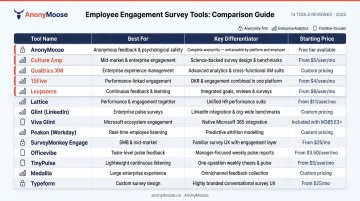
Each tool below was evaluated across five dimensions: anonymity architecture, action loop design, analytics depth, delivery channels, and ease of use.
| Tool | Best For | Key Differentiator | Starting Price |
|---|---|---|---|
| AnonyMoose | Psychological safety & anonymous comms | True anonymity by design; neither platform nor employer can identify authors | Custom SaaS pricing |
| Culture Amp | Mid-market, desk-based teams | 1.6B+ survey response dataset; deep benchmarking | Custom (annual billing) |
| Qualtrics XM | Enterprise with analytics teams | Predictive attrition modeling; Text iQ analysis | Custom |
| CultureMonkey | Multilingual & frontline workforces | 150+ languages; WhatsApp, QR code, kiosk delivery | Custom |
| 15Five | Mid-market performance + engagement | Predictive Impact Score; OKR integration | $4/user/month |
| WorkTango | Mid-to-large teams wanting surveys + recognition | AI Sentiment Cloud; combined surveys and rewards | Custom (~$8K/year) |
| Workleap (Officevibe) | Small teams, fast setup | Automated pulse surveys; quick time-to-value | $5/user/month |
| Lattice | Engagement tied to performance reviews | Mercer benchmark integration; AI driver analysis | $4,000/year minimum |
| Leapsome | Mid-to-large global organizations | AI Manager Assistant; 18 UI languages, 45 content languages | $7/user/month (annual) |
| Perceptyx | Large enterprise listening programs | Conversational and Narrative Analysis AI agents | Custom |
| Workday Peakon | Workday HCM-native enterprises | Native Workday integration; no CSV uploads | Custom |
| SurveyMonkey | One-off surveys, no continuous program | 400+ templates; transparent per-seat pricing | $30/user/month |
| TINYpulse | Small teams building first feedback habit | Lightweight weekly pulse; Slack/Teams delivery | Custom |
| Quantum Workplace | Teams prioritizing validated engagement models | e9 engagement model; Retention Radar for turnover prediction | Custom |
AnonyMoose
AnonyMoose is a SaaS-based anonymous employee communication platform built specifically for psychological safety. The core differentiator is architectural: neither AnonyMoose nor the employer can identify the author of any submission. The platform contains no technical mechanism that links a submission to an individual user.
The platform organizes communication across four listening paths:
- Openlines — Always-on anonymous two-way channels that replace one-on-ones, town halls, and open-door policies. Employees initiate conversations from any device; managers respond through a web dashboard. Identity is never revealed, even across multi-turn exchanges.
- Polls & Surveys — Anonymous pulse surveys with push notification delivery and advanced targeting. Organizations can segment by up to five custom criteria (for example, women managers in a specific city with 10+ years of tenure).
- Broadcast — One-to-many instant messaging for leadership announcements, safety alerts, and compliance updates — delivered via push notification to every employee's phone, including deskless workers.
- Hotlines — Structured anonymous channels for reporting sexual harassment, discrimination, bias, compliance violations, and microaggressions. Employees report from their own device, in real time, without needing to find privacy or speak to a stranger.
AnonyMoose consolidates emails, websites, forms, phone lines, walk-ins, and traditional whistleblower hotlines into a single mobile-first platform. Research cited by the platform shows 90% participation rates in anonymous surveys versus 30% in non-anonymous ones — a gap the platform's architecture is specifically designed to close. Research from buildempire.co.uk confirms the honest-feedback dimension: anonymous surveys produce 58% more honest feedback, and the SHRM Study (2020) found that 82% of employees are more likely to share critical feedback when anonymity is preserved alongside a 47% increase in actionable management-related feedback — together the strongest quantitative case for why anonymity architecture is a survey program requirement, not a feature.
Best for: Organizations where psychological safety, DEI, and incident reporting are primary concerns. Particularly well-suited for deskless workforces — delivery, hospitality, construction, manufacturing — where email-only tools systematically miss people. Pricing is SaaS-based with zero hardware investment; contact AnonyMoose for a custom quote.
Culture Amp
Culture Amp is a mid-market engagement platform built on a dataset of over 1.6 billion survey responses, giving it deep benchmarking capability across engagement, DEI, manager effectiveness, and exit surveys. Its science-backed question frameworks make it straightforward for HR teams without dedicated researchers to deploy credible surveys quickly.
Its primary differentiator is industry benchmarking depth — the ability to see how your scores compare across peer organizations at scale. Best suited for desk-based mid-market organizations (roughly 500+ employees) that want peer comparison data alongside internal trend tracking. Pricing is billed annually with custom Enterprise pricing.
Qualtrics XM
Qualtrics XM is an enterprise-grade experience management platform with predictive attrition modeling, Text iQ open-text analysis, and org-hierarchy drill-downs. Its AI-powered tools identify attrition risk by combining experience feedback with behavioral data, making it a meaningful option for organizations prioritizing proactive retention.
That depth comes with a trade-off. Teams without a dedicated people analytics function will underuse it, and some Text iQ features require separate add-on agreements. Best suited for 1,000+ employee organizations with analyst support. Pricing is custom.
CultureMonkey
CultureMonkey is an enterprise lifecycle listening platform supporting over 150 languages, with verified integrations including Workday, SuccessFactors, Darwinbox, and Oracle. Multi-channel delivery covers WhatsApp, SMS, Slack, Microsoft Teams, QR codes, and kiosk mode, making it one of the few platforms purpose-built for frontline and deskless workforce reach.
For organizations with multilingual or geographically dispersed workforces where email-only delivery leaves large segments unmeasured, CultureMonkey is a strong fit (G2: 4.7/5). Pricing is custom.
15Five
15Five combines weekly check-ins, pulse surveys, OKR tracking, and performance reviews in a single mid-market platform. Its Predictive Impact Score identifies which engagement drivers most correlate with outcomes for each specific team — so managers see where to act, not just where scores are low.
The manager enablement focus is the key differentiator. If your goal is connecting engagement data to performance outcomes without managing two separate platforms, 15Five is a strong fit. The Engage plan starts at $4/user/month.
WorkTango
WorkTango is one of the few platforms combining engagement surveys and employee recognition in a single product. Its AI-powered Sentiment Cloud analyzes open-text responses to surface themes, and the platform supports unlimited customizable surveys with anonymous two-way conversation features.
Best for mid-market to large companies (500+ employees) looking to eliminate a separate recognition tool. Pricing is approximately $8,000/year with an annual commitment required (contact WorkTango directly to confirm current rates).
Workleap (Officevibe)
Workleap (formerly Officevibe, rebranded when GSoft renamed the company in 2023) is a feedback-first platform built around automated pulse surveys, anonymous feedback, peer recognition via Good Vibes, and manager coaching prompts. Its main advantage is speed: setup is fast and the survey cadence runs automatically from day one.
The trade-off is flexibility. The standardized question bank cannot be replaced with custom driver frameworks, which limits it for organizations wanting to measure proprietary engagement models. Best for teams under 500 employees starting their first structured listening program. Starts at $5/user/month.
Lattice
Lattice connects engagement surveys to performance reviews, OKR tracking, and career development in one platform. Its Mercer benchmark integration brings compensation data into the engagement context, and AI-powered driver analysis helps identify what's actually moving scores.
The $4,000 annual minimum is the entry point, with Engagement starting at $4/seat/month and Performance or OKRs at $8/seat/month each. Best when engagement is part of a broader performance program, not a standalone initiative.
Leapsome
Leapsome covers engagement surveys, performance management, learning, and goal tracking. Its AI-powered Manager Assistant and multilingual support (18 UI languages with content translation available in 45 languages) make it a strong fit for mid-to-large global organizations.
Psychologist-backed survey templates reduce the design burden on HR teams, and the modular architecture lets organizations add capabilities over time. Starts at $7/user/month with annual billing (verified via G2).
Perceptyx
Perceptyx is built for large enterprises running simultaneous listening programs — annual surveys, lifecycle surveys, 360-degree feedback, and crowdsourcing — in parallel. Its AI-powered Conversational Listening Agent and Narrative Analysis Agent ingest open-text feedback, detect themes, sentiment, and intent, and surface patterns that manual analysis would miss.
Per Perceptyx, partners include over 30% of the Fortune 100. Implementation requires professional services support. Best for 1,000+ employee organizations with dedicated HR operations resources. Pricing is custom.
Workday Peakon
Workday Peakon's primary advantage is native integration with Workday HCM — employee records, reporting lines, and tenure data sync through a prebuilt SCIM 2.0 API connection with no CSV uploads required. For organizations already running Workday, that eliminates a significant data management overhead.
Outside the Workday ecosystem, Peakon has no meaningful competitive advantage over purpose-built alternatives. Best for 1,000+ Workday-native enterprises. Pricing is custom.
SurveyMonkey
SurveyMonkey is a general-purpose survey tool with 400+ easy-to-edit templates, transparent per-seat pricing, and AI-assisted survey creation. It is not a dedicated engagement platform — it lacks driver analysis, action planning loops, and HRIS integration — but it's the most accessible option for teams running a one-off survey without committing to a continuous listening program.
Team Advantage starts at $30/user/month (minimum 3 users, billed annually).
TINYpulse
TINYpulse (now under WebMD Health Services, having returned to its original brand name in 2024) sends one anonymous pulse question on a recurring basis — weekly or every few weeks — via email, Slack, or Microsoft Teams. Results surface in manager dashboards the following period.
Fast setup and built-in peer recognition are its strengths. The pre-built question bank cannot be replaced with custom drivers. Best for small teams establishing their first structured feedback habit. Pricing is custom.
Quantum Workplace
Quantum Workplace uses its scientifically validated e9 engagement model to measure engagement depth through peer benchmarking against its network of organizations. Its Retention Radar feature uses AI and predictive analytics to analyze employee feedback and identify flight risk — flagging employee groups most likely to leave before they do.
Manager dashboards can feel overwhelming for non-analyst users, so it's best paired with some internal analytics capacity. Best for 500+ employee teams that want a validated measurement model alongside turnover prediction. Pricing is custom.
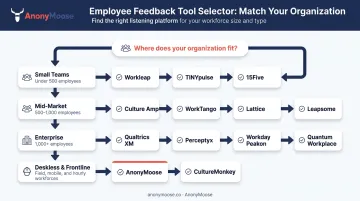
How to Choose the Best Employee Engagement Survey Tool
The most common mistake buyers make is selecting a tool based on feature count or brand recognition. Neither predicts whether the program will actually change behavior. Four factors do.
Anonymity and Psychological Safety
Not all anonymity claims are equal. Surface-level anonymity means the vendor promises not to share names. Genuine anonymity architecture means there's no technical mechanism to trace a submission back to an individual.
Look for:
- Threshold-based suppression — results hidden when team size falls below five respondents (Quantum Workplace recommends a minimum of five; CultureMonkey's guidance cites five to ten as typical)
- No admin override of anonymity settings
- Role-based access controls limiting who sees what
If employees don't trust the anonymity, they'll participate — but they won't be honest. And high participation with dishonest responses is worse than low participation, because it creates a false signal. Organizations that build genuine listening programs also report meaningful retention gains: Vantage Circle research found a 30% decrease in employee turnover among organizations that adopted anonymous feedback tools — a downstream benefit of collecting data honest enough to actually surface the issues driving attrition.
Analytics and Action Planning
Match analytics depth to your internal capacity. Gallup research shows that 70% of the variance in team engagement is attributable to management — which means manager-level dashboards with recommended actions matter more than executive-level predictive models for most organizations.
Without a dedicated people analytics team, prioritize platforms that surface clear, actionable insights at the manager level over predictive modeling. Gallup also notes that asking for feedback without visibly acting on it can actively decrease engagement and increase turnover — making action planning support a requirement, not a nice-to-have.
The practical test: ask vendors to show you the manager dashboard before the executive dashboard.
Delivery Channels and Workforce Reach
Email-only survey delivery consistently excludes frontline and deskless workers. McKinsey estimates 70% of the US workforce is in frontline roles (roughly 112 million people). If more than 20% of your workforce lacks a corporate email address or regular computer access, you need a platform that supports:
- WhatsApp or SMS delivery
- QR code surveys for shared spaces
- Kiosk mode for manufacturing and retail environments
- Push notification delivery via mobile app
Before signing a contract, ask vendors directly: which delivery channels are included in your tier, and which require an upgrade?
Pricing, Scalability, and Integration
Realistic pricing benchmarks:
- Entry-level: $2–5/user/month (15Five Engage, Workleap Officevibe)
- Mid-tier: $6–11/user/month (Leapsome, Lattice)
- Enterprise: Custom quotes, often with annual minimums of $4,000–8,000+
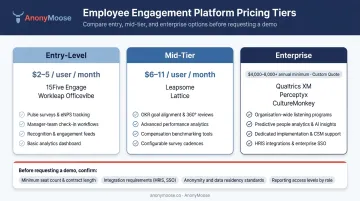
Before requesting a demo, confirm: HRIS integration compatibility, minimum user commitments, and whether benchmarking and driver analysis are included in the base tier or locked behind upgrades.
Conclusion
The right employee engagement survey tool matches your workforce composition, your team's analytics capacity, and your genuine commitment to closing the feedback loop. Brand name and feature count are poor proxies for fit.
Survey data is only as honest as the anonymity protections behind it. When employees don't trust that their responses are confidential, participation rates can look healthy while the actual insights are shallow — a misleading picture that leads to the wrong decisions. Organizations serious about psychological safety need tools that engineer anonymity, not just claim it.
That's where AnonyMoose stands apart. Its architecture is built so that neither the platform nor the employer can identify individual authors — meaning honest feedback becomes structurally guaranteed, not just hoped for. For organizations where psychological safety is a real priority, not a talking point, it's worth a closer look.
Explore AnonyMoose's anonymous communication platform to see how it can complement or replace your current feedback tools.
Frequently Asked Questions
What is an employee engagement survey tool?
It's a software platform designed to collect and analyze employee feedback through structured surveys, pulse checks, and eNPS. Unlike generic survey builders, these tools are built specifically for workforce sentiment and cultural health monitoring, with driver analysis and HRIS integration included by design.
What features should I look for in an employee engagement survey tool?
The must-haves are: true anonymity architecture, manager-level action dashboards, multi-channel delivery, driver analysis, and HRIS integration. Priority varies by workforce size — a 200-person desk-based team has different needs than a 5,000-person distributed organization.
What is the difference between pulse surveys and full engagement surveys?
Full engagement surveys are comprehensive, run annually or biannually, and measure all major engagement drivers. Pulse surveys are short and frequent (monthly or quarterly) designed to track sentiment between full cycles. The most effective programs use both: full surveys set the baseline, pulses track movement.
How much do employee engagement survey tools cost?
Entry-level tools run $2–5/user/month; mid-tier platforms average $6–11/user/month. Enterprise options typically require custom quotes with annual minimums starting around $4,000–8,000/year. Several tools in this list — Perceptyx, CultureMonkey, and Quantum Workplace among them — don't publish public pricing.
How often should employee engagement surveys be sent?
Most organizations run one full engagement survey annually, supplemented by quarterly or monthly pulse surveys. Frequency matters less than follow-through : employees sustain participation when they see visible evidence that previous feedback led to real changes.
How can organizations increase employee survey response rates?
Three factors drive participation consistently: genuine anonymity that employees actually trust (not just claim to trust), delivery through channels employees already use rather than just email, and visible proof that previous survey feedback changed something concrete. That third factor — closing the loop with a "here's what changed" message — is what most programs drop after the first survey cycle.