Introduction
Only 20% of employees worldwide were engaged at work in 2025 — and that disengagement carried a price tag of roughly $10 trillion, or 9% of global GDP, according to Gallup's State of the Global Workplace report. For most organizations, that cost is hiding in plain sight.
Free snacks and flexible hours aren't enough anymore. Organizations need structured systems that make every employee feel genuinely heard, not just periodically surveyed. The global employee collaboration and engagement software market was valued at USD 1.71 billion in 2024 and is projected to grow at a 15.5% CAGR through 2030 — a signal that HR leaders are backing this shift with serious budget.
The best employee experience management (EXM) platforms go well beyond annual surveys. They unify anonymous communication, continuous listening, performance management, and AI analytics into systems that connect employee input directly to measurable action.
This guide covers 10 leading platforms evaluated on feedback depth, anonymity safeguards, AI capabilities, deployment ease, and real business impact.
Key Takeaways
- Low engagement costs the global economy $10 trillion annually; employee experience management software is built to address that gap
- The best 2026 platforms combine anonymous feedback channels, continuous listening, performance tools, and AI-driven analytics
- AnonyMoose stands out for architecture-enforced anonymity that neither the employer nor the platform can trace back to individual employees
- Key selection criteria: genuine anonymity, mobile accessibility, HRIS integration, and real-time reporting
- No single platform fits every organization; match the tool to your workforce size, culture, and primary EX challenge
What Is Employee Experience Management Software?
Employee experience management software spans the full employee lifecycle — from onboarding feedback to exit interviews — giving organizations the tools to measure, understand, and systematically improve how employees perceive and interact with their workplace.
The distinction from standalone engagement or HRIS tools matters. True EXM platforms don't just run surveys — they unify feedback collection, communication, and analytics into one connected system that drives action, not just reporting.
Gartner defines Voice of the Employee solutions as tools that "collect and analyze employee opinions, perceptions, and feelings." The best platforms go further — translating those signals into action workflows, manager dashboards, and trackable improvements in engagement over time.
The 10 platforms reviewed below cover distinct strengths within this category:
- Anonymous communication and psychological safety
- Continuous listening and pulse surveys
- AI-powered analytics and sentiment analysis
- Workflow integration and manager-level action tools
Top 10 Employee Experience Management Software of 2026
These platforms were selected based on feature depth, anonymity and psychological safety support, scalability, ease of use, integration capability, and verified user trust signals including G2, Gartner, and Forrester recognition.
1. AnonyMoose
AnonyMoose is a SaaS platform built for anonymous employee communication and active listening. It's designed for organizations that prioritize DEI, engagement, and ethical workplace culture — where employees need a genuinely safe channel to speak up.
The platform's anonymity is enforced at the architecture level. Neither the employer nor AnonyMoose can identify individual submission authors — this is a structural constraint built into the data layer, not a policy commitment. Submissions are linked to an organization but never to an individual within it.
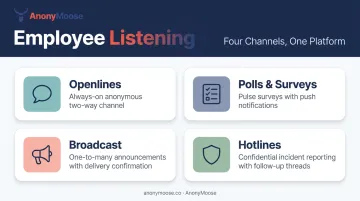
The platform consolidates fragmented communication channels — emails, town halls, walk-ins, open-door policies, one-on-ones — into four structured listening paths accessible via a mobile-first app from anywhere in the world:
- Openlines — always-on, anonymous two-way channels between employees and specific leaders or departments
- Polls & Surveys — targeted employee pulsing with push notification delivery and anonymous responses
- Broadcast — instant one-to-many messaging for critical announcements, with file attachments and confirmed delivery
- Hotlines — confidential incident reporting for harassment, discrimination, ethics violations, and microaggression, with persistent threads for follow-up
The APA found a 30% improvement in employee satisfaction within one year for organizations that implement genuine anonymous feedback programs, as well as a 30% increase in employees' sense of belonging — outcomes that reflect what becomes possible when employees trust that speaking up carries no personal risk. Founder Sonali Siddha, a 20-year IT industry veteran, built AnonyMoose to address a specific gap: the absence of a safe, structured internal channel drives employees toward external platforms like Glassdoor and Blind.
| Key Features | Anonymous Openlines, Polls & Surveys, Broadcast messaging, confidential Hotlines, mobile-first SaaS, architecture-enforced encrypted identities |
| Best For | Organizations prioritizing psychological safety, DEI, anonymous incident reporting, and preventing external whistleblowing |
| Pricing | SaaS-based, low upfront cost, zero hardware investment; contact AnonyMoose at info@anonymoose.co for current plan details |
2. Culture Amp
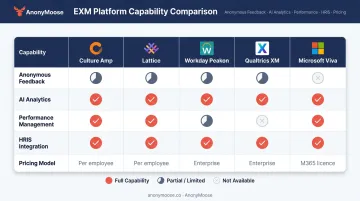
Culture Amp is trusted by 6,000+ organizations globally as a people and culture platform for measuring and improving engagement, performance, and retention through science-backed surveys and AI analytics.
Key differentiators:
- 40+ research-backed survey templates across engagement, onboarding, and exit use cases
- AI-driven comment analysis with automated sentiment categorization
- Real-time benchmarking against industry peers
- Social impact discounts: 35% for registered nonprofits, 10% for certified B Corps
| Key Features | Engagement surveys, performance reviews, AI comment analysis, industry benchmarking, manager coaching tools |
| Best For | Mid-to-large organizations seeking robust survey capabilities paired with performance management |
| Pricing | Quote-based (Standard, Enterprise tiers); annual billing required — verify current pricing before committing |
3. Lattice
Lattice combines performance management, OKR tracking, engagement surveys, and an AI-powered HR agent into one platform, reducing tool sprawl for HR teams managing multiple point solutions.
Key differentiators:
- Individual development plans linked directly to 1:1s and performance reviews
- Engagement benchmarking powered by Mercer data (1.5M+ employee survey responses annually)
- Competency matrices for career path transparency
- AI Agent for HR that answers policy questions and gives career-growth recommendations
| Key Features | OKR/goal tracking, pulse surveys, performance reviews, career pathing, AI HR agent, eNPS tracking |
| Best For | Companies building structured performance management and employee development systems |
| Pricing | Performance: $8/seat/month; Engagement: +$4; Grow: +$4; Compensation: +$6; $4,000/year minimum |
4. Workday Peakon
Workday Peakon is an enterprise-grade continuous listening platform with native integration into the Workday HR ecosystem, built for organizations that need feedback at scale across complex, distributed workforces.
Key differentiators:
- Real-time pulse surveys with science-backed question libraries
- Generative AI comment summaries (announced December 2024) drawing on employee feedback from 160+ countries
- True Benchmark comparisons for consistent cross-organization measurement
- Native Workday integration for seamless data flow into HR case management and personalized employee journeys
| Key Features | Continuous pulse surveys, AI comment analysis, True Benchmarks, Workday ecosystem integration, manager dashboards |
| Best For | Large enterprises already using Workday or requiring continuous anonymous listening at scale |
| Pricing | Enterprise pricing; contact Workday sales for custom quotes |
5. Microsoft Viva
Microsoft Viva embeds an employee experience layer directly into Microsoft Teams, unifying communications, knowledge sharing, engagement surveys, and learning inside the tools employees already use daily.
Key differentiators:
- Dashboard cards surfacing HR and IT service requests inside Teams
- Viva Glint for organization-wide engagement measurement and manager action planning
- LinkedIn Learning integration connecting survey findings to targeted development content
- Highly accessible pricing for existing Microsoft 365 customers
| Key Features | Teams-embedded workflows, Viva Glint engagement surveys, knowledge Q&A, manager recommendations |
| Best For | Organizations already invested in Microsoft 365 seeking an integrated EX layer without new infrastructure |
| Pricing | From $2/user/month (Communications & Communities) to $12/user/month (Viva Suite); annual commitment |
6. Leapsome
Leapsome is an all-in-one people enablement platform covering HRIS capabilities, performance reviews, engagement surveys, learning paths, and compensation management — supporting up to 47 language configurations for global teams.
Key differentiators:
- Leapy AI Copilot embedded across all modules for goal improvement, meeting summaries, and wiki Q&A
- Dedicated customer success management with structured business reviews
- 14-day free trial across all modules
- Startup discounts up to 25% for three years (for qualifying organizations under 50 employees)
| Key Features | AI Copilot, performance cycles, engagement surveys, learning paths, HRIS integrations, compensation management |
| Best For | Mid-sized to global companies seeking an all-in-one HR enablement platform with multilingual support |
| Pricing | Modular custom quotes; one-year minimum; 14-day free trial — verify current pricing before committing |
7. Qualtrics XM
Qualtrics XM is an enterprise-level experience management platform — named a Leader in the Forrester Wave: Employee Experience Management Platforms, Q2 2025 — known for advanced survey architecture and predictive workforce analytics.
Key differentiators:
- Predictive flight-risk analytics that model attrition scenarios and identify at-risk employees
- Lifecycle surveys spanning candidate experience through onboarding, development, and exit
- Highly configurable dashboards for HR and business leaders
- Deep integrations with major HRIS and communication platforms
| Key Features | Predictive analytics, lifecycle surveys, configurable dashboards, sentiment analysis, cross-system integrations |
| Best For | Large enterprises requiring deep analytics, sophisticated survey design, and workforce-wide listening programs |
| Pricing | Enterprise pricing; contact Qualtrics sales for custom quotes |
8. Betterworks
Betterworks replaces annual review cycles with continuous performance enablement — always-on goal tracking, structured feedback conversations, and AI-assisted goal-setting aligned to live business priorities.
Key differentiators:
- AI Goal Assist uses job title and past goals to suggest aligned OKRs via a private, self-hosted LLM
- Real-time 1:1 conversations tied directly to live goal data
- External feedback collection from clients and partners without requiring a Betterworks account
- Performance calibration tools with audit trails to reduce evaluation bias
| Key Features | OKR management, AI Goal Assist, 360-degree feedback, pulse surveys, performance calibration, external feedback |
| Best For | Mid-to-enterprise organizations replacing annual reviews with continuous performance conversations |
| Pricing | Pricing upon request; contact Betterworks sales |
9. 15Five
15Five is a performance and engagement platform built around manager effectiveness, with weekly check-ins, AI coaching tools, and HR outcomes dashboards that connect employee sentiment to measurable business results.
Key differentiators:
- Kona AI Meeting Assistant for real-time 1:1 summaries, agendas, and action items
- Kona Coach for in-the-moment manager guidance during conversations
- HR Outcomes Dashboard with engagement heat maps and manager effectiveness indicators connecting HRIS, review, and compensation data
- Automated 360-degree review cycles
| Key Features | Weekly check-ins, Kona AI coaching, HR outcomes dashboard, 360-degree feedback, engagement heat maps |
| Best For | Organizations focused on building manager effectiveness and connecting engagement data to performance outcomes |
| Pricing | From $4/user/month (Engage) to $16/user/month (Total Platform); add-ons available |
10. Simpplr
Simpplr is a Gartner Magic Quadrant Leader for Intranet Packaged Solutions (2025, third consecutive year) that combines an AI-powered intranet with enterprise search, employee surveys, recognition tools, and an AI virtual assistant — functioning as a unified Digital HQ for the workforce.
Key differentiators:
- 200+ out-of-the-box integrations with business applications (vendor-stated)
- AI-adaptive personalized content delivery
- Built-in pulse and eNPS surveys with peer recognition and rewards
- Comms AI for internal communicators and a vendor-stated 90%+ employee adoption rate
| Key Features | AI intranet, enterprise search, AI virtual assistant, employee surveys, recognition & rewards, analytics |
| Best For | Mid-to-large organizations seeking a unified digital workplace hub with strong communication and engagement |
| Pricing | Quote-based; contact Simpplr sales |
Must-Have Features in Employee Experience Management Software
Before shortlisting platforms, evaluate these five functional categories:
- Continuous feedback and pulse surveys — ongoing listening that captures shifts as they happen
- Anonymous communication channels — genuine anonymity for psychological safety and DEI-sensitive topics
- Performance and goal management — OKR tracking, 1:1s, and development planning
- AI-powered analytics — sentiment analysis, comment summarization, and predictive insights
- HRIS and payroll integrations — direct API connections that eliminate manual re-entry
The Anonymity Question Most Buyers Miss
Not all "anonymous" tools are created equal. Qualtrics distinguishes anonymous surveys (responses fully separated from personally identifiable information) from confidential surveys (responses linked to personal data but kept private). That difference matters enormously for trust.
The IBE's 2024 Ethics at Work Survey found that 34% of employees who witnessed misconduct didn't report it because they feared losing their job, and 46% who did raise concerns faced retaliation or personal disadvantage. When employees don't believe a channel is genuinely anonymous, they won't use it honestly — or at all.
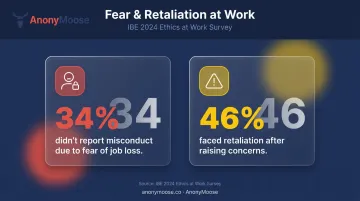
Those numbers point to a specific architectural question buyers should ask: can an administrator toggle anonymity off, or is it enforced at the system level? Platforms like AnonyMoose build anonymity into the architecture itself, meaning there is no technical mechanism to link a submission to an individual — regardless of admin settings. The SHRM Study (2020) shows what's at stake: 82% of employees are more likely to share critical feedback when anonymity is preserved, and organizations see a 34% boost in productivity through improved employee morale and trust — returns that are only achievable when employees believe the system they are using is genuinely safe.
Baseline Expectations for 2026
Mobile-first accessibility, zero-hardware deployment, and SaaS pricing are now table stakes. Beyond those basics, prioritize platforms that offer:
- Real-time manager dashboards — act on feedback without waiting for a quarterly HR report
- Mobile-first access — employees engage where they already are, not through a desktop portal
- Zero-hardware deployment — cloud-based setup with no IT infrastructure investment
That last point matters more than it sounds: real-time visibility is what separates active listening from passive data collection.
How We Chose the Best Employee Experience Management Software
Evaluation Framework
Each platform was assessed on:
- Feature breadth — feedback, performance, analytics, communication, and integration coverage
- Anonymity and psychological safety — weight given to platforms with technical (not just policy-level) protections
- AI and analytics depth — sentiment analysis, predictive modeling, generative summaries
- Verified trust signals — Gartner, Forrester, and G2 recognition where applicable
- Pricing transparency — ability for buyers to assess cost without a sales call
- Fit across organization sizes — SMB to enterprise suitability
The Most Common Buying Mistake
Too many EXM purchases are driven by brand recognition alone. A platform can have a well-known logo and still fail on the dimension that matters most: whether employees trust it enough to use it honestly.
Before committing, ask three questions:
- Are responses technically anonymous, or just promised to be confidential?
- Does the platform close the feedback loop — or just collect data into a dashboard no one acts on?
- What's the actual adoption rate among employees, not just administrators?
If employees won't engage with it, even the most feature-rich platform won't move the needle on culture or retention.
Conclusion
The right employee experience management software depends on what problem you're actually trying to solve. Organizations rebuilding psychological safety after trust breakdowns need something different from companies trying to streamline manager conversations or unify a dispersed workforce.
Before you commit to any platform:
- Verify anonymity guarantees technically, not just in marketing copy — ask whether submissions can be traced at the platform or employer level
- Pilot with one team or department before a full rollout to validate adoption and fit
- Confirm integration requirements so the platform works with your existing HRIS without heavy custom development
- Define success metrics upfront — participation rates, eNPS, retention changes, and time-to-resolution all tell you whether the investment is working
If your checklist keeps circling back to anonymity gaps and integration friction, that's a specific problem worth solving directly. AnonyMoose adds a genuine anonymous communication layer to any existing EX stack — no hardware, no complex deployment, and no long implementation timelines. Visit anonymoose.co or reach out at info@anonymoose.co to learn more.
Frequently Asked Questions
What is the difference between employee experience management software and employee engagement software?
Employee engagement software measures how employees feel — primarily through surveys and sentiment tracking. EXM software spans the full employee lifecycle, combining feedback, communication, performance management, and service delivery into a system designed to actively improve how work gets done, not just measure it.
What features should I prioritize when choosing employee experience management software in 2026?
Focus on continuous feedback tools, genuine anonymity safeguards, AI-powered analytics, HRIS integration, mobile accessibility, and real-time dashboards. Pay close attention to anonymity claims — confirm whether the platform technically prevents identity exposure or simply promises confidentiality through policy.
How does anonymous feedback improve employee experience outcomes?
When employees trust their identity is protected, they surface real concerns — DEI issues, safety problems, workplace misconduct — that would otherwise go unreported. The IBE's 2024 survey found 46% of employees who raised concerns experienced retaliation, making architectural anonymity a meaningful risk control, not a cosmetic feature.
Can small businesses benefit from employee experience management platforms?
Many platforms, including AnonyMoose, offer SaaS-based models with no hardware investment that work well for lean teams. Smaller organizations often see faster ROI because cultural improvements become visible and actionable more quickly at lower headcount.
What metrics should I track to measure the success of my employee experience platform?
Track eNPS and employee satisfaction scores, feedback participation rates, retention and turnover changes, time-to-resolution for reported issues, and platform adoption rates. High adoption is the clearest early signal that employees trust and value the tool.
How do I ensure employees actually trust and use our employee experience platform?
Trust comes from three things: guaranteed anonymity, visible action on feedback, and communicating results back to employees. Platforms where leadership responds openly to anonymous input — rather than letting it disappear into a dashboard — consistently see higher adoption and better outcomes.