in California](https://file-host.link/website/anonymoose-075woh/assets/blog-images/90cdb196-3f04-475c-a72e-76902b02930a/1781176705581974_eba2e617dc9e4d89831b7786b9b2d11f/360.webp)
That hesitation is understandable. But it carries a cost. Evidence fades, deadlines pass, and employers build stronger defenses while employees wait.
This guide walks through exactly how to report workplace discrimination in California: what qualifies, how to document it, which agencies handle complaints, the deadlines you cannot miss, and the mistakes that sink otherwise valid cases.
Key Takeaways
- Workplace discrimination based on protected characteristics is illegal under California's Fair Employment and Housing Act (FEHA) and federal law
- Report internally first (in writing), then escalate to the Civil Rights Department (CRD) or EEOC if unresolved
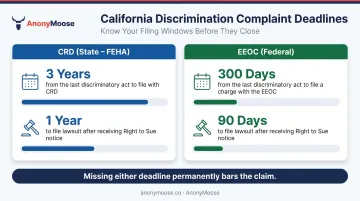
- CRD deadline: 3 years from the last discriminatory act; EEOC deadline in California: 300 days
- Documentation is everything: emails, incident logs, performance records, and witness names all matter
- Administrative exhaustion — completing the agency complaint process — is required before you can file a lawsuit
What Counts as Workplace Discrimination in California?
Discrimination occurs when an employer takes an adverse employment action against someone because of a protected characteristic. California's FEHA sets a broader standard than federal law, covering more characteristics and applying to smaller employers.
Protected Characteristics Under FEHA
California Government Code §12940 protects employees from discrimination based on:
- Race, color, national origin, and ancestry
- Sex, gender, gender identity, and gender expression
- Sexual orientation
- Physical or mental disability and medical condition
- Age (40 and older)
- Religion
- Marital status
- Reproductive health decision-making
- Genetic information
- Veteran or military status
FEHA applies to employers with 5 or more employees for general discrimination claims — a lower threshold than most federal laws, which require 15 or more employees.
What "Adverse Employment Action" Actually Means
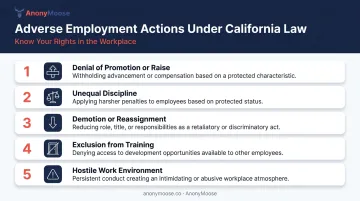
Knowing who is protected is only part of the picture — the conduct itself also has to meet a legal threshold. Adverse action isn't limited to being fired. Under California case law (see Yanowitz v. L'Oréal), any action that negatively affects the terms, conditions, or privileges of employment qualifies. In practice, that includes:
- Denial of a promotion or raise you were qualified for
- Unequal discipline compared to employees outside your protected class
- Demotion or reassignment to a less desirable role
- Exclusion from training programs or advancement opportunities
- A hostile work environment that makes the job intolerable
The distinction that matters: unfair treatment is not automatically illegal. The adverse action must be directly connected to a protected characteristic.
A demanding manager creates a tough work environment. A manager who disciplines, demotes, or excludes employees based on their race, age, or disability is breaking the law — and that difference is what makes a claim viable under FEHA.
How to Report Workplace Discrimination in California
Step 1: Report the Discrimination Internally
The first step is reporting the discrimination in writing to HR — or to a supervisor if HR is unavailable (and not to the supervisor if they're the one responsible).
This matters for several reasons:
- It creates an official, timestamped record
- It puts the employer on legal notice
- It triggers an obligation to investigate
- Under the federal Faragher-Ellerth doctrine, an employer's failure to act after receiving a complaint can remove their affirmative defense in harassment cases
Many employees skip this step out of fear of retaliation. That fear is legitimate — but California law prohibits retaliation against employees who report discrimination in good faith, and retaliation itself constitutes a separate legal violation.
For employees who want to report without revealing their identity, AnonyMoose lets internal complaints be submitted through a secure mobile app without exposing the reporter. The Hotlines feature is built for sensitive incident reporting (discrimination, harassment, ethics violations) and routes submissions to designated HR, legal, or leadership contacts.
Anonymity is enforced at the platform level, not just by policy, so the employee's identity cannot be traced. Submissions support attachments (screenshots, documents, images), and the conversation thread stays open for follow-up — creating a documented, timestamped record that proves internal reporting occurred before any external filing.
What to include in your internal report:
- A factual description of what happened
- Specific dates, times, and locations
- Names of everyone involved, including witnesses
- Any supporting documents or communications
Step 2: Document Every Incident Thoroughly
Strong documentation is what separates a credible claim from one that gets dismissed. Start collecting evidence immediately — before memory fades and before documents disappear.
Types of evidence to gather:
- Emails, texts, and other written communications showing discriminatory statements or decisions
- Performance reviews — especially if they changed after you raised concerns
- Pay stubs or compensation records showing disparities
- Promotion or termination letters
- Calendar entries or meeting notes
- A written incident log with specific dates, times, locations, and witnesses
There are two categories of evidence that matter in discrimination cases:
- Direct evidence: An explicit discriminatory statement or decision in writing — rare, but powerful
- Circumstantial evidence: Patterns of unequal treatment, replacement by someone outside your protected class, or performance reviews that contradict previous evaluations — very common, and frequently enough to prevail
One critical rule: keep copies somewhere private. Store documentation in personal email or at home, not exclusively on company devices or systems you may lose access to.
Step 3: File a Formal Complaint with the CRD or EEOC
If internal reporting doesn't resolve the issue — or if the situation makes internal reporting impractical — the next step is filing a formal complaint with an administrative agency. This step, called administrative exhaustion, is required before you can file a lawsuit.
Two agencies handle these complaints:
| Agency | Governs | Employer Threshold |
|---|---|---|
| California Civil Rights Department (CRD) | FEHA (state claims) | 5+ employees |
| EEOC | Title VII, ADA, ADEA (federal claims) | 15–20+ employees |
Because of a worksharing agreement between the CRD and EEOC, a charge filed with one agency is automatically shared with the other. You typically don't need to file twice.
How to file with the CRD:
- Online via the CCRS portal
- Email: contact.center@calcivilrights.ca.gov
- Mail: 651 Bannon Street, Suite 200, Sacramento, CA 95811
- Phone: 800-884-1684
How to file with the EEOC:
- Online via the EEOC Public Portal
- Phone: 1-800-669-4000
- In person at an EEOC field office
Your charge must include your name and contact information, the employer's information, a description of what happened, the relevant dates, the basis for discrimination (race, age, disability, etc.), and your signature.
Employees can also request an immediate Right to Sue letter from either agency, bypassing the investigation entirely. Only do this with an employment attorney — if the CRD issues an immediate Right to Sue, it will not investigate the complaint even if you later decide not to file suit.
Step 4: Navigate the Agency Investigation and Right-to-Sue Process
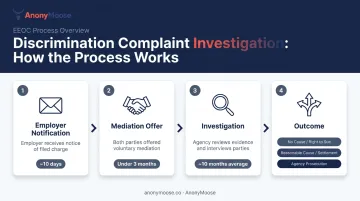
After your charge is filed, the agency reviews it for jurisdiction. The process then follows a predictable sequence:
- Notification: The agency notifies the employer within approximately 10 days
- Mediation offer: Both agencies may offer mediation — typically resolved in under 3 months — before a full investigation begins
- Investigation: If mediation fails or isn't used, the agency investigates — reviewing documents, interviewing witnesses, and potentially visiting the workplace. EEOC investigations take approximately 10 months on average
- Outcome: One of three results follows:
- No reasonable cause found → Right to Sue notice issued
- Reasonable cause found → Agency attempts settlement or conciliation
- Agency decides to prosecute directly (rare)
A Right to Sue letter is required before you can file a civil lawsuit. Under FEHA, once the CRD issues that letter, you have one year to file suit. Under federal law, you have 90 days from receipt of the EEOC's notice.
Get legal counsel before that clock starts running.
Filing Deadlines You Cannot Afford to Miss
Missing a deadline doesn't weaken your case — it eliminates it entirely.
| Complaint Type | Deadline | Agency |
|---|---|---|
| FEHA/state discrimination | 3 years from last discriminatory act | CRD |
| Federal discrimination (general) | 300 days from last act (California) | EEOC |
| Federal age discrimination | 300 days if state law covers same basis | EEOC |
| Lawsuit after CRD Right to Sue | 1 year from notice date | Civil court |
| Lawsuit after EEOC Right to Sue | 90 days from receipt | Federal court |
Three deadline rules that often catch people off guard:
- The EEOC's standard 180-day deadline extends to 300 days in California because the CRD enforces state law covering the same protected bases
- The clock starts from the most recent discriminatory act — not when discrimination first began
- For ongoing harassment, the EEOC will consider all incidents if at least one falls within the filing period
Even with California's 3-year CRD window, waiting is a mistake. Witnesses become unavailable, emails get deleted, and employers start building their documentation while yours sits unwritten. The sooner you file, the stronger your evidence stays.
Common Mistakes That Weaken Discrimination Cases
Skipping Internal Reporting
Not reporting to HR before filing externally can hurt your credibility with agencies and courts. Investigators often look for evidence that the employer had a genuine opportunity to correct the behavior — and didn't. Employees who bypass internal channels entirely may face stronger employer defenses, particularly in federal harassment cases under the Faragher-Ellerth doctrine.
Missing Deadlines or Filing with the Wrong Agency
The EEOC's 300-day window closes fast. Employees who miss it lose access to federal remedies under Title VII, the ADA, and the ADEA. Filing inaccurate information can also create problems during litigation if defense attorneys find inconsistencies between the charge and later testimony. Consult an employment attorney before filing — not after the charge is already submitted.
Incomplete or Inconsistent Information in the Charge
That inaccuracy risk extends to how you write the charge itself. Your initial charge is a legal document, and defense attorneys will compare every statement in it to your later testimony. Contradictions — even minor ones — can undermine your credibility.
When drafting your charge:
- Write only what you can support with evidence
- Be specific about dates, actions, and statements
- Avoid speculation or language you can't back up
Frequently Asked Questions
What does discrimination look like in the workplace?
Discrimination can appear as unequal pay, denied promotions, biased performance reviews, exclusion from training, or termination — all tied to a protected characteristic like race, gender, age, or disability. Patterns of unequal treatment over time carry the same legal weight as a single explicit incident.
How does HR handle discrimination complaints?
HR is required to investigate internal discrimination complaints, but HR represents the employer's interests. Document your complaint in writing, keep personal copies of everything submitted, and don't assume a positive internal outcome means the issue is resolved.
How does the agency investigate discrimination complaints?
After a charge is filed, the CRD or EEOC gathers documents, interviews the parties and witnesses, and reviews employment records. Outcomes can include a finding of reasonable cause, a settlement attempt, or a Right to Sue letter if no cause is found.
What is the deadline to file a workplace discrimination complaint in California?
Employees have 3 years to file with the CRD and 300 days to file with the EEOC from the date of the last discriminatory act. Missing either deadline can permanently bar the claim with that agency.
Can I be fired for reporting workplace discrimination in California?
No — California law prohibits retaliation against employees who report discrimination in good faith. Termination or other adverse treatment in response to a complaint is itself an illegal act and can form the basis of a separate retaliation claim.
Should I report to HR or file with the CRD first?
Report to HR first, in writing, to put the employer on notice and create a documented record. If the issue isn't resolved internally, file with the CRD or EEOC. Agencies give more weight to claims that show the employer was notified and failed to act.