Many employees lose their right to sue simply because they didn't know how this process works, or they waited too long while hoping an internal complaint would resolve things.
This guide is for employees who have experienced unfair treatment based on a protected characteristic and want to understand the formal charge-filing process: what to document, how to file, deadlines you cannot afford to miss, and what happens after you submit.
Key Takeaways
- A charge of discrimination is a signed statement filed with the EEOC (or a state agency) — not an internal HR complaint
- Most employees must file within 180 days of the discriminatory act; extended to 300 days in states with their own anti-discrimination laws
- You can file online, by phone, in person, by mail, or through a state Fair Employment Practices Agency (FEPA — a state-level counterpart to the EEOC)
- After filing, the EEOC may investigate, offer mediation, or issue a Right to Sue notice
- No attorney is required to file, but missing the deadline permanently forfeits your right to sue
What Counts as Workplace Discrimination?
Federal law makes it illegal to treat an employee or job applicant unfavorably because of a protected characteristic. Not every unfair act qualifies — the treatment must be tied to one of the following covered classes.
Protected Characteristics Under Federal Law
The EEOC enforces protection based on:
- Race and color
- Religion
- Sex — including pregnancy, gender identity, and sexual orientation (the Supreme Court confirmed in Bostock v. Clayton County that firing someone for being gay or transgender violates Title VII)
- National origin
- Age (40 or older)
- Disability
- Genetic information
Many states extend these protections further. If you're unsure whether your state provides broader coverage, check with your state's Fair Employment Practices Agency.
What Types of Employment Decisions Are Covered?
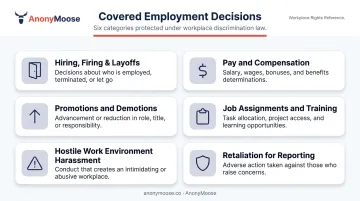
Actionable discrimination can occur in:
- Hiring, firing, and layoffs
- Pay and compensation
- Promotions and demotions
- Job assignments and training
- Harassment that creates a hostile work environment
- Retaliation for reporting discrimination
A manager being rude or playing favorites is frustrating — but it's not automatically illegal. The unfavorable treatment must connect to a protected characteristic and affect a tangible aspect of your employment.
Before You File: What to Document and Prepare
Strong documentation doesn't guarantee success, but weak documentation consistently hurts cases. Before you submit anything to the EEOC, build your record.
What to Compile
- A written timeline — dates, locations, and factual descriptions of each discriminatory incident
- Names of witnesses who observed the conduct or can speak to the pattern
- Copies of relevant communications — emails, texts, performance reviews, written warnings
- HR records showing disparate treatment compared to similarly situated employees outside your protected class
Keep everything factual. Vague or emotional descriptions are harder to act on; specific dates and concrete details are far more useful.
The Internal Reporting Step
Many organizations require or strongly encourage employees to report discrimination through HR before external escalation. Filing internally can create a documented company record and sometimes leads to resolution.
Critical caveat: An internal HR complaint does not pause the EEOC's filing clock. The Supreme Court has confirmed that using a grievance procedure does not toll the deadline for filing a charge. If your deadline is approaching, file with the EEOC regardless of where your internal complaint stands.
Anonymous Reporting Tools as a Pre-Filing Step
If internal HR reporting feels risky, some organizations offer anonymous employee reporting platforms as an intermediate step. AnonyMoose, for example, allows employees to submit incident reports to HR without revealing their identity. Its Hotlines feature is built specifically for discrimination, harassment, bias, and compliance violations.
Each report is managed as a structured case through the employer's dashboard — with case status tracking, urgency levels, activity history, and file attachments. Because anonymity is built into the platform's architecture (neither AnonyMoose nor the employer can identify who submitted a report), employees can document incidents without fear of immediate retaliation.
This creates a timestamped internal record before you escalate to a formal charge. That said, anonymous internal reporting does not substitute for filing with the EEOC if you plan to pursue legal remedies.
How to File a Workplace Discrimination Charge
A charge of discrimination is a signed formal statement asserting that your employer violated anti-discrimination law and requesting EEOC action. Filing one is required before you can bring a private lawsuit under Title VII, the ADA, the ADEA, and similar statutes.
One exception: the Equal Pay Act lets you go directly to court without filing an EEOC charge first.
What Information You'll Need
Before you start, gather:
- Your name, address, and contact information
- The employer's name, address, and approximate number of employees
- A factual description of the discriminatory acts and dates they occurred
- The protected characteristic you believe motivated the treatment
Most private employers must have at least 15 employees to be covered by EEOC laws (20 employees for age discrimination cases).
Step 1: Start with the EEOC Public Portal
Go to publicportal.eeoc.gov and submit an inquiry. This starts the process and lets you schedule a telephone, video, or in-person intake interview at one of the EEOC's 53 field offices nationwide.
Step 2: Complete the Intake Interview
An EEOC staff member reviews your submitted information to determine whether the claim falls within the agency's jurisdiction. They'll confirm whether your employer meets the employee threshold and whether your claim involves a covered protected characteristic.
Step 3: File the Formal Charge
After the intake, you submit the formal charge: a signed, verified legal document. An unsigned charge will be rejected until corrected, so confirm your submission is complete before closing out of the portal.
Step 4: Alternative Filing Methods
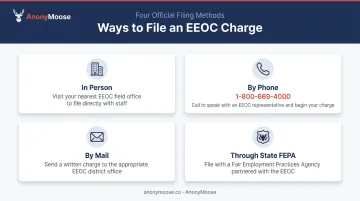
If the online portal isn't your preference, you have four other options:
- In person at a local EEOC office — walk-ins are seen on a first-come basis
- By phone at 1-800-669-4000 to start the process verbally
- By mail with a signed letter containing all required details sent to your nearest EEOC office
- Through a state or local FEPA — if the FEPA has jurisdiction under federal law, it automatically dual-files your charge with the EEOC — no separate filing required
Key Filing Deadlines and Time Limits
Deadlines here are not flexible. Missing them typically means losing your right to file a charge and your right to sue.
The 180-Day General Deadline
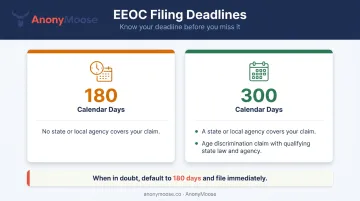
Under EEOC rules, you must file a charge within 180 calendar days from the date of the last discriminatory act. This clock runs regardless of any internal HR complaint or ongoing company investigation.
The 300-Day Extended Deadline
The deadline extends to 300 calendar days if a state or local agency enforces a law prohibiting employment discrimination on the same basis as your federal claim. For age discrimination specifically, the 300-day extension applies only when both a state law and a state agency enforcing that law are in place.
Not sure which applies to you? Default to 180 days and file immediately — the earlier you act, the more options you preserve.
Here's a quick reference:
| Scenario | Deadline |
|---|---|
| No state/local agency covers your claim | 180 calendar days |
| State or local agency covers the same claim | 300 calendar days |
| Age discrimination with qualifying state law + agency | 300 calendar days |
If a Deadline Is Imminent
Don't wait. Call 1-866-408-8075 to request an immediate intake interview, or go in person to your nearest EEOC office that day.
What Happens After You File a Charge
Once your charge is submitted, the EEOC follows a structured process that can span months. Here's what to expect at each stage.
Confirmation
The EEOC sends a charge number and written confirmation. Keep copies of everything and track your charge status through the EEOC Public Portal.
Investigation
The EEOC reviews the charge, may request documents from both parties, and interviews relevant witnesses. According to the EEOC, investigations take approximately 10 months on average.
In FY2024, the agency received 88,531 new charges (a 9% increase over the prior year), so timelines can stretch depending on caseload and complexity.
Mediation
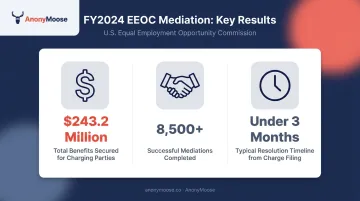
Before or during investigation, the EEOC may offer voluntary mediation. If both parties agree, a neutral mediator helps reach a settlement. Mediation moves faster than a full investigation, often resolving in under 3 months. Key outcomes from FY2024 mediation:
- $243.2 million in total benefits secured for charging parties
- More than 8,500 successful mediations completed
- A signed settlement agreement fully resolves the charge
Conciliation
If the EEOC finds reasonable cause that discrimination occurred but mediation doesn't produce a resolution, the agency attempts conciliation. If that also fails, the EEOC may file a lawsuit on your behalf or issue a Right to Sue notice.
Right to Sue Notice
This notice is issued when the EEOC dismisses the charge, chooses not to litigate, or concludes conciliation without resolution. It gives you 90 days to file a private lawsuit in federal court.
That 90-day window is a hard deadline. Missing it forfeits all court remedies, regardless of the strength of your underlying claim.
Common Mistakes to Avoid When Filing
Waiting Too Long
The most consequential mistake employees make is delaying while hoping an internal process resolves things. The 180-day clock runs from the date of the discriminatory act, not the date you gave up on HR. By the time many employees decide to escalate externally, their deadline has already passed.
Documentation and Procedural Errors
- Submitting an unverified charge — a charge must be signed and verified; this defect must be corrected before processing can proceed
- Failing to confirm submission in the EEOC online portal
- Writing vague, emotional descriptions instead of factual accounts with specific dates and details
- Filing with the wrong agency for your employer size or claim type
Confusing an HR Complaint with a Formal Charge
These are entirely separate processes. An internal HR complaint goes to your employer's own HR department — it creates no obligation on the EEOC, does not start an investigation, and does not stop your filing deadline from running.
If your internal complaint resolves the issue, the EEOC process can be withdrawn. But internal resolution does not automatically satisfy EEOC requirements or preserve your right to sue.
Frequently Asked Questions
What qualifies as discrimination at work?
Workplace discrimination occurs when an employer treats an employee or applicant unfavorably because of a legally protected characteristic — such as race, gender, age, disability, or religion. The treatment must affect a tangible aspect of employment, such as hiring, firing, pay, or promotion, not just general rudeness or unfair management.
How long do I have to file a discrimination charge with the EEOC?
The general deadline is 180 calendar days from the date of the discriminatory act. This extends to 300 calendar days if a state or local agency also enforces anti-discrimination law covering the same basis. File as early as possible. Do not wait for the deadline.
Do I need a lawyer to file an EEOC charge?
No attorney is required to file a charge; employees can file on their own through the EEOC Public Portal, by phone, or in person. Legal guidance may be valuable in complex situations, particularly when deadlines are close or the facts are disputed.
What happens after I file a charge with the EEOC?
You receive written confirmation and a charge number. The EEOC investigates (averaging about 10 months), may offer mediation, and will either file a lawsuit or issue a Right to Sue notice if cause is found.
Can my employer retaliate against me for filing a discrimination charge?
Retaliation for filing an EEOC charge is illegal under Title VII, the ADA, and the ADEA. If your employer takes adverse action after you file, you can submit a separate retaliation charge or amend your existing one.
What is the difference between an internal HR complaint and a formal charge of discrimination?
An internal HR complaint goes to your employer's HR department and carries no legal weight with the EEOC: it does not pause deadlines or create government obligations. A formal charge is a legal filing with a government agency, required before any federal discrimination lawsuit can proceed.