The result: leadership operates with incomplete information while problems compound below the surface.
Anonymous reporting directly addresses this gap. But the decision to allow it comes with real questions — about credibility, investigations, legal exposure, and trust. This article walks through what anonymous reporting actually is, why it matters, the legitimate concerns, and how to build a system that works.
Key Takeaways
- Anonymous reporting lets employees raise concerns without revealing their identity — even to the organization
- Fear of retaliation is the #1 reason employees stay silent; anonymity directly removes that barrier
- Anonymous reports are substantiated at rates comparable to named reports — they reflect real issues, not noise
- Challenges like investigation depth and follow-up rates are manageable with the right platform and process in place
- Organizations that enable anonymous reporting build stronger speak-up cultures and catch problems before they escalate externally
Anonymous vs. Confidential Reporting: Understanding the Difference
These two terms get used interchangeably, but they work differently — and the distinction matters when designing a reporting framework.
| Type | Who Knows the Reporter's Identity | How It Works |
|---|---|---|
| Anonymous | No one — not HR, not the investigator | Organization receives the concern with no way to connect it to a specific person |
| Confidential | At least one party (typically HR or a designated investigator) | Identity is known but protected and shared only on a need-to-know basis |
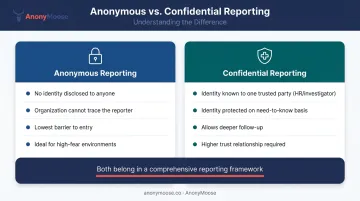
Both belong in a well-designed reporting framework. Anonymous channels lower the barrier to entry. Confidential channels allow for deeper follow-up when a reporter is willing to engage more directly.
Is Anonymous Reporting Legal in the US?
Yes — and in some sectors, it's required. SOX Section 301 (15 U.S.C. 78j-1) mandates that audit committees of publicly listed companies establish procedures for the confidential, anonymous submission of employee concerns about accounting or auditing matters. The SEC's whistleblower program similarly permits anonymous submissions.
Organizations operating across borders should verify local requirements. The EU's Whistleblower Protection Directive (2019/1937) requires confidentiality of reporter identity but leaves Member States discretion on whether anonymous reports must be accepted and followed up. Legal counsel should confirm obligations by jurisdiction.
That legal foundation addresses the "what" — but organizations also need to understand the "how." A common operational concern is worth addressing directly.
The "No Follow-Up" Myth
A common misconception is that anonymous reports can't be investigated. Platforms like AnonyMoose support two-way anonymous communication: an investigator can ask follow-up questions through a persistent conversation thread, and the employee can respond — with neither party's identity ever disclosed. Anonymity is built into the architecture, not just promised in a policy document.
Why You Should Allow Anonymous Reporting at Work
Retaliation Fear Is Real — and Rational
46% of employees who witnessed misconduct didn't report it due to fear of retaliation. That's not timidity — it's risk calculation. When employees weigh the cost of speaking up against the likelihood of career consequences, silence often wins.
Anonymous reporting changes that equation. By decoupling the concern from the identity of the person raising it, organizations create a path for information to surface without forcing employees to put their careers on the line. The APA (2021) found that employees are 70% more likely to disclose unethical practices in anonymous settings compared to traditional feedback methods — a figure that underscores why structural anonymity, not just policy promises, is what actually shifts reporting behavior.
The downstream cost of that silence is significant. Workplace misconduct costs US businesses approximately $20.2 billion annually, and problems that go unreported internally tend to escalate — to Glassdoor, social media, or regulators.
Anonymous Reports Are Substantiated — Not Frivolous
A persistent objection is that anonymous reports lack credibility. The data doesn't support this. According to NAVEX's 2024 Whistleblowing & Incident Management Benchmark Report, anonymous reports accounted for a median 56% of all reports received in 2023, with a substantiation rate of 33%. That's not noise — that's a meaningful signal about real workplace problems.
Named reports do substantiate at a higher rate (50%), but dismissing anonymous reports as unreliable means ignoring more than half of incoming concerns.
Anonymous Reporting Is a DEI Imperative
Employees from marginalized groups face compounded barriers to reporting. UCLA Williams Institute research highlights the scale of this problem:
- 46% of LGBTQ employees are not open about their identity to their supervisor
- Transgender and nonbinary employees experience discrimination and harassment at more than twice the rate of cisgender LGBQ colleagues
- For employees who already feel exposed or disbelieved, a named channel isn't a neutral option — it carries real risk
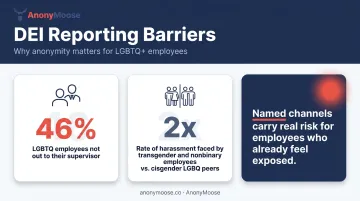
Anonymous reporting gives these employees a protected path to be heard. The American Psychological Association found that organizations with effective anonymous feedback programs see a 30% increase in employees' sense of belonging at work — a metric that matters especially for employees from marginalized groups who carry a disproportionate cost when speaking through named channels.
Julie Ann Crommett, a DEI advisor to AnonyMoose with over a decade leading systemic change across media and tech, frames it plainly: organizations that don't offer anonymous channels are effectively making it harder for the employees who most need protection to speak up.
Anonymity Is Often Temporary
That protection doesn't have to be permanent. Many employees who report anonymously eventually identify themselves — once they see the organization handles concerns fairly and without repercussion. NAVEX's benchmark research notes this pattern directly: anonymity is frequently a starting point, not a fixed state.
This matters because it reframes the trade-off. Anonymous reporting doesn't permanently sacrifice investigation depth. It lowers the barrier enough for employees to come forward at all — and once trust is established, the conversation can deepen.
The Concerns About Anonymous Reporting — And How to Address Them
Concern 1: It Will Invite False or Malicious Reports
This is the most commonly cited objection. The evidence doesn't support it.
EQS's 2025 Whistleblowing Report, based on a study of 2,200 companies, found that abusive reports intended to damage a reputation accounted for just 10% of submissions — and that figure held steady regardless of whether anonymous reporting was offered. Allowing anonymity did not increase bad-faith submissions.
Bad actors determined to file false reports will do so with or without anonymity. What anonymity does is remove the single biggest barrier stopping legitimate reporters from speaking up at all.
Concern 2: Investigations Can't Proceed Without Knowing the Reporter
Anonymous reports can be harder to investigate when initial details are thin — but two design choices largely solve this:
- Structured intake forms that prompt reporters to include dates, locations, names of parties involved, and whether others witnessed the incident
- Two-way anonymous communication that lets investigators ask targeted follow-up questions without the reporter ever identifying themselves
Tools designed specifically for this (like AnonyMoose) maintain persistent anonymous conversation threads, so investigations can progress even when the reporter's identity is never disclosed.
Concern 3: Follow-Up Rates on Anonymous Reports Are Low
NAVEX benchmark data shows the median follow-up rate on anonymous reports was 27% in 2023 — down from 36% in 2019. That's a real problem, but it's a process and culture failure, not an inherent flaw of anonymous reporting.
Organizations improve follow-up rates by:
- Training intake teams on how to respond to anonymous submissions
- Establishing clear response protocols with defined timelines
- Communicating back to the organization — even in general terms — that reports lead to action
When employees see that anonymous reports are taken seriously, they're more likely to provide fuller information and to follow up themselves.
Concern 4: Employees Won't Believe the System Is Actually Anonymous
This skepticism is warranted — many employees assume "anonymous" means the company simply promises not to look, which is very different from technical anonymity.
The solution is choosing a platform where anonymity is built into the architecture — one that doesn't collect IP addresses, require login credentials tied to employee identity, or store linkable metadata. AnonyMoose's approach is direct on this point: neither AnonyMoose nor the employer can identify the author of any submission. Anonymity is enforced by design, not by policy or goodwill.
What Can Employees Report Anonymously?
A well-designed system should handle both formal compliance violations and everyday workplace concerns. Common reportable categories include:
- Harassment and discrimination — sexual harassment, identity-based harassment, hostile work environment
- Safety violations — physical hazards, unsafe practices, OSHA-relevant concerns
- Ethical misconduct — fraud, bribery, conflicts of interest, financial irregularities
- Retaliation — against employees who have previously reported concerns
- Policy violations — expense abuse, data misuse, code of conduct breaches
- Cultural concerns — microaggressions, exclusionary behavior, management misconduct
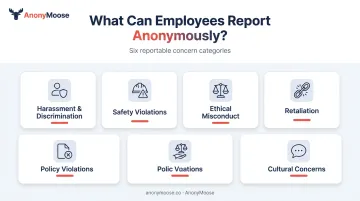
The scope should be defined in writing and communicated clearly. Employees shouldn't have to guess whether their concern qualifies.
Whistleblowing vs. Everyday Feedback
Formal whistleblowing covers regulatory violations and serious ethical breaches. Broader employee feedback covers culture, workload, management practices, and DEI concerns. Both categories deserve a dedicated channel — not just the serious ones.
AnonyMoose separates these use cases by design: Hotlines handle serious incident reporting (harassment, discrimination, ethics violations), while Openlines support ongoing two-way feedback on everyday workplace concerns. Not every problem is a compliance issue, but every problem still needs somewhere to go.
Legal Protections Are Real
Understanding these protections helps employees feel confident enough to actually report. Employees cannot be lawfully fired for making a good-faith anonymous complaint. Federal anti-retaliation protections exist under Sarbanes-Oxley (18 U.S.C. 1514A), Dodd-Frank, and OSHA's Whistleblower Protection Program — which covers provisions across more than 20 federal laws. Many states add further protections on top of that.
Include these legal protections in your reporting policy. Employees who understand their rights are significantly more likely to use the system.
How to Set Up an Anonymous Reporting System That Actually Works
Step 1: Define Scope and Policy First
Before selecting any tool, decide:
- What types of issues the system will handle
- Who receives, reviews, and investigates reports
- What the response protocol and timeline look like
- What protections apply to reporters
A written policy is the foundation of a credible program. Without one, a reporting channel is just a suggestion box.
Step 2: Offer Multiple Channels
Not every employee is comfortable with the same medium, and not every employee has the same access. Effective programs offer range:
- Mobile app (critical for distributed, shift-based, or remote workforces)
- Web-based submission form
- Dedicated hotline option
- Physical options in environments where digital access is limited
AnonyMoose unifies these paths within a single mobile-first platform — Openlines for ongoing feedback, Hotlines for incident reporting, and Polls & Surveys for organizational pulse checks — accessible from any device, anywhere, with identity protected at the architecture level.
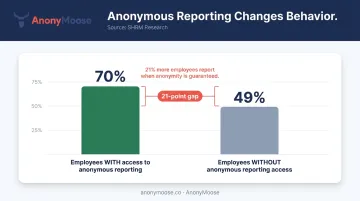
SHRM data points to a clear outcome: among employees who knew their employer offered anonymous reporting, 70% reported an incident they witnessed or experienced, compared to 49% among employees without that option. Channel availability changes behavior. The SHRM Study (2020) adds further dimension: 82% of employees are more likely to share critical feedback when anonymity is preserved, and organizations with genuine anonymous channels see a 47% increase in actionable feedback related to management practices — precisely the concerns that named reporting systems consistently fail to surface. This pattern extends to ethical concerns specifically: according to the American Psychological Association (APA, 2021), employees are 70% more likely to disclose unethical practices in anonymous settings compared to traditional feedback methods — a finding that directly links anonymous reporting infrastructure to the organization's ability to surface misconduct before it escalates.
Step 3: Choose a Platform Where Anonymity Is Structural
Purpose-built platforms should:
- Not collect IP addresses or device identifiers that could re-identify reporters
- Not require login credentials linked to employee identity
- Prevent both the employer and the platform provider from tracing submissions to individuals
- Support two-way anonymous communication for investigative follow-up
Bolt-on anonymity (a promise not to look) is not the same as architectural anonymity (no mechanism to look). That distinction matters when evaluating platforms.
Step 4: Train Before You Launch
The platform is only as strong as the people managing it. Effective pre-launch training covers:
- How to handle incoming anonymous reports without unintentionally triggering retaliation claims
- How to conduct fair, thorough investigations when reporter identity is unknown
- How to communicate outcomes back to the organization — even in general terms — to demonstrate that reports lead to action
Step 5: Promote It and Measure It
A reporting channel no one knows about won't get used. Communicate availability through onboarding, all-hands meetings, manager conversations, and internal communications. Treat it as infrastructure, not a compliance checkbox.
Then measure: reporting volume, follow-up rates, resolution timelines, and patterns in reported concerns. The Insights Dashboard in AnonyMoose surfaces AI-analyzed patterns across reported incidents, helping leadership understand what employees are collectively experiencing without exposing individual identities. That visibility is what separates reactive case management from proactive culture improvement.
Frequently Asked Questions
What can employees report anonymously in the workplace?
Employees can report harassment, discrimination, safety violations, fraud, bribery, ethical misconduct, retaliation, and cultural concerns such as microaggressions or exclusionary behavior. Organizations should define and publish the specific scope of their reporting program in a written policy.
Can you be fired for filing an anonymous complaint at work?
Retaliation for good-faith reports is illegal under federal laws including Sarbanes-Oxley, Dodd-Frank, and OSHA's Whistleblower Protection Program. Anonymity adds a practical layer of protection by making it harder to connect a report to a specific person — employees with concerns should review their organization's policy and consult an employment attorney.
Are anonymous workplace reports really anonymous?
Purpose-built platforms guarantee anonymity at the architecture level (no IP addresses, no login links, no traceable metadata). Basic tools like email or standard phone lines don't offer this protection. Organizations should choose platforms that protect reporter identity by design, not just by policy.
What is an anonymous reporting system for employees?
It's a structured, technology-enabled channel for employees to submit workplace concerns (misconduct, policy violations, safety issues) without revealing their identity. Well-designed systems let investigators ask follow-up questions through the same anonymous channel, enabling thorough investigation without disclosure.
What is the difference between anonymous and confidential reporting?
In anonymous reporting, no one — including the organization — knows who submitted the report. In confidential reporting, the reporter's identity is known to at least one person (such as an HR representative) but is kept protected and shared only on a need-to-know basis. Both have a place in a comprehensive reporting framework.