The numbers are stark. According to ECI's 2023 Global Business Ethics Survey, 65% of global employees observed misconduct — yet 46% of those who did report it experienced retaliation. That's a punishing signal to send across an organization.
Anonymous reporting changes that calculus entirely. When employees can flag concerns without putting their name on them, the barriers that keep misconduct hidden start to fall. This guide covers what anonymous reporting actually is, why it matters for HR and the business, how to handle complaints correctly, and how to build a system employees will genuinely use.
Organizations without a credible anonymous channel don't just miss complaints. They accumulate legal exposure, invite regulatory scrutiny, and create a culture where problems compound quietly until they surface publicly — on Glassdoor, in litigation, or in the press.
Key Takeaways
- Anonymous reporting lets employees flag misconduct, harassment, fraud, and safety concerns without revealing their identity — dramatically increasing the likelihood issues get surfaced.
- Among employees who knew their employer offered anonymous reporting, 70% reported an incident they experienced or observed (SHRM).
- HR must log every complaint, investigate proportionately, and never attempt to identify the reporter.
- Without a trusted internal channel, employees vent externally — 83% of job seekers research employer reviews before applying (Glassdoor).
- The right platform, like AnonyMoose, handles anonymous two-way follow-up and case management in one mobile-accessible tool.
What Is Anonymous Reporting in the Workplace?
Anonymous reporting gives employees a way to submit workplace concerns — ranging from harassment and fraud to safety violations and ethics breaches — without disclosing their name, contact details, or any information that could identify them.
Anonymous vs. Confidential Reporting
Many HR teams use these terms interchangeably, but the distinction matters enormously to employees deciding whether to speak up.
| Type | What It Means |
|---|---|
| Anonymous | Identity is completely unknown — even to HR and the platform provider |
| Confidential | Identity is known to a limited circle but legally protected from wider disclosure |
Employees weighing whether to report a manager, a peer, or a senior leader often need true anonymity — not just a promise that their name won't travel far. The difference between these two options can determine whether a report gets filed at all.
How Reporting Channels Have Evolved
Reporting mechanisms have moved well beyond the traditional phone hotline. Modern systems include:
- Secure web portals — web-based intake now rivals hotlines in usage volume
- Mobile apps — accessible anytime, from any device, without requiring a work computer
- Two-way encrypted messaging — allows investigators to ask follow-up questions without ever learning who the reporter is
A report that can't be followed up is often a report that can't be resolved. AnonyMoose's Hotlines feature keeps conversation threads open and persistent, so HR can request additional details, share policy documents, or connect employees with support resources — without the reporter ever losing their anonymity.
Why Anonymous Reporting Matters: Benefits for HR and the Business
The Reporting Gap — and How Anonymity Closes It
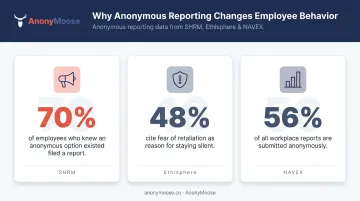
SHRM research found that among employees who knew their employer offered a way to report anonymously, 70% reported an incident they experienced or observed. Awareness of an anonymous channel doesn't just inform employees — it activates them. The SHRM Study (2020) provides additional depth: 82% of employees are more likely to share critical feedback when their anonymity is preserved, and organizations with structural anonymity see a 47% increase in actionable feedback related to management practices — precisely the category that HR most needs to understand and that employees are least likely to surface through traditional named channels.
The primary reason employees stay silent is fear of retaliation. According to Ethisphere, 48% of non-reporters cite retaliation fear as their reason for staying quiet, with another 49% believing nothing would be done anyway. Anonymity directly neutralizes the first barrier. A credible, well-promoted system addresses the second.
NAVEX's 2024 Whistleblowing Benchmark found that anonymous reports account for a median 56% of all workplace reports. That's not a niche channel — it's the dominant one.
Early Detection Before Small Problems Become Large Ones
Anonymous reporting functions as an organizational early warning system. A safety near-miss reported anonymously today prevents the injury claim next month. A harassment complaint filed before a pattern solidifies is far easier to address than a class action two years later.
The legal risk of inaction is concrete. The EEOC received 88,531 new discrimination charges in FY2024 and secured more than $665 million in relief for victims. Retaliation charges alone accounted for approximately 47.8% of all FY2024 filings — the single largest category.
DEI and Equity
Employees from underrepresented groups, or those in power-imbalanced situations like reporting a direct manager, often have no other viable voice. Traditional channels: walking into HR, requesting a meeting with a senior leader — carry social and professional risk that falls disproportionately on people with less institutional power.
Anonymity levels the playing field. When employees know their identity is technically protected (not just promised in a policy), the barrier to speaking up drops — and participation tends to broaden across the workforce as a result.
Redirecting External Venting
Without a trusted internal outlet, employees take their frustrations elsewhere. Research from Glassdoor shows:
- 83% of job seekers research company reviews and ratings before deciding where to apply
- 75% consider employer brand before submitting an application
A single Glassdoor thread about unreported harassment or a Reddit post about workplace safety can reach thousands of candidates. A strong internal reporting system redirects those disclosures inward, protecting both culture and employer brand before the damage is done.
Types of Anonymous Complaints HR Teams Encounter
Not all anonymous complaints are created equal. How HR should respond depends heavily on what the complaint actually contains.
Fact-Based Anonymous Complaints
These include specific names, dates, locations, and potential witnesses. The reporter's identity is unknown, but the complaint itself is highly actionable. Even without knowing who filed it, HR has enough to open a formal investigation.
These are the most straightforward to handle. The anonymity of the reporter rarely impedes the process when the facts are specific.
Anonymous Complaints with Partial Facts
These complaints identify some elements — involved parties, approximate timing, a general description of the conduct — but lack the full picture. HR can still work with partial information.
Two-way anonymous follow-up tools are especially useful here. Rather than closing a complaint because details are incomplete, investigators can send questions back through the platform and wait for the reporter to add context, all without breaking anonymity.
Vague Anonymous Complaints Without Actionable Facts
The most challenging category: general, unattributed concerns with no specific details. These might read as "there's a morale problem in the sales team" or "something inappropriate is happening on the night shift."
HR still has a duty to respond, even when details are thin. At minimum:
- Log the complaint with a timestamp and the verbatim report text
- Conduct a preliminary assessment to determine whether any corroborating signals exist
- Consult legal counsel before deciding whether a full investigation or documentation alone is sufficient
Ignoring vague complaints entirely creates legal exposure. Courts have found organizations liable because they were "on notice" — even when the original report lacked specifics.
How HR Should Handle Anonymous Complaints: A Step-by-Step Guide
Step 1: Log and Acknowledge Every Complaint
Every anonymous complaint, regardless of how vague, must be recorded. Do not filter complaints before logging — the act of documentation is itself legally protective. Once a complaint exists in the system, the organization legally has notice of the underlying concern.
Platforms like AnonyMoose Web handle this automatically: every incoming report becomes a structured case with a timestamp, urgency field, status tracking, and internal notes.
Step 2: Assess Severity and Scope
Before deciding how to respond, evaluate:
- How many employees may be affected
- Whether the conduct alleged violates law, policy, or both
- Whether harm is ongoing or contained
- Whether a manager, executive, or HR staff member is implicated (which affects who should lead the investigation)
This assessment determines the speed and scale of response — not all complaints warrant the same level of urgency.
Step 3: Gather Information Before Acting
Use the details available: named parties, locations, timeframes, departments. If the platform supports two-way anonymous communication — as AnonyMoose's Hotlines do — send follow-up questions through the thread before drawing conclusions or launching interviews.
Skipping this step — common when teams feel pressure to act fast — produces investigations that either over-reach or miss the core issue entirely.
Step 4: Conduct a Proportionate Investigation
The investigation should match the complaint:
| Complaint Type | Appropriate Response |
|---|---|
| Fact-based or partially fact-based | Formal investigation: witness interviews, document review, possible external investigator |
| Vague or unverifiable | Lighter-touch review, documentation, and monitoring |
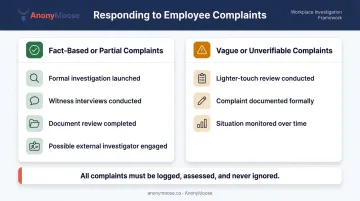
Whatever the scope, maintain impartiality. Document every step. Never reveal the complaint's existence to the subject in a way that might expose the reporter.
Step 5: Close the Loop With the Reporter
Where the platform allows, update the reporter on the outcome — even a general summary. This step is frequently skipped, which is a mistake.
When employees see that reports lead to action, they trust the system. When they hear nothing, they assume nothing happened — and they stop reporting. Acknowledging outcomes through the anonymous channel signals that speaking up matters — and that signal travels further than any HR memo.
Common Mistakes HR Must Avoid When Handling Anonymous Reports
Even well-intentioned HR teams can undermine anonymous reporting systems through predictable, avoidable errors. Here are three that come up most often.
Mistake 1 — Reacting before thinking. When a complaint involves a senior leader or a serious allegation, the instinct is to act fast. But fast and careless aren't the same thing. Emotional or rushed responses compromise investigation integrity. Follow the defined process — calmly, even when it's uncomfortable.
Mistake 2 — Playing detective on the source. In practice, this impulse is hard to suppress. Someone receives a complaint and immediately wonders, "Who could have written this?" Any attempt to narrow down the reporter — by writing style, by who was present in the meeting described, by process of elimination — introduces bias and risks unfair treatment. It can also expose the organization to retaliation claims, even if the reporter is never actually identified.
Mistake 3 — Allowing confidentiality to leak. Information about an anonymous complaint should be shared only with those directly involved in the investigation. One casual mention to the wrong person — even with good intentions — can destroy employee trust in the entire system. Rebuilding that trust takes far longer than protecting it.
How to Build and Sustain an Anonymous Reporting System
Choose the Right Reporting Channels
Effective systems offer multiple access points because employees are not uniform in how they prefer to report. NAVEX's 2025 benchmark confirmed that web-based reporting has surpassed phone hotlines for the first time — and web intake carries the highest anonymity rate at 71% median anonymous submissions.
Mobile-first platforms extend that reach further. Employees who don't sit at a desk — warehouse staff, delivery drivers, hospitality workers — need a channel that works from their phone, not from a work computer in a shared office.
AnonyMoose addresses this with a unified SaaS solution that consolidates four pathways into a single mobile-accessible platform:
- Hotlines — anonymous incident reporting for harassment, discrimination, safety violations, and ethics breaches
- Openlines — two-way anonymous dialogue between employees and specific leaders or HR
- Polls & Surveys — targeted employee pulsing on any topic
- Broadcast — leadership communication pushed directly to employee devices
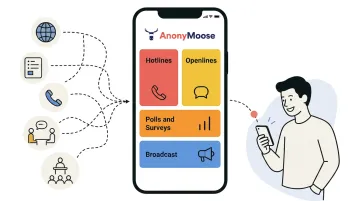
Anonymity is built into the architecture itself. Neither AnonyMoose nor the employer can identify the author of any submission — the system simply doesn't store that linkage.
Establish Clear Policies and Train Your Workforce
A platform without policy context is a tool employees don't know how to use. The written policy should cover:
- What types of concerns can be reported
- How reports are handled and by whom
- Anti-retaliation protections and what they mean in practice
- What employees can expect in terms of follow-up timelines
Training matters too. SHRM's data showed 70% reporting rates among employees who knew an anonymous option existed. Awareness drives use — employees who don't know the system exists can't use it. Organizations that make anonymous reporting a sustained cultural norm also see concrete retention benefits: Vantage Circle research found a 30% decrease in employee turnover among organizations that deployed anonymous feedback tools, as the issues that previously went unspoken finally surface early enough to address.
Promote the System Consistently
Policy and training get employees ready — but sustained promotion keeps the system alive. The most common reason anonymous reporting systems fail isn't technology. It's invisibility. Employees don't know the system exists, or they tried it once, heard nothing, and stopped.
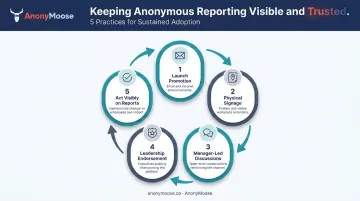
Promotion should be multi-channel and ongoing:
- Email campaigns and intranet reminders when the system launches and periodically thereafter
- Posters and physical signage in common areas
- Manager-led team discussions that normalize speaking up
- Leadership endorsements that signal the system is real and taken seriously
AnonyMoose's Broadcast feature supports this directly — HR can push reminders and policy updates to every employee's phone instantly, without relying on them to check their email.
When leadership visibly acts on reports and endorses the reporting channel, the system stops being a tool and becomes a cultural norm. Employees notice when concerns get addressed. That visibility, more than any promotion campaign, is what psychological safety looks like in practice.
Frequently Asked Questions
Are anonymous HR complaints really anonymous?
With a properly designed system, yes. Platforms like AnonyMoose strip identifying information at the architectural level, storing submissions with no linkage to the individual who sent them. Neither the employer nor the platform provider can trace a report back to a specific person.
What are 5 examples of serious misconduct?
Common categories employees report anonymously include: workplace harassment or sexual harassment, fraud and financial misconduct, discrimination based on protected characteristics (race, gender, age, disability), workplace safety violations, and retaliation against a prior complainant.
What should HR do first when they receive an anonymous complaint?
Log it and take it seriously — regardless of how vague it appears. The first obligation is documentation, which establishes that the organization has notice of the concern. From there, assess severity and determine whether legal obligations are triggered before deciding on next steps.
Can an employer find out who filed an anonymous complaint?
With a properly configured third-party platform, no. AnonyMoose's architecture makes individual identification technically impossible: the system records that a submission came from an organization but doesn't link it to any individual. Attempting to identify reporters would undermine system trust and expose the organization to retaliation claims.
What types of workplace issues can be reported anonymously?
Anonymous systems can capture harassment, discrimination, fraud, ethics violations, safety hazards, bullying, policy breaches, and retaliation concerns. Platforms like AnonyMoose extend this further to general feedback, DEI concerns, and employee suggestions, making them useful well beyond crisis reporting.
How can HR encourage employees to actually use reporting channels?
Employees use reporting channels when they've seen them work. Promote the tool consistently, take visible action on reports where possible, enforce anti-retaliation policies without exception, and have leaders openly endorse speaking up. Employees file reports when they believe doing so is safe and will lead to action.