The result is a pattern that plays out across organizations of every size. Culture and engagement programs get funded. Annual surveys get deployed. And yet serious issues still surface through lawsuits, regulatory investigations, or a wave of Glassdoor reviews rather than internal reports. The communication infrastructure simply wasn't built for honesty.
This article explains what employee hotlines actually do in practice, why anonymity is the variable that determines whether they work, and what it takes to turn a hotline from a compliance checkbox into a tool that genuinely changes organizational outcomes.
Key Takeaways
- Employee hotlines are confidential channels for reporting misconduct, raising concerns, and sharing feedback — outside direct management
- The core value is early detection — issues resolved internally cost far less than those that escalate to litigation, regulation, or media coverage
- According to ACFE's 2024 fraud report, organizations with hotlines had median fraud losses of $100,000 vs. $200,000 without one
- 48% of employees who witnessed misconduct stayed silent due to fear of retaliation
- Modern hotlines are mobile-first, anonymous platforms — consolidating reporting, feedback, and two-way communication
What Is an Employee Hotline?
An employee hotline is a dedicated communication channel — accessible via phone, web form, or mobile app — that lets employees report concerns, flag violations, or share feedback without routing the message through their direct management chain.
Most people picture a phone number on a compliance poster. Modern hotlines cover far more ground than that. They capture:
- Fraud and financial misconduct (billing irregularities, expense abuse, procurement violations)
- Harassment and discrimination (sexual harassment, bias, microaggressions, DEI concerns)
- Safety violations (unreported hazards, procedural shortcuts, unsafe conditions)
- Ethics and compliance breaches (policy violations, conflicts of interest, regulatory non-compliance)
- General feedback and suggestions (constructive input that employees wouldn't attach their name to)
Platforms like AnonyMoose separate these functions by design. Their Hotlines feature handles sensitive incident reporting — sexual harassment, discrimination, compliance violations — while a separate Openlines channel handles ongoing anonymous two-way feedback and suggestions. Keeping these separate prevents a sensitive harassment report from landing in the same queue as a general suggestion — and signals to employees that each concern is taken on its own terms.
Why "Anonymous" Changes Everything
Not all hotlines deliver equal results. What separates effective ones from ineffective ones is whether anonymity is structural or just promised.
Confidentiality means someone knows your identity but promises not to share it. True anonymity means the system cannot identify you at all. Employees understand this difference intuitively — a confidentiality promise asks them to trust a person or a policy, while structural anonymity removes the question entirely.
AnonyMoose's architecture is built on this principle. Neither the platform nor the employer can identify who submitted a report — not because of a policy, but because individual identity is never linked to submissions in the system. There is no technical mechanism that can expose who sent a message.
That design choice directly addresses a documented barrier to reporting. Ethisphere's 2024 Ethical Culture Report found that 48% of employees who witnessed misconduct stayed silent because they feared retaliation. When anonymity depends on a policy promise, that fear is rational. When it's baked into the system architecture, employees have no reason to hesitate. The APA (2021) quantifies what that architectural difference produces: employees are 70% more likely to disclose unethical practices in anonymous settings than through traditional feedback methods — making structural anonymity the most consequential design decision in any hotline implementation.
Key Advantages of Employee Hotlines in Corporate Relations
Early Issue Detection and Compliance Protection
The most quantifiable advantage of a hotline is how much it compresses the window between when a problem starts and when the organization responds to it.
According to ACFE's 2024 Occupational Fraud Report:
| Metric | With Hotline | Without Hotline |
|---|---|---|
| Median fraud loss | $100,000 | $200,000 |
| Median fraud duration | 12 months | 24 months |
| Fraud detected by tips | 43% of all cases | — |
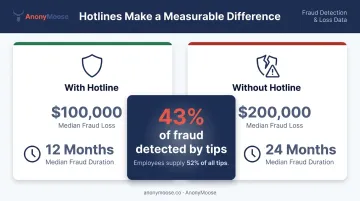
Tips are the single most common fraud detection method — more common than internal audits, management review, or any other control. And employees supply 52% of all tips. That means the organization's own workforce is its best early-warning system, but only if they have a channel they trust enough to use.
Early detection also has direct compliance implications. Two U.S. regulatory frameworks make internal reporting mechanisms legally required rather than optional:
- SOX Section 301 (15 USC 78j-1) requires public company audit committees to establish procedures for confidential, anonymous employee submissions about questionable accounting or auditing matters
- FAR 52.203-13 requires covered government contractors to maintain an internal reporting mechanism — such as a hotline — that allows anonymity or confidentiality for employees reporting suspected improper conduct
For organizations outside these mandates, the case is still straightforward: unaddressed issues compound. A manageable HR matter becomes a regulatory investigation. A billing discrepancy becomes a federal audit. The longer an issue goes undetected, the more expensive it becomes to resolve.
This advantage is most critical in: regulated industries (healthcare, finance, government contracting), organizations scaling rapidly, distributed or remote workforces, and post-merger integrations where culture misalignment creates blind spots.
Psychological Safety, DEI, and Employee Engagement
Beyond compliance, hotlines give employee voice a protected, always-available channel — one where seniority, location, and power dynamics don't determine who gets heard.
This is where hotlines intersect directly with DEI. Traditional reporting mechanisms — manager conversations, HR walk-ins, town halls — disproportionately silence the employees most at risk: junior staff, marginalized groups, remote workers, and anyone whose concern involves their direct supervisor. A well-designed anonymous channel removes those barriers. Every employee gets the same access, regardless of seniority, location, or background.
Consider the scale of what's currently going unreported. HR Acuity's 2025 Employee Relations Benchmark Study found that discrimination, harassment, and retaliation claims reached 14.7 issues per 1,000 employees in 2024 — up from 6.4 in 2021. That's not necessarily an increase in misconduct. It's an increase in reporting, which suggests organizations with functioning channels are surfacing issues that would previously have gone silent.
The engagement connection is direct. Gallup's Q12 meta-analysis reports 51% lower voluntary turnover in organizations in the top engagement quartile compared to low-turnover organizations. The SHRM Study (2020) adds a specific mechanism: organizations with genuine anonymous channels see an 82% higher likelihood of employees sharing critical feedback and a 47% increase in actionable feedback related to management practices — the two dimensions that employee hotlines are specifically designed to unlock. Employees who feel structurally heard stay longer and contribute more. SHRM estimates employee replacement costs range from 50% to 200% of annual salary depending on level — which frames retention as a measurable financial risk, not just a culture priority.
AnonyMoose's Custom Hotlines can be configured for sexual harassment, discrimination, bias, compliance violations, and microaggressions. The platform's Polls & Surveys feature achieves 90% participation rates compared to 30% for non-anonymous surveys — a difference that reflects how much employees self-censor when their identity is attached to a response. Organizations relying on traditional channels are likely seeing only a fraction of what employees actually think.
This advantage is most critical in: organizations undergoing culture transformation, those with documented retaliation history, hybrid/remote workforces where informal feedback is harder to capture, and companies with meaningful DEI gaps.
Preventing External Escalation and Protecting Brand Reputation
Employees who don't feel heard internally don't stay silent. They go to Glassdoor, Blind, social media, or — in serious cases — directly to the EEOC, OSHA, or the SEC. None of those outcomes are reversible quickly, and all of them carry costs that dwarf what proactive internal resolution would have required.
The EEOC filed 88,531 new discrimination charges in FY 2024 — a 9% increase from FY 2023. Many of those charges began as internal concerns that went unaddressed or unacknowledged. Giving employees a credible, responsive internal channel doesn't eliminate all external complaints, but it materially changes the proportion of issues that get resolved before they escalate.
Employer brand exposure is equally concrete. Glassdoor data shows that a 0.5-point rating improvement is associated with 20% more job clicks and 16% more apply starts. The reverse is also true: negative reviews compound, particularly when they cluster around themes like management not listening or retaliation for raising concerns.
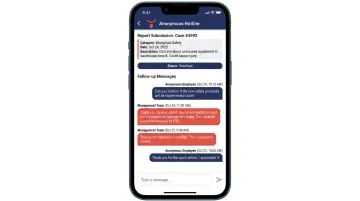
The mechanism here isn't just about providing an outlet. It's about demonstrating that the outlet works. AnonyMoose's persistent conversation threads allow management to respond to anonymous reports, follow up on investigations, and share next steps — without ever revealing the reporter's identity. Static reporting forms end at submission. Persistent threads keep the conversation going until resolution. When employees see that a report generated a real response, the internal channel gains credibility — and the impulse to post on Glassdoor or file an external complaint diminishes.
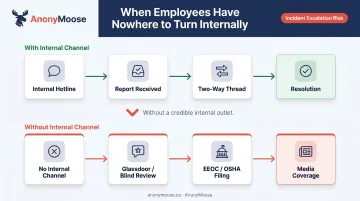
This advantage is most critical in: high-growth organizations onboarding rapidly, industries under public scrutiny (tech, finance, healthcare), organizations that have had recent public incidents, and companies operating across multiple jurisdictions.
What Happens When Employee Hotlines Are Missing or Ignored
The consequences aren't theoretical. They follow a predictable pattern:
- Fraud and misconduct run twice as long (median 24 months vs. 12 months with a hotline) and cost twice as much per incident
- Compliance failures compound because no one with ground-level knowledge had a safe way to flag the issue before it became a regulatory matter
- Engagement erodes quietly as employees conclude that raising concerns is pointless or risky, then disengage or leave
- External escalation happens — frustrated employees turn to Glassdoor reviews, regulatory complaints, or media coverage when internal channels fail them
- Culture management becomes reactive — leadership responds to crises instead of early signals, and by then the reputational or financial damage is already done
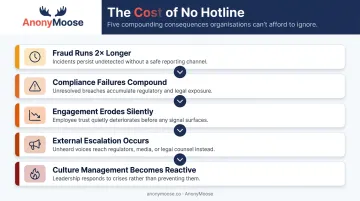
Every one of these gaps compounds the others. Disengaged employees stop reporting misconduct. Unreported misconduct grows into compliance failures. Compliance failures attract external scrutiny. Organizations that treat hotlines as optional often discover the real cost only after all five consequences have already landed at once.
How to Get the Most Value from an Employee Hotline
A hotline that employees don't use is a compliance document, not a communication tool. Three conditions determine whether a hotline delivers actual value:
1. Accessibility without friction
The channel must be available 24/7 with no complex steps. ACFE's 2024 data shows employees now use email (40%) and web-based forms (37%) more than traditional phone lines (30%) to submit reports, and NAVEX's 2025 benchmark confirms web intake has surpassed telephone as the dominant channel.
Employees report when it's convenient and private — often outside working hours from a mobile device. Any friction between the impulse to report and the act of reporting suppresses reporting.
AnonyMoose consolidates hotlines, anonymous feedback channels, polls, surveys, and broadcast messaging into a single mobile app. Employees open the app, select the relevant Hotline, and start typing — from their desk, their warehouse floor, or their commute — the moment an incident occurs.
2. Anonymity that's structural, not promised
Employees need to know that anonymity is technical, not dependent on an HR professional keeping a secret. Audit your current system against two hard questions:
- Can the platform provider identify individual submissions?
- Can management identify reporters under any conditions?
If the answer to either is yes, the channel will underperform — because employees will figure that out.
3. Closed-loop follow-through
A report that disappears into silence is worse than no hotline at all — it confirms the employee's assumption that speaking up is pointless. Employees need visible evidence that reports result in action. Even a confirmation that a report was received and is under review builds more trust than silence.
AnonyMoose's persistent conversation threads address this. Once a report is submitted, the thread stays open. Management can respond, ask follow-up questions, share resources, and update case status — all while the employee remains completely anonymous. That two-way dialogue is what turns a reporting channel into one employees actually return to.
Conclusion
An employee hotline delivers value through three connected outcomes:
- Earlier detection that contains damage before it compounds
- Psychological safety that retains and engages employees long-term
- An internal outlet that keeps issues from reaching regulators or public forums
None of those outcomes happen automatically. They require a channel employees actually trust — one where anonymity is built into the architecture, access is straightforward, and reports visibly lead to responses.
Organizations that treat the hotline as a long-term investment in trust, and commit to acting on what they hear, compound that value over time. Those that deploy it purely for compliance tend to get exactly that: a system employees ignore and issues that surface elsewhere.
Frequently Asked Questions
What is an employee hotline?
An employee hotline is a confidential or anonymous channel — phone, web form, or mobile app — that lets employees report concerns, misconduct, or feedback without going through direct management. Modern hotlines operate as digital platforms with mobile accessibility and two-way communication, moving well beyond the traditional phone line.
Are employee hotlines legally required?
For certain organizations, yes. SOX Section 301 mandates anonymous submission procedures for public companies; FAR 52.203-13 requires covered government contractors to maintain an internal reporting mechanism. Many others implement hotlines voluntarily for compliance, culture, and liability protection.
How do you ensure true employee anonymity on a hotline?
The key distinction is between confidentiality (a promise not to share identity) and structural anonymity (the system cannot identify the reporter at all). The strongest platforms — AnonyMoose among them — are built at the system level so that neither the employer nor the platform provider can trace a submission to an individual, making anonymity an architectural fact rather than a policy commitment.
What types of issues can employees report through a hotline?
Employees can report a wide range of concerns, including:
- Fraud, harassment, discrimination, and safety violations
- Policy breaches, management misconduct, and ethics violations
- DEI concerns such as bias and microaggressions
- Constructive feedback and suggestions
Many platforms separate sensitive incident reporting (Hotlines) from general feedback channels (Openlines) so employees always have the right channel for what they need to raise.
How does an employee hotline differ from an open-door policy?
An open-door policy requires employees to feel comfortable approaching a specific manager — which fails when that person is the problem, or when seniority creates fear. A hotline provides an independent, always-available channel that removes those power dynamics entirely, making it accessible regardless of who the concern involves.
What should organizations look for when choosing an employee hotline platform?
Key criteria include:
- Structural anonymity: neither the employer nor platform can identify reporters
- 24/7 mobile accessibility: available anytime, from any device
- Ease of use: minimal steps to submit a report
- Two-way communication: reporters can receive follow-up without losing anonymity
- Case management tools: built-in tracking and resolution workflows
- Scalability: flexible enough to grow across teams and locations