Introduction
Organizations spend real money setting up anonymous employee hotlines, then watch them sit idle. The tool exists. Employees don't use it.
The problem isn't technology. According to ECI's 2023 Global Business Ethics Survey, 28% of employees who witnessed workplace misconduct chose not to report it — and the top reasons weren't a lack of reporting channels. They were distrust in confidentiality, fear of job loss, and the belief that nothing would happen anyway.
That gap between "hotline installed" and "hotline trusted" is where most implementations fail. Closing it requires more than a phone number or web form. It takes:
- Anonymity that employees can actually verify
- Sustained awareness so the channel stays top of mind
- Clear processes so reports lead to visible action
- A culture where speaking up feels genuinely safe
This article breaks down the most common challenges organizations face when implementing an anonymous employee hotline — and what it takes to overcome them.
Key Takeaways
- Most employees who stay silent aren't missing a reporting channel — they're missing a reason to trust it
- Only 56% of employees know anonymous reporting options exist at their organization — awareness alone is a barrier
- Anonymous reports make up 56% of all hotline submissions, yet follow-up happens in fewer than 1 in 3 cases
- Misuse risk is real but manageable with pattern analytics that don't compromise individual anonymity
- A successful hotline needs architectural anonymity, defined workflows, clear ownership, and genuine leadership buy-in — not just policy promises
Why Implementing an Anonymous Employee Hotline Is More Complex Than It Seems
Most organizations treat hotline deployment as a purchasing decision: buy a platform, send an announcement, consider the work finished. What they underestimate is that the system's effectiveness depends entirely on employee belief — not the platform's technical capability.
This trust gap shows up in the numbers. NAVEX's 2024 Whistleblowing & Incident Management Benchmark Report tracked 1.86 million reports across 57 million employees, arriving at a median of just 1.57 reports per 100 employees. That's a thin margin of engagement for a workforce tool meant to surface safety issues, ethics violations, and HR concerns.
Those numbers have real consequences when a hotline fails to earn trust:
- Employees who distrust internal channels don't stay quiet — they post on Glassdoor, vent on Blind, or disengage entirely
- Misconduct that goes unreported internally tends to escalate, eventually surfacing as a legal or reputational problem
- Leaders lose visibility into ground-level issues precisely when they need it most
When employees bypass the hotline entirely, the organization doesn't just miss reports — it misses the early warning signals that prevent larger failures down the line. Organizations that succeed in building trusted anonymous channels see measurable downstream gains: the American Psychological Association found a 30% improvement in employee satisfaction within one year in organizations that sustain genuine anonymous feedback programs — a signal that trust in the reporting infrastructure extends well beyond formal incident reports into overall workplace experience.
Common Challenges in Implementing an Anonymous Employee Hotline
Employees Don't Trust That Their Anonymity Is Real
"Anonymous" on paper rarely feels anonymous to the employee hitting submit.
The fear isn't irrational. Employees worry about IP tracking, writing style recognition, and being identified by context — especially in small departments where a complaint about "the manager on the Tuesday shift" narrows the field to one or two people.
ECI's research confirms that lack of trust in confidentiality is one of the top reasons employees don't report misconduct, and separately, that 46% of global employees who did report experienced retaliation. The APA (2021) quantifies what organizations lose from that trust gap: employees are 70% more likely to disclose unethical practices in anonymous settings compared to traditional feedback methods — a gap that no phone number or web form can close without the architectural anonymity guarantee that makes employees believe the channel is genuinely safe.
Most employees don't realize there's a structural difference between confidentiality and anonymity:
| Type | What it means | Who can see your identity |
|---|---|---|
| Confidential | HR promises not to share your name | HR has it — they just agreed not to disclose it |
| Truly Anonymous | The system structurally cannot identify you | Nobody — the link doesn't exist |
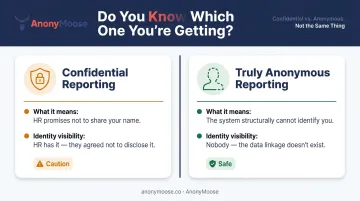
Most hotlines offer confidentiality. Employees assume they're getting anonymity. That gap in expectation is where trust collapses.
Even well-intentioned intake forms can de-anonymize reporters. Asking for department, shift, tenure, and incident date in a team of six doesn't just narrow the field — it effectively identifies the reporter. This is a design problem, not a policy one.
Platforms like AnonyMoose address this at the architecture level. The platform is built so that neither the employer nor AnonyMoose itself can identify the author of a submission — not by policy, but because that data linkage is technically absent from the system. Employee data is encrypted at all times, and submissions are stored anonymously with no connection to individual identity.
Low Adoption and Poor Awareness
HR Acuity's 2025 Workplace Harassment and Misconduct survey of 2,000+ U.S. employees found that only 56% were aware anonymous reporting options existed at their organization. Employees who knew reported at nearly double the rate of those who didn't.
Half your workforce doesn't know the option exists — and silence follows directly from that.
A single onboarding mention won't fix this. The stakes of awareness are real: buildempire.co.uk research shows that genuinely anonymous reporting channels achieve 90% participation rates compared to 30% for identified alternatives, and produce 58% more honest feedback — a difference that only materializes when employees know the channel exists and trust that it delivers what it promises. Sustained awareness requires:
- Multi-channel communication — email, manager briefings, posters, intranet, and direct app notifications
- Repeated reinforcement — quarterly reminders, not annual ones
- Accessible channels — deskless workers on factory floors or construction sites won't use a desktop-only submission portal
NAVEX's benchmark data shows web and phone intake methods each represent about 34% of report volume, with other methods making up the remaining third. Organizations that only track web and hotline submissions capture 1.07 reports per 100 employees — versus 2.25 for those monitoring all intake channels.
AnonyMoose's mobile-first design directly addresses the deskless worker gap. The app is built for access anytime, from anywhere — a construction site, a warehouse floor, a remote field location — without requiring a desktop or a corporate intranet login.
Risk of Misuse and Bad-Faith Reports
There's a real tension built into anonymous reporting: stronger anonymity guarantees lower the barrier for everyone — including bad actors filing retaliatory or fabricated reports.
NAVEX's benchmark data offers useful context here. Anonymous reports are substantiated at a 33% rate, compared to 50% for named reports. That gap is worth noting, but lower substantiation doesn't mean bad faith — anonymous reporters often lack access to documentation, or report concerns that are harder to corroborate without investigation.
What organizations do need is a way to detect patterns that suggest misuse — multiple reports targeting the same individual from similar submission windows, or report clusters that don't align with any organizational event or incident. The goal is systemic oversight, not individual surveillance.
Effective misuse management looks like:
- Pattern analytics that flag behavioral anomalies across submissions
- Clear terms of use that prohibit false or malicious reports, with defined consequences
- Investigation protocols that apply consistent standards regardless of who's named
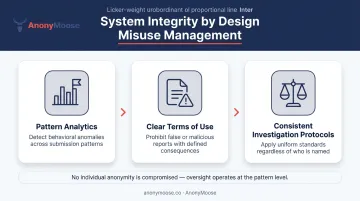
None of these require piercing individual anonymity. The analytics operate at a population or pattern level — not at the level of identifying who filed a specific report.
Operational and Compliance Gaps
Even well-designed hotlines fail operationally. The most common failure point: no one owns what happens after submission.
NAVEX's benchmark data makes this concrete. Median follow-up to anonymous reports was 27% in 2023 — meaning nearly three in four anonymous reporters heard nothing back. Median case closure ran 22 days.
Employees who submit a report and receive no acknowledgment don't conclude the issue is under investigation. They conclude it was ignored.
On the compliance side, the legal requirements are specific and unforgiving:
- SOX / SEC Rule 10A-3 requires listed companies to establish procedures for confidential, anonymous employee submissions about accounting or auditing matters
- SEC Rule 21F-17 prohibits actions that impede employees from communicating directly with SEC staff about potential securities violations
- EU Directive 2019/1937 mandates acknowledgment within 7 days and substantive feedback within 3 months for in-scope organizations
- GDPR Articles 5 and 32 impose data minimization and security requirements on how reports are stored and processed
These are baseline requirements that must be built into system design from the start — not retrofitted when a regulator asks.
AnonyMoose's Hotlines feature includes a case management workflow with urgency levels, status tracking, internal notes, and activity history — giving HR teams a structured way to manage each report from intake through resolution.
Two-way anonymous communication keeps the conversation thread open throughout, so HR can ask follow-up questions or share outcomes without the employee ever revealing their identity.
How to Overcome These Implementation Challenges
Each implementation challenge has a concrete fix. Here's what actually works.
1. Make anonymity architectural, not aspirational Choose platforms where identification is technically impossible by design, not just promised by policy. The standard to look for: neither the employer nor the platform vendor can link a submission to an individual. AnonyMoose, for example, encrypts identities at the infrastructure level so no data linkage exists anywhere in the system.
2. Build and enforce a written anti-retaliation policy Employees need to hear this from leadership, not just read it in fine print. The policy should be endorsed at the senior level, included in the employee handbook, and referenced at onboarding and in recurring communications. NAVEX's 2025 data shows only 49% of organizations have a formal non-retaliation policy — that's the baseline gap to close.
3. Prioritize mobile-first, multi-channel access A hotline that only works on a desktop during business hours doesn't serve shift workers, field teams, or remote employees. Every employee — regardless of role or location — should be able to submit a report from their phone, privately and comfortably.
4. Use analytics to protect system integrity Misuse detection doesn't require compromising individual anonymity. Pattern-level analytics can flag suspicious reporting behavior — repeated reports targeting the same person, submission clusters without corresponding incidents — without identifying any individual reporter.
5. Close the feedback loop Define who owns each report, set a response timeline (48–72 hours for acknowledgment is a reasonable baseline), and communicate outcomes back to reporters through the anonymous channel. When employees see reports lead to real responses, they keep using the system.
Policies and Systems That Support a Successful Anonymous Employee Hotline
Three foundational policies every organization needs before going live:
- Anti-retaliation policy — protects reporters from adverse employment action and is enforced, not decorative
- Data access policy — defines who can view submission details, under what circumstances, and with what authorization
- Escalation protocol — documents how reports move from intake to investigation to resolution, with defined owners and timelines
The system requirements that support these policies:
- End-to-end encryption for secure storage of all report data
- Case management tooling that tracks each report through every stage, with status updates, internal notes, and activity history
- Audit trail documentation that records how each report was handled — supporting both internal accountability and regulatory compliance
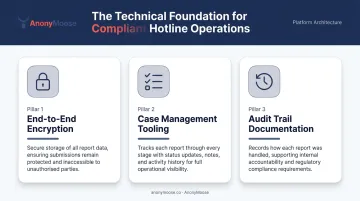
Getting the technology right is only half the equation. The hotline shouldn't operate as a standalone tool — the data it surfaces should feed directly into HR, DEI, and compliance programs.
If a hotline is generating consistent reports about a specific team or management practice, that's a training signal and a policy signal — not just a case queue. Organizations that treat hotline data as isolated incident management miss the organizational intelligence the system is already generating.
71% of organizations use purpose-built technology for hotline and incident management, according to NAVEX's 2025 State of Risk and Compliance report — which means shared inboxes and tracking spreadsheets are no longer the norm. Organizations still relying on them are behind the curve.
Frequently Asked Questions
Can employees remain anonymous when they use an anonymous employee hotline?
It depends on how the platform is built. Confidentiality means HR has your identity but agrees not to share it. True anonymity means the system cannot identify you at all. The strongest platforms, like AnonyMoose, are designed so that neither the employer nor the vendor can link a submission to an individual — by architecture, not just policy.
Why is an anonymous employee hotline important for reporting compliance or HR concerns?
Fear of retaliation is the primary reason employees stay silent about misconduct — and 46% of those who did report experienced retaliation according to ECI's 2023 data. An anonymous channel removes that barrier, allowing organizations to surface compliance violations, safety concerns, and HR issues before they escalate into regulatory or legal exposure.
What policies and systems should an organization implement for an anonymous employee hotline?
Three things need to be in place before launch: an anti-retaliation policy endorsed by senior leadership, a data access policy limiting who can view submissions, and a case management system with defined escalation workflows. Retrofitting any of these after the first report arrives creates unnecessary risk.
How can organizations prevent misuse of an anonymous employee hotline?
Pattern-level analytics can identify suspicious reporting behavior — such as repeated reports targeting the same individual — without requiring any breach of individual anonymity. Clear terms of use that define consequences for bad-faith reports add a behavioral deterrent. The goal is systemic oversight, not individual surveillance.
What should HR do after receiving a report through an anonymous hotline?
HR should assess urgency, investigate with defined ownership, take corrective action, and communicate an outcome back through the anonymous channel. Closing that loop is where most organizations currently fall short — and where trust in the system is won or lost.