Key Takeaways
- 80% of campus sexual assaults go unreported to police, revealing a massive gap between actual incidents and official records.
- True anonymity depends on technical architecture — no IP logging, no metadata, no device fingerprints — not a privacy policy alone.
- Anonymous tools help universities meet Clery Act and Title IX obligations through better incident data collection.
- Effective platforms combine multiple reporting paths (hotlines, open feedback, surveys, broadcasts) for diverse campus populations.
- Deployment only works when paired with awareness campaigns, non-retaliation policies, and a clear response loop.
Why Universities Need Anonymous Incident Reporting Tools
University campuses aren't workplaces in the conventional sense. The same institution houses undergraduates, graduate students, postdocs, adjunct faculty, tenured professors, and administrative staff — each operating under different power dynamics with different stakes for speaking up.
The result is chronic underreporting. According to Bureau of Justice Statistics data, 80% of rape and sexual assault victimizations against female college students went unreported to police between 1995 and 2013. Among those who stayed silent, 20% cited fear of reprisal as the primary reason.
The Gap Between Silence and Safety
Low reporting rates don't reflect low incident rates. The AAU 2019 Campus Climate Survey found that 25.9% of undergraduate women experienced nonconsensual sexual contact by physical force or inability to consent since enrollment — yet official Clery statistics at those same institutions captured a fraction of that number. Survey-based estimates consistently exceed official records because many reports never reach a Campus Security Authority.
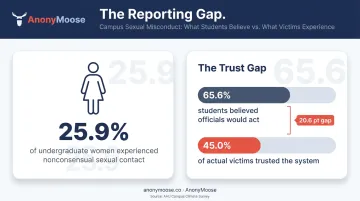
The data reveals a trust gap that makes this worse. While 65.6% of all students believed officials would take their report seriously, that number dropped to 45.0% among victims of nonconsensual sexual contact by force. Students who've already experienced harm are the least likely to trust the system meant to protect them.
Regulatory Pressure Is Real
US universities face concrete legal obligations that anonymous reporting tools help address:
- The Clery Act requires annual disclosure of campus crime statistics across on-campus, off-campus, and adjacent public property — published by October 1 each year. Data must come from Campus Security Authorities, and institutions maintaining campus police must keep a public daily crime log covering the past 60 days.
- Title IX prohibits sex-based discrimination in federally funded education programs. The 2020 Title IX Rule is currently in effect following the January 2025 vacating of the 2024 Final Rule.
- The Stop Campus Hazing Act, signed December 23, 2024, amended Clery Act requirements specifically related to hazing reporting.
- Texas and Illinois both have state laws requiring universities to provide electronic anonymous reporting options for sexual harassment, assault, and related misconduct.
Anonymous tools don't replace these formal systems. They feed them. Incidents that would otherwise go unrecorded reach Campus Security Authorities. Clery data becomes more complete. Institutions can identify patterns early — before isolated events become systemic failures.
Types of Incidents Universities Should Capture
A university reporting platform needs broader incident coverage than a standard corporate compliance hotline. The campus environment generates incident types that don't exist in most workplaces.
Core Incident Categories
| Incident Type | Prevalence Data |
|---|---|
| Sexual harassment | 8.4% of students in prior 12 months (ACHA 2024) |
| Verbal threats | 10.4% of students in prior 12 months (ACHA 2024) |
| Unwanted sexual contact | 5.1% of students in prior 12 months (ACHA 2024) |
| Stalking | 4.1% of students in prior 12 months (ACHA 2024) |
| Hazing | 55% of students in clubs, teams, or organizations (National Hazing Study) |
| Mental health/suicide risk | 13% past-year suicidal ideation (Healthy Minds Study 2023-2024) |
| Academic integrity violations | Estimated 65–75% of undergraduates admit to cheating at least once |
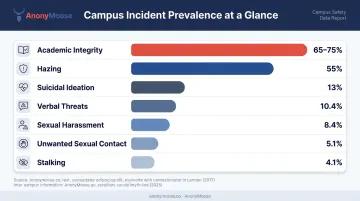
Those categories cover the highest-volume incidents, but a complete platform also needs reporting paths for:
- Racial harassment and discrimination
- Faculty and staff misconduct
- Research integrity violations
- Campus safety hazards
Structured vs. Open-Text Input
Predefined categories help route reports to the right office. But free-text fields matter just as much — they capture situations that don't fit neatly into a dropdown menu and surface emerging patterns that fall outside existing categories.
Universities also need to distinguish between time-sensitive threats (imminent self-harm, threats of violence) and pattern-relevant conduct (ongoing harassment, a hostile department climate). A capable platform handles both: urgency triage for time-sensitive threats and aggregate trend analysis for ongoing conduct issues.
Must-Have Features in a University Anonymous Reporting Tool
True Technical Anonymity
This is the foundation everything else depends on. A privacy policy that promises confidentiality is not the same as a system that makes identification technically impossible.
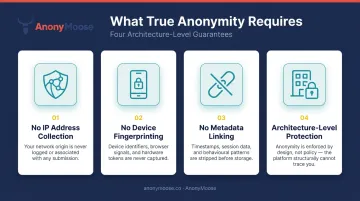
Genuine anonymity requires:
- No IP address collection
- No device fingerprinting
- No metadata that could link a submission to an individual
- Architecture designed so that neither the platform provider nor the institution can trace a report back to its source
AnonyMoose is built on this principle. The platform's anonymous-by-design architecture means no technical pathway exists to expose who sent a message — not for AnonyMoose, and not for the institution's HR or compliance team. Submissions are stored as belonging to the organization, never linked to an individual identity. For reporters weighing whether to come forward at all, that technical guarantee matters more than any policy statement.
Mobile-First, Multi-Channel Access
University populations are predominantly mobile users. Students report incidents late at night, off-campus, from residence halls, or while traveling — rather than during business hours from a desktop computer. Any reporting platform that isn't optimized for mobile access immediately creates a barrier.
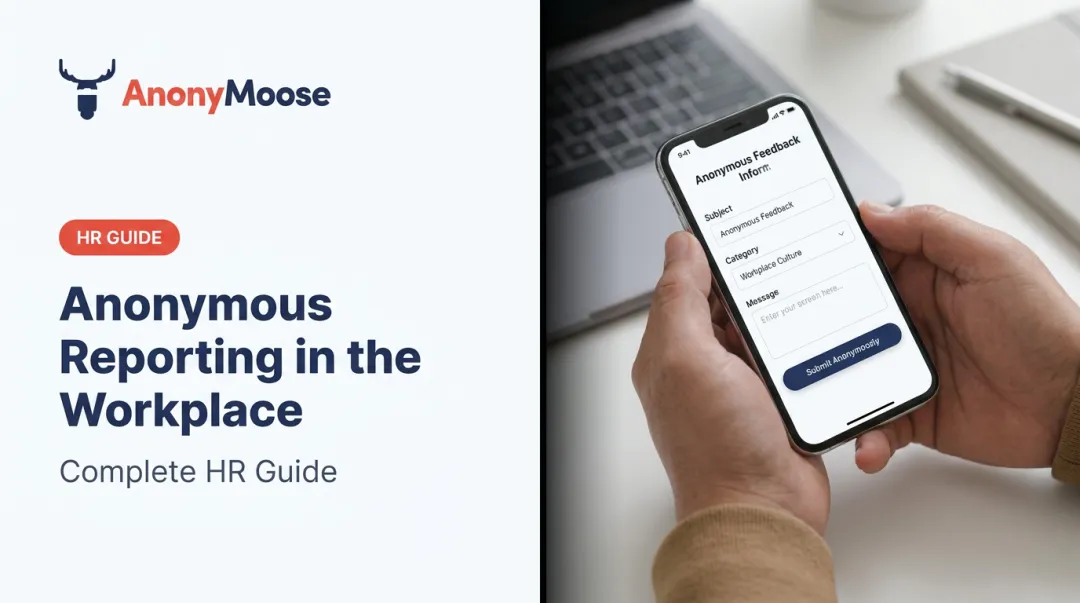
AnonyMoose is designed as a mobile-app-centric SaaS platform, requiring no special hardware and no university-issued device. Students and staff use their personal phones. The platform also provides a web management interface for administrators and an Insights Dashboard for leadership, keeping all parties connected through a unified system.
Two-Way Anonymous Communication
Initial reports are often incomplete — not because reporters are withholding information, but because they're scared, processing trauma, or unsure what details are relevant. Investigators need to ask follow-up questions. Reporters need to answer them without being forced into an identified channel.
AnonyMoose's Hotlines maintain persistent conversation threads that stay open after submission. The receiving team — whether that's a Title IX coordinator, compliance officer, or Dean of Students — can ask follow-up questions, share policy documents, or provide counseling resources, all within the same thread. The reporter remains technically unidentifiable throughout the entire exchange.
Configurable Routing Workflows
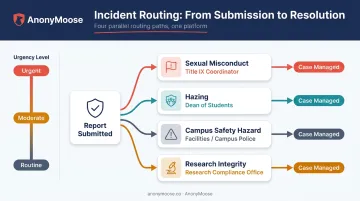
Universities aren't a single office. Different incident types need to reach different people:
- Sexual misconduct reports go to the Title IX coordinator
- Hazing concerns route to the Dean of Students
- Campus safety hazards reach facilities or campus police
- Research integrity issues go to the research compliance office
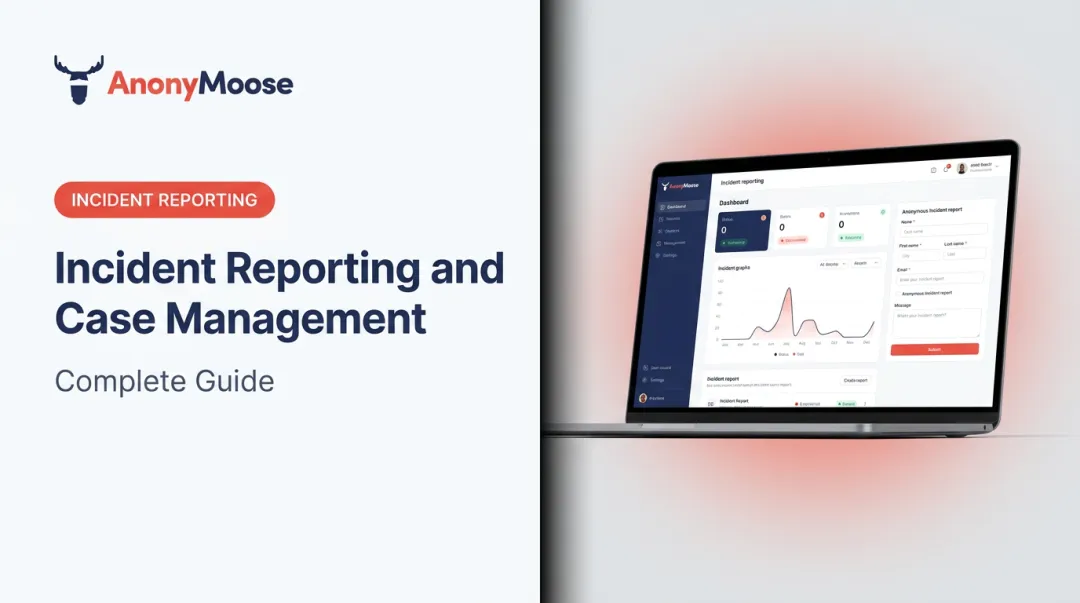
AnonyMoose supports custom Hotline directories where each incident type routes to designated recipients. Urgency levels, case status, and internal notes are managed through the web interface, giving administrators a structured case-management workflow rather than a chaotic inbox.
Analytics and Trend Reporting
Individual reports are valuable. Patterns across hundreds of reports are essential for policy change. The AnonyMoose Insights Dashboard aggregates incident data across Hotlines and other channels, identifying themes and recurring issues by department or incident type. Leadership can design targeted interventions based on real data, without ever exposing individual reporter identities.
How Anonymous Reporting Works on a University Campus
Submission and Intake
A student, faculty member, or staff person opens the AnonyMoose mobile app, selects the relevant Hotline from a custom directory configured by the institution, and submits their report. They can attach supporting files — screenshots, images, documents — within the app, from anywhere, at any time. The system guides them through a structured form without requiring legal language or formal complaint terminology.
Routing, Triage, and Response
The platform routes the report to the designated recipient for that incident type. For urgent reports — a threat of imminent harm, for example — administrators can set urgency levels immediately through the web interface and escalate internally. For non-urgent pattern-relevant reports, administrators route the case to the management queue for review and follow-up.
Anonymous Two-Way Follow-Up
The conversation thread remains open after submission. Investigators can ask clarifying questions. The reporter can respond. Both parties exchange information — including file attachments — without either party's identity being revealed. Unlike a phone hotline, this persistent thread keeps the investigation moving days or weeks after the initial report.
Data Aggregation and Institutional Response
Over time, reported data flows into the Insights Dashboard. Leadership can identify clusters — an uptick in harassment reports from a specific residence hall, recurring conduct complaints from a particular department — and design responses based on evidence rather than individual incidents.
The same data supports key compliance obligations, including:
- Clery Act documentation and annual reporting
- Title IX response tracking and case timelines
- Institutional compliance filings and audit trails
Best Practices for Universities Implementing Anonymous Reporting
Invest in Awareness Before and After Launch
Deploying a tool accomplishes nothing if the campus community doesn't know it exists or doesn't trust it. Universities should build awareness through:
- New student and faculty orientation sessions
- Posters and digital signage across campus
- Student organization communication channels
- Faculty senate and staff communications
- Explicit explanation of how anonymity is technically protected
Closing the feedback loop matters just as much. When reports lead to visible changes — updated policies, additional training, environmental interventions — communicate that to the community without breaching any reporter's anonymity. Students report more when they believe something will actually change.
Publish and Enforce Non-Retaliation Policies
Technical anonymity only addresses one barrier. Students and staff also need to trust that no one will connect the dots through other means — who was in a particular class, who had access to a specific incident, who complained informally before filing a report.
Non-retaliation policies must be explicit, published, and actively reinforced through training for every person involved in report management. Confidentiality obligations aren't optional add-ons.
Choose a SaaS Platform Built for Rapid Deployment
University IT departments and compliance offices are stretched thin. A platform that requires server provisioning, custom integration projects, or ongoing hardware maintenance creates adoption delays that leave real safety gaps.
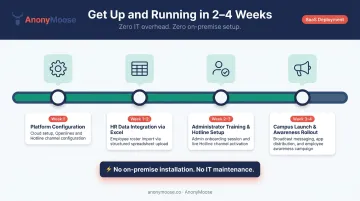
Platforms like AnonyMoose are built specifically to avoid those delays. It deploys in two to four weeks, runs entirely in the cloud, and pulls student or employee data from any HR system via a standard Excel file. There's no on-premise installation, no IT maintenance burden, and no large upfront licensing cost — a practical fit for institutions operating on tight budgets.
Common Challenges Unique to University Anonymous Reporting
Balancing Anonymity with Actionability
University administrators frequently worry that anonymous reports won't contain enough detail to investigate. This concern is legitimate but overstated when the right tools are in place.
Two-way anonymous communication resolves most completeness gaps without forcing reporters into identified channels. File attachment support adds documentary evidence. Beyond individual reports, aggregate data is itself actionable — a pattern of complaints from a specific department can justify a policy review or staff training even when no individual complainant steps forward.
Building Trust with Students Who Distrust Institutions
Only 45% of assault victims in the AAU survey believed officials would take their report seriously. That distrust doesn't disappear because an anonymous tool exists.
Universities need to demonstrate responsiveness through visible action. Effective approaches include:
- Sharing aggregate outcomes so students see reports lead to results
- Publishing policy changes driven by reported trends
- Engaging student leadership in governing and promoting the reporting system
Peer ambassador programs — where student leaders explain how the tool works and confirm anonymity is technically guaranteed — reach skeptical audiences more directly than institutional messaging alone.
Frequently Asked Questions
Are anonymous incident reporting tools truly anonymous?
Reputable tools are genuinely anonymous when built with the right architecture — meaning no IP logging, no metadata collection, and end-to-end encryption. Not all tools offer equal protection. Universities should verify that neither the platform provider nor the institution can technically trace a submission back to an individual, not just take that assurance on faith.
What are the main types of incident reporting used by universities?
Universities typically use three parallel channels: anonymous digital reporting (app, web form, or hotline), formal complaint processes (Title IX, student conduct), and confidential disclosures to counselors or ombudspersons. Anonymous tools sit alongside these formal channels, capturing incidents that would otherwise go unreported.
What regulations require universities to have anonymous reporting systems?
No single federal law mandates a specific anonymous tool, but the Clery Act requires campus crime disclosure, Title IX mandates processes for sexual misconduct reporting, and states including Texas and Illinois specifically require electronic anonymous reporting options.
Can anonymous reports lead to formal investigations?
Yes. Anonymous reports can trigger formal investigations, particularly when they contain sufficient detail or form a recognizable pattern. Named perpetrators may be contacted directly, and aggregate data from multiple reports can support policy reviews even when no individual complainant comes forward.
What is the difference between anonymous and confidential reporting?
Anonymous reporting means the institution does not know who submitted the report. Confidential reporting means the reporter's identity is known to a specific individual — such as a counselor, ombudsperson, or advocate — who is legally restricted from sharing it without consent. Both channels serve important functions, and universities should offer both rather than treating them as substitutes.
How can universities encourage students to actually use anonymous reporting tools?
Consistent visibility matters most: reporting links in student apps and portals, regular orientation reminders, and peer ambassador programs. The single most powerful driver of adoption, though, is demonstrating that reports lead to real outcomes. Students are far more likely to use a reporting tool when they've seen evidence — aggregate and anonymized — that submissions result in actual institutional change.