Introduction
Many HR teams face the same moment: something has shifted in the workplace — morale, a policy change, a reorg — and leadership wants to know how employees feel. So someone fires off either a quick poll or a full survey, often without a clear reason for choosing one over the other.
The result? Sometimes you get a percentage that confirms what you already suspected but tells you nothing useful. Other times, you've asked 25 questions about a problem that could have been diagnosed with three.
Using the wrong tool creates real costs. McKinsey research on survey fatigue points to leader behavior, not question volume, as the real culprit: employees disengage when they see no action after sharing feedback. On the other side, deploying a quick poll when deeper diagnosis is needed gives you a directional signal that can't support a strategic decision.
The distinction between polls and surveys is more straightforward than it appears. This guide breaks down what each tool does, when to use it, and how to choose based on what your organization actually needs to learn.
Key Takeaways
- A poll is a single-question tool for fast, real-time sentiment checks; a survey is a multi-question instrument for deeper diagnosis
- Polls work for immediate, low-stakes decisions; surveys work for complex, strategic questions
- Choose based on how much depth you need, how fast you need it, and what decision the data has to drive
- Anonymity matters for both — employees respond more honestly when they trust their identity is genuinely protected
- Use polls and surveys together — each tool has a distinct job, and neither replaces the other
Poll vs. Survey: Quick Comparison
Before diving into each tool, here's how they stack up side by side:
| Dimension | Poll | Survey |
|---|---|---|
| Number of questions | 1–3 | 5–30+ |
| Question types | Closed-ended (multiple choice, yes/no) | Likert scales, open-ended, ranking, demographics |
| Time to complete | Seconds | 5–15 minutes |
| Depth of insight | Snapshot / directional | Diagnostic / trend analysis |
| Data output | Raw counts, percentages | Cross-tabulation, segmentation, trend lines |
| Ideal use case | Quick preference check, real-time reaction | Engagement deep dive, culture assessment, exit research |
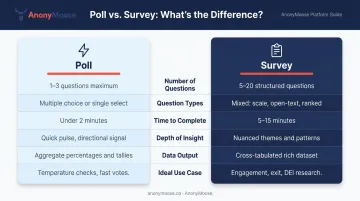
A poll is technically a type of survey: it uses standardized questions asked of a sample, as Britannica's definition of opinion polls confirms. But not every survey is a poll. The distinction matters because choosing the wrong tool gives you either too little data to act on or too much friction for employees to respond — both outcomes undermine the feedback you're trying to collect.
What Is a Poll?
A poll is a single-question instrument (occasionally two or three questions) designed to capture a quick snapshot of opinion, preference, or sentiment on one specific topic at one specific moment.
Core characteristics:
- Closed-ended answers only (yes/no, multiple choice, simple rating)
- Ultra-low friction — employees respond in seconds
- Results appear as raw counts or percentages
- No personal information required
- No skip logic or branching
Polls are most effective when you need directional input fast: gauging real-time reaction to an announcement, checking a team preference before a decision is made, or generating engagement during a town hall or all-hands meeting. Best practices for virtual all-hands meetings recommend deploying polls beforehand to shape the agenda around what employees actually want to discuss.
Use Cases of a Poll in the Workplace
Consider this scenario: an HR team is finalizing a new wellness benefits package and has narrowed it down to three options. A single poll question, deployed to the full workforce on a Monday morning, can surface majority preference by afternoon. No 20-question survey required. No analysis backlog.
That speed is the point. Because polls require almost no effort from respondents, they can run frequently, weekly or bi-weekly, without creating friction.
This makes them ideal for tracking mood or morale over short intervals. A quick "How are you feeling about the changes announced last week?" with three response options gives leadership something to act on before the sentiment becomes harder to address.
On AnonyMoose's platform, the Polls & Surveys feature supports this kind of rapid deployment: authorized users can create and publish a poll instantly, with push notifications delivered directly to employees' phones. The single-tap response design keeps participation effortless even for employees on a factory floor or working remotely.
What Is a Survey?
A survey is a structured, multi-question research instrument that collects both quantitative and qualitative data to uncover patterns, motivations, and behaviors — not just what people think, but why.
Core characteristics:
- Multiple question types: Likert scales, open-ended text, ranking, demographics
- Skip logic and branching based on prior answers
- Completion time ranges from 5 to 15 minutes
- Data suitable for cross-tabulation, segmentation, trend analysis, and cohort comparisons
- Gallup recommends semiannual engagement surveys for core performance drivers
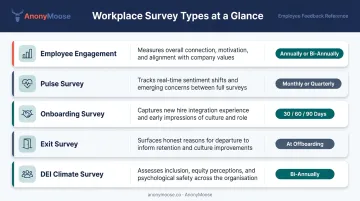
The main survey types relevant to workplace listening include:
| Survey Type | Primary Purpose | Recommended Frequency |
|---|---|---|
| Employee engagement survey | Diagnose satisfaction, clarity, recognition, manager support | Semiannual |
| Pulse survey | Track targeted themes or monitor change | Monthly or quarterly (5–15 questions) |
| Onboarding survey | Capture new hire experience | At 30/60/90-day marks |
| Exit survey | Understand turnover drivers | At offboarding |
| DEI climate survey | Measure inclusion, trust, psychological safety | 1–3 times per year |
Use Cases of a Survey in the Workplace
Here's where surveys prove their worth: imagine a company noticing that voluntary turnover in two departments has risen 18% over two quarters. A poll can confirm employees are unhappy. It cannot tell you whether the issue is manager behavior, workload, compensation perception, or something else entirely.
A 15–20 question quarterly engagement survey can:
- Identify which departments are declining and by how much
- Segment findings by tenure, role level, and team
- Surface manager behaviors that correlate with higher retention elsewhere
- Create a defensible basis for investment decisions
Culture Amp recommends keeping full employee surveys to 10 minutes or less — that's roughly 15–25 questions depending on format. Longer than that and completion rates tend to fall. Ask only the questions required to answer the strategic question at hand — not every question you could ask.
Poll vs. Survey: Which One Should You Use?
The choice comes down to four factors:
- Depth needed — Do you want a snapshot or a diagnosis?
- Urgency — Do you need input in hours or can you wait days?
- Topic complexity — Is this binary/simple, or nuanced and multi-dimensional?
- Decision weight — Low-stakes logistics, or budget, policy, and strategy?
Situational Guidance
| Situation | Use |
|---|---|
| "Should we move the all-hands to Friday?" | Poll |
| "Which of three perks do employees prefer?" | Poll |
| "Why is turnover rising in Q3?" | Survey |
| "How safe do employees feel raising concerns?" | Survey |
| "Did employees see last week's announcement?" | Poll |
| "What's driving the engagement gap in engineering?" | Survey |
The false dilemma is assuming you have to choose one permanently. The most effective listening strategies use both: polls for continuous, high-frequency signals and surveys for periodic, structured deep dives. Each tool has its own time horizon and purpose — the goal is knowing when to reach for which.
The Anonymity Factor
Whether you're running a poll or a survey, anonymity directly shapes the quality of your data. Gallup notes that when employees don't believe their input is truly anonymous, response rates drop and data becomes less reliable — this effect is especially pronounced for sensitive topics like manager effectiveness, psychological safety, or DEI climate. The SHRM Study (2020) quantifies the gap: 82% of employees are more likely to share critical feedback when their anonymity is preserved, and research from buildempire.co.uk shows genuinely anonymous instruments generate 58% more honest feedback at 90% participation versus 30% for identified alternatives — whether those instruments are polls or surveys.
AnonyMoose's Polls & Surveys feature is built so that neither the platform nor the employer can identify individual respondents. The system records that a submission belongs to an organization, but never links it to a specific person — so employees who'd never respond honestly to an HR-branded email survey will share their real views.
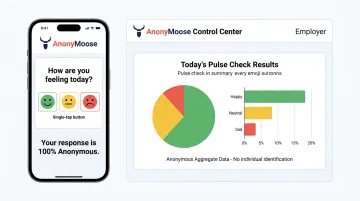
Both polls and surveys carry the same anonymity guarantee on the platform, managed from a single Control Center interface. HR teams don't need to switch tools or reconfigure privacy settings based on format.
Conclusion
Polls and surveys don't compete — they answer different questions at different depths. The real decision is which tool fits the moment, the question, and the action your organization is ready to take.
The research adds a sobering note: Perceptyx found that 71% of organizations share survey results, but only 51% see actual improvements. The tool matters far less than what happens after the data comes in.
Organizations that listen actively — using polls for real-time signals, surveys for structural diagnosis, and anonymity to build the psychological safety that makes honest responses possible — make better decisions and build teams that stay.
Frequently Asked Questions
What is the difference between a survey and a poll?
A poll is a single-question tool for capturing quick opinion snapshots — fast to complete and easy to analyze. A survey is a multi-question instrument for collecting deeper data on complex topics. Both have distinct purposes and operate on different time horizons.
What are the four types of polls?
The main poll types are: opinion/issue polls (general public sentiment on topics), election polls (forecasting electoral outcomes), exit polls (capturing voter choices as they leave polling locations), and market or product preference polls (assessing consumer attitudes or product choices).
What is an example of a poll?
A workplace example: asking employees "Which of these three team-building formats would you prefer — a volunteer day, a workshop, or a team dinner?" and offering those three options. That single closed-ended question, answered in seconds, gives a team lead a clear direction without a full survey process.
What does "poll" mean?
The word "poll" originally meant "head," as in counting heads, and by the 1620s evolved into a verb meaning to take individual votes. Today it refers to any structured method for capturing group opinions or preferences, typically through one question with predefined answer choices.
Can you use polls and surveys together as part of an employee listening strategy?
Yes, and the most effective organizations do exactly that. Polls handle high-frequency pulse checks; surveys handle deeper periodic research. Together, they create a layered listening system that captures real-time sentiment and long-term trends without overloading employees.
Are polls and surveys anonymous?
Anonymity depends on how the platform is built and configured. In platforms like AnonyMoose, where anonymity is enforced at the architectural level, neither the platform nor the employer can identify individual respondents — making responses significantly more candid than tools where anonymity is merely promised but not technically guaranteed.