Introduction
Target runs a formal internal employee survey — known internally as the "Best Team" survey — across its roughly 440,000-person workforce. The numbers look right: large sample size, regular cadence, company-wide reach.
In practice, something is broken.
Target Workers Unite's independent survey collected 500+ responses from 382 stores across 44 states and found that workers explicitly stated the corporate survey "does not result in improvement" — and that results were never shared back with the employees who completed them. Fast-forward to 2025: the Wall Street Journal reported that Target's internal companywide survey drew roughly 260,000 responses, with about 40% of respondents lacking confidence in the company's future — scores lower than the prior year, especially at Minneapolis headquarters.
High participation with no visible follow-through doesn't just waste effort — it actively erodes trust in leadership over time.
This guide covers what makes employee surveys at large retail organizations work: the design principles, the right questions to ask, and how to close the feedback loop so surveys drive change rather than frustration.
Key Takeaways
- Target's "Best Team" survey has a documented trust problem: results aren't shared and workers say conditions don't improve
- 47% of employees regularly feel pressured to withhold honest feedback on engagement surveys
- Anonymity must be structural, not just promised — the platform itself must make individual identification technically impossible
- Surveys without visible follow-through create fatigue; only 27% of employees say HR always acts on survey results
- Pair annual engagement surveys with short pulse follow-ups, and always share aggregated results with all employees
Why Target Employee Surveys Often Fall Short
The problem isn't survey design. It's what happens — or doesn't — after the survey closes.
The Trust Deficit
Target Workers Unite documented a clear pattern: workers said the Best Team survey didn't lead to improved conditions, and they never saw the results. When employees complete a survey and hear nothing back, the rational conclusion is that nobody read it. That assumption shapes every survey they fill out after that.
The pattern isn't unique to Target. Visier's 2024 research found that only 27% of employees say HR always takes meaningful action based on survey results. Culture Amp frames the real problem as "lack-of-action fatigue" — not survey fatigue. Employees don't mind answering questions. They mind answering questions into a void.
The Fear Factor
Frontline retail workers have real reasons to self-censor. In a high-visibility store environment, candid criticism of management feels risky when you're not certain your response is truly anonymous.
That fear is widespread and measurable:
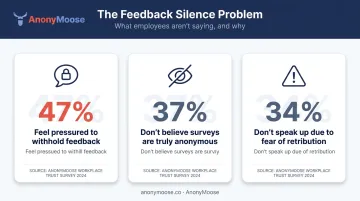
- 47% of employees often or occasionally feel pressured to withhold feedback on engagement surveys (Visier, 2024)
- 37% don't believe surveys are ever truly anonymous (Visier, 2024)
- 34% of U.S. employees don't speak up at work due to fear of retribution (DecisionWise)
The SHRM Study (2020) shows what closing that fear gap would mean: when anonymity is genuinely guaranteed, 82% of employees are more likely to share critical feedback, and organizations see a 47% increase in actionable feedback related to management practices — exactly the category that Target's survey has historically underperformed in because employees in frontline roles calculated that honesty about their managers wasn't safe.
When employees feel watched, they default to neutral "safe" answers — and survey data loses its diagnostic value at exactly the moment it's needed most.
The Confidence Signal
The 2025 Wall Street Journal report illustrates what happens when a survey instrument captures declining morale without triggering a genuine response. About 40% of Target's survey respondents lacked confidence in the company's future — lower scores than the year before, with even steeper drops at headquarters. The survey worked as a detection mechanism. The response mechanism is what's missing.
Surveys break down when the feedback loop stops at data collection. Without built-in anonymity, transparent results, and visible follow-through, even well-designed surveys produce responses employees have already learned not to trust.
Best Practices for Designing an Effective Target Employee Survey
Guarantee Anonymity at the System Level
There's a meaningful difference between a platform that says results are anonymous and one that is technically incapable of linking a response to an individual. Employees can tell the difference — and their willingness to answer honestly depends on it.
System-level anonymity means:
- The platform records that a submission belongs to an organization, but never links it to a specific person
- There is no technical mechanism — not for administrators, not for HR, not even for the platform provider — to expose who sent a response
- Anonymity is enforced by design, not by access controls or policy commitments
Platforms like AnonyMoose are built on this principle. Neither the employer nor AnonyMoose itself can identify individual survey respondents — because the architecture doesn't store that linkage in the first place. Without that structural guarantee, response rates and candor both suffer.
Keep Surveys Focused and Time-Appropriate
Frontline retail workers don't have 20 minutes of uninterrupted downtime during a shift. Respect that.
| Survey Type | Length | Cadence | Purpose |
|---|---|---|---|
| Annual engagement survey | 15–20 questions | Once per year | Broad benchmark, trend tracking |
| Pulse survey | 10–15 questions | Quarterly | Follow-up on specific issues |
Gallup's core engagement instrument uses 12 items as its validated baseline. Culture Amp supports 10–15 questions for pulse surveys. Aim for enough depth to surface actionable data — not so many questions that completion rates fall.
Time Surveys Strategically
Avoid launching surveys during peak retail periods — holiday rush, back-to-school season — when workload stress is highest. Rushed responses produce unreliable data. To improve timing and response quality:
- Schedule during moderate-traffic periods, not peak seasons
- Communicate the survey window in advance so employees can plan
- Give a clear deadline — open-ended timelines lower completion rates
Mix Question Formats
A well-designed survey uses both types:
- Likert-scale items (1–5 ratings) generate quantifiable trend data you can track over time
- Open-ended prompts (e.g., "What one change would most improve your experience at work?") surface qualitative insights that ratings miss — especially useful for safety concerns or management issues
- Sequencing matters: lead with rating scales, close with open-ended questions so respondents aren't fatigued before they reach the most insightful prompts
Ensure Mobile-First Accessibility
Target's hourly workforce isn't sitting at a desk. Any survey tool needs to be accessible via smartphone, on the employee's own time, without requiring store devices or manager involvement. AnonyMoose's platform is built as a mobile-first solution. Employees can respond via app from anywhere: on a shift break, at home, or on the floor.
Key Questions Every Target Employee Survey Should Include
Management and Trust
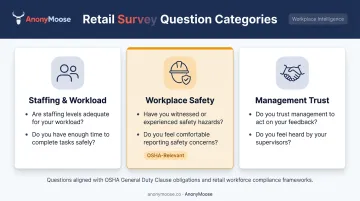
- Do you feel your manager values your contributions?
- Does leadership follow through on commitments made to the team?
- Do you trust that your concerns will be taken seriously?
These questions directly address what Target Workers Unite documented — workers reporting low trust and feeling that management expectations were unrealistic.
Workload, Staffing, and Safety
- Do you have adequate staffing to complete expected tasks during your shift?
- Have you experienced or witnessed a safety hazard in the past 90 days?
- Do you feel comfortable reporting a safety concern without fear of consequences?
The TWU survey found that understaffing and unrealistic productivity expectations were among the top complaints. Those staffing pressures often create physical hazards, too. Target's OSHA record — including a $464,750 settlement over exit and storage hazards across multiple states — underscores why safety questions belong in every retail survey program.
DEI and Psychological Safety
- Have you experienced or witnessed discrimination or harassment at work?
- Do you feel the workplace is equitable regardless of race, gender, or background?
- Do you feel you belong here?
Forward-Looking Confidence
This question is worth tracking consistently over time:
"How confident are you in Target's ability to succeed over the next 12 months?"
The WSJ-reported 2025 confidence decline makes this a leading indicator of retention risk. Culture Amp's retail benchmark finds 20% of retail employees are already thinking about or actively seeking other jobs. A forward-looking confidence question surfaces that disengagement before it shows up in your turnover numbers.
How to Build Psychological Safety Before and During the Survey
Psychological safety isn't created by the survey itself — it's built in the weeks before it launches and maintained through what happens after.
Before the survey:
- Communicate the purpose clearly: what the data will be used for, who sees aggregated results, and what commitment leadership is making to respond
- Explain specifically how anonymity works — not just "your responses are confidential" but how the platform ensures no one can identify individual respondents
- Brief store managers on encouraging participation without giving them access to individual-level results
During the survey window:
- Keep the window open long enough for shift workers on varying schedules to participate
- Use broadcast messaging to remind employees of the deadline without pressuring them
- Ensure managers aren't standing over employees' shoulders during completion
Between survey cycles:
Formal surveys only capture a moment in time. Supplementing them with always-on anonymous feedback channels keeps the conversation going between cycles.
AnonyMoose's Openlines feature gives employees a continuous, safe path to share concerns, functioning as a persistent anonymous two-way thread between employees and specific leaders or departments. This takes the pressure off annual surveys to capture everything. Paired with Polls & Surveys for structured pulse check-ins, organizations can stay connected to employee sentiment without waiting 12 months for the next formal cycle.
Closing the Feedback Loop: Turning Survey Data Into Action
This is where most corporate survey programs fail — and where trust is won or lost.
Share Results With Everyone
Every employee who participated — not just leadership or HR — should see aggregated findings, including the uncomfortable ones. Target Workers Unite specifically called out that Best Team survey results were never shared with workers. Committing to transparency, even when scores are declining, signals that the survey is genuine.
AnonyMoose's Broadcast feature allows leadership to push aggregated results directly to employees' phones via push notification, with attachments for summary reports or action plans. Every eligible employee sees it, regardless of location or shift.
Assign Ownership and Set a Timeline
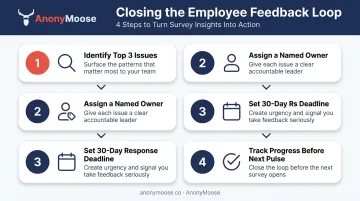
Surfaced problems require named owners, or nothing changes. After each survey cycle:
- Identify the top three issues from the data
- Assign a named owner at the store or district level for each issue
- Set a 30-day deadline to communicate a response plan back to employees
- Track progress on each item before the next pulse survey
Use Pulse Surveys to Verify Whether Changes Landed
A quarterly pulse (10–15 questions) allows you to check whether specific interventions improved scores before the next annual survey. Culture Amp supports this schedule, and AnonyMoose's Polls & Surveys feature supports targeted pulse deployment to subgroups, such as employees at a store where a particular issue was flagged.
Don't launch the next pulse without first sharing what you did with the last survey's data. When that step is skipped, response rates drop — employees conclude the survey is performative, not functional.
Frequently Asked Questions
What is a good employee survey score?
Culture Amp's January 2026 retail benchmark reports 70% employee engagement as the retail median. Trend direction typically matters more than any single benchmark — a score improving from 62% to 67% signals healthier momentum than a stagnant 75%.
What is a Target survey?
In the employment context, a Target survey refers to Target Corporation's internal employee feedback survey, sometimes called the "Best Team" survey, used to measure team member engagement, satisfaction, and sentiment across its store network and corporate offices.
How often should Target conduct employee surveys?
One annual comprehensive engagement survey (15–20 questions) supplemented by quarterly pulse surveys (10–15 questions) is a practical cadence. This allows trend tracking without overwhelming frontline staff who have limited downtime.
Why do employees distrust corporate employee surveys?
Distrust typically comes from three sources: no structural anonymity guarantee, no visible follow-through on prior results, and results never shared back with respondents. Research into retail workforce dynamics consistently ties low survey participation to all three of these failures.
What questions should a retail employee survey include?
Cover these six areas:
- Management trust and communication
- Workload and staffing adequacy
- Workplace safety
- DEI and sense of belonging
- Compensation fairness
- Confidence in the company's direction
How can managers respond constructively to negative survey results?
Share aggregated findings openly with your team, commit to one or two specific changes, and schedule a follow-up check-in. Defensive responses signal to employees that honest feedback carries consequences — which kills future participation.