In 2026, running these surveys well has become genuinely urgent. Hybrid and remote work have eliminated most informal feedback channels, while Glassdoor reports burnout mentions rose 65% year over year in Q1 2026, appearing 2.5x more often than before the pandemic. Organizations that don't actively listen aren't just missing signals — they're pushing employees to vent externally instead.
This guide covers what an employee sentiment survey is, how to design and run one effectively, the best practices that matter most in 2026, and the common mistakes that undermine the entire exercise.
Key Takeaways
- Sentiment surveys measure how employees feel — distinct from engagement surveys, which measure what employees do as a result
- Anonymity is the single biggest factor in honest responses: without it, you measure social desirability, not reality
- The survey process is a closed loop: skipping the "act and communicate" step destroys trust faster than not asking at all
- Pulse surveys (monthly/quarterly) and deeper annual surveys serve different purposes and work best in combination
- Segmenting results by team, department, or tenure reveals the localized issues that organization-wide averages hide
What Is an Employee Sentiment Survey?
An employee sentiment survey captures employees' emotional attitudes, satisfaction levels, and perceptions about their workplace — covering areas like culture, leadership, workload, DEI, and psychological safety. Gartner describes this category as tools that collect and analyze how employees feel about their work and organization.
How It Differs from an Engagement Survey
These two terms get conflated constantly, but they measure different things:
- Sentiment = how employees feel right now (emotional state, attitudes)
- Engagement = what employees do as a result (commitment, discretionary effort)
Gallup defines engagement as the "involvement and enthusiasm" of employees — a broader behavioral measure. Sentiment feeds directly into that. When sentiment deteriorates, engagement typically follows — which means catching sentiment shifts early gives organizations a window to act before disengagement turns into attrition.
What These Surveys Look Like
Modern sentiment surveys combine two question types:
| Question Type | Purpose | Example |
|---|---|---|
| Likert-scale / rating | Produces quantifiable, benchmarkable scores | "On a scale of 1–5, I feel my manager values my input" |
| Open-ended | Yields qualitative depth and specific themes | "What is one thing leadership could do to improve your experience?" |
The mix of both is what makes sentiment surveys actionable. Scaled questions surface where problems exist; open-ended responses explain what's actually driving them.
Why Employee Sentiment Surveys Matter in 2026
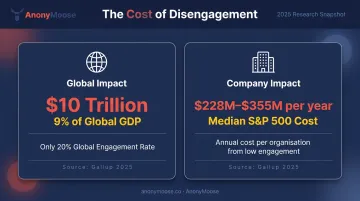
The business case is no longer abstract. Gallup estimates low employee engagement cost the global economy $10 trillion in lost productivity in 2025 — roughly 9% of global GDP — while global engagement fell to just 20%, its lowest level since 2020.
At the individual company level, McKinsey estimates disengagement and attrition cost a median S&P 500 company between $228M and $355M per year in lost productivity.
The Hybrid Feedback Gap
Remote and hybrid work didn't just change where people work — it eliminated the informal feedback channels that gave managers a read on team morale. Hallway conversations, body language, spontaneous one-on-ones: gone for most distributed teams.
Microsoft's Work Trend Index found that 87% of employees reported being productive, while only 12% of leaders had full confidence their teams actually were. Structured sentiment surveys are now the main tool managers have for understanding how distributed employees actually feel.
That perception gap points to a deeper problem with feedback frequency. The same data showed only 43% of employees said their company solicits feedback at least once a year, while 75% of employees and 80% of managers said it wasn't frequent enough.
When Feedback Has Nowhere to Go
When organizations don't create safe, structured channels for employees to share concerns internally, those concerns go somewhere else:
- Burnout, dissatisfaction, and cultural issues surface on Glassdoor, Blind, and LinkedIn instead
- Undetected disengagement escalates into turnover
- Leadership makes decisions without understanding employee reality, widening the perception gap further
Deloitte's 2024 Global Human Capital Trends report found 97% of HR leaders said their organizations had improved DEI outcomes — but only 37% of workers strongly agreed progress was being made. It surfaces in surveys — if those surveys are designed to capture it honestly.
How to Design and Run an Employee Sentiment Survey
The survey process is a closed loop: define objectives → design → deploy → analyze → act and communicate. Skipping any step, especially the last one, breaks the trust employees placed in the process.
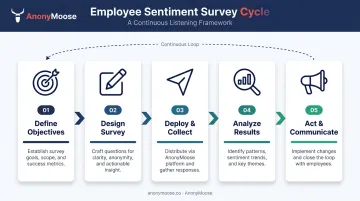
Before writing a single question, define what you're actually measuring. Overall morale? Reaction to a specific organizational change? Manager effectiveness? DEI sentiment in a particular region? Unfocused surveys produce unfocused insights.
Step 1: Design the Survey
Question design principles:
- Keep the survey under 10 minutes — Qualtrics notes that surveys exceeding 12 minutes see declining response rates and quality
- Use Likert-scale questions for benchmarkable, trackable data
- Include 2–3 open-ended questions for qualitative texture
- Avoid leading questions, double-barreled questions, and jargon that not all employees will parse the same way
Example questions to include:
- "How likely are you to recommend this company as a place to work?" (eNPS format)
- "I feel comfortable sharing concerns with my manager without fear of consequences" (5-point scale)
- "What is one thing leadership could do differently to improve your day-to-day experience?" (open-ended)
Anonymity must be built into the design, not added as an afterthought. Employees need technical assurance that responses cannot be traced back to them: not a policy promise, but a genuine architectural guarantee. The SHRM Study (2020) found that 82% of employees are more likely to share critical feedback when anonymity is preserved, and research from buildempire.co.uk shows anonymous surveys generate 58% more honest feedback alongside 90% participation rates versus 30% for identified surveys — figures that represent the practical ceiling of what a sentiment program can achieve when structural trust is in place.
Platforms like AnonyMoose are purpose-built for this. The system records that a submission belongs to a given organization but never links it to any individual identity, making responses technically un-traceable by the platform, the HR team, or any subsequent investigator.
Step 2: Deploy and Collect Responses
Delivery and timing:
- Mobile-first access matters for frontline, deskless, and hybrid employees — participation rises when employees can respond from any device, on any shift, without needing a company email or laptop
- Avoid launching during performance review cycles, major reorganizations, or high-stress operational periods — responses will reflect the moment, not the underlying sentiment
- Push notifications at launch drive significantly higher response rates than email-only delivery
Survey types and cadence:
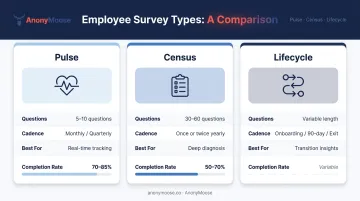
| Survey Type | Length | Frequency | Best For |
|---|---|---|---|
| Pulse survey | 5–10 questions | Monthly or quarterly | Real-time trend tracking |
| Census/annual survey | 30–60 questions | Once or twice a year | Deep diagnosis |
| Lifecycle survey | Varies | Onboarding, 90-day, exit | Transition moments |
Pulse surveys achieve 70–85% completion rates versus 50–70% for annual surveys, according to WorkTango benchmarks. Running both in combination gives organizations the breadth of an annual diagnostic alongside the real-time sensitivity of continuous pulsing.
AnonyMoose's Polls & Surveys feature is designed specifically for the pulse layer. It deploys instantly via push notification to any targeted employee group, reaching frontline and deskless workers who don't sit at laptops, with single-tap response capability that eliminates participation friction.
Step 3: Analyze Results and Close the Loop
Analyzing open-ended responses:
Open-ended comments are where the real signal lives, but analyzing them at scale requires more than human reading. Natural Language Processing (NLP) classifies responses as positive, neutral, or negative and surfaces recurring themes, turning qualitative data into comparable, trackable metrics.
AnonyMoose's Insights Dashboard includes AI-assisted pattern recognition that identifies themes across aggregated anonymous feedback, helping leadership understand what employees are collectively experiencing without accessing individual identities.
Closing the feedback loop:
Analysis only creates value if it leads to action. This is where most survey programs fail. After results are in:
- Share high-level findings with employees — not just leadership
- Communicate specifically what actions will be taken and by when
- Follow up to confirm those actions were completed
- Reference previous survey results when launching the next survey cycle
AnonyMoose's Broadcast feature supports this loop directly: leadership can push survey findings, action plans, and follow-up communications to all employees or specific subgroups via guaranteed push notification, reaching every device in seconds regardless of location or shift.
Gallup's research confirms that when organizations fail to act on survey results, engagement decreases and turnover increases. The survey itself is not the intervention. What you do with the results is.
Employee Sentiment Survey Best Practices for 2026
Getting your survey process right means more than picking good questions. These five practices separate programs that drive real change from ones that collect data and go quiet.
1. Build anonymity into the platform, not just the policy Employees correctly suspect that many "anonymous" surveys aren't truly anonymous. Demographic filtering on small teams, manager-distributed surveys, and platforms that retain identifying metadata all create real retaliation risk. Communicate the technical anonymity guarantee before the survey launches, and use platforms where anonymity is built into the system's architecture — not just promised in a policy document.
2. Survey on a regular schedule, not just after problems emerge Surveying only after a crisis signals that listening is damage control, not a genuine practice. Define a regular rhythm — short pulse monthly, deeper survey semi-annually — so employees come to expect it and leadership can track trends over time rather than react to isolated snapshots.
3. Write clear, unbiased questions Plain language matters. Every employee — regardless of role, location, or education level — should be able to read a question and know exactly what it's asking. Test questions on a small representative group before full deployment.
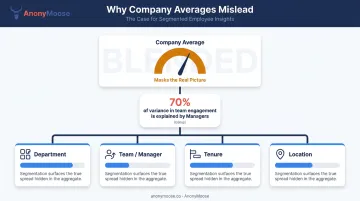
4. Segment results to find where problems actually live Organization-wide averages mask serious localized issues. McKinsey's segmentation research shows that averages blend dramatically different populations, from thriving employees to those on the verge of quitting.
Break results down by department, team, manager, tenure, and location. Gallup research finds that managers account for 70% of variance in team engagement, which means team-level data is far more actionable than any company-wide score. The SHRM Study (2020) corroborates this with a specific finding: organizations with genuine anonymous channels see a 47% increase in actionable feedback related to management practices — the category most likely to be sanitized when employees are asked to put their name on their answers.
5. Track trends, not just scores A single eNPS of 17 (Culture Amp's global median for 2026, based on ~102 million responses from ~5,000 organizations, tells you almost nothing without context. What matters is whether your score is improving, by how much, and how that compares to previous cycles. Set measurable improvement targets and hold teams accountable for movement.
Common Mistakes and Misconceptions
Surveying Without Acting
This is the most damaging pattern in corporate survey programs. Employees who see their feedback ignored become less likely to participate in future surveys — and more likely to disengage or post on Glassdoor instead.
Before launching any survey, assign a clear owner and set a specific timeline for action. The survey creates an obligation.
Survey Fatigue from Surveys That Are Too Long
As McKinsey notes, survey fatigue is caused by inaction — not by the surveys themselves. Short, well-crafted pulse surveys run consistently outperform exhaustive annual questionnaires that employees dread completing. Annual surveys should aim for 15–30 minutes maximum; pulse surveys should stay under 5 minutes.
Assuming Anonymity When It Isn't Guaranteed
Many organizations claim anonymity while using tools that allow demographic filtering — which can identify individuals on small teams. Others have managers distribute and collect surveys directly, undermining any credibility the anonymity claim might have.
Even if the data is technically anonymous, responses skew toward social desirability if employees don't believe it is. The guarantee means nothing unless it's communicated clearly and credibly.
Frequently Asked Questions
How do you measure employee sentiment in a survey?
Sentiment is measured by combining closed-ended scale questions — which produce quantifiable, trackable scores — with open-ended questions analyzed using NLP to classify responses as positive, neutral, or negative and surface recurring themes. Together, these produce a sentiment score that can be monitored across survey cycles.
What is a good employee sentiment score?
There's no universal benchmark. Culture Amp's 2026 global data reports a median eNPS of 17 across approximately 5,000 organizations, but scores are most meaningful when tracked over time against your own previous results and industry-specific comparisons. Trend direction matters more than any single number.
What is a good comment for an employee sentiment survey?
Useful comments are specific, honest, and constructive. Vague answers like "management could improve" give HR nowhere to go; specific ones like "my team doesn't get feedback on projects until after decisions are made" are actionable. The more concrete the detail, the more useful it is.
How often should you run an employee sentiment survey?
A layered approach works best: short pulse surveys monthly or quarterly for real-time tracking, a more comprehensive survey annually or semi-annually for deeper diagnosis, and lifecycle surveys at key moments like onboarding and exit. Each serves a different purpose.
What is the difference between employee sentiment and employee engagement?
Sentiment is how employees feel — their emotional state and current attitudes toward their work environment. Engagement is what employees do as a result — their level of commitment, discretionary effort, and connection to the organization. Positive sentiment typically drives higher engagement, but they're separate metrics requiring different measurement approaches.
How do you improve response rates in employee sentiment surveys?
Three factors drive response rates: guaranteed anonymity so employees feel safe being honest, short surveys accessible on mobile, and visible proof that past feedback led to real changes. When employees see their input acted on, they keep participating.