Introduction
Financial services firms are facing a workforce management reality that annual reviews and quarterly town halls simply cannot keep up with. High-pressure culture, shrinking talent pipelines, and accelerating turnover are creating conditions where outdated feedback channels leave HR leaders making retention decisions without reliable data.
The numbers reflect a sector under strain. BLS JOLTS data from April 2026 shows 191,000 total separations in financial activities in a single month — with 109,000 of those being voluntary quits. Meanwhile, Culture Amp's January 2026 Financial Services benchmark reports that 17% of financial services employees are actively thinking about or looking for another job, even within an industry that posts 74% overall engagement.
Strong aggregate engagement scores can mask real flight risk at the team or role level — and by the time that risk surfaces in exit data, it's already too late to act.
This guide breaks down what financial services firms actually need from an employee survey platform: the features that matter, the survey cadences that work, and how to turn responses into actions that employees notice.
Key Takeaways
- Financial services employees face unique feedback barriers — hierarchy, compliance pressure, and fear of retaliation — that standard HR tools don't address
- True anonymity (where neither the employer nor the platform can identify respondents) is the single feature that unlocks honest signal in this sector
- A regular cadence of engagement, pulse, exit, and DEI surveys produces more actionable insight than any single annual survey
- Survey data only generates value when employees see it lead to visible change — silence after a survey does more damage than not surveying at all
- The right platform reduces external whistleblowing risk, improves retention, and builds a stronger compliance culture — starting with the employees themselves
Why Financial Services Firms Need a Dedicated Employee Survey Platform
The Engagement-Retention Link Is Real
Financial services firms don't struggle with engagement in isolation. When employees feel unheard, the effects ripple outward — into client interactions, compliance behaviors, and institutional risk.
Deloitte's survey of 700 US financial services professionals found that 66% of remote or hybrid workers would likely leave if required to return to the office full time. That's not a remote-work debate — it's evidence of how quickly retention risk activates when employees feel their preferences are ignored. A dedicated survey platform catches those signals before they become resignations.
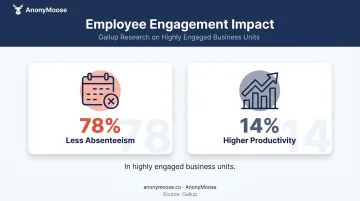
Cross-industry data from Gallup puts the business stakes in sharper terms: highly engaged business units experience 78% less absenteeism and 14% higher productivity. In financial services, where service quality and compliance depend on present, focused employees, those numbers translate directly to risk management.
Traditional Feedback Channels Don't Work Here
That retention risk doesn't resolve itself through the standard toolkit. Annual reviews, town halls, and skip-level meetings have three structural problems in financial services:
- Annual reviews happen too infrequently. By the time a culture issue surfaces in review data, it's already shaped behavior, accelerated departures, or attracted regulatory attention
- Town halls create social pressure. Asking a junior analyst to raise a concern about their manager in front of peers and senior leadership is not a feedback mechanism — it's a silence mechanism
- One-on-ones are limited by the manager relationship. When the manager is the problem, that channel closes entirely
The Turnover Cost Argument
Those channel gaps feed directly into turnover. Gallup estimates that 42% of voluntary turnover is preventable — and replacement costs run approximately 80% of annual salary for technical professionals and 200% for managers and leaders. In a sector where junior analysts, relationship managers, and compliance officers all carry substantial replacement costs, a survey platform that prevents even a handful of departures per year pays for itself quickly.
Employees who feel unheard rarely leave quietly. The downstream behaviors add up fast:
- Posting negative reviews on Glassdoor or Blind
- Filing formal HR or regulatory complaints
- Disengaging in place — present but unproductive
- Leaving abruptly without surfacing fixable problems
An internal anonymous channel addresses the root cause: employees have no safe place to speak.
Unique Challenges Facing Financial Services Employee Surveys
Fear of Retaliation Suppresses Honest Feedback
In financial institutions, job performance is tracked closely, hierarchies are steep, and compliance culture means everything gets documented. For junior staff especially, the decision to speak up is simple math: the risk of being identified outweighs any benefit of sharing honest feedback.
This fear doesn't disappear with a "confidential" checkbox. It disappears only when employees have genuine technical assurance that their identity cannot be traced — not by HR, not by their manager, and not by the platform itself.
Compliance and Data Privacy Add Real Complexity
Running employee surveys in financial services isn't just an HR decision. Several regulatory frameworks shape how survey data must be handled:
- SOC 2 — controls for security, availability, confidentiality, and privacy of outsourced systems
- GDPR / CCPA — lawful data processing, data minimization, storage limits, and individual rights
- OCC third-party risk guidance — risk management lifecycle requirements for banking vendor relationships
- FINRA cybersecurity standards — technology governance, access management, and vendor oversight
- SEC whistleblower rules / SOX §806 — protections against retaliation for compliance disclosures
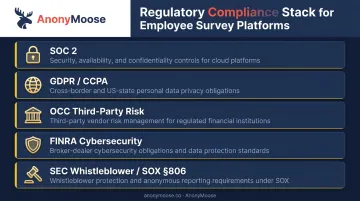
Any platform handling employee survey data in financial services needs to align with this governance stack — not just the privacy layer.
Survey Fatigue Is a Structural Problem
Culture Amp's January 2026 data points to a specific pattern in financial services:
- Work Pressure and Purpose scores are significantly below industry averages
- 19% of employees disagree their total compensation is fair relative to similar internal roles
- These are the exact topics least likely to surface in named surveys
When employees watch previous surveys produce no visible change, they stop participating. HR leaders then receive data that underrepresents the most disengaged segments — exactly the people whose feedback matters most.
Distribution and Access Challenges
Larger financial institutions compound these problems through operational complexity:
- Branch employees across multiple sites who rarely have consistent desk access
- Remote and hybrid teams across multiple time zones
- Diverse language backgrounds requiring accessible survey formats
- Shift structures that make synchronous feedback impossible
A survey platform that only works on company laptops during business hours will systematically exclude large portions of the workforce.
Must-Have Features in a Financial Services Employee Survey Platform
True, Verified Anonymity
This is non-negotiable. There's a meaningful difference between confidentiality (the employer promises not to look) and true anonymity (the architecture makes identification technically impossible).
Confidential surveys still log who responded. A determined HR leader, manager, or investigator can cross-reference submission timing, content, or response patterns to narrow down authorship. In compliance-heavy environments, that's enough to suppress honest feedback.
True anonymity means no individual response can be traced by HR, by the platform, or by a third-party auditor. AnonyMoose is built around this principle: submissions are linked to an organization, not to an individual. The anonymity is a technical fact, not an organizational promise.
That distinction matters most for compensation fairness and work pressure feedback — the two areas where Culture Amp's 2026 data shows the weakest scores in financial services.
Mobile-First, Zero-Hardware SaaS Access
Branch tellers, field advisors, and relationship managers are rarely at a desk when those opinions take shape. A survey platform that requires a company laptop and a VPN connection will miss them entirely.
The right platform is accessible from any personal smartphone, at any time, with no hardware investment or IT infrastructure required. For financial services firms deploying across multiple locations or geographies, this means setup in weeks (not months), automatic scaling, and no ongoing maintenance burden for internal IT teams.
Real-Time Pulse Survey Capability
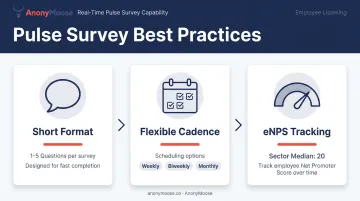
Annual surveys miss the fast-moving sentiment shifts that define high-pressure financial environments. A platform should support:
- Short surveys (1–5 questions) delivered via push notification
- Flexible cadences — weekly, biweekly, or monthly depending on the topic
- eNPS tracking — Culture Amp's 2026 benchmark puts financial services median eNPS at 20, making this a useful directional indicator between comprehensive surveys
Enterprise-Grade Data Security
Financial services firms should require platforms that demonstrate each of the following at minimum:
- SOC 2 alignment
- GDPR/CCPA compliance
- End-to-end encryption
- Clear data residency options
Given OCC third-party risk guidance and FINRA cybersecurity standards, vendor evaluation should include documented security architecture — not just self-reported claims.
Segmentation and Trend Analytics
Aggregate scores tell you where to look, not what to fix. The platform should allow HR leaders to filter results by department, tenure, role, and location — then compare against financial services industry benchmarks to determine whether gaps are organizational problems or sector-wide patterns. Culture Amp's 2026 data puts the sector engagement median at 74%, giving HR leaders a concrete external reference point for internal scores.
Types of Surveys Every Financial Services Company Should Be Running
Engagement and Pulse Surveys
These two formats serve different purposes and work best together.
Annual engagement surveys establish a comprehensive baseline, covering leadership trust, learning and development, compensation fairness, workload manageability, and inclusion. They give HR the strategic depth needed for annual planning and board-level reporting.
Pulse surveys track what's happening right now. A 3-question pulse sent monthly can detect a spike in burnout following a reorg, a drop in manager trust after a leadership transition, or early-stage disengagement before it becomes a resignation.
In financial services, where market conditions and internal pressures can shift rapidly, waiting 12 months for the next data point is too long.
Adding an eNPS question to regular pulse surveys creates a single directional indicator that's easy to track over time. With the sector median sitting at 20, financial services HR leaders have a concrete external benchmark to measure against.
Exit and Stay Surveys
Exit surveys capture why people leave. Stay surveys — or stay interviews — capture what would make someone stay before they've decided to go.
In a sector where McKinsey projects a 90,000–110,000 US wealth advisor shortage over the next decade, retaining advisors is a strategic priority, not just an HR metric. Exit interviews after departure are too late. Stay surveys, run anonymously on a regular cadence, surface the flight-risk signals while there's still time to act.
DEI and Inclusion Surveys
Culture Amp's 2026 data shows financial services firms with 500–1,000 employees scored well above average on Action, Voice, and Inclusion. Aggregate inclusion scores, however, can mask real disparities by role, seniority, gender, or department that standard engagement surveys won't surface.
A dedicated DEI survey, conducted anonymously, allows firms to identify equity gaps sitting underneath favorable headline numbers. This matters for both compliance and investor reporting:
- SEC Regulation S-K requires material human capital disclosures — workforce experience data, not just headcount demographics
- EEO-1 reporting is mandatory for employers with 100+ employees
- Survey data on lived employee experience strengthens both filings and investor confidence
Best Practices for Turning Survey Insights Into Action
Close the Feedback Loop Fast
The single strongest predictor of future survey participation is whether employees see their last round of feedback lead to visible change. In financial services, where employees are already skeptical that surveys produce anything, silence after a survey is worse than not surveying at all — it confirms their assumption.
The process should be simple and visible:
- Share results within a defined timeframe — including the uncomfortable findings
- Name specific commitments tied to those findings
- Reference those commitments explicitly in the next survey cycle
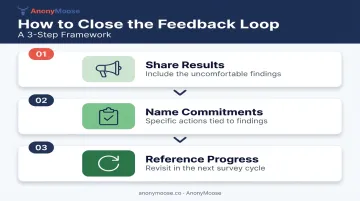
Broadcast messaging tools (like AnonyMoose's push-notification Broadcast feature) handle this directly: HR leaders can reach every employee, including deskless and distributed staff, the moment results are ready to share.
Distribute Ownership Beyond HR
Gallup's research shows managers account for 70% of variance in team engagement — and warns against treating engagement as "an HR thing." When survey results sit only in a central HR report, the people with the most power to change team-level conditions never see the data.
Distributing ownership looks like this in practice:
- Break results down by team and assign action items to department heads and line managers
- Shift HR's role to facilitation and accountability tracking, not sole ownership of improvement
- Involve the full management tier in action planning — changes managers own tend to actually happen (per SHRM guidance)
Benchmark Against Industry Standards, Not Just Last Year
Measuring only against internal historical scores can create false confidence or unnecessary alarm. Comparing scores against Culture Amp's 2026 financial services benchmarks — 74% sector engagement, eNPS 20 — tells you whether a gap is an organizational problem or an industry-wide pattern.
That distinction matters when making the case for investment. A 68% engagement score looks alarming in isolation; set against the sector median, it reframes the leadership conversation and points toward specific, defensible interventions rather than a general alarm.
Frequently Asked Questions
What types of employee surveys are most effective in financial services?
A combination of annual engagement surveys, quarterly pulse surveys, and targeted exit and DEI surveys gives the most complete picture. Annual surveys provide strategic depth, pulse surveys catch emerging trends, and exit and DEI surveys surface the specific gaps that general engagement data misses.
How often should financial services companies survey their employees?
Use a layered cadence: annual comprehensive surveys for strategic benchmarking, quarterly pulse surveys for trend tracking, and event-triggered surveys (onboarding, exit, post-promotion) for lifecycle insights. More frequent isn't always better — what matters is acting on each round before the next one runs.
How do you improve employee survey response rates in financial services?
Response rates hinge on three factors: guaranteed technical anonymity to reduce fear of retaliation, demonstrated action from previous surveys so employees believe participation is worth their time, and mobile accessibility so responses don't depend on desk access or company devices.
What questions should a financial services employee survey include?
Focus on the areas Culture Amp's 2026 benchmarks identify as key drivers and pain points: leadership trust, learning and development opportunities, workload manageability, compensation fairness, and whether employees feel their feedback leads to real change. These are also the topics most likely to be underreported in non-anonymous formats.
How does anonymity improve employee survey results in financial services?
In compliance-heavy, hierarchical cultures, employees fear being identified even when surveys claim to be "confidential." True anonymity — where the platform architecture itself prevents identification — removes that barrier and produces the kind of honest signal HR can actually act on.
What should financial services HR leaders do after receiving survey results?
Share findings transparently with employees — including difficult findings — assign specific action items to team leaders rather than centralizing everything in HR, and follow up at the next survey cycle with measurable progress.