Introduction
Remote workers are, statistically, your most engaged employees. Gallup's 2025 research found that fully remote workers hit 31% engagement — the highest of any work location group. Yet those same employees report higher loneliness, more daily stress, and lower life satisfaction than their hybrid or on-site peers.
That tension is the central challenge HR leaders face with distributed teams. Employees can be productively engaged and emotionally strained at the same time, and without the right listening tools, organizations miss both signals entirely.
Engagement surveys are one of the most direct ways to close that gap — but only when they're designed for how remote work actually functions, not retrofitted from in-office templates. Most off-the-shelf survey templates were built around office assumptions: shared context, visible managers, easy watercooler feedback. Remote teams need something different. This article covers five strategies specifically built for distributed workforces — ones that generate honest, actionable data rather than polite, filtered responses.
Key Takeaways
- Remote employees face unique challenges — isolation, async friction, and career visibility gaps — that standard surveys consistently miss
- True anonymity requires structural design, not just a policy promise — without it, remote employees self-censor
- Pulse surveys (monthly or quarterly, 5–10 questions) outperform annual marathons for distributed teams
- Combining Likert scales with rotating open-ended questions captures trends and uncovers root causes
- Closing the feedback loop visibly and quickly is what makes employees participate next time
Why Remote Employee Engagement Surveys Are Different
Standard engagement surveys were built for co-located teams — ones where managers can read the room, catch hallway signals, and notice when morale shifts. Remote work removes all of that context.
Without informal check-ins, visible body language, or the spontaneous hallway conversation, surveys become the primary window into how distributed employees actually feel. Most standard survey templates aren't designed for this role.
The Gaps Standard Surveys Miss
Remote-specific pain points rarely appear in generic question banks:
- Digital fatigue — Microsoft found the average employee spends 57% of their working time in meetings, email, and chat, with Teams meeting time up 252% since 2020
- Time zone friction — HBS research shows synchronous communication drops 11% for each additional hour of time zone difference
- Career visibility anxiety — remote workers received 31% fewer promotions than in-office colleagues in 2023, according to Live Data Technologies analysis of 2 million white-collar workers
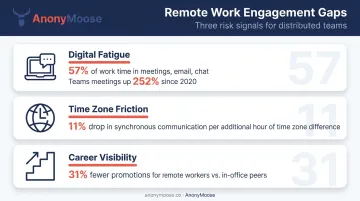
A question like "Do you feel recognized at work?" won't surface any of these issues. Each data point above points to a structural gap — one that only shows up when you ask questions designed specifically for distributed work. Remote engagement surveys aren't a replacement for standard surveys. They layer on top, capturing what generic templates are simply not built to find.
5 Strategies for Remote Employee Engagement Surveys That Work
Strategy 1: Design Questions Around Remote-Specific Challenges
Generic questions ("Do you feel valued?") produce generic answers. They don't isolate whether an employee feels disconnected because of poor management, inadequate tools, time zone exclusion, or something else entirely.
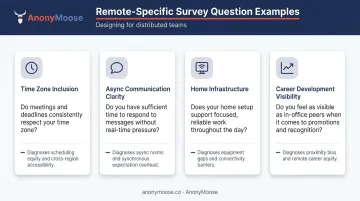
Four question categories every remote survey should cover:
- Team connection — Do employees feel tied to company goals and team culture despite physical distance?
- Manager accessibility — Are virtual check-ins happening, and are they useful?
- Remote performance — Can employees structure their day and focus without office infrastructure?
- Well-being — Is work-life separation actually possible, or are boundaries eroding?
Example questions you won't find on a standard survey:
- "How often do meeting times require you to work significantly outside your normal hours?" — surfaces time zone inclusion issues
- "When you receive async instructions, how often do you have enough context to move forward without follow-up?" — diagnoses communication clarity in distributed workflows
- "Do you have access to the hardware, software, and internet quality you need to do your job effectively from home?" — catches infrastructure gaps managers can't see
- "In the past 30 days, have you had a meaningful conversation with your manager about your career development?" — tracks promotion-visibility risk before it becomes attrition
McKinsey research found employees included in detailed communication were nearly 5x more likely to report increased productivity — which suggests that asking about communication quality isn't just engagement hygiene, it's a performance lever.
Strategy 2: Make Anonymity Non-Negotiable
Remote employees already face a documented disadvantage on promotions. Asking them to share candid concerns in a survey that could be traced back to them is asking a lot. Most won't do it.
SHRM has noted that department, title, tenure, and salary level — common survey demographic fields — can be enough to identify specific respondents, especially in small or specialized teams. When employees suspect this, they self-censor or skip participation entirely.
What True Anonymity Actually Requires
Most platforms that "offer anonymity" still retain metadata. True anonymity means responses cannot be traced to individuals: not through the survey link, not through timestamps, not through demographic combinations, and not through administrator access on the vendor side.
AnonyMoose's Polls & Surveys feature is built to this standard. Specifically:
- Neither the employer nor AnonyMoose can identify who submitted a response
- No administrator view exposes individual submissions
- No toggle, no exception — anonymity is enforced at the platform level, not by policy alone
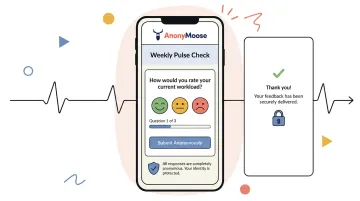
This distinction matters for participation. Anonymous surveys reach participation rates of 90% versus roughly 30% for identified surveys, and capture significantly more honest critical feedback. For remote teams who already feel career-vulnerable, that psychological safety gap is the difference between useful data and noise.
Strategy 3: Use Pulse Surveys Instead of Infrequent Marathons
Annual surveys have one core problem: by the time results are analyzed and shared, the conditions that generated them have changed. For remote teams — where sentiment shifts rapidly with reorgs, RTO mandates, or team restructuring — a 12-month feedback cycle is almost useless for real-time decision-making.
The case for pulse surveys:
- Shorter format (5–10 questions) means higher completion rates and less survey fatigue
- Monthly or quarterly cadence lets HR track trends as they develop, not after the fact
- Emerging engagement dips get caught before they become turnover
- Repeated measurement builds longitudinal data that annual snapshots can't provide
Microsoft's Work Trend Index data shows that 55% of hybrid employees and 50% of remote employees felt lonelier at work than before going remote — sentiment that can shift meaningfully within weeks, not annually.
Platforms like Qualtrics support weekly, biweekly, and monthly pulse distribution with optional rotating questions to reduce fatigue. Culture Amp benchmarks suggest 80–90% response rates as a healthy target for pulse formats.
Cadence and trust go together. A five-question monthly pulse employees believe will drive change outperforms a 50-question annual survey — but only if the feedback loop closes visibly, which brings us to Strategy 5.
Strategy 4: Mix Quantitative and Qualitative Question Types
Neither format alone tells the full story.
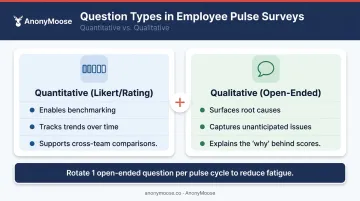
Quantitative questions (Likert scales, 1–10 ratings) enable benchmarking. You can track whether manager accessibility scores are trending up or down month over month. You can compare scores across teams or regions. You get numbers that can drive decisions.
Qualitative open-ended questions explain the numbers. Culture Amp's research on open-ended survey questions describes them as essential for surfacing issues that fixed-choice formats miss — the "why" behind a low score that no pre-set option could have anticipated.
Smart Question Rotation
Not every employee needs to answer every open-ended question in each cycle. Rotating qualitative prompts across survey cycles reduces respondent burden while still generating rich qualitative data across the full team over time.
One high-value open-ended question per pulse cycle is enough. Something like:
"What is one thing the company could do differently to support you right now?"
At scale, sentiment analysis tools can tag open-ended responses by topic and sentiment — positive, neutral, or negative — making qualitative data actionable without manual review of every comment. For large remote teams, this is the only practical way to extract signal from open-ended responses consistently.
Strategy 5: Close the Feedback Loop Visibly and Quickly
The most common reason remote employees stop participating in surveys is silence after submission. When feedback disappears into an HR process with no visible outcome, the logical conclusion is that nothing changed — and there's no reason to share honest input next time.
Qualtrics data suggests employees who feel their feedback isn't acted on are 4x more likely to consider leaving. For remote teams, where disengagement can quietly accelerate without visible signals, that consequence moves fast.
The "You Said, We Did" Model
The principle is simple: share what you heard, then name at least one specific action being taken in response.
- Share key findings within a set timeframe after each survey cycle — including uncomfortable themes
- Acknowledge areas where action is being taken and areas where it isn't, with honest explanation
- Communicate through channels remote employees actually use, not just email
AnonyMoose's Broadcast feature supports exactly this. Leadership can send a targeted message — with attached documents, summaries, or action plans — directly to employees' phones via push notification the moment a communication is ready. The same platform used to collect feedback delivers the response, creating a closed loop that remote employees can actually see.
When employees see their input reflected in a specific decision — even a small one — participation in the next survey cycle goes up. The loop has to close before it can compound.
What to Cover in a Remote Employee Engagement Survey
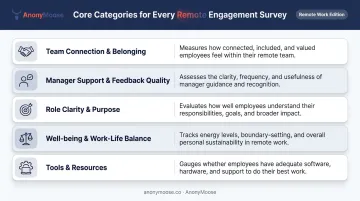
Every remote engagement survey should address these core categories:
| Category | What It Measures |
|---|---|
| Team connection & belonging | Sense of inclusion, cultural ties despite distance |
| Manager support & feedback quality | Virtual check-in frequency, development conversations |
| Role clarity & purpose | Expectation clarity, understanding of how work connects to goals |
| Well-being & work-life balance | Boundary erosion, burnout risk, workload sustainability |
| Tools & resources | Hardware, software, internet, and async workflow adequacy |
Knowing what to include is only half the equation. Equally important is knowing what to cut.
What to leave out:
- Overly personal questions unrelated to work experience
- Vague mood-of-the-day questions that don't track patterns over time
- Any demographic combination narrow enough to identify individuals on small teams
Include at least one open-ended question per cycle. A prompt like "What is one thing we could do differently to support you right now?" captures concerns that no pre-set question anticipated — and often surfaces what no rating scale could predict.
Common Mistakes That Undermine Remote Survey Effectiveness
Using a one-size-fits-all survey template. A generic survey designed for co-located teams will miss remote-specific pain points. Low relevance produces low response rates, and low response rates produce unusable data. Design for the actual context of your workforce.
Deploying surveys without an action plan. Many organizations launch surveys with no clear owner for analysis, no timeline for sharing results, and no specific decisions the data will inform. That approach is worse than not surveying at all — it actively erodes trust. Research consistently shows that following up on survey results is what makes employees feel their opinions actually matter.
Relying on optional or policy-based anonymity. Surveys that offer anonymity as a toggle, or that promise confidentiality without technical enforcement, do not create psychological safety. Employees — especially remote employees who feel less visible and more career-vulnerable — will always wonder whether their response could be traced. Only system-level, technically enforced anonymity removes that doubt.
Each of these mistakes points to the same underlying gap: surveys designed without remote employees in mind. The strategies below address each one directly.
Frequently Asked Questions
How often should you survey remote employees?
Monthly or quarterly pulse surveys work better than annual formats for remote teams. Remote sentiment shifts quickly (reorgs, tool changes, shifting team dynamics) and shorter cycles let HR catch and respond to engagement dips before they become attrition.
How do you ensure anonymity in a remote employee engagement survey?
True anonymity requires a platform where neither the employer nor the vendor can technically trace responses to individuals, not just a promise in the survey instructions. Demographic fields like department, title, and tenure can re-identify respondents in small teams even when names are removed.
What questions should be included in a remote employee engagement survey?
Cover five core categories: team connection, manager support, role clarity, remote well-being and work-life balance, and access to tools and resources. Include at least one open-ended question per cycle — this surfaces concerns no pre-set option would catch.
How do you increase participation rates in remote employee surveys?
Four factors drive participation: guaranteed technical anonymity, short survey length, clear communication of purpose, and visible follow-through on past feedback. Employees engage when they believe it's safe and worth their time.
What should you do after collecting remote engagement survey results?
Follow the "you said, we did" model: share key findings quickly, acknowledge difficult themes without spin, and name at least one specific action being taken. Use channels employees actually check, not just email.
How is a remote employee engagement survey different from a regular engagement survey?
Remote surveys include questions specific to distributed work: digital tool access, time zone inclusion, async communication clarity, virtual manager accessibility, and home-office environment. Standard surveys don't address these categories and miss the root causes unique to remote work.
Conclusion
Remote employee engagement surveys work when they're built around how distributed work actually functions — not when they're copied from in-office playbooks. The questions, the frequency, the anonymity model, and the follow-through all have to reflect the specific realities of employees who lack hallway conversations, visual morale cues, and organic connection with leadership.
Without psychological safety, employees self-censor. Without visible follow-through, they stop participating. Both failures produce the same outcome: data that can't be trusted and decisions that lead you in the wrong direction.
If you're building or refining a remote feedback system, AnonyMoose's anonymous communication platform offers three direct paths to the kind of culture where honest feedback actually flows:
- Polls & Surveys — delivers anonymous pulse surveys to every employee's phone, with no individual response traceable to anyone
- Openlines — always-available two-way channels between employees and leadership, with anonymity enforced at the platform level
- Hotlines — a secure route for employees to surface serious concerns that standard feedback channels can't safely carry
Visit anonymoose.co or contact info@anonymoose.co to see how AnonyMoose helps distributed teams turn anonymous feedback into real decisions.