This pattern is why so many survey programs fail. Not because the questions were wrong, but because the entire process lacked follow-through.
This guide covers everything you need to build a survey program that actually works: what employee feedback surveys are, which types to use, what questions to ask, how to design for honest responses, why anonymity matters more than most HR teams realize, and how to turn results into a real action plan.
Key Takeaways
- Employee feedback surveys evaluate the organization — not the individual — and are distinct from performance reviews.
- Gallup's Q12 Meta-Analysis links top-quartile engagement to 23% higher profitability and 51% lower turnover.
- Combining Likert-scale and open-ended questions surfaces measurable trends alongside unexpected themes.
- Anonymity is the foundation of honest feedback — without it, employees only say what feels safe.
- Surveys without follow-through actively damage trust and depress future participation.
What Is an Employee Feedback Survey and Why Does It Matter?
An employee feedback survey is a structured questionnaire — delivered digitally or otherwise — that gives employees a channel to share their opinions, experiences, and concerns about their work environment, management, culture, and growth opportunities.
Unlike a performance review, this process evaluates the organization — not the individual employee.
The Business Case
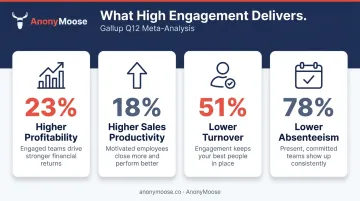
Gallup's 11th edition Q12 Meta-Analysis, drawing on data from over 3.3 million employees across 90 countries, found that top-quartile engagement units outperformed bottom-quartile units by:
- 23% higher profitability
- 18% higher sales productivity
- 51% lower turnover in low-turnover organizations
- 78% lower absenteeism
Despite this, Gallup reported in 2025 that U.S. employee engagement fell to 31% — a 10-year low — while 17% of U.S. employees were actively disengaged.
For context, Gallup estimates that low engagement costs the global economy $8.9 trillion annually — roughly 9% of global GDP. The operational gap is real, and measurable.
The Risk of Doing Nothing
Organizations that skip surveys — or run them poorly — don't avoid the feedback problem. They just lose control of where it surfaces. Employees who feel unheard often turn to platforms like Glassdoor or Blind to post what they wouldn't say internally.
Negative Glassdoor reviews directly affect recruiting: a 2023 Employer Brand study found that 86% of job seekers research company reviews before applying. Internal feedback channels give organizations a chance to address concerns before they become public — and permanent.
Types of Employee Feedback Surveys
Choosing the right survey type matters as much as writing the right questions. Each format answers a different organizational question.
Four Survey Types to Know
| Survey Type | Best For | Typical Cadence |
|---|---|---|
| Annual engagement survey | Broad, strategic view of culture and engagement | Once per year, 30–50 questions |
| Pulse survey | Tracking fast-moving issues and real-time sentiment | Monthly (10–15 questions) or quarterly (15–20) |
| Stay survey | Understanding what keeps current employees before they leave | Proactive; no fixed cadence |
| Exit survey | Diagnosing why employees leave and identifying patterns | At offboarding |
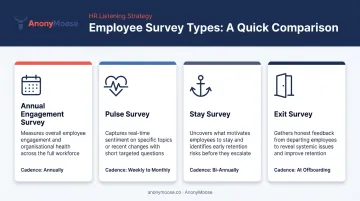
The right cadence depends entirely on what you're trying to learn. Annual surveys give you the strategic snapshot. Pulse surveys catch issues before they compound. Stay surveys are among the most underused tools in retention — SHRM describes them as proactive conversations that surface what employees need before turnover occurs, not after.
Question Formats: Mixing Likert-Scale and Open-Ended
Both formats serve different purposes, and using only one gives you an incomplete picture.
Likert-scale (closed-ended): Quantifiable, trend-able, comparable over time. Example: "On a scale of 1–5, I feel comfortable raising concerns with my manager."
Open-ended: Surfaces unexpected themes, captures nuance and employee voice. Example: "What's one thing leadership could do differently to support your team?"
Engagement vs. Satisfaction: Not the Same Thing
These terms get used interchangeably, but they measure different things:
- Satisfaction asks whether the job is fair, safe, and adequately supported — it measures contentment.
- Engagement asks whether employees will go the extra mile — it measures commitment and discretionary effort.
Both are worth tracking. A satisfied employee isn't necessarily engaged, and an engaged employee can still be burning out. Tracking both gives you a fuller picture of where your workforce actually stands — and where it's heading.
Employee Feedback Survey Questions by Category
The most useful survey questions are specific, free of jargon, and tied to areas the organization can actually act on. Below are example questions organized by theme. Pick and adapt based on what your organization most needs to understand.
Engagement and Belonging
- "I feel comfortable raising concerns with my manager without fear of consequences." (Likert scale: 1–5)
- "I understand how my work connects to the company's broader goals." (Likert scale: 1–5)
- "I feel genuinely valued for the contributions I make at work." (Likert scale: 1–5)
- "What would make you feel more connected to where this company is headed?" (Open-ended)
Work Environment and Culture
- "I experience fair and equitable treatment regardless of my background or identity." (Likert scale: 1–5)
- "Diverse perspectives are genuinely welcomed on my team." (Likert scale: 1–5)
- "Our team culture supports collaboration over competition." (Likert scale: 1–5)
- "What would you change about our workplace culture if you could?" (Open-ended)
Management and Leadership
- "My manager gives me feedback that helps me improve and grow." (Likert scale: 1–5)
- "I feel my manager genuinely cares about my professional development." (Likert scale: 1–5)
- "Leadership communicates organizational decisions clearly and with appropriate context." (Likert scale: 1–5)
- "What's something leadership could do to better support your day-to-day work?" (Open-ended)
Growth, Compensation, and Work-Life Balance
- "I have access to the learning and development opportunities I need to grow in my role." (Likert scale: 1–5)
- "My compensation feels fair relative to my responsibilities and contributions." (Likert scale: 1–5)
- "My current workload is sustainable over the long term." (Likert scale: 1–5)
- "What would most improve your ability to do your best work?" (Open-ended)
Growth opportunities, compensation, and workload are among the strongest predictors of turnover intent. If scores in this category trend low, treat it as an early signal and prioritize a response before employees start disengaging or leaving.
Best Practices for Designing Effective Employee Feedback Surveys
Good survey design determines whether you collect signal or noise. These five principles make the difference between a program employees trust and one they quietly ignore.
Keep It Short Enough to Finish
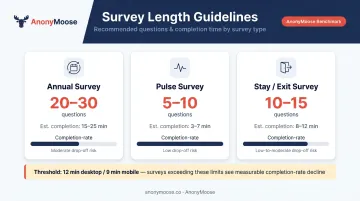
SurveyMonkey's analysis of over 25,000 surveys found completion rates drop from 89% at 10 questions to 79% at 40 questions — and that's for general surveys, not workplace-specific ones where stakes feel higher. The practical benchmarks:
- Annual engagement survey: 20–30 questions
- Pulse survey: 5–10 questions
- Stay or exit survey: 10–15 focused questions
Surveys that take longer than 12 minutes on desktop or 9 minutes on mobile see meaningful drop-off, per Qualtrics guidance. When in doubt, cut questions — you can always resurvey on specifics.
Write Neutral, Not Leading Questions
Questions that suggest a "correct" answer produce responses that tell you what employees think you want to hear, not what they actually think.
- Leading: "Don't you agree that leadership has been transparent about company decisions?"
- Neutral: "How clearly does leadership communicate the reasoning behind major decisions?"
The neutral version opens space for honest assessment. The leading version closes it before employees even respond.
Segment Results to Find What Averages Hide
A company-wide satisfaction score of 3.8/5 can mask a department sitting at 2.1 and another at 4.7. Segmenting by department, tenure, role level, and demographic group is where the real insight lives.
For organizations focused on DEI, segmentation is how you detect whether certain employee groups are having meaningfully different experiences than the overall numbers suggest. AnonyMoose's Polls & Surveys feature supports targeting and segmentation using up to five custom criteria drawn from your HRMS data, eliminating the need for manual data work.
Communicate Before You Launch
Employees respond more honestly — and at higher rates — when they understand why the survey is being run, how anonymity is protected, and what will happen with results. Leadership endorsement matters here. Organizations that visibly communicate purpose before launch and demonstrate that prior feedback led to actual change consistently see higher participation.
Pilot Before You Publish
Run a small test group through the survey first. You're checking for confusing wording, accessibility issues, and whether the actual completion time matches your estimate. A survey you planned for 8 minutes that runs 15 will quietly drain your response rate.
The Role of Anonymity in Getting Honest Employee Feedback
Anonymity isn't a nice-to-have. It's the condition under which honest feedback actually occurs.
A DecisionWise benchmark study of over 100,000 U.S. employees found that 34% of employees don't speak up because of fear of retribution. Employees who fear consequences won't tell you what's actually wrong — they'll give you a response that feels safe. The cost of that silence is measurable: the SHRM Study (2020) found that when anonymity is genuinely guaranteed, 82% of employees are more likely to share critical feedback, and organizations see a 34% boost in productivity through improved employee morale and trust — outcomes that only become possible when the survey channel earns enough trust to capture honest input. Research on employee feedback quantifies the gap: anonymous surveys generate 58% more honest feedback compared to non-anonymous surveys — meaning nearly half of the honest signal in any feedback program is lost the moment employees doubt their identity is protected.
"Confidential" Is Not the Same as "Anonymous"
This distinction matters more than most survey programs acknowledge:
- Confidential surveys may collect identifying information but restrict who sees it. HR could still trace responses if needed.
- Truly anonymous surveys collect no personally identifiable information. No one — including HR — can link a response to an individual.
Employees often sense the difference, even when they can't articulate it technically. Perceived anonymity affects response quality as much as actual anonymity. If employees believe their responses could be traced — regardless of what the policy says — they'll self-censor.
What Happens When Employees Don't Feel Safe
When internal channels feel risky, feedback doesn't disappear. It migrates. Employees turn to Glassdoor, Blind, or public forums to say what they couldn't say inside — creating brand risk, reputation damage, and sometimes legal exposure that's far harder to manage than internal candor ever would have been.
Anonymous internal feedback channels are a proactive alternative. They give employees a trusted place to speak honestly before external platforms become the default.
AnonyMoose's Approach to Technical Anonymity
AnonyMoose's Polls & Surveys feature is built so that neither AnonyMoose nor the employer can identify who submitted a response — not by policy promise, but by technical design. There is no mechanism within the system that permits tracing a response back to an individual. Research from buildempire.co.uk confirms the practical impact: anonymous surveys generate 58% more honest feedback and see 90% participation rates compared to 30% for identified surveys — a difference that determines whether your feedback program surfaces actionable intelligence or socially acceptable noise. The downstream impact of this architectural commitment is documented: the American Psychological Association found that organizations that sustain anonymous feedback programs see a 30% improvement in employee satisfaction within one year — an outcome that compounds across retention, morale, and organizational performance.
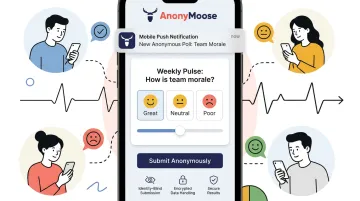
This architecture changes what employees are willing to say. Key platform features that support honest participation:
- Identity-blind submissions — responses cannot be traced to individuals by the platform or the employer
- Mobile push notifications — surveys reach employees on their phones, not their work inboxes
- Single-tap responses — low friction drives higher participation than email-based surveys
- Always-on encryption — data is encrypted throughout, with no identifying metadata attached
Higher participation on its own isn't the full picture. For DEI-focused organizations, technical anonymity also addresses an equity gap: employees from underrepresented groups self-censor at higher rates when they perceive retaliation risk. Removing that risk structurally — not just through policy — means every voice gets equal footing in the data.
Building an Action Plan from Your Survey Results
The survey is not the finish line. What happens after is what determines whether your program builds trust or destroys it.
The Commitment Before You Ask
Before launching any survey, leadership should have a documented process for reviewing results, prioritizing issues, and communicating findings back to employees. Surveys without follow-through don't just fail — they actively damage trust. Employees interpret silence as confirmation that their input was never going to matter.
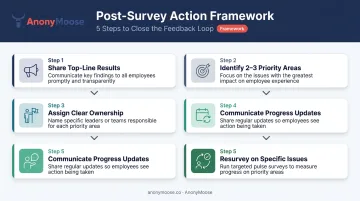
A Five-Step Post-Survey Framework
- Share top-line results with all employees within one week of receiving them — not just leadership. Transparency signals respect.
- Identify two to three priority areas for near-term action. Trying to fix everything fixes nothing.
- Assign clear ownership for each initiative with a realistic timeline. Vague commitments without owners and deadlines rarely produce results.
- Communicate progress updates at a regular cadence — quarterly works for most organizations.
- Resurvey on specific issues after changes are implemented. Closing the feedback loop demonstrates that input actually changed something.
Segmenting and Prioritizing Findings
Not every piece of feedback requires the same response. When analyzing results:
- Systemic issues — patterns appearing across multiple teams, demographics, or tenure groups — warrant organizational-level responses.
- Isolated concerns — one team, one situation — may be better addressed at the manager or department level.
- Involve employees in designing solutions where possible. Top-down fixes applied to employee-raised problems often miss what employees were actually describing.
AnonyMoose's Insights Dashboard supports this kind of segmented analysis with aggregated, anonymized trend data across custom organizational attributes. HR and leadership get the pattern visibility they need without compromising individual privacy.
Frequently Asked Questions
What is an employee feedback survey?
An employee feedback survey is a structured questionnaire that gives employees a channel to share their experiences, concerns, and opinions about their workplace. It helps leadership make informed decisions about culture, management, and engagement — with the organization as the subject of evaluation, not the individual employee.
What are good employee feedback survey questions?
Good questions are specific, neutral in tone, and tied to areas the organization can act on. Cover themes like engagement, management effectiveness, culture, growth, and psychological safety. Mixing Likert-scale questions with open-ended ones gives you measurable trends and the context behind them.
How often should you conduct employee feedback surveys?
Annual surveys work well for comprehensive engagement snapshots. Pulse surveys — monthly or quarterly, with 5–15 questions — track fast-moving issues more effectively. The key is consistency and always following up with results, regardless of cadence.
How do you encourage employees to participate in feedback surveys?
Participation rises when employees trust that anonymity is protected and have seen prior feedback lead to real change. Leadership endorsement and a clear explanation of what happens with results drive meaningfully higher response rates.
How do you analyze and act on employee survey results?
Segment results by team, tenure, and demographics to surface patterns that company-wide averages hide. Prioritize two to three action areas with clear ownership and timelines, share findings with employees, and resurvey after changes are made to close the feedback loop.