Introduction
Most organizations have invested heavily in communication tools — Slack channels, SharePoint intranets, company-wide email lists. The problem? Those tools were built for people sitting at desks.
According to Microsoft's Work Trend Index, frontline workers represent 80% of the global workforce — roughly 2 billion people. Yet the data paints a stark picture: 63% say messages from leadership never reach them, and 62% feel leadership doesn't prioritize building workplace culture. That's a tooling failure, not a people problem.
The nurse checking vitals at 3 a.m., the warehouse worker mid-pick, the hotel housekeeper between rooms — none of them have a corporate inbox to check. When organizations rely on email-first strategies, they're effectively excluding the majority of their own workforce.
This guide covers what's actually driving the communication gap, why traditional tools fail, which platform features genuinely matter, and how to roll out a solution that frontline workers will actually use.
Key Takeaways
- 80% of the global workforce is deskless, yet most communication tools assume a desk and a corporate email
- Email and intranets are structurally designed to exclude frontline workers
- Effective platforms must be mobile-first, VPN-free, and built for real-time two-way communication
- Anonymous feedback channels are often the missing layer — without psychological safety, honest input stays suppressed
- Adoption depends as much on change management as on platform selection
The Deskless Worker Communication Gap
Who Gets Left Out
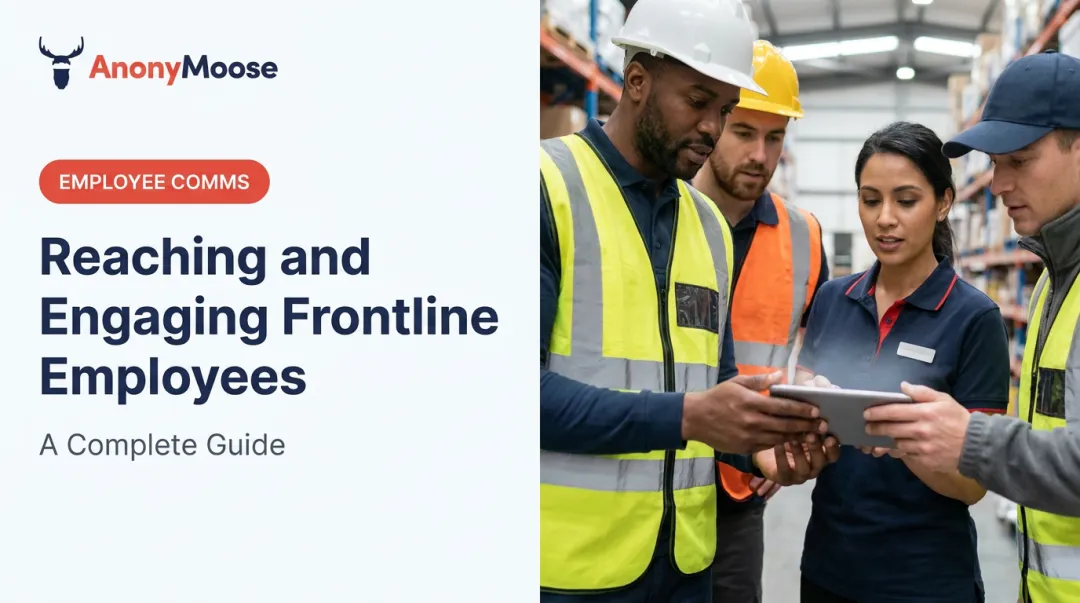
"Deskless workers" covers more ground than most leaders realize. It includes retail associates, nurses, warehouse operatives, construction crews, logistics drivers, hotel housekeepers, factory line workers, and field technicians — anyone whose job doesn't involve sitting at a desk.
Emergence Capital estimates over 2.7 billion deskless workers worldwide — the dominant share of the global workforce. Yet workplace technology investment has concentrated almost entirely on the minority who sit at desks.
The result is a communication gap with measurable consequences:
- 63% of frontline workers say leadership messages don't reach them
- 32% feel their voice isn't heard when they raise workplace issues
- McKinsey reports 45% of U.S. frontline workers plan to leave their jobs within 3–6 months
The Business Cost
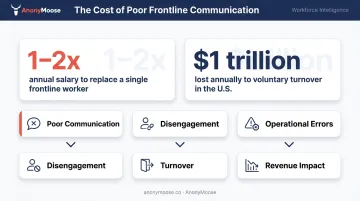
Poor frontline communication sets off a chain reaction: disengaged employees turn over faster, turnover produces operational errors, and those errors show up directly in customer experience — and revenue.
Replacing a frontline employee isn't cheap. Gallup estimates the cost of replacing a single worker can reach one to two times their annual salary — and voluntary turnover costs U.S. businesses $1 trillion annually.
There's also a brand risk embedded in this gap. Deskless workers are the face of most organizations — the people customers interact with most. When those employees are out of the loop on company direction or values, customers feel it before leadership does.
Why Traditional Tools Fail Frontline Workers
The Email Dead End
Most frontline workers don't have corporate email accounts. Many don't sit at computers during shifts at all. An email-first internal communication strategy structurally excludes this group — not just underserves them.
Research from The Employee App found that 87% of frontline workers lack intranet access, and 33% lack corporate email access entirely. Organizations that treat email as the default communication channel are, by design, leaving a third of their workforce permanently out of the loop.
The Intranet Problem
Intranets don't fare much better. SWOOP Analytics' SharePoint benchmark found that 99.76% of intranet access is desktop-based — leaving mobile access at a fraction of a percent. Workers without desk access, VPN credentials, or company-issued devices simply can't reach it.
Only 28% of employees cite the company intranet as where they get most company news, according to a 2025 Staffbase/YouGov survey of 3,574 employees.
App Overload and the One-Way Trap
Beyond email and intranets, many organizations layer additional disconnected tools — scheduling apps, HR portals, messaging platforms — forcing workers to juggle multiple systems. Research from Harvard Business Review found workers toggle between apps roughly 1,200 times per day. Each additional system is another barrier to staying informed, regardless of how tech-savvy the worker is.
The underlying design flaw across all these tools is the same: one-way broadcasting. Email blasts, notice boards, and top-down announcements give frontline workers no structured way to respond, ask questions, or flag concerns. The result is passive reception. Over time, that breeds disengagement and erodes trust.
The gap shows up clearly in the numbers:
- Only 29% of non-desk employees report being satisfied with internal communication
- 47% of desk-based employees say the same — an 18-point gap driven by tools that were never built for frontline realities
That disparity isn't a minor inconvenience. It's the cumulative cost of defaulting to communication infrastructure that assumes everyone works at a desk.
Must-Have Features in a Deskless Communication Platform
Mobile-First, No Email or VPN Required
This is the non-negotiable starting point. Any platform requiring a corporate email address, a company-issued device, or a VPN connection will automatically exclude the workers it's meant to reach.
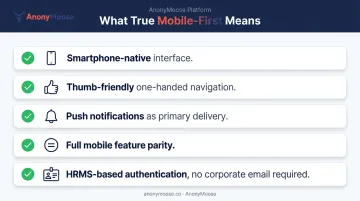
True mobile-first means more than a desktop tool with a mobile app attached. It means:
- Interface designed around a smartphone screen from the ground up
- Navigation built for thumb-driven, one-handed use
- Push notifications as the primary delivery mechanism (not email digests)
- Full feature parity on mobile — not a stripped-down version of the desktop experience
- Authentication that doesn't require a corporate email — for example, HRMS-based sign-in using an employee ID
AnonyMoose takes this approach directly: employees download the app on their personal phones, authenticate via HRMS upload, and start receiving push notifications immediately. No IT provisioning, no email accounts, no company hardware.
Real-Time Messaging and Push Notifications
Push notifications solve the visibility problem that email cannot. Instead of waiting for a worker to check an inbox they may not have, time-sensitive updates arrive on the device already in their pocket.
For shift-based and mobile teams, this distinction matters enormously. Consider what's at stake: a schedule change or safety alert delivered by push reaches the worker in seconds. The same message sent by email may sit unread for hours, or never be seen at all.
Two-Way Communication and Feedback Tools
One-way broadcast is a floor, not a ceiling. Effective platforms include:
- **Polls and pulse surveys** — quick, single-tap responses frontline workers can complete in under a minute
- Open-line channels — two-way conversation threads between employees and specific leaders or departments
- Anonymous feedback options — discussed in the next section
- Message reactions — low-friction acknowledgment that signals engagement without requiring a written response
The key is integration. When feedback tools are built into the same platform workers use for daily communications — not managed through a separate annual survey system — participation rates rise and insights arrive in real time.
Analytics and Message Reach Tracking
Without measurement, leaders have no way to know whether communications are landing or whether the platform is actually being used. The metrics that matter for deskless communication specifically include:
- Read and open rates by message, role, and location
- Survey completion rates by team or shift
- Platform adoption broken down by department or geography
- Engagement trends over time to spot disconnected pockets of the workforce
AnonyMoose's Insights Dashboard provides aggregated analytics across Openlines, Polls, Surveys, and Broadcasts — including AI-assisted pattern recognition across Hotline submissions — all without exposing individual identities.
Offline Access and Multilingual Support
Construction sites, hospital basements, and remote logistics routes share one common problem: unreliable connectivity. Platforms that require a live internet connection for every function leave workers in these environments periodically unreachable.
Language diversity adds another layer of complexity. The Migration Policy Institute reports that 6 million foreign-born workers were employed in vital U.S. frontline industries, representing 19% of all workers in those sectors. Among immigrant workers in hard-hit industries, 55% had limited English proficiency.
A platform that delivers messages only in English excludes a substantial share of the workforce it's supposed to reach.
AnonyMoose supports multi-language functionality, so employees can receive and respond to messages in their preferred language.
The Missing Layer: Anonymous Feedback and Psychological Safety
Most communication platforms solve for reach but ignore what happens after a worker receives a message. Can they respond honestly? Will they?
Gallup reports that only 3 in 10 U.S. workers strongly agree their opinions count at work. That number reflects a systemic problem: even when feedback channels exist, fear of identification suppresses honest input. Power imbalances between frontline workers and their direct managers are real. Concerns about retaliation — formal or informal — are widespread.
The consequences for organizations are significant. When workers stay silent internally, problems don't disappear. They escalate. Safety issues go unreported until they become incidents. Morale problems hit Glassdoor before anyone internally hears about them. Operational inefficiencies build unnoticed until they're expensive to fix.
Gallup's data is instructive here: moving the share of workers who feel their opinions count from 3 in 10 to 6 in 10 could produce a 27% reduction in turnover, a 40% reduction in safety incidents, and a 12% increase in productivity. The SHRM Study (2020) extends this picture: organizations with genuine anonymous feedback systems see a 34% boost in productivity through improved employee morale and trust, while Vantage Circle research found a 30% decrease in employee turnover specifically attributed to the adoption of anonymous feedback tools — making the case for anonymous channels in deskless environments not just a matter of inclusion, but of measurable business performance.
This is where anonymous feedback platforms serve a distinct function. AnonyMoose is built specifically to give every employee — including deskless workers — a technically anonymous channel that cannot be traced back to them, not by the platform and not by their employer.
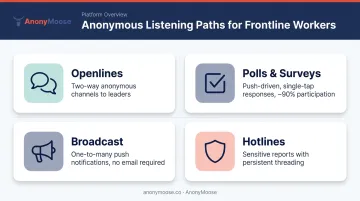
The four active listening paths cover different scenarios:
- Openlines connect employees directly to specific leaders or departments through two-way anonymous channels — filling the gap left by open-door meetings frontline workers can rarely attend
- Polls & Surveys use push notifications and single-tap responses, driving participation rates near 90% versus the ~30% typical of identified email surveys — consistent with findings from buildempire.co.uk showing anonymous surveys also generate 58% more honest feedback
- Broadcast delivers one-to-many messages via push notification, reaching workers who don't have corporate email
- Hotlines handle sensitive reports — harassment, safety violations, ethics concerns — with persistent conversation threading and attachment support
The technical anonymity guarantee matters. AnonyMoose's architecture stores submissions without linkage to individual identities. No technical mechanism exists to trace a specific submission back to a specific person. That's a meaningful distinction from platforms that promise anonymity by policy while retaining technical identifiers in the background.
For frontline workers in environments with rigid management hierarchies — healthcare, manufacturing, logistics — this distinction is the difference between a channel workers trust and one they avoid.
How to Choose the Right Platform for Your Workforce
Before shortlisting platforms, answer four questions that meaningfully narrow the field:
- Device access: Do your workers have personal smartphones, or do you need SMS-first options for those without data plans?
- Scale and geography: Are you connecting 200 workers across two locations, or 20,000 across multiple countries and time zones?
- Tech ecosystem: Are you already committed to Microsoft 365 or another platform that should inform interoperability decisions?
- Primary need: Is your priority communication-first (updates, feedback, engagement) or workforce-management-first (scheduling, task tracking, compliance)?
Your answers will quickly separate general-purpose chat tools from purpose-built frontline platforms — and point you toward the non-negotiable criteria every shortlisted option should meet.
Non-Negotiable Evaluation Criteria
Regardless of organization type, every platform under consideration should clear these bars:
| Criterion | Why It Matters |
|---|---|
| Works without corporate email or VPN | Without this, you exclude the workers you're trying to reach |
| Supports personal smartphones | Company-issued devices aren't practical for high-turnover environments |
| Includes two-way feedback tools | One-way broadcast doesn't build engagement |
| Provides analytics on reach and adoption | Without measurement, you're guessing |
| Fast enough onboarding for high turnover | Frontline teams can't absorb hour-long training sessions |
| Multilingual support | Required for diverse frontline workforces |
The Pilot Approach
Start with a 60–90 day pilot at one location or team before rolling out organization-wide. Run a short baseline measurement before launch, then repeat it at the end. Those results give you the internal business case you need — and real data to act on. Track:
- Adoption rates (how many workers actually logged in)
- Message reach (what percentage received and opened communications)
- Worker sentiment (use the same 3–4 pulse questions pre- and post-pilot)
Implementing Your Platform Successfully
Choosing the right platform matters — but a poor rollout can make even the best tool invisible. What drives actual adoption is how the launch is executed, not just what was purchased.
Manager-First Launch
Train managers as platform champions before the workforce launch. When frontline workers see their direct managers actively using the platform, adoption follows naturally. Uncertainty or indifference at the manager level travels just as fast down the floor.
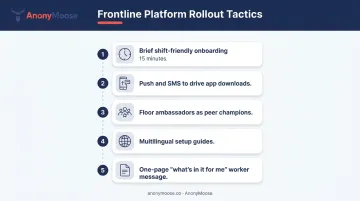
Practical tactics for frontline rollouts:
- Brief, shift-friendly onboarding sessions (15 minutes, not an hour-long training deck)
- **Push notifications and SMS** to drive initial app downloads
- App ambassadors on the floor — peer voices carry more weight than top-down directives
- Multilingual setup guides for diverse workforces
- A simple one-page "what's in it for me" message written from the worker's perspective, not the organization's
Closing the Feedback Loop Visibly
The fastest way to kill platform adoption is to collect feedback and do nothing visible with it. Workers who see their input lead to real changes are more likely to stay engaged long-term.
Microsoft's analysis of over 3 million employee survey responses found that employees at highly engaged organizations are 56% more likely to say their organizations continually improve processes. Organizations that hit that benchmark share one habit: they respond to feedback in a way employees can actually see.
Build the review-and-respond cadence into the implementation plan from day one:
- Review submissions and survey results on a defined schedule
- Communicate what was heard — even when the answer is "we're still looking into this"
- Report back on what changed as a direct result of employee input
- Repeat consistently — not just after launch
Consistency is what makes the difference. A platform that responds earns ongoing participation; one that goes quiet earns distrust.
Frequently Asked Questions
Frequently Asked Questions
What's the best platform for employee messaging?
For deskless workers, the priority is mobile-first access without corporate email or VPN, with real-time push notifications and two-way feedback built in. Purpose-built frontline platforms consistently outperform general tools like Slack or Teams here — they're built around the smartphone experience, not desk access.
What are the 5 types of communication in the workplace?
The five types are verbal (face-to-face or voice), written (email, messaging), non-verbal (body language, tone), visual (signage, infographics), and digital/electronic (apps, platforms). For deskless workers, digital mobile communication is the only channel that reaches employees without a desk or corporate login.
What is a deskless worker communication platform?
A mobile-first software solution that connects frontline employees to updates, colleagues, and operational information — no desk, corporate email, or company device required. Workers authenticate through alternative means such as HRMS data uploads, and receive communications via push notification to personal smartphones.
Why do standard communication tools like email and intranets fail frontline workers?
Email and intranets assume workers are at a desk with a corporate login. Most frontline employees lack company email accounts, rarely access desktops during shifts, and have no VPN access — making these tools structurally inaccessible. The failure is structural, not behavioral.
What features should an employee communication platform for deskless workers include?
The essentials: works on personal smartphones without corporate email, push notifications for real-time updates, two-way feedback tools (polls, surveys, anonymous channels), multilingual support, and analytics to track message reach and adoption. Offline access is important for environments with unreliable connectivity.
How do you get frontline workers to actually adopt a new communication platform?
Three things drive adoption:
- Train managers first so they model and champion the tool
- Communicate value to workers in their own terms, not organizational goals
- Close the feedback loop visibly so workers see their input lead to real changes
Platforms that feel useful rather than surveillance-oriented earn adoption faster.