This guide covers why frontline workers are structurally hard to reach, what groundwork organizations need to lay before building a strategy, a five-step approach that actually works, the variables that determine whether it succeeds or fails, and the most common mistakes to avoid.
Key Takeaways
- Frontline workers are deskless and mobile — communication must meet them on their phones, not in inboxes they don't check
- Top-down broadcasting alone fails; genuine two-way channels are essential for real engagement
- Mobile-first tools, consistent cadence, and manager enablement are the three pillars of reliable frontline reach
- Track behavioral outcomes like retention and safety compliance, not just tool adoption, to confirm the strategy is working
Why Frontline Employees Are Hard to Reach and Engage
The challenge isn't that organizations don't try. It's that most communication infrastructure was built for desk workers and then retrofitted, poorly, onto a workforce that operates nothing like them.
The Structural Problem
Frontline workers have no fixed workstation, no corporate email, and limited downtime during physically demanding shifts. A warehouse picker mid-route or a nurse three hours into a double shift has no practical way to consume a lengthy internal newsletter — even if it somehow reached them.
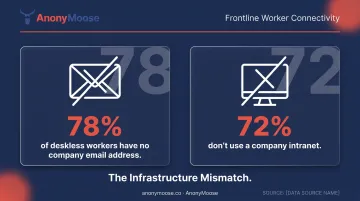
ScreenCloud's 2025 research found that 78% of deskless workers don't have a company email address and 72% don't use a company intranet. Organizations that rely on these channels are functionally unreachable to the majority of their frontline workforce.
The Manager Bottleneck
Most frontline communication travels through a chain: senior leadership → internal comms → middle management → line managers → frontline workers. Each handoff introduces distortion or dropout.
Microsoft's 2023 Work Trend Index puts a number on it: 69% of frontline managers say senior leadership isn't communicating effectively with them — which means the problem cascades down before it even reaches frontline staff. Managers without clear information can't relay it accurately, and many don't relay it at all.
The Activity Paradox
High performers are often the hardest to reach. The more productive and engaged a frontline worker is, the less downtime they have to absorb non-urgent communications — wellness updates, DEI initiatives, policy changes. The workers most valuable to retain are frequently the ones operating in an information vacuum.
The Psychological Barrier
Even when channels exist, many frontline workers don't use them. A 2024 Institute of Business Ethics survey of 12,000 employees across 16 countries found that **46% of employees who raised concerns reported personal disadvantage or retaliation**.
When workers don't trust that speaking up is safe, they disengage internally — and sometimes vent publicly on platforms like Glassdoor instead. The same Microsoft research found 32% of frontline workers feel their voice isn't heard when they raise workplace issues. That silence signals a trust deficit, not indifference.
What You Need Before Building a Frontline Communication Strategy
Results are only as good as the groundwork laid before launch. Skipping preparation is the most common reason strategies collapse within the first 90 days.
Channel and Device Assessment
Start here: what devices do your frontline workers actually carry during shifts?
- Personal smartphones — enables SMS, push-notification apps, and mobile-first platforms
- Company-issued ruggedized devices — similar app capabilities, though download policies and IT restrictions often apply
- Shared kiosks or break-room terminals — limits real-time messaging; works only for posted or scheduled updates
This audit determines which channels are viable before a single tool is purchased. An SMS campaign is useless if half your workforce is in a facility with restricted personal device policies. An app-based platform is irrelevant if workers won't download anything on personal phones without a clear privacy guarantee.
Leadership and Manager Readiness
Technology won't close the gap if managers aren't ready to use it. Before launch, assess:
- Whether frontline managers understand their role as communication amplifiers, not just task supervisors
- Whether they have consistent habits around sharing updates with their teams
- Whether they know what they're supposed to communicate, and when
Any gaps in manager readiness need to be addressed alongside tool deployment, not as an afterthought. Once that's in order, the next step is knowing how you'll measure success.
Baseline Engagement Metrics
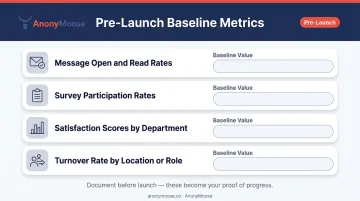
Establish a benchmark before deploying anything new. Without a starting point, you can't demonstrate improvement. Identify the metrics that matter for your organization:
- Message open and read rates
- Survey participation rates
- Reported satisfaction scores by department
- Turnover rate by location or role
Pick three to five metrics and document them before launch. These numbers become your proof of progress — and your clearest argument for continued investment.
How to Build a Frontline Communication Strategy That Actually Works
An effective frontline communication strategy isn't a single tool or one-off campaign — it's a repeatable system with defined channels, clear ownership, consistent cadence, and genuine feedback loops.
Step 1: Conduct a Communication Audit
Map every channel currently used to reach frontline employees: shift huddles, bulletin boards, email, WhatsApp groups, manager calls, break-room signage. Then ask which workforce segments are being missed entirely.
Most organizations discover the opposite of what they expect: not too few channels, but too many fragmented ones. SafetyCulture's research found that more than 25% of frontline workers said their organization lacked a single go-to channel for important updates, and 32% said the primary channel didn't work for their job function. Fragmentation is the problem; consolidation is the fix.
Step 2: Consolidate Around a Mobile-First Platform
A single, unified communication hub eliminates the burden of checking multiple sources — and for deskless workers, that burden is often enough to ensure they check none of them.
The non-negotiables for any platform serving frontline workers:
- Works on personal smartphones without requiring a corporate device
- Doesn't require a company email address for access
- Delivers push notifications, not inbox messages that get buried
- Functions reliably in environments with limited connectivity
AnonyMoose authenticates employees through an HRMS data upload rather than corporate email credentials, meaning workers who have never had a company email address can still access the platform from day one. Setup typically takes two to four weeks.
Step 3: Design a Content and Messaging Calendar
Consistent reach requires consistent planning. A structured calendar covering operational updates, safety reminders, wellness messages, recognition moments, and company news removes the guesswork. It also prevents the two failure modes: communication deserts, then overwhelming information dumps.
Segment messages by role, shift, or location so that content stays relevant. A warehouse associate in Phoenix and a delivery driver in Chicago have different operational realities — identical, generic communications signal that the organization hasn't thought seriously about either of them.
Step 4: Build In Anonymous Two-Way Communication Channels
Most feedback tools fail for one reason: workers don't trust them. If a survey isn't genuinely anonymous — if responses could be traced back through context, sample size, or system access — participation drops and honest feedback never arrives.
AnonyMoose addresses this with technical anonymity rather than policy-based promises. The platform's architecture makes individual identification structurally impossible: submissions are linked to an organization but never to a specific person. Neither AnonyMoose nor the employer can identify who sent a given message — that's a design constraint, not a privacy pledge.
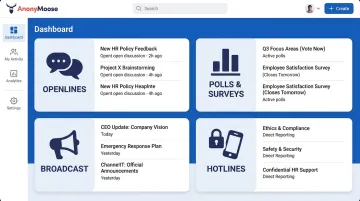
The platform's four communication pathways work together to replace fragmented channels:
- Openlines — always-available, anonymous two-way channels connecting employees to specific leaders or departments; replaces one-on-ones, town halls, and open-door policies
- Polls & Surveys — anonymous pulse surveys delivered via push notification to personal phones, with single-tap responses and ~90% participation rates
- Broadcast — instant one-to-many messaging with guaranteed push-notification delivery to every employee's phone
- Hotlines — structured, anonymous incident reporting with attachment capability for photos or documentation, managed through a case-based employer dashboard
Step 5: Train Managers as Communication Champions
Technology handles reach. Managers handle trust. These aren't interchangeable.
Specific actions that distinguish communication-effective managers from the rest:
- Run pre-shift check-ins that explicitly cover what's new, not just what's operational
- Acknowledge survey results publicly in team settings — "here's what we heard, here's what we're doing about it"
- Escalate concerns transparently rather than absorbing and filtering feedback before it reaches leadership
- Model the behavior by using the same channels they ask their teams to use
Gallup's research found that managers account for at least **70% of the variance in employee engagement scores** across business units. One ineffective manager can functionally disconnect an entire team, regardless of how sophisticated the broader communication infrastructure is. Research from Axios HQ, based on LinkedIn studies, shows that 42% of employees have left an organization due to poor internal communication — a retention failure that is largely preventable when organizations give frontline workers reliable, two-way channels to surface what they're experiencing before it becomes a departure decision.
Key Variables That Shape Frontline Engagement Success
Identical tools can produce radically different outcomes depending on how they're deployed. Four variables determine whether frontline engagement efforts actually work.
Channel Fit vs. Workforce Reality
A channel that doesn't match how workers behave during their shift will be ignored. SMS consistently outperforms email for frontline audiences: according to CTIA, text messages have a 98% open rate compared to roughly 20% for email campaigns. For a safety protocol that needs to be read before the shift starts, that gap is the difference between compliance and risk.
Poor channel fit also creates equity gaps — certain workforce segments become functionally unreachable, meaning critical information (scheduling changes, safety updates, policy shifts) reaches some teams and skips others entirely.
Message Frequency and Timing
Over-communicating creates noise fatigue. Under-communicating leaves workers feeling forgotten. Neither extreme serves the organization.
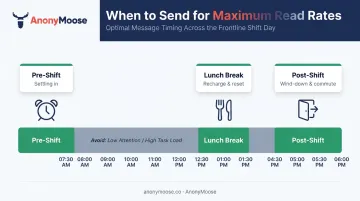
Timing shapes results as much as frequency does. Messages sent during peak shift hours or on scheduled days off consistently underperform, regardless of content quality. Scheduling around natural break points improves read rates meaningfully:
- Before shift start, when workers are settling in
- During lunch, when attention is less divided
- Immediately post-shift, before workers fully disengage
Psychological Safety and Anonymity
When employees don't believe their feedback is truly anonymous, participation drops and the responses that do come in skew positive. Artificially optimistic survey results give leadership a false picture of workforce sentiment. Suppressed safety concerns, in turn, create direct operational risk.
Organizations that can genuinely guarantee anonymity see higher participation and more honest, actionable feedback. Whether that guarantee holds up depends entirely on the technical architecture of the platform — and workers know the difference. The SHRM Study (2020) found that 82% of employees are more likely to share critical feedback when anonymity is preserved, and the APA found that employees are 70% more likely to disclose unethical practices in anonymous settings compared to traditional feedback methods — findings that apply with particular force to frontline environments where power differentials between workers and managers are often most pronounced.
Manager Communication Quality
The frontline manager is both the final link in top-down communication and the first point of contact for bottom-up feedback. A single manager who filters, delays, or distorts messages in either direction can disconnect an entire team from the broader organization.
With Catalyst reporting that frontline managers may supervise up to 80% of total employees in companies with frontline workforces, the manager layer represents the single largest point of leverage in the entire communication system.
Common Mistakes Organizations Make When Communicating with Frontline Workers
Treating Communication as a One-Way Broadcast
Organizations that push information without opening genuine response mechanisms signal to frontline workers that their role is to receive orders, not raise concerns. This erodes engagement and accelerates turnover faster than any other single factor.
Using Desk-Worker Channels for a Deskless Workforce
Email and intranet portals are invisible to frontline employees. Workvivo's 2025 Frontline Gap Report, based on responses from 7,500 frontline workers, found that 48% say most company communications seem irrelevant to them — and that's among workers who actually received the message. Many never do.
Measuring the Wrong Success Metrics
Tracking message-sent volume or tool adoption rates without connecting them to behavioral outcomes gives organizations a false sense of progress. The metrics that actually tell you something are:
- Safety incident rates over time
- Survey participation trends by department
- Turnover rates segmented by team or location
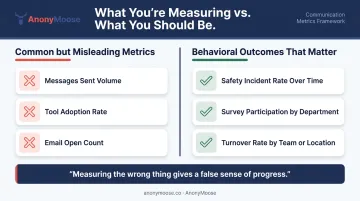
The number of emails your platform sent last quarter isn't one of them.
Frequently Asked Questions
What is the most effective communication channel for frontline employees?
SMS and push notifications consistently outperform other channels for deskless workers, with open rates near 98% compared to roughly 20% for email. The strongest approach consolidates multiple channels — text, push notifications, anonymous feedback tools — into a single mobile-first platform so workers have one place to both receive and send communications.
How do you engage frontline employees who don't have company email access?
Text-based outreach, mobile apps that authenticate through HRMS data rather than corporate email, and shared communication hubs are the most effective alternatives. Audit device access and existing authentication barriers before selecting any tool — the wrong platform will hit an adoption wall immediately.
Why do frontline workers feel disconnected from company leadership?
The communication cascade from senior leadership to frontline staff passes through internal comms, middle management, and line managers — each layer introducing distortion or dropout. The Microsoft Work Trend Index found 63% of frontline workers say leadership messages don't reach them. This is a systemic design failure, not an individual one.
How can organizations encourage honest feedback from frontline employees?
Psychological safety is the prerequisite. Workers won't share honest feedback unless they believe their identity is protected and their input will drive visible action. Tools where identification is architecturally impossible (not just policy-promised) produce higher participation and more candid responses than manager-mediated surveys.
What are the biggest mistakes companies make when communicating with frontline workers?
Three patterns account for most failures: defaulting to broadcast-only communication with no response mechanism, using email and intranet channels most frontline workers can't access, and measuring tool adoption instead of behavioral outcomes as a proxy for communication effectiveness.
How do you measure the effectiveness of frontline employee communication?
Effective measurement combines leading indicators (message read rates, survey participation, feedback volume) with lagging outcomes (turnover rate changes, safety incident frequency, productivity metrics). Establishing a baseline before launching any new strategy is essential; without one, there's no way to demonstrate whether anything improved.