Low engagement isn't cheap to ignore. Gallup estimates disengaged employees cost the global economy roughly $10 trillion in lost productivity in 2025 — about 9% of global GDP. The fix isn't more data. It's faster data.
This guide covers what real-time employee feedback analysis actually is, why it matters now more than ever, which platform types exist, what features to prioritize, and how to choose the right tool for your organization's specific situation.
Key Takeaways
- Real-time feedback analysis captures employee sentiment as it happens, not weeks or months after the fact
- 80% of employees who received meaningful feedback in the past week were fully engaged (Gallup)
- Anonymity is an analytical requirement: employees who fear being identified give incomplete, unreliable feedback. The SHRM Study (2020) found that 82% of employees are more likely to share critical feedback when anonymity is preserved, and buildempire.co.uk research shows anonymous surveys generate 58% more honest feedback with 90% participation versus 30% for identified surveys — confirming that real-time analysis is only as valuable as the trust behind the data it processes
- Four platform categories serve distinct needs: engagement suites, pulse survey tools, AI sentiment analysis, and anonymous listening platforms
- The best platform is the one employees actually use — adoption and participation matter as much as features
What Is Real-Time Employee Feedback Analysis?
Real-time employee feedback analysis is the ongoing process of collecting, processing, and interpreting employee input as it's submitted — using digital platforms to surface trends, sentiment shifts, and actionable insights without the delays tied to annual or quarterly review cycles.
The contrast with traditional approaches is straightforward:
| Method | What It Captures | What It Misses |
|---|---|---|
| Annual survey | A single sentiment snapshot | Everything that happens between cycles |
| Quarterly pulse | Periodic trend data | Rapid sentiment shifts mid-quarter |
| Real-time platform | Continuous, live input | Very little — by design |
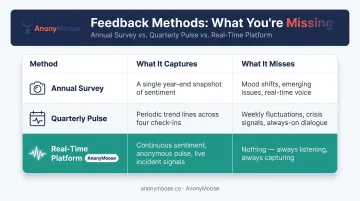
Traditional surveys capture a moment in time; real-time analysis captures the full picture as it develops. When a new policy rolls out and triggers immediate anxiety, or a leadership change creates uncertainty across departments, only continuous listening catches those early warning signs before they become retention problems.
Why Organizations Need Real-Time Feedback Analysis
The engagement gap is expensive
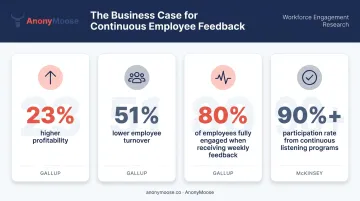
Gallup's Q12 meta-analysis found that business units with high engagement report 23% higher profitability, 18% higher sales productivity, and 51% lower turnover in low-turnover industries. The feedback frequency connection is direct: 80% of employees who received meaningful feedback in the past week were fully engaged — a number that collapses without regular touchpoints.
Annual surveys can't sustain that cadence. By the time results are analyzed and acted on, the employee who flagged a concern has either disengaged or left. That limitation becomes even sharper when teams aren't in the same room.
The hybrid visibility problem
Remote and hybrid teams create a specific challenge. Managers who once picked up on disengagement through in-person cues lose that visibility entirely when their team spans time zones and home offices.
Microsoft's 2022 Work Trend Index reported that 85% of leaders said the shift to hybrid work made it harder to feel confident their employees were productive. Employees who believe their company acts on feedback reported notably higher outcomes:
- Satisfaction: 90% vs. 69% among those who don't see that connection
- Engagement: 89% vs. 73%
Real-time digital listening gives distributed teams a consistent channel to surface what in-person proximity once revealed naturally.
The "moments between moments" problem
Major organizational changes — new policies, leadership transitions, return-to-office mandates, layoffs — generate immediate employee sentiment. Annual cycles miss these entirely. Real-time platforms are specifically designed to capture exactly these inflection points, when the window to respond constructively is still open.
McKinsey documented that a weekly pulse survey, implemented as part of a continuous-listening strategy, collected feedback from more than 90% of employees in the first year of operation. Well-designed real-time listening programs achieve strong participation at scale — but only when employees trust that their responses are genuinely anonymous and acted upon.
Types of Real-Time Employee Feedback Platforms
Real-time feedback platforms aren't interchangeable. Each category serves different use cases, team sizes, and analytical needs. Understanding the distinctions before selecting a tool saves significant time and cost.
Employee Engagement and Continuous Listening Platforms
Tools like Workday Peakon Employee Voice, Microsoft Viva Glint, Qualtrics EmployeeXM, Culture Amp, and Eletive are built specifically for HR teams managing engagement at scale.
- Recurring pulse surveys with live dashboards
- Benchmarking against industry or internal historical data
- Burnout risk flagging and department-level trend tracking
- AI-powered insight recommendations
These platforms offer deep analytics and enterprise-grade reporting. The tradeoff: they often require significant configuration, dedicated HR resources, and a separate login environment that not all employees access consistently.
Survey and Polling Tools
Platforms like SurveyMonkey, SurveySparrow, Typeform, and Mentimeter prioritize fast deployment and flexible survey creation with real-time response visualization.
Good for organizations that need quick feedback without a full engagement platform investment. The tradeoff: limited longitudinal trend tracking, minimal sentiment analysis on open-text responses, and no native engagement benchmarking without additional integrations.
AI-Powered Sentiment Analysis Tools
Where survey tools collect structured responses, AI-powered platforms like IBM Watson Natural Language Understanding and Amazon Comprehend process open-text feedback at scale — detecting sentiment, surfacing recurring themes, and flagging negative language automatically.
These tools integrate into existing survey or HR systems rather than operating standalone. They're most useful when qualitative feedback volume is too large for manual review.
Anonymous Feedback and Active Listening Platforms
Purpose-built platforms that prioritize psychological safety through guaranteed anonymity — encouraging honest reporting through open suggestion lines, polls, hotlines, and broadcast messaging.
The data quality difference is real: when employees aren't worried about being identified, what they submit reflects what they actually think — not what they consider safe to say. AnonyMoose falls into this category, offering four distinct listening paths:
- Openlines — always-open, two-way anonymous channels between employees and leaders or departments, removing scheduling friction and the psychological barrier of in-person conversations
- Polls & Surveys — anonymous pulse surveys sent via push notification to all employees or defined subgroups, with results feeding directly into the Insights Dashboard
- Broadcast — one-to-many messaging for announcements, policy updates, or emergency alerts, with guaranteed delivery to every employee's device
- Hotlines — anonymous incident reporting with persistent conversation threads, allowing HR to follow up and manage cases without exposing the reporter's identity
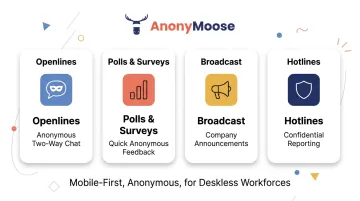
AnonyMoose is mobile-first and accessible without a corporate email address. It's built specifically for deskless workforces — roughly 80% of the global workforce.
Key Features to Evaluate in a Feedback Analysis Platform
Not all platforms deliver the same analytical value. These are the features worth scrutinizing before committing:
Real-Time Dashboards and Alerts
The platform should surface insights as feedback arrives — not 24 hours later. Look for live dashboards with automated alerts when sentiment drops below a threshold in a specific team or department. AnonyMoose's Insights Dashboard includes AI-powered pattern recognition that analyzes trends across all feedback channels without exposing individual identities.
Sentiment Analysis and NLP
Especially critical for open-ended questions. The tool should automatically categorize and theme qualitative responses so HR teams aren't manually reading through hundreds of comments to find patterns. Both enterprise platforms and purpose-built anonymous tools now treat NLP as a standard feature, not a premium add-on.
Anonymity and Data Security
Without genuine anonymity protections, employees self-censor , producing skewed data that's analytically unreliable. Verify that the platform encrypts data, structurally prevents individual identification (not just promises it as a policy), and communicates these protections clearly to employees. AnonyMoose's architecture makes identification technically impossible by design, not by policy: even AnonyMoose itself cannot trace a submission back to its author.
Integration with Existing HR Systems
A feedback platform that operates in isolation creates data silos. Look for compatibility with your HRIS and communication tools. AnonyMoose supports employee data upload from any HRMS via a straightforward file import, enabling targeting and segmentation without complex technical integration.
Actionability and Role-Specific Reporting
Collecting feedback is only useful if the platform helps you act on it. Prioritize tools that offer role-specific views, trend tracking over time, and the ability to create action plans or assign follow-up tasks directly from results. Per HBR research, a 24% increase in speaking up occurs when employees believe managers will actually act on their input.
The Role of Psychological Safety and Anonymity in Feedback Quality
Why fear distorts your data
Most feedback analysis problems aren't technical — they're human. Employees who fear identification don't submit honest responses. They submit safe ones.
The Institute of Business Ethics 2024 Ethics at Work Survey found that 34% of employees cited fear of jeopardizing their job as a reason for not reporting misconduct. Workplace bullying and sexual harassment go unreported not because employees don't want to raise them, but because the risk feels too high.
When that fear operates in the background of a survey, the data you receive reflects what employees think is safe to say — which is not the same as what they actually think.
What psychological safety means in practice
Amy Edmondson's research defines psychological safety as a shared belief that a team is safe for interpersonal risk-taking. Google's Project Aristotle identified it as the top predictor of team effectiveness across hundreds of teams studied.
In a feedback context, psychological safety means employees believe they can raise concerns, flag problems, or report violations without negative consequences. Without it, real-time analysis platforms surface only the feedback employees feel comfortable sharing — not the full picture organizations need to make sound decisions.
How AnonyMoose addresses this directly
AnonyMoose is built around the premise that anonymity is a technical guarantee, not a policy promise. The platform's architecture stores submissions without linking them to individual users — meaning neither AnonyMoose nor the employer organization can trace a response back to its author. There's no mechanism within the system that could expose who sent a message.
That technical architecture has measurable consequences for data quality. Research cited by AnonyMoose indicates anonymous surveys achieve 90% participation rates versus 30% for identified surveys, capturing 58% more honest feedback. A study referenced by the American Psychological Association documented a 30% improvement in employee satisfaction within one year of deploying anonymity-driven communication channels.
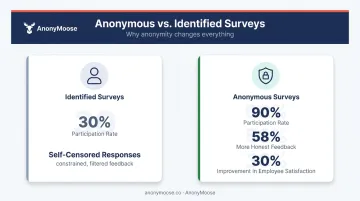
For organizations dealing with DEI challenges, trust deficits, or whistleblowing risk, that gap in data quality isn't a minor variance — it's the difference between decisions based on curated silence and decisions based on what employees actually think.
How to Choose the Right Platform for Your Organization
Match the platform to your primary problem
Different organizational situations call for different tools:
- Trust deficits or retaliation concerns → Anonymous feedback platform (AnonyMoose, AllVoices)
- Performance management integration → Engagement platform with review features (Glint, Culture Amp)
- Large-scale qualitative text processing → AI sentiment analysis layered onto existing tools
- Fast, low-cost survey deployment → Survey tool (SurveySparrow, Typeform)
If your organization faces DEI challenges, a history of external whistleblowing, or industries with significant compliance requirements (healthcare, financial services, manufacturing), the anonymity guarantee is not optional — it's the foundation of analytical reliability.
Prioritize adoption over features
The best analytics in the world produce nothing if employees don't respond. Culture Amp reports its average survey response rates are well over 80%; Perceptyx finds large-enterprise census surveys average 72% to 88%, leaving up to 28% of the workforce unrepresented in the data.
Participation is directly tied to:
- Mobile-first access (critical for deskless workforces)
- No requirement for corporate email or company devices
- Genuine anonymity that employees trust and understand
- Minimal friction in the submission process
Consider implementation timeline and total cost
Enterprise platforms like Qualtrics EmployeeXM and Workday Peakon carry significant licensing, configuration, and onboarding investment, along with implementation timelines to match. For organizations that need insights quickly, SaaS-based platforms with zero hardware requirements offer a faster path to value.
AnonyMoose, for example, deploys for hotline and active listening use cases in approximately 2–4 weeks, with employee data loaded via a simple HRMS file export. Pricing scales with organization size, and the platform consolidates several point tools under a single subscription:
- Active listening and open feedback channels (Openlines)
- Pulse surveys and polls
- Broadcast messaging
- Anonymous incident reporting (Hotlines)
That consolidation matters when comparing total cost of ownership against single-purpose tools.
Frequently Asked Questions
What is real-time employee feedback analysis?
It's the continuous collection and immediate processing of employee input using digital platforms — unlike periodic reviews, insights are available as soon as feedback is submitted. Organizations can detect and respond to sentiment shifts as they happen rather than weeks or months later.
How is real-time feedback analysis different from annual employee surveys?
Annual surveys produce a single data point and miss everything that happens between cycles. Real-time platforms enable ongoing listening, so organizations can detect emerging issues (burnout, policy concerns, management problems) while there's still a window to respond meaningfully.
Why does anonymity matter for employee feedback analysis?
Employees who fear identification self-censor, producing incomplete or overly positive data that doesn't reflect reality. Anonymity removes that barrier, generating more honest and representative feedback — which leads to more accurate analysis and better organizational decisions.
What features should I prioritize when choosing a real-time feedback platform?
Prioritize live dashboards, NLP-based sentiment analysis for open-text responses, and genuine anonymity protections that are technical rather than just policy-based. Also look for mobile accessibility for distributed teams and compatibility with your existing HRIS and communication tools.
Can real-time feedback analysis help reduce employee turnover?
Yes — by identifying disengagement signals, unaddressed concerns, or management issues as they develop rather than after an employee has decided to leave. Early detection creates an intervention window that annual surveys simply don't provide.
How often should organizations collect employee feedback?
A layered approach works best: pulse surveys monthly or quarterly, always-open anonymous channels for continuous input, and structured reviews tied to business cycles. Match the frequency to your actual capacity to act — feedback without follow-through erodes trust faster than no feedback at all.