For HR leaders, this makes employee sentiment analysis software a strategic priority, not a nice-to-have. When organizations actively listen and respond to employee feedback, the results compound: higher retention, stronger culture, and measurable productivity gains. Qualtrics research shows that businesses effectively hearing their employees are 12x more likely to engage and retain them.
This guide covers the top 10 employee sentiment analysis tools available today — what they do, who they're built for, and how to choose the right fit for your organization's size, culture goals, and DEI priorities.
Key Takeaways
- Employee sentiment analysis software uses AI and NLP to turn unstructured feedback into actionable workforce insights in real time.
- The best tools offer continuous, anonymous listening across multiple channels — not just annual surveys.
- Key evaluation criteria: anonymity safeguards, channel breadth, AI/NLP depth, ease of deployment, and reporting clarity.
- Top 10 tools covered: AnonyMoose, Qualtrics, Culture Amp, Glint (Microsoft Viva), Simpplr, Leapsome, 15Five, Medallia, ThriveSparrow, and Remesh.
- No single platform fits every organization. Match the tool to your outcomes, not your feature wishlist.
What Is Employee Sentiment Analysis Software?
Employee sentiment analysis software uses natural language processing (NLP) and AI to automatically evaluate employee feedback — from surveys, pulse checks, and open-ended comments — classifying responses as positive, neutral, or negative to give HR leaders a real-time read on workforce mood.
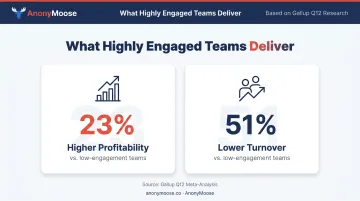
Sentiment data connects directly to financial outcomes. Gallup's Q12 research finds that highly engaged teams deliver 23% higher profitability and 51% lower turnover in low-turnover organizations. The problem is that most organizations don't hear honest sentiment — they hear what employees are willing to say when they're not anonymous.
That gap between reported sentiment and actual sentiment is what these tools are built to close — by creating the psychological safety employees need to share what they actually think. The SHRM Study (2020) quantifies what becomes possible when that safety is genuine: 82% of employees are more likely to share critical feedback when they know their anonymity is preserved, and research from buildempire.co.uk shows anonymous surveys yield 58% more honest feedback than non-anonymous alternatives — the difference between data organizations can act on and data shaped by what employees feel safe saying.
Top 10 Employee Sentiment Analysis Software
The tools below were evaluated on reliability, feature depth, anonymity protections, ease of use, and relevance to modern HR and DEI goals — spanning small teams to large enterprises.
1. AnonyMoose
AnonyMoose is a mobile-first SaaS platform built for anonymous employee communication and active listening. It's designed to create psychologically safe workplaces where every voice (especially the quietest ones) is heard without fear of retaliation or identification.
What sets it apart is its architecture: anonymity is built into the system, not just promised by policy. Neither the employer nor AnonyMoose can technically identify who submitted any piece of feedback. That's a structural guarantee, not a policy position.
The platform offers four distinct listening channels:
- Openlines — Always-on, anonymous two-way conversations between employees and specific leaders or departments; replaces one-on-ones, town halls, and open-door policies
- Polls & Surveys — Real-time pulse tool with push notification delivery; supports granular targeting via custom employee subgroups
- Broadcast — Instant one-to-many messaging from leadership to all employees or specific segments, with guaranteed push delivery
- Hotlines — Dedicated anonymous incident reporting for sensitive issues like harassment, discrimination, bias, and ethics violations
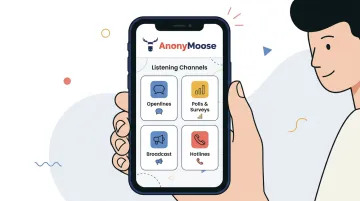
The Insights Dashboard layers AI analysis on top — identifying themes across Hotline reports and surfacing patterns in survey data without ever exposing individual identities.
| Feature | Details |
|---|---|
| Key Features | Anonymous Openlines, Polls & Surveys, Broadcast messaging, confidential Hotlines; mobile-app centric; zero hardware investment; AI-powered Insights Dashboard |
| Best For | Organizations focused on DEI, psychological safety, reducing external whistleblowing, and improving honest participation across distributed or deskless teams |
| Pricing | SaaS-based with low upfront cost; visit anonymoose.co for current pricing |
2. Qualtrics Employee Experience
Qualtrics is an enterprise-grade experience management platform combining employee survey tools, NLP-powered text analytics, and omnichannel listening at scale. Its Text iQ engine assigns sentiment labels across a -2 to +2 scoring range, enabling nuanced analysis beyond simple positive/negative classification.
Qualtrics earned a Leader designation in the Forrester Wave: Employee Experience Management Platforms, Q2 2025 — making it a strong fit for large, complex organizations that need deep text analytics and multi-source feedback integration.
| Feature | Details |
|---|---|
| Key Features | NLP sentiment scoring, omnichannel listening, conversational analytics, real-time dashboards, pulse surveys, lifecycle feedback |
| Best For | Large enterprises requiring sophisticated text analytics and multi-source feedback integration |
| Pricing | Enterprise pricing; visit qualtrics.com for current plans |
3. Culture Amp
Culture Amp blends engagement surveys, pulse checks, and AI-powered analytics — grounded in a science-backed approach that draws on 1.5 billion data points across more than a decade of research. Its benchmarking capability compares results against thousands of organizations by industry and region, giving HR teams meaningful context rather than raw numbers alone.
Trusted by 6,000+ companies, it's a strong choice for organizations building sustained culture improvement programs.
| Feature | Details |
|---|---|
| Key Features | Engagement surveys, pulse checks, performance reviews, AI insights, industry benchmarking, manager-facing dashboards |
| Best For | Mid-size to enterprise companies investing in long-term culture transformation and people analytics |
| Pricing | Tiered pricing based on headcount; visit cultureamp.com for current plans |
4. Microsoft Viva Glint
Originally LinkedIn's Glint — which migrated to the Microsoft Viva suite in July 2023 — Viva Glint uses AI to surface real-time employee sentiment from pulse surveys and connects that data directly with Microsoft Viva Insights (behavioral work patterns) and Microsoft Teams notifications.
The result is a connected picture of how employees feel and how they work, all within the Microsoft ecosystem.
| Feature | Details |
|---|---|
| Key Features | AI-driven pulse surveys, real-time people analytics, Microsoft Viva Insights integration, Teams notifications, recommended manager action plans |
| Best For | Organizations embedded in the Microsoft ecosystem seeking connected HR intelligence |
| Pricing | Part of the Microsoft Viva suite; visit microsoft.com/viva/glint for current pricing |
5. Simpplr
Simpplr is an AI-powered intranet and employee experience platform — a three-time Leader in the Gartner Magic Quadrant for Intranet Packaged Solutions — that embeds sentiment analysis directly into everyday digital interactions. Rather than requiring separate survey deployments, it aggregates engagement data, polls, and insights in a single hub alongside internal communications.
| Feature | Details |
|---|---|
| Key Features | Built-in pulse surveys, sentiment check tools, real-time engagement insights, AI analytics dashboard, intranet and comms integration |
| Best For | Organizations seeking an all-in-one intranet and employee listening platform without deploying separate survey tools |
| Pricing | Custom pricing; visit simpplr.com for current plans |
6. Leapsome
Leapsome is an all-in-one people enablement platform that ties sentiment data directly to performance and learning outcomes. Its AI-powered analytics detect sentiment shifts and connect engagement scores to OKR progress, performance reviews, and learning modules — in a single view most point solutions don't support.
Serving 2,000+ organizations globally, it's built for companies that want workforce feeling and workforce performance in the same view.
| Feature | Details |
|---|---|
| Key Features | Engagement surveys, 360 feedback, OKR tracking, learning modules, AI-powered insights, continuous feedback loops |
| Best For | Companies that want sentiment data integrated with performance management and learning programs |
| Pricing | Modular pricing per feature; visit leapsome.com for current plans |
7. 15Five
15Five centers its approach on a consistent cadence — weekly check-ins, pulse surveys, and manager 1:1 tools — without creating survey fatigue. Its HR Outcomes Dashboard connects engagement scores to business results, tracking employee engagement, performance, and turnover in one place.
Real-world outcomes from 15Five customers include Auror maintaining 94% retention and Pendo reducing turnover by 21%.
| Feature | Details |
|---|---|
| Key Features | Weekly check-ins, pulse surveys, engagement reports, 1:1 meeting tools, performance reviews, HR Outcomes Dashboard |
| Best For | Small to mid-size companies seeking a lightweight, manager-friendly continuous listening and performance tool |
| Pricing | Per-user monthly pricing; visit 15five.com for current plans |
8. Medallia
Medallia started in customer experience and expanded into employee listening — and that origin is its competitive edge. Its platform connects employee sentiment data with customer experience metrics, making it particularly valuable for service-heavy industries where staff morale directly impacts customer outcomes.
Medallia also earned a Leader designation in the Forrester Wave: Employee Experience Management Platforms, Q2 2025, placing it alongside Qualtrics at the top of that evaluation.
| Feature | Details |
|---|---|
| Key Features | Employee pulse surveys, text analytics, real-time alerts, role-based dashboards, CX data integration |
| Best For | Large enterprises in retail, hospitality, healthcare, or contact centers linking employee experience to customer experience |
| Pricing | Enterprise pricing; visit medallia.com for current plans |
9. ThriveSparrow
ThriveSparrow is an AI-native employee engagement platform with a standout multilingual capability: surveys can be converted into 100+ languages, making it an accessible option for globally distributed teams where language barriers compromise sentiment accuracy.
Its automated reports translate engagement and pulse data into readable insights without requiring HR analysts to interpret raw outputs.
| Feature | Details |
|---|---|
| Key Features | AI sentiment analysis, engagement surveys, pulse checks, multilingual survey support (100+ languages), automated reports, performance insights |
| Best For | Global or multilingual organizations needing accessible, AI-powered engagement and sentiment tracking |
| Pricing | Tiered pricing; visit thrivesparrow.com for current plans |
10. Remesh
Remesh moves beyond static surveys into live and asynchronous large-group dialogue. Using NLP to analyze and cluster open-ended responses in real time, it lets HR teams run qualitative "conversations" with hundreds of employees simultaneously — surfacing sentiment themes and opinion groups that scored surveys routinely miss.
Support for 40+ languages with built-in translation makes it a strong fit for major organizational change moments at global scale.
| Feature | Details |
|---|---|
| Key Features | Live and async group dialogue, NLP response analysis, AI clustering, real-time translation, 40+ languages, sentiment trend reporting |
| Best For | Organizations needing qualitative depth at scale, especially for global workforces or significant change initiatives |
| Pricing | Custom pricing; visit remesh.ai for current plans |
Key Features to Look For in Employee Sentiment Analysis Software
Not all sentiment tools are built the same. Here's what separates platforms that generate honest, actionable feedback from those that collect data no one trusts.
Anonymity and Psychological Safety
This is the most overlooked evaluation criterion — and the most important. Tools that require employees to self-identify often yield socially acceptable answers rather than honest sentiment, particularly on sensitive topics like management, DEI, or workplace safety.
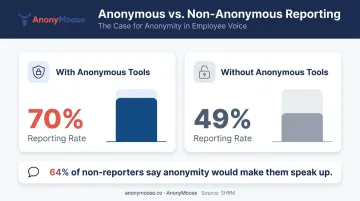
SHRM data shows that 70% of employees reported incidents when anonymous tools were available, versus 49% when they weren't. And 64% of non-reporters said anonymity would make them more likely to speak up. The organizational gains from closing that gap extend beyond incident reporting: the SHRM Study (2020) found a 47% increase in actionable feedback related to management practices and a 34% boost in productivity through improved employee morale and trust in organizations that built genuine anonymous listening systems.
Look for platforms that guarantee identity protection at both the platform and employer level — not just through policy, but through technical architecture.
Channels, Analysis, and Integration
- Supports multiple input types — surveys, pulse checks, open-text, hotlines, and mobile — so you're not missing deskless or distributed workers
- Goes beyond positive/negative scoring with aspect-based analysis, emotion detection, and trend clustering that surface root causes
- Connects with existing HRIS platforms, Slack, or Microsoft Teams, making it easier for both administrators and employees to participate
Most mid-market organizations shouldn't need IT involvement to launch a listening program. Prioritize tools that deploy quickly, support mobile-first access, and scale with headcount — particularly if your workforce is remote, distributed, or deskless.
How We Chose the Best Employee Sentiment Analysis Software
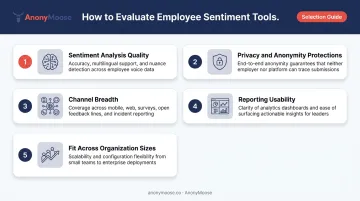
Tools on this list were assessed across five dimensions:
- Sentiment analysis quality — NLP/AI capability beyond surface-level scoring
- Privacy and anonymity protections — Technical guarantees, not just policy promises
- Channel breadth — How and where feedback is collected
- Reporting usability — Whether HR teams can act on the data without a data science background
- Fit across organization sizes — From small teams to enterprise deployments
Two selection mistakes consistently undermine results. The first is prioritizing features over adoption — employees won't use tools they don't trust, making anonymity architecture a baseline requirement. The second is choosing platforms with no real anonymity guarantee, which produces unreliable data that masks real workforce issues.
These criteria matter most because use cases vary widely: real-time disengagement detection, DEI feedback loops, anonymous incident reporting, and executive-level workforce intelligence each demand different strengths. Use the dimensions above to match a platform to your specific goal.
Conclusion
Employee sentiment analysis software is only as effective as the psychological safety behind the data. A tool without credible anonymity produces incomplete, skewed feedback — and decisions made on that data tend to make things worse, not better.
When evaluating platforms, ask not just what the software does, but whether employees will actually use it honestly. That question usually narrows the field quickly.
That's precisely where AnonyMoose stands apart. Built as a mobile-first anonymous communication platform, it gives employees four distinct channels to speak freely: Openlines, Polls & Surveys, Broadcast, and Hotlines. The technical architecture ensures neither the employer nor the platform can identify who said what.
It's designed for employees who would never speak through traditional channels — and those are often the voices organizations most need to hear.
To see how AnonyMoose can help your organization build a genuine listening culture, visit anonymoose.co to explore the platform and get started.
Frequently Asked Questions
What are the best employee sentiment analysis tools?
Top options include AnonyMoose (for anonymity and psychological safety), Qualtrics (for enterprise text analytics), Culture Amp (for culture transformation programs), and Remesh (for qualitative depth at scale). The best choice depends on your company size, use case, and whether anonymity is a priority.
How do you measure employee sentiment?
Employee sentiment is measured through pulse surveys, open-ended feedback, eNPS scores, focus groups, and AI-powered text analysis. Modern platforms automate analysis of unstructured responses into sentiment scores and trend reports, so HR teams spend less time on manual interpretation.
What is the difference between employee engagement and employee sentiment?
Engagement measures behavioral outcomes — discretionary effort, commitment, intention to stay. Sentiment measures emotional state and attitudes. Sentiment data explains the root causes behind engagement scores — revealing why engagement is high or low, not just that it is.
Why is anonymity important in employee sentiment tools?
Employees won't share honest feedback when they fear identification or retaliation — SHRM data shows anonymous reporting raises incident reporting rates from 49% to 70%. Anonymous tools produce higher participation and more candid data, especially on sensitive topics like management, DEI, and workplace safety.
Can small businesses use employee sentiment analysis tools?
Yes. AnonyMoose, 15Five, and ThriveSparrow are all designed for organizations of various sizes, with low-cost SaaS pricing and fast deployment that don't require dedicated IT teams or heavy implementation timelines.
What features should I look for in employee sentiment analysis software?
Focus on: anonymity safeguards (technical, not just policy-based), multi-channel feedback collection (surveys, pulse checks, hotlines, open text), AI/NLP analysis depth, ease of deployment without IT overhead, and reporting clarity that HR teams can act on directly.