Introduction
According to Gallup's 2022 research, workers with fair or poor mental health miss nearly 12 unplanned days per year — compared to 2.5 days for other employees — generating an estimated $47.6 billion in annual lost productivity in the US alone. That's not a wellness statistic. It's an operating cost.
Absenteeism is only part of the picture. The APA's 2023 Work in America Survey found that 77% of workers experienced work-related stress in the prior month. Among those dissatisfied with their employer's mental health support, 57% planned to leave within a year. Rising disability claims, declining engagement, and growing legal exposure trail close behind.
This guide covers what psychological health and safety (PH&S) actually means, the real costs of inaction, the hazards organizations must identify, and the practical steps needed to build a safer workplace culture. Treating it as an operational priority — not an HR checkbox — is where the work begins.
Key Takeaways
- Psychological health and safety is built through policies, leadership behavior, and organizational systems — not wellness perks
- Poor psychosocial conditions generate measurable costs: higher turnover, absenteeism, and burnout
- Hazards like excessive workload, bullying, and role ambiguity require proactive identification, not reactive fixes
- Systemic change — leadership commitment, structural policies, and safe feedback channels — drives real improvement
- PH&S is an ongoing practice requiring regular measurement and iteration, not a one-time initiative
What Is Psychological Health and Safety in the Workplace?
The Foundational Definition
The CCOHS cites CSA Standard Z1003-13 (R2018) — the benchmark North American framework — defining a psychologically healthy and safe workplace as one that "promotes workers' psychological well-being and actively works to prevent harm to worker psychological health including in negligent, reckless, or intentional ways."
The WHO builds on this, defining mental health as "a state of mental well-being that enables people to cope with the stresses of life, realize their abilities, learn and work well, and contribute to their community." Both definitions point to the same conclusion: psychological well-being at work is a direct driver of performance, not a side effect of it.
Psychological Safety vs. Psychological Health and Safety
These terms are often conflated, but they describe different — if connected — concepts:
- Psychological safety (Amy Edmondson, 1999): A team-level belief that it's safe to take interpersonal risks — to speak up, admit mistakes, or challenge ideas without punishment
- Psychological health and safety: A broader organizational system of policies, management practices, and structural climate designed to prevent psychosocial harm at work
Google's Project Aristotle confirmed that psychological safety was the single most important factor distinguishing high-performing teams from low-performing ones. Team-level safety, however, doesn't emerge on its own. It depends on the organizational conditions that either enable or undermine it.
The Psychosocial Safety Climate Model
The Psychosocial Safety Climate (PSC) framework, developed by Hall, Dollard, and Coward, operates through four dimensions:
- Senior management commitment to psychological health
- Relative priority of psychological health over productivity pressures
- Organizational communication that sets clear expectations and reinforces shared values
- Worker participation in decisions affecting their well-being
Research by Law et al. (2011) demonstrated that strong PSC reduces workplace bullying and harassment while improving the balance between job demands and available resources. When demands consistently outpace resources, psychological health erodes. The PSC framework gives organizations a practical structure for addressing that imbalance before it becomes a crisis.
The 13 Psychosocial Factors
The Z1003 standard and Guarding Minds at Work framework identify 13 organizational factors leaders can assess and improve:
- Organizational Culture
- Psychological and Social Support
- Clear Leadership and Expectations
- Civility and Respect
- Psychological Demands
- Growth and Development
- Recognition and Reward
- Involvement and Influence
- Workload Management
- Engagement
- Balance
- Psychological Protection
- Protection of Physical Safety
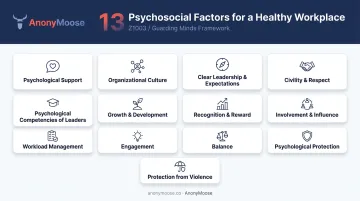
Each factor represents a specific, measurable condition that organizations can assess, benchmark, and improve — giving leaders a concrete starting point for building a healthier workplace.
Why Psychological Health and Safety Matters
The Financial Case
The numbers are hard to dismiss:
- SHRM reported mental health-related leaves rose 33% in 2023 versus 2022 — and 300% from 2017 to 2023
- In Canada, mental health accounts for 30–40% of short-term disability claims, with those cases lasting roughly twice as long as other claim types (Deloitte Canada, 2019)
- The WHO estimates depression and anxiety cost the global economy 12 billion working days and $1 trillion in lost productivity annually
- 51% of employees with disabilities identified a mental health condition as their primary disability (SHRM, 2024)
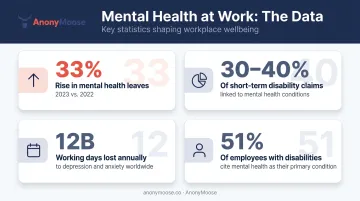
Employees experiencing psychological distress don't just take sick days. Presenteeism — showing up but operating below capacity — reduces team output even when people are physically present, compounding the financial impact well beyond absenteeism alone.
The Human Cost
Chronic workplace stress follows a predictable trajectory: sustained pressure escalates to burnout, burnout to psychological distress, and in cases involving bullying or harassment, to post-traumatic stress symptoms. Research links low psychological safety climate (PSC) directly to higher rates of all three.
The risk is especially acute in high-demand roles, where:
- Burnout accumulates from sustained cognitive and emotional load
- Compassion fatigue depletes workers in caregiving or service-intensive positions
- Emotional exhaustion persists even after time off when structural causes aren't addressed
The Talent and Brand Dimension
Poor PH&S conditions don't just harm current employees — they compromise recruitment:
- 92% of workers said it was important to work for an organization that values their psychological well-being (APA, 2023)
- 57% of workers dissatisfied with employer mental health support intended to seek a new job within the next year, versus 33% overall
MIT Sloan Management Review's analysis of the Great Resignation identified toxic culture as the strongest predictor of employee dissatisfaction and attrition — outperforming compensation as a driver of turnover.
The Legal and Compliance Dimension
The regulatory landscape is shifting:
- US employers: OSHA's General Duty Clause requires workplaces free from recognized hazards likely to cause serious harm — which increasingly applies to psychosocial risks
- Australia: Safe Work Australia introduced enforceable psychosocial hazard regulations in 2022, with Commonwealth jurisdiction amendments taking effect April 1, 2023
- UK: The HSE requires employers to conduct stress risk assessments and act on findings
- EU: EU-OSHA treats psychosocial risks as formal occupational safety and health issues
Even where standalone PH&S mandates don't yet exist, the regulatory trajectory points toward broader enforcement. Organizations that treat psychosocial hazards as optional are building compliance exposure into their operations — not avoiding it.
Key Psychosocial Hazards Every Workplace Must Address
Identifying Where Harm Originates
Psychosocial hazards are work-related conditions — rooted in how work is organized, managed, and experienced — that can cause psychological harm. Identifying them requires multiple data sources:
- Absenteeism rates, turnover data, complaint reports, and engagement survey trends (quantitative signals)
- Direct conversations, focus groups, and structured observations (qualitative insight)
- Audits of management practices and existing policies to surface structural gaps
A workplace can show normal absenteeism rates while masking significant psychological harm that only surfaces in anonymous employee conversations. No single data source gives the full picture.
The Main Hazard Categories
| Hazard | Example |
|---|---|
| Excessive workload | Chronically understaffed teams with unrealistic deadlines |
| Role ambiguity | Unclear job expectations or conflicting priorities from multiple managers |
| Social isolation | Remote employees with no structured communication touchpoints |
| Bullying and harassment | Repeated intimidation by senior staff that goes unchallenged |
| Lack of autonomy | Micromanagement that removes employee discretion entirely |
| Insufficient support | Managers who are unavailable or dismissive of concerns |
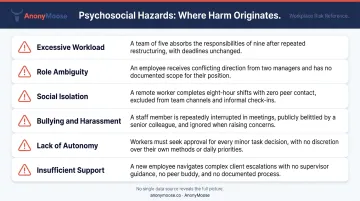
Even with the right tools in place, many of these hazards go unreported. The reason is less about disengagement and more about self-protection.
The Silence Problem
One of the most underappreciated barriers to hazard identification is the rational decision employees make to stay quiet — avoiding the risk of being seen as incompetent, overly sensitive, or disloyal. Researchers call this impression management.
Research by Milliken, Morrison, and Hewlin (2003) found the most frequently cited reason for employee silence was fear of being viewed or labeled negatively. Detart and Edmondson (2011) described these as "implicit voice theories" — unspoken beliefs about when speaking up is safe or appropriate.
The result: organizations routinely underestimate the severity of their psychosocial climate until problems surface as formal complaints, turnover spikes, or damaging public employer reviews.
How to Build a Psychologically Safe Workplace
Start with Leadership
Senior management commitment is the single most important driver of a strong PSC. Leaders who visibly acknowledge mistakes, invite disagreement, and treat concerns as useful data — rather than threats — establish the behavioral norms that shape the entire organization.
The practical shift is from managing through authority to coaching through development. That means recognizing individual strengths, creating space for honest conversation, and modeling the psychological safety they want their teams to experience.
Build Structural Foundations
Leadership behavior alone isn't enough. Organizations need systemic controls:
- Clear anti-bullying and anti-harassment policies with defined consequences
- Workload standards that reflect realistic human capacity
- Flexible work arrangements that accommodate different employee needs
- Formal worker consultation processes embedded in decision-making
A 2019 JAMA randomized controlled trial of 32,974 employees found that workplace wellness programs improved some self-reported behaviors but had no significant effect on absenteeism, work performance, or tenure after 18 months. The WHO's guidance is consistent: organizational interventions that change actual working conditions outperform individual-level programming.
Create Always-Available Anonymous Feedback Channels
Even well-designed open-door policies fail when employees anticipate that raising a concern will expose them to judgment or retaliation. Organizations end up hearing only what employees feel safe saying — rarely the full picture.
Purpose-built anonymous channels close this gap. AnonyMoose provides four active listening features, each built on technical anonymity — not just promised confidentiality. The SHRM Study (2020) found that 82% of employees are more likely to share critical feedback when anonymity is preserved, and a 34% boost in productivity through improved employee morale and trust follows from building workplaces where employees genuinely feel safe to speak:
- Openlines: Permanent, always-available two-way channels between employees and specific leaders, managers, or departments — accessible from any device, at any time, with no technical mechanism capable of revealing identity
- Polls & Surveys: Anonymous pulse surveys reaching 90%+ participation rates (versus ~30% for identified surveys), because employees know responses can't be traced back to them
- Hotlines: Structured incident reporting for serious concerns — harassment, discrimination, ethics violations — accessible by phone without requiring voice communication or physical presence
- Broadcast: Leadership-to-employee messaging that ensures deskless and remote workers receive critical information via push notification
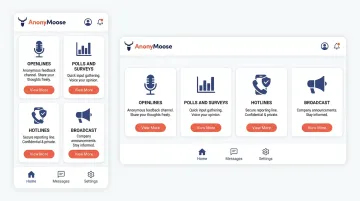
The platform is cloud-based, mobile-first, and accessible 24/7. Submissions are untraceable by design — neither AnonyMoose nor the employer can identify individual users. For employees who've encountered "anonymous" systems that weren't, that technical guarantee is what makes the difference between a channel people actually use and one they ignore.
Measure, Communicate, and Iterate
PH&S built without measurement is built on assumptions. The APA found a 30% improvement in employee satisfaction within one year among organizations that implemented genuine anonymous listening programs — a benchmark worth tracking alongside clinical indicators when evaluating whether wellbeing investments are landing. Practical measurement approaches include:
- Edmondson's 7-item Psychological Safety Scale to assess team-level safety
- Anonymous employee surveys to track psychosocial climate over time
- HR metrics: absenteeism trends, turnover rates, leave duration data
- Behavioral indicators: participation in feedback channels, idea-sharing frequency, escalation patterns
AnonyMoose's Insights Dashboard provides aggregated analytics from Polls, Surveys, and Hotlines — surfacing themes without exposing individual identities — so leadership can track whether workplace culture is actually improving.
Share findings with employees (aggregated, never identified), acknowledge what's been heard, and demonstrate visible action. When employees see their input produce change, participation increases. When feedback disappears into silence, it stops coming.
Common Mistakes Organizations Make
Treating PH&S as a Campaign, Not a System
Annual awareness days, one-time training events, and wellbeing newsletters create the appearance of action without producing structural change. The JAMA wellness trial makes this clear: even a well-resourced program with thousands of participants moved the needle on self-reported behaviors but not on the outcomes that matter operationally.
The difference between a campaign and a system: campaigns happen once or annually; systems operate continuously. PH&S improvements require embedding expectations into job design, management accountability, and ongoing feedback loops — not scheduling an annual workshop.
Relying Solely on Identified Feedback Formats
Open-door policies, town halls, and manager one-on-ones share a structural problem: employees participate under conditions where their identity and social standing are fully visible. Silence is the rational choice when speaking up carries personal risk.
When employees have no credible internal channel, unresolved concerns migrate outward. MIT Sloan's Great Resignation research confirmed that employees use public review platforms to describe culture concerns — and those descriptions affect satisfaction, attrition, and recruiting.
Providing a trusted anonymous internal channel redirects that feedback to where it can actually be acted on, rather than broadcast publicly.
Ignoring Early Warning Signs
By the time PH&S problems appear as formal complaints or leadership crises, the organizational damage is already extensive. The earlier signals are:
- Rising absenteeism: chronic stress or disengagement, not coincidental illness
- Declining survey participation — employees who stop responding have already stopped trusting the process
- Increased turnover, especially among high performers who have options elsewhere
- Teams in psychologically unsafe environments stop proposing new ideas — reduced idea-sharing is one of the clearest early signs
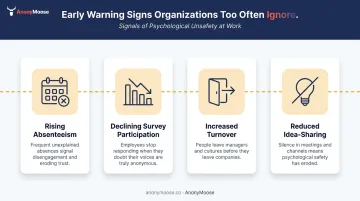
Each of these is measurable and addressable — but only if organizations treat them as signals rather than background noise.
Conclusion
Psychological health and safety is built through leadership behavior, organizational policy, and communication systems that protect employees' ability to speak up, raise concerns, and contribute without fear. The research on costs, the regulatory trajectory, and the talent data all point in the same direction.
The practical starting point is honest assessment: what do your HR metrics actually show? What do employees experience that management doesn't hear about? What structural changes — not just communications — would address the hazards present in your workplace?
Those structural changes only work when employees trust they can speak without consequence. Every employee's feedback is data — but only if the channels exist to capture it honestly and act on it visibly. Organizations that build those conditions, and protect the people who use them, create the psychosocial climate that retains talent, sustains performance, and holds up under growing regulatory scrutiny. Tools like AnonyMoose's anonymous feedback channels give employees a path to share what they won't say in a meeting — and give leadership the signal they need to act.
Frequently Asked Questions
What is the difference between psychological safety and psychological health and safety?
Psychological safety — Amy Edmondson's concept — is a team-level belief that it's safe to take interpersonal risks without fear of punishment. Psychological health and safety is a broader organizational system: policies and management practices designed to prevent psychosocial harm across the entire workplace.
What are the warning signs of a psychologically unsafe workplace?
Key indicators include high absenteeism, elevated turnover, reluctance to share ideas or raise concerns, frequent interpersonal conflicts, declining engagement scores, and falling participation in internal feedback channels.
What are psychosocial hazards, and how do they affect employees?
Psychosocial hazards are work-related factors — such as excessive workload, bullying, poor communication, and role ambiguity — that can cause psychological harm. Sustained exposure causes burnout, anxiety, depression, and reduced productivity.
How can managers promote psychological health and safety on their teams?
Practical steps include:
- Acknowledge mistakes openly to model psychological safety
- Set clear role expectations and address conflicts promptly
- Provide a confidential reporting channel employees can use without risking their standing
Is psychological health and safety a legal requirement for employers?
In the US, OSHA's General Duty Clause broadly requires workplaces free from recognized hazards — which can apply to psychosocial risks. Australia now has enforceable psychosocial hazard regulations; the UK requires stress risk assessments. More countries are moving toward explicit PH&S requirements.
How do you measure psychological safety in the workplace?
Start with Edmondson's validated 7-item Psychological Safety Scale for team-level assessment, paired with anonymous employee surveys for broader climate data. HR metrics — absenteeism, turnover, and leave duration — provide a quantitative baseline alongside those results.