According to Gallup, just 3 in 10 U.S. workers strongly agree that their opinions count at work. That's not a communication problem. It's a psychological safety problem.
The consequences reach further than most leaders realize. Gallup's research shows that moving from 3 in 10 to 6 in 10 employees who feel their opinions count is associated with a 27% reduction in turnover, a 40% reduction in safety incidents, and a 12% increase in productivity — all from the same underlying shift in how safe employees feel to speak. The SHRM Study (2020) found that when psychological safety translates into improved morale and trust, organizations see a 34% boost in productivity — a compound effect from the same root cause Gallup identifies: employees who feel safe to speak up perform at a higher level.
This article covers what psychological safety actually is, how it drives engagement, the warning signs when it's missing, and — most practically — what organizations can do to build it in ways that last.
Key Takeaways
- Psychological safety is the shared belief that speaking up, taking risks, and admitting mistakes won't result in punishment or humiliation.
- Google's Project Aristotle identified it as the #1 factor in team effectiveness — above all other variables.
- Low psychological safety drives disengagement, suppresses innovation, and accelerates attrition — with the sharpest impact felt by employees from underrepresented groups.
- Sustaining it takes deliberate leader behavior, inclusive team norms, and structured channels where raising concerns carries no risk of retaliation.
What Is Psychological Safety?
Amy Edmondson, whose 1999 research established the modern framework, defines team psychological safety as "a shared belief held by members of a team that the team is safe for interpersonal risk taking." That means asking questions, sharing dissenting views, admitting errors, and proposing new ideas — without fear of embarrassment, retaliation, or rejection.
That team-level climate connects directly to the individual. William Kahn's 1990 work on personal engagement identified safety as one of three core conditions employees need to bring their full selves to work. Without it, people withhold — not just effort, but identity.
What It Is Not
Psychological safety is frequently misunderstood. Three distinctions matter most:
- Not about being nice — candid, difficult conversations are entirely compatible with psychological safety
- Not the absence of accountability — high standards and safe environments coexist
- Not individual trust — trust is a one-to-one relationship; psychological safety is a group-level climate
The Four Stages
Dr. Timothy Clark's framework maps psychological safety as a progression through four stages:
- Inclusion Safety — accepted as a member, regardless of background or role
- Learner Safety — free to ask questions, experiment, and make mistakes
- Contributor Safety — confident enough to do meaningful work and share ideas
- Challenger Safety — empowered to question the status quo without retaliation
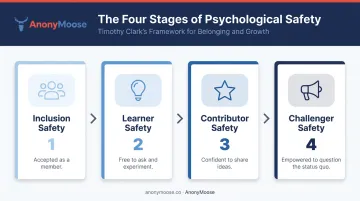
Each stage mirrors a deeper level of employee engagement. Teams that stop at Stage 1 — inclusion — get compliance. The discretionary effort, innovation, and candid feedback that drive real engagement only emerge in Stages 3 and 4.
How Psychological Safety Drives Employee Engagement
When fear is removed, employees shift from self-protection mode to contribution mode. They invest discretionary effort — going beyond minimum requirements — because they trust their participation is valued, not risky.
The Research Foundation
The evidence connecting psychological safety to engagement is substantial:
- Google's Project Aristotle analyzed hundreds of teams and found that psychological safety was the single most important factor in team effectiveness — ranked above dependability, structure, meaning, and impact
- Gallup's Q12 Meta-Analysis (2024), covering over 3.3 million employees across 53 industries, found that top-quartile engagement business units had 23% higher profitability than bottom-quartile units
- Kahn's original research identified that engagement and psychological safety co-vary across relationships, management style, and organizational norms — they're not independent variables
Creativity and Innovation
A 2017 meta-analysis by Frazier et al., covering 136 independent samples, found psychological safety positively related to four key organizational behaviors:
A 2017 meta-analysis by Frazier et al., covering 136 independent samples, found psychological safety positively related to four key organizational behaviors:
- Information sharing (rho = 0.52)
- Learning behavior (rho = 0.62)
- Task performance (rho = 0.43)
- Creativity (rho = 0.13)
Fear of judgment doesn't just reduce comfort. It measurably suppresses the behaviors organizations need most.
Retention and Belonging
BCG's 2024 research, drawing on a survey of 28,000 employees across 16 countries, found that:
- 12% of employees with the lowest psychological safety said they were likely to quit within a year
- That figure dropped to 3% when psychological safety was high
- Retention improves by more than four times for women and BIPOC employees, five times for people with disabilities, and six times for LGBTQ+ employees when leaders create psychological safety
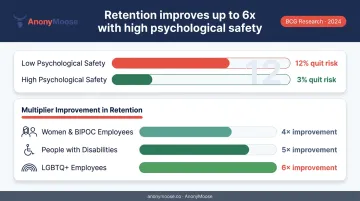
Psychological safety doesn't just improve engagement — it functions as an equalizer, disproportionately benefiting employees from groups that face higher baseline interpersonal risk at work. The American Psychological Association found that organizations with strong psychological safety infrastructure see a 30% increase in employees' sense of belonging and a 30% improvement in overall employee satisfaction within one year — outcomes that reinforce each other and compound over time as employees develop trust that their input is both safe and consequential.
The Disengagement Spiral
Remove psychological safety, and the damage compounds quietly. Employees stop raising concerns in meetings. Errors get hidden rather than reported. Problems fester until they escalate.
When internal channels feel unsafe, employees turn to external ones: Glassdoor reviews, anonymous forums, social media. That shift carries reputational risk — Glassdoor data shows 65% of job seekers read at least five reviews before forming an opinion of a company.
Key Elements of Psychological Safety in the Workplace
Belonging and Inclusion as the Foundation
Psychological safety begins with inclusion safety — the basic need to feel accepted for who you are. Employees who feel they don't belong don't take interpersonal risks.
BCG's research makes this concrete: in organizations with the lowest psychological safety, 18% of LGBTQ+ employees were at attrition risk, versus 12% of straight, cisgender employees. In the top 30% of psychological safety, attrition risk fell to 3% for all groups. Inclusion isn't an add-on — it's the prerequisite.
Open Communication and Equitable Voice
Healthy psychological safety produces balanced participation. That means senior voices don't automatically dominate, dissent flows upward, and employees feel safe raising concerns before problems escalate.
Nembhard and Edmondson's research on healthcare teams found that leader inclusiveness — defined as words and deeds that invite and appreciate others' contributions — directly reduced the effect of status differences on psychological safety. The same principle applies in any organizational hierarchy.
Freedom to Learn from Failure
Edmondson's hospital research produced a counterintuitive finding: better-performing nursing teams appeared to make more errors. Not because they were worse — but because they felt safe enough to acknowledge and report them. Teams that hide mistakes don't fix them.
When organizations treat errors as learning opportunities rather than causes for blame, they reduce anxiety, promote experimentation, and sustain engagement over time.
Constructive Conflict and Leader Modeling
Two elements work in tandem here:
- Constructive conflict — disagreement focused on ideas rather than people — is a sign of psychological safety, not a threat to it. Teams that feel safe debate more rigorously, which produces sharper decisions.
- Leader modeling determines whether any of the above actually happens. When leaders share their own mistakes, ask genuine questions, and respond to dissent without defensiveness, they signal to the entire team that it's safe to be human at work.
A 2018 study found humble leadership was positively related to psychological safety (b = 0.23, p < 0.001), which in turn predicted follower creativity. How leaders behave sets the ceiling for how safe everyone else feels.
Warning Signs: When Psychological Safety Is Low
The early indicators are behavioral, not survey-driven. Watch for:
- Silence during brainstorming — people nod and agree, then vent privately afterward
- No upward feedback — managers receive only positive signals, never concerns
- Errors go unreported — problems surface only after they've escalated
- High turnover in specific groups — especially employees from underrepresented backgrounds, who often experience lower baseline psychological safety
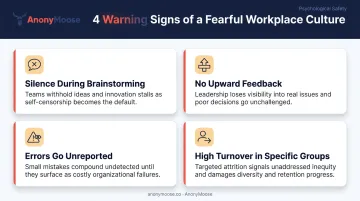
The organizational consequences are consistent across industries. Innovation slows as ideas are self-censored before they're spoken. Poor decisions go unchallenged because dissenting perspectives are withheld. And disengagement sets in without announcement — teams that feel unsafe don't say so, they just stop contributing.
That internal silence doesn't stay internal. When employees have no safe channel to speak up at work, they find channels outside of it. Platforms like Glassdoor and Blind become the outlet. Given that 79% of job seekers are more likely to apply when employers are active and responsive on Glassdoor, the reputational consequences of internal silence are measurable — not just cultural.
How to Build Psychological Safety That Sustains Engagement
Lead with Vulnerability and Authentic Communication
Leaders who share their own mistakes and uncertainties signal that it's safe for everyone else to do the same. A practical starting point: open team meetings with a brief personal reflection from the leader. What didn't go as planned last week? What did you learn? This single habit, practiced consistently, shifts the climate faster than most formal interventions.
Normalize Learning from Mistakes
Institutionalize this through retrospectives and post-mortems framed around improvement rather than accountability. When employees observe that calculated risks are respected — even when they fail — they become more invested in the process, not less.
Cultural habits alone aren't enough, though. The environment also needs structures that make it physically easy — and safe — for every voice to reach leadership.
Create Structural Channels for Every Voice
Individual bravery shouldn't be a prerequisite for speaking up. Organizations need structural mechanisms that make it safe and easy for every voice to be heard — channels that don't require employees to put themselves at personal risk.
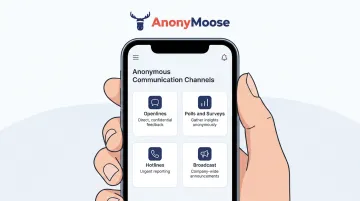
This is exactly the problem AnonyMoose was built to solve. The platform provides four anonymous communication paths:
- Openlines — two-way anonymous channels replacing traditional one-on-ones and open-door policies
- Polls & Surveys — mobile-first pulse tools that reach deskless and remote employees with near-100% delivery via push notification
- Hotlines — structured anonymous channels for reporting sensitive concerns, harassment, or ethical violations
- Broadcast — leadership-to-employee messaging that closes the communication loop with guaranteed reach
Research by Mao and DeAndrea (2019) found that employees evaluate a voicing channel as safer and more effective when it is perceived as more anonymous. AnonyMoose's architecture takes this further — anonymity is by design, not policy. Neither AnonyMoose nor the employer organization can technically identify the author of any submission. The organizational effects of that trust are well documented: the SHRM Study (2020) found that 82% of employees are more likely to share critical feedback when their anonymity is preserved, and a 34% boost in productivity through improved employee morale and trust follows when employees believe their voice is genuinely protected. The APA further found a 30% improvement in employee satisfaction within one year among organizations that built genuine anonymous listening systems — an outcome directly traceable to the psychological safety that structural anonymity creates.
Respond Constructively and Close the Feedback Loop
Providing a channel is only half the work. When employees share feedback and receive no visible response, the channel loses credibility faster than if no channel existed at all. Closing the loop means acknowledging input, explaining what will change, and following through. That sequence is what turns a feedback channel into a trust-building mechanism.
AnonyMoose's Openlines and Hotlines support two-way anonymous dialogue for exactly this reason. Leadership can respond, ask follow-up questions, and share resources within the same thread — and the employee's identity stays protected throughout.
Measure Psychological Safety as a Leading Indicator
Treating psychological safety as a lagging outcome means addressing problems after they've already affected engagement scores and attrition numbers. Treat it as a leading indicator instead.
Edmondson's validated 7-item scale includes questions such as:
- Are mistakes held against people?
- Can members raise problems and tough issues?
- Is it safe to take a risk on this team?
Segment results by team and demographic group to identify where safety gaps exist. Research from Quantum Workplace found that anonymous communication in organizations drives a 35% increase in employees' sense of belonging — making psychological safety pulse data one of the clearest leading indicators of whether inclusion programs are producing genuine cultural change or surface-level compliance. Anonymous pulse surveys, including targeted ones reaching specific subgroups, give organizations ongoing visibility into where the climate is eroding — before it shows up in exit interviews. That early signal is the difference between prevention and damage control.
Frequently Asked Questions
How does psychological safety impact employee engagement?
Psychological safety removes fear as a barrier to contribution. When employees believe they won't be penalized for speaking up or making mistakes, they invest discretionary effort, share ideas openly, and stay emotionally committed — the core markers of genuine engagement.
What are the key elements of psychological safety in the workplace?
The five core elements are: inclusion and belonging, equitable voice and open communication, freedom to learn from failure, constructive conflict norms, and empathetic leader modeling. Each builds on the last, following the progression Timothy R. Clark outlines in his four-stage psychological safety framework.
What are the signs of low psychological safety in the workplace?
Key indicators include silence during meetings, absence of upward feedback, employees agreeing publicly but venting privately, errors going unreported, and elevated turnover — particularly among employees from underrepresented groups who face greater baseline interpersonal risk.
How can leaders build psychological safety on their teams?
Model vulnerability by sharing mistakes openly and responding to dissent without defensiveness. Normalize failure through structured retrospectives, actively solicit input, and provide anonymous channels for employees who face higher interpersonal risk when speaking directly.
What is the difference between psychological safety and trust?
Trust is a one-to-one relationship: confidence in a specific person. Psychological safety is a group-level climate — the collective belief that the team environment makes interpersonal risk-taking safe. You can trust your manager personally and still not feel psychologically safe on your team.
How do anonymous feedback tools support psychological safety?
Anonymous channels reduce the interpersonal risk of speaking up, making it safe for employees who fear retaliation or judgment to share honest feedback. Junior employees and those from underrepresented groups benefit most, as they typically face higher consequences for candor in traditional settings.