That last point matters. Under Title VII of the Civil Rights Act, sexual harassment is illegal — and it covers more than most people assume. The EEOC recognizes two forms: quid pro quo harassment (when job benefits are tied to sexual compliance) and hostile work environment harassment (when unwelcome conduct is severe or pervasive enough to interfere with your work). You don't need to be physically touched for it to be illegal.
This article walks through exactly what to do — how to document, who to report to, in what order, what mistakes to avoid, and where to turn if your employer fails to act.
Key Takeaways
- Sexual harassment includes unwelcome advances, sexual coercion, and hostile work environments — all illegal under federal law.
- Document every incident privately before approaching anyone internally.
- Report to HR or a designated compliance contact first, then escalate to the EEOC if your employer fails to respond appropriately.
- The EEOC filing deadline is 180 days from the incident (up to 300 days in states with their own anti-discrimination laws).
- Retaliation for reporting is independently illegal and can be filed as a separate complaint.
Before You Report: How to Build Your Case
Walking into any reporting conversation without documentation weakens your position. Preparation here isn't procedural — it directly affects how seriously your complaint is taken and whether it holds up legally.
Document Every Incident in Writing
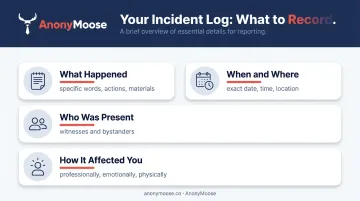
Start a private log immediately after any incident. For each entry, record:
- What happened — specific words, actions, or materials
- When and where — exact date, time, location
- Who was present — witnesses, bystanders, anyone who may have seen or heard
- How it affected you — professionally, emotionally, physically
Store this log somewhere personal and secure — not on a work computer, not in a work email account. A personal device or private cloud storage keeps it out of your employer's reach.
Preserve physical evidence the same way. Screenshot harassing texts or emails, save voicemails, photograph inappropriate materials. Keep copies at home or in personal storage. Equal Rights Advocates specifically advises documenting emails, texts, and communications alongside dates, locations, and witnesses.
Know Your Company's Harassment Policy
Check your employee handbook or HR portal for the company's sexual harassment policy. Note who the designated complaint contact is — it isn't always HR. Some organizations route complaints through a compliance hotline, a third-party system, or an ombudsperson.
Some companies also offer anonymous internal reporting tools that let employees flag misconduct without identifying themselves. AnonyMoose's Hotlines feature works this way: employees submit reports through a mobile app, and the platform's architecture makes identification technically impossible. Neither AnonyMoose nor the employer can trace a submission to the person who sent it.
The channel is also two-way. HR can ask follow-up questions within the same thread while the employee stays anonymous throughout the entire exchange. If your company uses a tool like this, it's a lower-risk starting point for employees who aren't ready to file formally.
Assess Your Safety and Support
The reporting process is emotionally taxing. Seek support from a trusted colleague, your company's Employee Assistance Program (EAP), or an outside counselor before and during the process.
If the harasser is in senior leadership, if your company has previously dismissed similar complaints, or if the situation is otherwise complex, speak with an employment attorney before filing any formal complaint. Many employment attorneys offer free initial consultations and work on contingency.
How to Report Sexual Harassment at Work
Reporting follows a sequence: internal first, then external. Each step strengthens your documentation and legal standing for whatever comes next.
Step 1: Report Internally to HR or a Supervisor
Most employers expect an internal complaint first. Identify the correct contact per your company's policy — usually HR, a compliance officer, or (if HR is implicated) a senior leader or ombudsperson.
Make the report in writing. An email creates a timestamped record that's difficult to dispute. In your complaint:
- Describe what happened specifically — what was said or done, when, and where
- Explain how it affected your work or working environment
- Request written acknowledgment that your complaint was received
Avoid vague language. "I felt uncomfortable" is less useful than "On [date], [name] said [specific statement] in front of [witness]."
Step 2: Follow Up and Document the Response
After submitting your complaint, track everything. Save every response from HR — what was communicated, promised, or investigated. If conversations happen verbally, follow up by email: "As we discussed today, you said the investigation would be completed by [date]."
A lawful employer response includes a prompt investigation, confidentiality protections, and no adverse treatment for reporting. Watch for red flags that signal mishandling — each one strengthens your case if you escalate externally:
- Unexplained delays in the investigation
- Pressure to withdraw or minimize the complaint
- Any change in your work conditions after reporting (reassignment, reduced hours, exclusion)
Step 3: File a Formal Complaint with the EEOC
If internal reporting fails — or if you're uncomfortable going internal at all — you can file directly with the EEOC.
The process:
- Submit an online inquiry through the EEOC Public Portal
- Schedule and complete an EEOC interview
- File a formal Charge of Discrimination
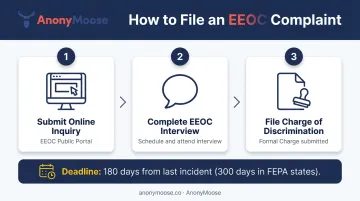
The critical deadline: 180 calendar days from the date of the last incident. This extends to 300 days in states with their own anti-discrimination agencies (called Fair Employment Practices Agencies, or FEPAs). California's Civil Rights Department and the New York Division of Human Rights both accept complaints up to three years from the incident — but don't rely on state extensions without verifying your state's specific rules.
As Equal Rights Advocates confirms: filing an internal complaint with your employer does not extend the EEOC's federal deadline. These clocks run independently.
Step 4: Pursue Legal Action If Necessary
If the EEOC investigation doesn't resolve the issue, the agency may issue a Notice of Right to Sue — which gives you 90 days to file a civil lawsuit against your employer. Once you receive that letter, the clock starts immediately.
Many employment attorneys handle harassment cases on contingency, meaning no upfront cost to you. If you need help finding representation:
- Legal Momentum — offers a HelpLine and legal assistance
- Equal Rights Advocates — free, confidential legal advice for workplace gender discrimination
- NWLC Legal Network for Gender Equity — connects people facing sex discrimination with attorneys for free initial consultations
Key Factors That Affect the Outcome of Your Report
The same incident can produce very different outcomes depending on several factors — some within your control, some not.
Three factors consistently shape how complaints are received and resolved:
- Report promptly. Delays create credibility gaps. Even an informal report strengthens the legal record — and the EEOC's 180-day filing deadline is non-negotiable.
- Document everything. Complaints backed by written logs, physical evidence, and witness accounts are far harder to dismiss than verbal-only accounts. The "who, what, when, where" log from your preparation phase is your strongest asset.
- Know your company's culture. A 2018 analysis by Lean In and McKinsey found that 98% of companies had policies prohibiting sexual harassment — yet more than half of women in senior leadership had experienced it anyway.
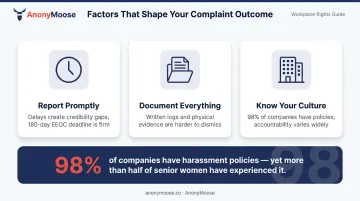
Policies on paper don't equal accountability in practice. Companies without functional reporting channels or genuine leadership accountability are more likely to mishandle complaints — which makes external escalation more necessary, not less.
Common Mistakes That Weaken Harassment Reports
Most reports that fail do so for predictable, avoidable reasons.
Waiting too long to document. Memory fades, digital evidence gets deleted, and the EEOC deadline is fixed. Even if you're not ready to report formally, start a private log immediately after any incident.
Reporting only verbally. Verbal complaints leave no paper trail and are easily denied. Always follow a verbal conversation with a written record. An email to HR stating "This summarizes what I reported today" is sufficient — and that record can become evidence.
Letting retaliation fear stop all action. The EEOC has identified retaliation fear as one of the primary reasons harassment goes unreported. What changes the calculus: retaliation is independently illegal under Title VII and can be separately reported to the EEOC, with its own legal remedies.
Anonymous reporting tools exist specifically to lower this barrier. If your company uses AnonyMoose or a similar platform, submissions cannot be traced back to you — making retaliation structurally harder to execute.
What to Do When Internal Reporting Fails
If your employer fails to investigate, dismisses your complaint, the harassment continues, or retaliation begins — escalating to external channels is a protected right, not a last resort.
File with the EEOC immediately. Don't wait to see if your employer "fixes it." Waiting eats into your 180-day filing window. The EEOC process runs on its own timeline, independent of whatever your employer is doing internally.
After a charge is filed, the EEOC notifies the employer (typically within 10 days) and may offer mediation, conduct an investigation, seek conciliation, or — if none of that resolves the issue — issue a Notice of Right to Sue.
Contact a legal professional or advocacy organization. Use the resources listed in Step 4 above. Before that conversation, pull together every record you have.
If your organization used an anonymous reporting tool like AnonyMoose, the Hotlines feature keeps structured case records — conversation threads, attached files, and case status history — accessible to your administrator. Even without identity links (anonymity is preserved by design), those documented records can support your escalation.
If physical safety is at risk, contact law enforcement. Physical assault and direct threats are criminal matters, not just workplace policy violations. Civil employment channels and law enforcement are not mutually exclusive — use both when your safety is involved.
Conclusion
Reporting sexual harassment is a process, not a single action. Document first, report internally with a written record, escalate to the EEOC if your employer falls short, and pursue legal action if the process fails. Timing and documentation quality are the two variables most within your control — and both matter from the moment an incident occurs, not from the moment you decide to act.
Title VII and other federal protections explicitly prohibit retaliation against employees who report harassment in good faith. External agencies like the EEOC exist precisely because internal processes fail — and they have real enforcement authority. Reporting, even imperfectly, creates a legal record that protects you and prevents the same treatment from happening to someone else.
One practical barrier many employees face is fear of being identified when reporting internally. Anonymous reporting channels — whether a dedicated hotline or a platform like AnonyMoose — can lower that threshold significantly, giving you a way to put an incident on record without exposing yourself before you're ready to escalate formally.
Frequently Asked Questions
What should I do if someone sexually harasses me at work?
Document the incident privately right away: date, time, what happened, and who was present. Review your company's harassment policy to identify the correct reporting contact, then report to HR or a designated compliance officer in writing. You are not required to confront the harasser directly.
What evidence do I need to report harassment?
A dated written log of incidents is your foundation. Add any saved communications (texts, emails), names of witnesses, and physical evidence like screenshots or photos. Specificity and consistency matter more than having a complete paper trail.
Is it worth reporting harassment?
Yes. Reporting creates a legal record, protects colleagues from the same behavior, and is a protected right under federal law. If internal reporting feels unsafe, the EEOC exists for exactly that situation — and retaliation for reporting is itself illegal.
Can my employer retaliate against me for reporting sexual harassment?
Retaliation is illegal under Title VII and is a separate violation with its own legal remedies. If you experience demotion, termination, or hostile treatment after reporting, you can file a retaliation charge with the EEOC independently of the original harassment complaint.
How long do I have to file a sexual harassment complaint?
The EEOC deadline is 180 calendar days from the date of the last incident, extended to 300 days in states with their own anti-discrimination agencies. Start documenting immediately — even before you decide to file — to protect your timeline.
What happens after I report sexual harassment at work?
Your employer should acknowledge the complaint, conduct a confidential investigation, and take corrective action. If they don't, or if you filed directly with the EEOC, the agency notifies your employer within approximately 10 days and pursues next steps: mediation, formal investigation, or issuing a Notice of Right to Sue.