This dilemma is more common than most organizations admit. According to NAVEX's summary of ECI's 2023 Global Business Ethics Survey, 53% of U.S. employees observed misconduct in 2023 — and among those who reported it globally, 46% experienced retaliation. Fear of that retaliation is the single biggest reason people stay silent.
This guide walks you through the full reporting process: recognizing what qualifies as unethical behavior, documenting your concerns safely, reporting through internal and external channels, and understanding your legal protections.
Key Takeaways
- 53% of U.S. employees witnessed workplace misconduct in 2023, yet fear of retaliation stops most from reporting
- Document everything — dates, witnesses, what was said — on personal devices before you do anything else
- Start with internal channels — HR, ethics hotlines, anonymous platforms — then escalate externally if needed
- OSHA, the EEOC, the SEC, and the DOL each handle specific violation types
- Federal law protects whistleblowers under more than 20 statutes; retaliation is itself illegal
What Counts as Unethical Behavior in the Workplace
Unethical workplace behavior is any action that violates organizational policy, professional standards, or law in a way that harms people or gives someone an improper advantage. The range is wide — subtle boundary violations at one end, outright criminal conduct at the other.
The Most Common Categories
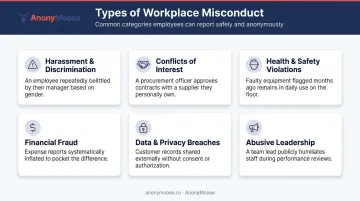
These are the violation types employees actually encounter and report most often, based on NAVEX's 2024 Whistleblowing & Incident Management Benchmark Report:
| Category | Real-World Example |
|---|---|
| Harassment & discrimination | A supervisor making repeated sexual comments; a manager passing over promotions based on race |
| Conflicts of interest | A procurement officer awarding contracts to a family member's company |
| Health & safety violations | Falsifying equipment inspection logs; ignoring reported hazards |
| Financial fraud | Expense report manipulation; falsifying revenue figures |
| Data & privacy breaches | Sharing customer data without authorization; bypassing access controls |
| Abusive leadership | Chronic intimidation, public humiliation, or threats tied to job security |
Unethical vs. Just Unpleasant
Not every difficult workplace experience crosses an ethical or legal line. A manager who gives vague feedback, a colleague who's consistently rude, or a boss with a frustrating communication style — these are legitimately hard to deal with, but they don't typically warrant formal reporting.
Formal reporting becomes appropriate when the behavior:
- Involves a protected class (race, gender, age, disability, religion)
- Breaks a specific policy or law
- Causes financial harm to the organization or individuals
- Creates physical danger in the workplace
- Gives someone an improper advantage
If you're asking whether your concern is "serious enough," that question alone usually means it's worth documenting.
Why Employees Don't Report — And What Silence Costs
The Four Real Barriers
Most employees who witness misconduct and say nothing aren't indifferent. They're calculating risk. The four most common barriers:
- Fear of retaliation — job loss, social exclusion, or being labeled a troublemaker. Globally, 46% of employees who reported misconduct experienced some form of retaliation.
- Distrust that anything will change — particularly in organizations with a history of protecting senior leaders
- Uncertainty about what qualifies — many employees genuinely aren't sure if what they saw rises to the level of a reportable violation
- Personal closeness to the person involved — reporting a colleague or mentor feels like betrayal, even when the behavior is clearly wrong
The Real Cost of Staying Silent
Unreported misconduct doesn't stay contained. ACFE's 2024 Report to the Nations found that the median occupational fraud scheme runs for 12 months before detection, with a median loss of $145,000 — and 22% of cases involved losses of $1 million or more. That's the financial cost of a single category of misconduct left unaddressed.
The damage doesn't stop at the balance sheet. SHRM found that one in five Americans left a job in the prior five years due to toxic company culture — contributing to an estimated $223 billion in turnover costs.
Each unreported breach sets a precedent. Over time, that precedent signals to everyone watching that the behavior is acceptable — and the next incident is rarely smaller.
Before You Report: How to Document Your Concerns
Documentation does two things: it makes your report more credible, and it protects you if retaliation follows.
What to Record
For every incident, capture:
- Date, time, and location
- Exactly what was said or done (direct quotes where possible)
- Who else was present
- Any physical evidence — emails, messages, documents
- Your own response at the time
Where to Keep It
Use personal devices and personal email — not company systems. Corporate laptops and work email accounts can be monitored, and anything stored there your employer can access. A personal notebook or a home folder works just as well for handwritten notes.
One hard limit: don't remove confidential company documents. You can note what you observed and describe documents you saw, but physically taking proprietary files can expose you to separate legal liability.
A Red Flag Worth Noting
If a supervisor tells you to "keep this between us," refuses to put a directive in writing, or actively discourages questions about a particular practice — document that conversation. It won't establish wrongdoing by itself, but investigators and employment attorneys treat it as a behavioral pattern worth examining.
How to Report Unethical Behavior Internally
Internal reporting should be your first step in most situations. It gives your organization a chance to address the issue before it escalates, and regulators sometimes require that internal channels be exhausted before they'll accept external complaints.
Identify Your Internal Reporting Options
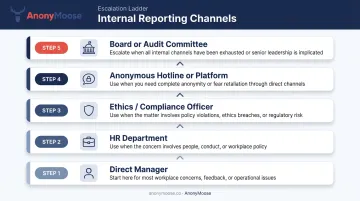
Most organizations offer several channels, and you don't have to go in a straight line:
- Your direct manager — appropriate for lower-level concerns, but skip this entirely if your manager is involved in the misconduct
- HR department — handles most employee relations issues and is obligated to investigate formal complaints
- Ethics or compliance officer — the right contact for policy violations, conflicts of interest, or anything that touches legal risk
- Anonymous reporting platform or ethics hotline — available in most mid-size and larger organizations; use it if you're concerned about being identified
- Board of directors or audit committee — reserved for serious violations, particularly financial misconduct, or when senior leadership is implicated
On anonymous channels: NAVEX's 2024 benchmark data shows that anonymous reports account for a median 56% of all internal reports — and that web-based tools produce even higher anonymity rates (71%) than traditional phone hotlines (50%). Employees report more when they trust their identity is protected, and the tool's architecture determines how much trust is realistic.
Platforms like AnonyMoose are built around this principle. The anonymity is structural: according to AnonyMoose's documentation, no technical mechanism exists within the platform to trace a submission back to its sender. Neither the employer nor AnonyMoose can identify a reporter. For employees weighing whether to report at all, that architectural guarantee carries more weight than a policy promise.
AnonyMoose's Hotlines feature handles sensitive incident reporting specifically — harassment, discrimination, compliance violations, safety concerns — keeping the conversation thread open after submission so HR can ask follow-up questions without the employee ever losing their anonymity.
Write Your Report Effectively
When you submit, keep it factual and specific:
- Describe what you observed, not what you believe the intent was
- Reference specific dates, times, and locations from your documentation
- Name witnesses only if you're comfortable doing so
- Cite the specific policy, law, or code of conduct section you believe was violated
After you submit, a well-run process includes an acknowledgment, a confidential investigation, and follow-up communication. If none of that happens within a reasonable timeframe, escalating externally becomes the next logical step.
How to Escalate When Internal Options Fail
External reporting is appropriate — and often legally protected — when:
- The misconduct is illegal and internal reports have been ignored
- Leadership itself is implicated
- You've faced retaliation after reporting internally
- The organization has no meaningful internal channel
Match Your Concern to the Right Agency
| Agency | What It Handles | How to Reach It |
|---|---|---|
| OSHA | Workplace safety violations; whistleblower retaliation | File a complaint at OSHA.gov |
| EEOC | Harassment, discrimination, retaliation | File a charge at EEOC.gov — received 88,531 new charges in FY 2024 |
| SEC | Financial fraud, securities violations, insider trading | Submit a tip at SEC.gov — received ~27,000 tips in FY 2025 |
| DOL/WHD | Wage theft, unpaid wages | Call 1-866-487-9243 — recovered $259M+ in back wages in FY 2025 |
| DOJ (False Claims Act) | Fraud against the federal government | Qui tam suits filed under seal; the reporter may receive 15–30% of the government's recovery |
Before filing an external complaint, particularly for anything involving retaliation or a False Claims Act claim, consult an employment attorney. Sealed qui tam filings are technically complex, deadlines vary by statute, and legal counsel can significantly affect the outcome.
That documentation work also matters at the external stage. Complaints backed by a paper trail and a clear record of internal attempts carry more credibility with investigators and regulators.
Your Legal Protections as a Whistleblower
Federal law provides meaningful protection. OSHA's Whistleblower Protection Program currently enforces protections under more than 20 federal statutes — covering workplace safety, securities fraud, environmental violations, food safety, tax, anti-money laundering, and more.
What Retaliation Looks Like — Legally
Retaliation isn't always a termination letter. Legally, it includes:
- Demotion or reassignment to a worse role
- Pay cuts or denial of a promotion
- Increased scrutiny or negative performance reviews that follow a report
- Termination or constructive discharge (making conditions so bad the employee quits)
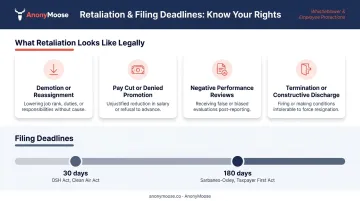
All of these are illegal responses to protected reporting activity. If any of them happen to you after you report, you have the right to file a separate retaliation complaint.
Filing Deadlines — Don't Miss Them
Deadlines vary by statute, and missing them can forfeit your rights entirely:
- 30 days from the retaliatory act under statutes including the OSH Act and Clean Air Act
- 180 days under statutes including Sarbanes-Oxley and the Taxpayer First Act
Those federal deadlines aren't the only ones to track. All 50 states and D.C. have some form of anti-retaliation provision in their whistleblower or employment statutes. These generally supplement federal law rather than replace it — meaning state protections can extend your options even after a federal deadline has passed.
Collective reporting adds another layer of coverage. Under the National Labor Relations Act, employees acting on behalf of a group — or a single employee raising concerns shared by coworkers — may qualify as "concerted activity" under NLRB guidelines. That classification broadens the legal protection available beyond standard whistleblower statutes.
Frequently Asked Questions
Frequently Asked Questions
How do I report ethics violations in the workplace?
Start with internal channels — HR, an ethics hotline, or an anonymous reporting platform like AnonyMoose. Document your concerns carefully before submitting. If internal efforts are ignored or unsafe, escalate to the relevant external agency (EEOC, OSHA, SEC, or DOL) based on the violation type.
What is considered an ethics violation in the workplace?
An ethics violation is any action that breaks organizational policy, professional standards, or law in a way that causes harm — including harassment, financial fraud, safety violations, conflicts of interest, and discrimination. The deciding factor is harm or unfair advantage, not simply behavior that feels uncomfortable.
What are common unethical behaviors in the workplace?
The most frequently reported include sexual harassment, financial fraud, discrimination, abusive leadership, conflicts of interest, and retaliation against reporters. Data privacy breaches and safety violations are also among the most frequently reported in internal reporting systems.
Can I report unethical behavior anonymously?
Yes. Many organizations provide anonymous reporting channels — ethics hotlines or dedicated platforms. Tools like AnonyMoose go further: the platform is built so that neither the employer nor the platform can technically identify the reporter. That technical design — not just a policy commitment — is what makes the anonymity reliable.
What happens after I report unethical behavior at work?
A properly run process includes acknowledgment of your report, a confidential investigation, and some form of outcome communication. Formal reporting systems typically allow you to follow up on status throughout the process.
What legal protections do whistleblowers have?
Federal law protects whistleblowers from retaliation under more than 20 statutes, enforced by OSHA, the SEC, the DOL, and other agencies — and all 50 states plus D.C. have additional anti-retaliation provisions. If you face retaliation, file a complaint promptly: deadlines range from 30 to 180 days depending on which law applies.