This guide is for federal employees who've witnessed misconduct, colleagues affected by it, and members of the public who want to escalate concerns through proper channels. The right process matters — both for accountability and for your own protection.
Key Takeaways
- Federal misconduct covers fraud, harassment, misuse of government property, time card falsification, nepotism, and lack of candor — not just major crimes.
- Document everything first: dates, names, specifics, and supporting files stored on personal (not government) devices.
- Reporting follows a clear escalation path: internal channels first, then agency OIG, then federal bodies like the EEOC, OSC, or MSPB depending on the violation.
- The Whistleblower Protection Act shields most federal employees from retaliation — including threats of retaliation, not just completed acts.
- Anonymous reporting tools like AnonyMoose offer a lower-risk first step before filing a formal external complaint.
What Is Federal Employee Misconduct?
OPM defines misconduct as a refusal or failure to comply with a workplace rule, regulation, or law. That distinction matters: misconduct implies intent or gross negligence, and it carries different reporting paths than a straight performance deficiency.
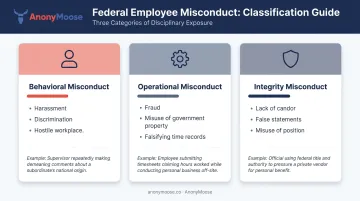
The key categories include:
- Behavioral misconduct — harassment, discrimination, hostile workplace conduct (e.g., a supervisor repeatedly targeting an employee based on their religion)
- Operational misconduct — fraud, misuse of government property, falsifying time records (e.g., a federal employee billing personal travel as official government business)
- Integrity misconduct — lack of candor, providing false information during an investigation, using a government position for personal gain (e.g., an employee denying known facts when interviewed by an IG investigator)
Misconduct vs. Performance Issues
Poor performance — missing targets, making errors, failing to meet standards — falls under 5 U.S.C. § 4303 and follows a separate process. Misconduct falls under 5 U.S.C. § 7512–7513, which covers removals, suspensions over 14 days, demotions, and pay reductions. That standard requires cause that promotes the efficiency of the service.
Poor performance — missing targets, making errors, failing to meet standards — falls under 5 U.S.C. § 4303 and follows a separate process. Misconduct falls under 5 U.S.C. § 7512–7513, which covers removals, suspensions over 14 days, demotions, and pay reductions. That standard requires cause that promotes the efficiency of the service.
If the behavior was intentional or grossly negligent, it's misconduct. Honest mistakes don't qualify — but once you've confirmed the conduct crosses that line, the next step is knowing where to report it.
How to Document Misconduct Before You File
Before filing anything, build a record that can stand on its own. Investigators work from specific, contemporaneous notes — not general impressions or timelines reconstructed months later.
What to Capture
Every entry in your documentation should include:
- Exact dates, times, and locations of each incident
- Names of everyone present — the subject of the complaint and any witnesses
- Direct quotes of specific statements or a precise description of behaviors
- Copies of supporting evidence: emails, messages, documents, photos, screenshots
- Separate entries for each occurrence if the behavior is repeated
OSC's complaint portal specifically asks filers to attach supporting evidence including documents, photographs, and other files. The more specific your records, the less an investigator has to infer — and the harder your complaint is to dismiss on procedural grounds.
Where to Store It
Store everything on a personal device or personal account — not government-issued equipment or your work email.
There's a legal wrinkle here: under 44 U.S.C. § 2911, if you forward work-related records to a personal account, you must copy them back to your official account within 20 days — or risk a separate disciplinary issue. The cleanest approach is a personal journal or notes app, keeping your documentation entirely outside work systems.
How to Report Federal Employee Misconduct
The general path is: internal channels → agency OIG → federal oversight bodies. Where you start, and whether you can skip steps, depends on what happened and who's involved.
Before filing, decide whether to report identified or anonymous. Named complaints generally receive more investigative attention. Anonymous reports are accepted at most channels, but investigators may have limited ability to follow up without contact information.
Step 1: Start With Internal Channels (When Appropriate)
Begin with your direct supervisor, HR department, or the agency's designated ethics or compliance office. Each agency must appoint a Designated Agency Ethics Official under 5 C.F.R. § 2638.104 — that's your internal ethics contact.
Skip this step if:
- Your supervisor is the subject of the complaint
- You've already raised the concern internally and it was ignored or suppressed
- The misconduct involves criminal behavior requiring immediate escalation
Step 2: Report to the Agency's Office of Inspector General (OIG)
Every federal agency has an OIG responsible for investigating fraud, waste, abuse, and misconduct. In FY 2025, the federal IG community processed 825,027 hotline complaints — a volume that reflects how seriously these channels are used across the government.
Find the correct OIG through the Inspectors General Directory at ignet.gov. When you submit:
- Include dates, specific incidents, names, and any supporting documentation
- Most OIGs accept anonymous complaints (though anonymity may limit investigation scope)
- Under 5 U.S.C. § 407, the OIG cannot disclose your identity without consent unless it's unavoidable during an investigation
Step 3: Escalate to Federal Oversight Agencies
If the OIG doesn't act, or if the nature of the misconduct falls outside its scope, escalate to the appropriate federal body. Filing deadlines are strict — missing them can forfeit your rights entirely.
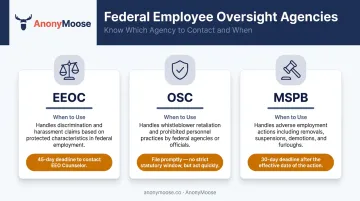
| Agency | When to Use | Deadline |
|---|---|---|
| EEOC | Discrimination or harassment based on protected characteristics | 45 days to contact an EEO counselor |
| OSC | Whistleblower retaliation, prohibited personnel practices, government wrongdoing disclosures | No universal deadline, but file promptly |
| MSPB | Challenging removal, suspension over 14 days, demotion, pay reduction | 30 days after the effective date of the action |
Which Agency Should You Report Federal Misconduct To?
Choosing the wrong agency wastes time and can cost you legal rights. Here's what each one handles:
- EEOC: Handles discrimination or harassment based on race, gender, religion, disability, age, or national origin. Federal employees must contact an EEO counselor within 45 days of the discriminatory act. In FY 2023, federal employees filed 10,907 EEO complaints.
- OSC: The primary channel for whistleblower retaliation and prohibited personnel practices (nepotism, improper hiring, coercion). OSC also accepts disclosures of violations of law, gross mismanagement, and waste of funds. In FY 2024, OSC handled 6,251 new cases and achieved 450 favorable outcomes. File through OSC's Online Filing Portal using OSC Form-14.
- MSPB: For challenging serious adverse employment actions connected to your misconduct report. Appeals must be filed within 30 days of the effective date. In FY 2024, MSPB issued 7,058 total decisions.
- Agency OIG: The most direct channel for fraud, waste, and abuse tied to a specific agency's programs.
- Elected representatives: A legitimate escalation path when agency-level complaints go unresolved. Contact your congressional representative through the Capitol switchboard.
Before escalating to any of the above, organizations can deploy an anonymous internal reporting tool like AnonyMoose. Employees submit detailed incident reports (with attachments, follow-up threads, and case tracking) without any identity exposure. That documented record can support a formal filing later while reducing early retaliation risk.
Whistleblower Protections and What to Do If You Face Retaliation
The Whistleblower Protection Act (1989), expanded by the Whistleblower Protection Enhancement Act of 2012, protects most civilian federal employees who disclose government wrongdoing from retaliation.
What Counts as a Protected Disclosure
Under 5 U.S.C. § 2302(b)(8), protected disclosures include:
- Violations of law, rule, or regulation
- Gross mismanagement or gross waste of funds
- Abuse of authority
- Substantial and specific danger to public health or safety
Who Is Excluded
The WPA does not cover employees at the FBI, CIA, DIA, NGA, NSA, ODNI, NRO, or agencies designated by the President as having foreign intelligence or counterintelligence as a principal function. Those employees may have protections under Presidential Policy Directive-19 (PPD-19) or agency-specific IC whistleblower channels.
Federal contractors have separate protections under 41 U.S.C. § 4712.
What Constitutes Illegal Retaliation
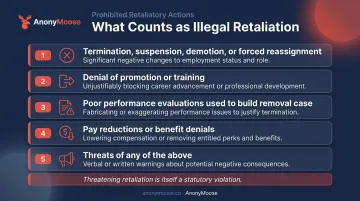
The statute is broad. Illegal retaliation includes:
- Termination, suspension, demotion, or forced reassignment
- Denial of promotion or training
- Poor performance evaluations intended to build a removal case
- Pay reductions or benefit denials
- Threats of any of the above (threatening retaliation is itself a statutory violation)
What to Do If Retaliation Happens
- File with OSC first — this is required before an Individual Right of Action (IRA) appeal to MSPB under 5 U.S.C. § 1221. OSC covers a broader range of adverse actions.
- File directly with MSPB for serious adverse actions (removal, lengthy suspension) within the applicable deadline.
- Consult legal counsel before choosing — filing one path can foreclose the other.
Reporting anonymously through an internal tool like AnonyMoose before filing formally can reduce early retaliation exposure. The platform is built so that neither AnonyMoose nor your employer can identify who submitted a report, letting you create a timestamped record of the concern while your identity stays protected.
Common Misconceptions About Reporting Federal Misconduct
"Only major fraud or criminal acts qualify."
This is incorrect. OPM treats a wide range of behaviors as reportable misconduct, including:
- AWOL and neglect of duty
- Misuse of office supplies or government vehicles
- Time card falsification
- Nepotism and lack of candor
The threshold is intent or gross negligence — minor severity alone doesn't disqualify a report.
"Reporting will automatically damage my career."
Federal law explicitly prohibits retaliation. Both the OSC and MSPB exist to reverse retaliatory actions and compensate affected employees. In FY 2024 alone, OSC resolved 3,768 PPP matters favorably.
The key is documenting your complaint and its timing from the start. That record creates a clear link between your protected disclosure and any adverse action that follows.
Frequently Asked Questions
How do I anonymously report someone to the feds?
Federal employees can report anonymously through their agency's OIG hotline, the OSC's secure disclosure portal, or anonymous reporting tools like AnonyMoose. Most OIGs accept anonymous submissions, though anonymity may limit investigators' ability to follow up for additional information.
What is considered misconduct for a federal employee?
Misconduct covers behavioral violations (harassment, discrimination), operational violations (fraud, misuse of government property, falsifying time records), and integrity violations (lack of candor, misuse of position). It's distinguished from performance deficiencies by intent or gross negligence.
What does it take to fire a federal employee for misconduct?
Under 5 U.S.C. § 7513, the agency must prove misconduct occurred and that removal serves the efficiency of the service. The employee gets at least 30 days' written notice, an opportunity to respond, and the right to appeal to the MSPB.
What is the Whistleblower Protection Act and who does it cover?
The WPA protects most civilian federal employees who disclose government wrongdoing from retaliation. Intelligence-community employees (FBI, CIA, NSA) are excluded and may fall under PPD-19 or agency-specific channels. Federal contractors have separate protections under 41 U.S.C. § 4712.
Can I report federal employee misconduct if I am not a federal employee?
Yes. Members of the public can file complaints with any agency's OIG hotline, contact the EEOC or OSC, or reach out to elected representatives. WPA retaliation protections apply specifically to federal employees, but anyone can submit a report through these channels.