Federal law gives pregnant workers concrete, enforceable protections. But knowing those rights is only half the battle. This guide walks you through recognizing pregnancy discrimination, building documentation that holds up, and navigating the full reporting process — from internal HR complaints to the EEOC.
Key Takeaways
- Pregnancy discrimination is illegal under federal law for employers with 15 or more employees.
- Start documenting immediately — documentation shapes whether your claim succeeds or fails.
- Report internally first — it creates a formal paper trail before filing with the EEOC or an attorney.
- Anti-retaliation protections mean your employer cannot legally punish you for reporting.
- Filing deadlines apply — you typically have 180–300 days from the discriminatory act to file with the EEOC.
What Qualifies as Pregnancy Discrimination?
Pregnancy discrimination is any adverse employment action taken because of pregnancy, childbirth, or related medical conditions. Protections cover job applicants and current employees alike — including those who have been pregnant, are currently pregnant, or could become pregnant.
Per the EEOC's pregnancy discrimination guidance, unlawful conduct includes discrimination in hiring, firing, pay, assignments, promotions, layoffs, training, and fringe benefits.
Concrete Examples
Discrimination doesn't always look obvious. Watch for:
- Being passed over for a promotion after announcing your pregnancy
- Having hours reduced without a clear business explanation
- Getting excluded from projects, meetings, or client assignments
- Receiving performance write-ups that only began after your disclosure
- Facing pressure — direct or implied — to resign or take early leave
Harassment counts in this category too. It doesn't need to come from your direct supervisor; a coworker, a client, or a manager from another department can be the source of actionable conduct.
Overt vs. Subtle Discrimination
Both forms can support a legal claim:
- Overt: "We can't have someone going on leave right now."
- Subtle: A sudden shift in performance reviews that coincides with a pregnancy announcement.
You have no legal obligation to disclose a pregnancy to a potential employer. EEOC guidance treats pregnancy-related inquiries during interviews as legally risky — they can be used as evidence of discriminatory intent if an adverse hiring decision follows.
Federal Laws That Protect Pregnant Employees
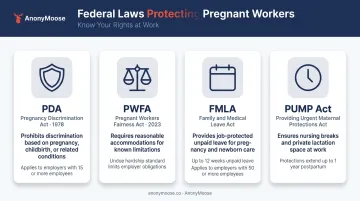
The Pregnancy Discrimination Act (PDA)
Enacted in 1978, the PDA amended Title VII of the Civil Rights Act to prohibit employers with 15 or more employees from discriminating in any term or condition of employment based on pregnancy, childbirth, or related medical conditions. The statutory standard: pregnant employees must be treated the same as other workers similar in their ability or inability to work.
The Pregnant Workers Fairness Act (PWFA)
The PWFA, which took effect June 27, 2023, goes further than the PDA: where the PDA prohibits discrimination, the PWFA affirmatively requires covered employers to provide reasonable accommodations for pregnancy-related limitations — unless doing so causes undue hardship. The EEOC's implementing regulation took effect June 18, 2024.
Common accommodations under the PWFA include:
- Modified job duties or workload adjustments
- Flexible scheduling or remote work options
- Ergonomic equipment or seating
Supporting Protections
| Law | What It Covers |
|---|---|
| FMLA | Up to 12 weeks of unpaid, job-protected leave for eligible employees at employers with 50+ workers |
| ADA | May cover pregnancy-related conditions (e.g., gestational diabetes, preeclampsia) that substantially limit a major life activity |
| PUMP Act | Guarantees nursing mothers break time and a private, non-bathroom space to express milk for up to one year after birth |
Beyond federal law, 31 states plus D.C. have laws offering additional protections to pregnant workers. Check your state's civil rights agency for local coverage that may exceed the federal floor.
How to Document Pregnancy Discrimination
Courts rely on evidence to establish a pattern. Without records, a case often comes down to one person's word against another's. Start documenting the moment you suspect discrimination — not weeks later when memory fades.
What to Record in Your Incident Log
For each incident, capture:
- Date, time, and location
- Who was present
- Verbatim quotes, or as close as you can recall
- The context (a performance review, a team meeting, a side conversation)
- Your own reaction and any witnesses
Keep this log in a personal, secure location — not on a work device or work email. Access to company accounts can be revoked the moment you're terminated.
Preserve Communications and Comparative Data
- Save relevant emails, texts, performance reviews, and commendations
- Print or screenshot digital records and store them outside company systems
- Note how non-pregnant colleagues in similar roles are treated regarding accommodations, schedules, assignments, and promotions — those disparities on paper can establish the unequal treatment courts look for
Two Types of Evidence Courts Recognize
Direct evidence is the clearest form: an explicit statement or written communication that ties a decision directly to your pregnancy. A manager's email stating the company can't promote someone going on leave is a textbook example.
Circumstantial evidence is far more common in these cases. It includes suspicious timing of adverse actions, inconsistent policy enforcement, or explanations that change each time they're challenged. Individually, these incidents may seem minor. Documented together, they build a pattern that's difficult to dismiss in court.
Step-by-Step: How to Report Pregnancy Discrimination
Step 1 — Document Before You Report
Before filing anything, make sure you have a clear, dated record of incidents in place. Documentation done after the fact is weaker. The log you build now becomes the backbone of every subsequent step.
Step 2 — Report Internally First
Most employers have an internal complaint process through HR or an EEO officer. Using it creates a formal paper trail and gives the employer an opportunity to remedy the situation before external agencies get involved.
Check your employee handbook for the reporting procedure and your HR contact. That said, many employees fear that walking into HR in person will expose them before they're ready. Anonymous reporting tools change that dynamic.
Platforms like AnonyMoose let employees submit discrimination concerns anonymously within their own organization through a dedicated Hotline channel built for sensitive incident reporting. Neither the employer nor the platform can identify the reporter — anonymity is built into the architecture, not just promised. HR receives the report and can follow up through the same thread while the employee's identity stays protected.
Step 3 — File a Charge with the EEOC
If internal resolution fails or isn't safe to pursue, the next step is a formal charge with the Equal Employment Opportunity Commission. You can file online through the EEOC Public Portal, in person at a field office, or by mail.
Critical deadline: generally 180 calendar days from the discriminatory act, extended to 300 days if a state or local anti-discrimination agency also has jurisdiction. Missing this window forfeits your right to pursue a federal claim, so file as soon as you've documented the incidents.
After filing, the EEOC notifies your employer within 10 days and may offer mediation. In FY 2025, EEOC mediation carried a 70% success rate across cases that went through the process. If mediation doesn't resolve the charge, the EEOC investigates — and that outcome determines whether you receive a right-to-sue letter.
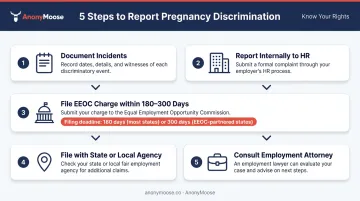
Step 4 — File with a State or Local Agency
Many states have their own civil rights agencies with broader protections or longer filing windows. Two examples:
- California: Civil Rights Department (CRD) at calcivilrights.ca.gov
- New York: Division of Human Rights (DHR) at dhr.ny.gov — no attorney required to file
Check your state agency's process; in many cases you can file with both the EEOC and your state agency at the same time.
Step 5 — Consider Legal Counsel
Consult an employment attorney who specializes in discrimination, particularly before taking legal action after receiving a right-to-sue letter. Initial consultations are often free, and many attorneys work on contingency for discrimination cases.
Understanding Anti-Retaliation Protections
Title VII and the PDA expressly prohibit employers from retaliating against employees who report pregnancy discrimination, file an EEOC charge, or participate in any related investigation. Retaliation is the most frequently alleged basis of discrimination in EEOC charges — 42,301 retaliation-based charges were filed in FY 2024 alone.
What Counts as Protected Activity
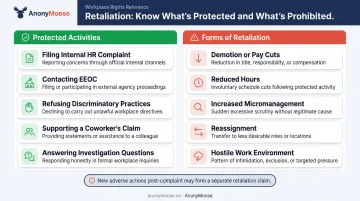
You are legally shielded when you:
- File an internal complaint with HR
- Contact the EEOC or a state agency
- Refuse to participate in discriminatory practices
- Support a coworker's discrimination claim
- Answer questions during an employer investigation
Understanding what triggers that protection is only half the picture. Once you've taken a protected action, any adverse employer response can constitute retaliation.
What Counts as Retaliation
Retaliation extends well beyond termination and can include:
- Demotion or pay cuts
- Reduced hours or shift changes
- Increased scrutiny or micromanagement
- Reassignment to less desirable roles
- Creation of a hostile work environment
If your treatment changes after you report discrimination, keep a dated record of each incident. New adverse actions following a complaint can form the basis of a separate retaliation claim — and courts treat separate retaliation claims as independent violations.
What Happens After You File a Complaint?
Once you file with the EEOC, the agency notifies your employer within 10 days. From there, the process moves in one of two directions:
If mediation is offered and succeeds: Both parties reach a negotiated resolution. Continue documenting any new incidents during this period — resolutions can unravel, and your records protect you.
If mediation fails or isn't used: The EEOC investigates. Two outcomes are possible:
- Reasonable cause found: The EEOC attempts conciliation — a negotiated resolution between you and your employer.
- No reasonable cause, or conciliation fails: The EEOC issues a Notice of Right to Sue. You can also request this letter yourself after 180 days. Once received, you have 90 days to file a lawsuit in federal court.
Potential Remedies
If discrimination is proven, available remedies can include:
- Back pay and front pay
- Reinstatement or promotion
- Compensatory damages for emotional distress
- Punitive damages in cases of egregious conduct
- Attorney's fees and court costs
See the EEOC's remedies page for a complete breakdown of what you may be entitled to.
Frequently Asked Questions
What qualifies as pregnancy discrimination?
Pregnancy discrimination is any adverse employment action — firing, demotion, pay reduction, denial of accommodations, or hostile treatment — taken because of pregnancy, childbirth, or related medical conditions. The PDA prohibits this conduct across all terms and conditions of employment.
How can I prove pregnancy discrimination?
Proof is either direct — explicit statements tying a decision to your pregnancy — or circumstantial, such as suspicious timing, inconsistent treatment compared to non-pregnant colleagues, or shifting explanations. A documented pattern of incidents strengthens a claim over any single event.
Who enforces the Pregnancy Discrimination Act?
The EEOC is the primary federal agency responsible for enforcing the PDA. It investigates charges, mediates disputes, and can pursue litigation when warranted.
How long do I have to file a pregnancy discrimination complaint?
In most cases, you must file with the EEOC within 180 days of the discriminatory act, or 300 days if a state or local agency also has jurisdiction. File as soon as possible — missed deadlines are strictly enforced and can forfeit your right to claim.
Can I be fired for reporting pregnancy discrimination?
Retaliation for reporting is illegal under Title VII and the PDA. Any adverse employment action taken in response to a complaint can form the basis of a separate retaliation claim and may increase the employer's total legal liability.
Does the Pregnancy Discrimination Act apply to small employers?
The PDA applies to employers with 15 or more employees. Workers at smaller employers should check state and local laws, which often provide broader coverage. The DOL Women's Bureau offers additional guidance on federal protections that may still apply.