Introduction
Most internal communications don't fail because the message is wrong. They fail because the message reaches the wrong people — or everyone, when only some people need it.
According to a Gartner survey summarized by HBR, 38% of employees receive excessive communication volume, and only 13% reported receiving less information in 2022 than the year before. Pair that with the SafetyCulture finding that 42% of frontline workers consider HQ communications irrelevant — and it's clear the default broadcast model isn't working.
Targeted employee communications solve this by delivering relevant messages to the specific segments who need them, rather than flooding everyone's attention with content that applies to only part of the workforce.
This guide covers the exact steps to build that system:
- Defining the right audience segments
- Choosing channels that reach each group effectively
- Writing messages that connect rather than get ignored
- Collecting honest feedback at scale
- Measuring outcomes beyond open rates
Key Takeaways
- Targeted communications direct messages to specific employee groups — by role, location, department, or lifecycle stage — rather than the whole workforce.
- Effective targeting requires clear objectives, clean employee data, the right channel for each group, and messaging framed for that segment.
- Two-way feedback is essential — without it, you can't know whether messages drove the intended behavior.
- The most common failure point is skipping segmentation entirely and defaulting to mass sends.
- Success metrics should include action completion rates, survey response rates, and segment-level engagement, not open rates alone.
How to Send Targeted Employee Communications: Step-by-Step
Step 1: Define Your Communication Objectives and Audience Segments
Before drafting anything, answer two questions: What outcome does this message need to drive? And which employees does that outcome actually apply to?
Vague objectives produce vague targeting. "Inform employees about benefits enrollment" is less useful than "drive form submissions from full-time employees in California and Texas before the November 15 deadline."
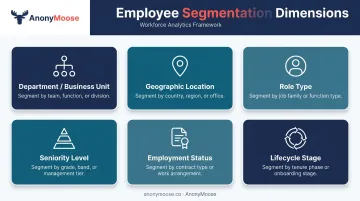
Primary segmentation dimensions to consider:
- Department or business unit — policy changes often apply to specific teams, not the whole organization
- Geographic location or region — operational updates, safety alerts, and compliance requirements frequently vary by site
- Role type — frontline, deskless, hybrid, or desk-based workers have fundamentally different day-to-day realities
- Seniority level — managers often need advance briefings before cascading information to their teams
- Employment status — full-time, part-time, and contract workers may have different eligibility and obligations
- Lifecycle stage — new hire onboarding, mid-tenure engagement, and pre-departure communications each serve distinct purposes
The more specific the objective, the more precisely you can define the audience — and the more relevant the message becomes.
Step 2: Collect and Validate Your Employee Data
Segmentation is only as accurate as the data behind it. Outdated employee records — wrong departments, inactive accounts, role changes not reflected in the system — mean targeted messages either miss their intended audience or reach the wrong people entirely.
Two approaches are common in practice:
- Using existing data — pulling attributes already on file from your HRIS: age, tenure, role, location, employment status. This is fast but depends entirely on data quality.
- Gathering employee input directly — using surveys or opt-in topic preferences to understand what employees actually need. This reveals preferences and concerns that HRIS records don't capture.
Before launching any targeted campaign, audit your employee data. Check that department fields reflect current assignments, that inactive accounts are removed, and that location data is current — especially for organizations with high turnover or frequent internal moves.
Platforms like AnonyMoose accept employee data uploaded from any HRIS as a simple Excel file, supporting up to five custom targeting attributes — but only clean, current data produces accurate segments.
Step 3: Select the Right Channel for Each Audience Segment
Channel choice must match how each group actually works — not how you assume they work.
BCG reports that deskless workers make up 70–80% of the global workforce, yet most internal communication strategies default to email and intranet — channels that assume desk access. Sending the right message through the wrong channel is one of the most common reasons targeted campaigns underperform.
Channel-audience fit guidelines:
| Audience | Recommended Channels |
|---|---|
| Desk-based / corporate | Email, intranet, collaboration tools |
| Frontline / deskless | Mobile push notifications, SMS |
| Manufacturing / warehouse | Digital signage, SMS, mobile app |
| Hybrid or distributed | Mobile app, email |
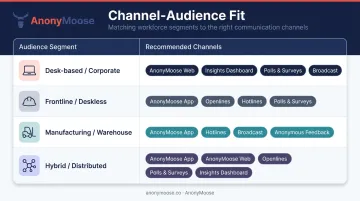
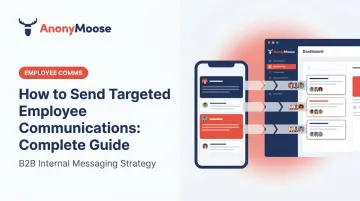
AnonyMoose's Broadcast feature is built specifically for distributed and frontline workforces. It pushes targeted messages directly to employees' phones via push notification — no company email address required, no hardware investment. Broadcast supports granular audience selection through Close User Groups, using up to five custom criteria drawn from HRIS data, so organizations can target plant floor employees at a specific location, managers above a certain level in a given region, or any other defined segment.
Step 4: Craft Segment-Specific Messages
Once audience and channel are defined, the message must be written for that specific group. A policy update worded for corporate office staff will land differently — and less effectively — when sent verbatim to warehouse workers.
This doesn't mean writing entirely new content for every segment. The core information typically stays the same. What changes is framing, emphasis, and the call-to-action.
Practical message structure:
- Open with what matters most to that group — not what's easiest to write
- Write in their register — skip corporate jargon when the audience is frontline workers
- Give one clear call-to-action, not three competing asks
- Name a specific deadline or next step — vague asks produce vague responses
For example: a benefits enrollment message sent to warehouse staff should open with when enrollment closes and what happens if they don't act — not with a paragraph about the company's commitment to employee wellbeing.
Step 5: Schedule, Send, and Optimize Delivery Timing
Even a well-targeted, well-written message can be ignored if it arrives at the wrong time. Delivery timing should reflect each segment's actual work rhythms.
Corporate staff may engage with email on Tuesday mornings. Shift workers typically check messages at the end of a shift or on break. Field employees are often reachable only during transit.
Axios HQ's analysis of more than 8.7 million internal emails found that low-volume send windows — including Sunday afternoon — can produce dramatically higher open rates. The takeaway isn't to send on Sundays; it's that timing matters, and assumptions about when employees are reading often don't hold up.
Test send times within segments. Most communication platforms allow you to schedule delivery at the optimal time per group, so each segment gets messages timed to their actual work patterns.
Step 6: Collect Feedback and Close the Loop
Targeted outbound messaging is only half the system. Without a return channel, communicators can't know whether messages drove actual behavior change — or whether they were read at all.
Anonymous feedback tools are particularly effective here. SHRM research notes that survey participation drops when employees don't trust that anonymity is genuinely protected — a problem that promised-but-not-verified confidentiality doesn't solve.
AnonyMoose's platform gives employees multiple paths to respond after receiving a targeted communication:
- Openlines — open, anonymous two-way text threads for ongoing dialogue with leadership
- Polls & Surveys — structured, single-tap responses for quick pulse checks on how a message landed
- Hotlines — structured incident reporting with full attachment support and persistent conversation threads
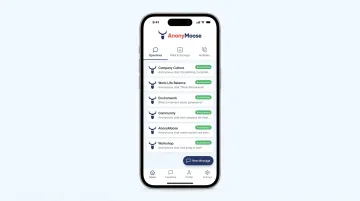
All three are accessible from the mobile app, with technical anonymity guaranteed by architecture — not just policy. The Insights Dashboard surfaces aggregated results by segment, allowing HR and communications teams to see how different groups experienced the same campaign.
When to Use Targeted vs. Universal Employee Communications
Not every message needs segmentation. Over-engineering the audience for a company-wide holiday closure announcement wastes time and can create confusion about who information applies to.
The deciding question: Does this message apply differently to different groups, or require different actions from different groups? If yes, target it. If no, send universally.
Use targeted communications for:
- Role-specific policy changes
- Location-based operational or safety updates
- Stage-specific onboarding and offboarding communications
- Benefit eligibility notifications
- Department-level announcements
- Safety alerts relevant only to specific site workers
Send universally for:
- All-hands announcements affecting everyone equally
- Company culture moments — milestones, recognition, holidays
- Crisis communications requiring simultaneous reach across the workforce
- Any situation where speed matters more than precision
According to industry research on frontline communication, 32% of frontline workers say they don't have time to read or act on HQ communications. Universal sends to employees who don't need the information train them to tune out everything — including the messages that do matter. Targeting by role, location, or group is how you protect that attention over time.
Key Variables That Determine Targeting Success
Even well-intentioned targeting fails when these four variables are mismanaged.
Segmentation Accuracy
The UK Government Communication Service defines audience segmentation as splitting the workforce into smaller, defined groups to better understand their needs and likely reactions. That definition points to the key risk: if you segment by the wrong criteria — or use outdated data — the message reaches people it isn't relevant to, or misses the people it's meant for entirely.
Multi-dimensional segmentation (role + location + lifecycle stage, for example) produces higher engagement than single-dimension targeting. An employee in a remote location who is also a manager and recently promoted has different communication needs than a peer in the same city who isn't a manager and has three months of tenure. Combining criteria surfaces that difference.

Channel-Audience Fit
Only 23% of frontline workers believe they have access to the technology needed to be productive, according to Deloitte. If your targeting strategy assumes email access for a workforce that doesn't reliably have it, the message never arrives — regardless of how well it was written or who it was segmented for.
Audit how different employee segments actually consume communications before selecting a default channel. In practice, this often means running a quick survey asking employees which channels they use, when, and how often. The answers are frequently surprising.
Message Relevance and Framing
Employees decide whether to engage with a communication in the first few seconds. If the subject line or opening doesn't immediately signal relevance to their situation, they move on.
Effective framing leads with the stakes that matter to that specific group. A safety protocol update for warehouse workers should open with operational impact — not the compliance rationale that matters to legal. The content may be identical; the entry point should be different.
Feedback Loop Quality
Organizations that build targeted outbound campaigns without a corresponding inbound feedback structure are flying blind. They know messages were sent. They don't know whether employees understood, agreed, had concerns, or changed their behavior.
Anonymous feedback mechanisms close that gap. When employees can respond without fear of identification, the results are immediate:
- Comprehension gaps surface before they become behavior problems
- Dissatisfaction becomes visible before it escalates
- Communicators can refine future campaigns based on what employees actually think
Common Mistakes in Targeted Employee Communications
Even well-intentioned targeting efforts break down in predictable ways. Here are four mistakes that undermine results — and what to do instead.
Defaulting to mass sends for convenience dilutes trust over time. Employees who receive repeated irrelevant messages start filtering or ignoring internal communications entirely — including the ones that matter. Segmentation feels like extra work until the alternative is a workforce that's tuned out.
Building campaigns on stale employee data produces the same reach problems as no targeting at all. Wrong departments, inactive accounts, and role changes not reflected in the system mean messages land in the wrong places. Data hygiene has to come first, before any targeting effort begins.
Investing in outbound targeting without any inbound structure is a one-way street. Without a mechanism for employees to respond — especially anonymously — communicators can't gauge whether messages landed, and employees feel talked at rather than engaged with.
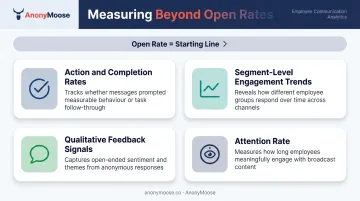
Treating open rates as a success metric overstates actual engagement. Open rates measure delivery and curiosity, not comprehension or behavior change. According to PoliteMail's benchmark of 2 billion internal emails, the average internal email click rate is just 7% — a reminder that opens are just the starting line.
Effective measurement includes:
- Action and completion rates (form submissions, policy acknowledgments, survey responses)
- Segment-level engagement trends over time
- Qualitative feedback signals on message clarity and relevance
- Attention rate (time spent reading, not just that the email was opened)
Conclusion
Targeted employee communications work when four things come together: clean segmentation data, channel choices that match how employees actually work, messages framed around each group's specific context, and a feedback loop that lets employees respond honestly.
Skip any one of these, and the others lose effectiveness. Good data with the wrong channel means messages don't arrive. Without a feedback mechanism, even well-crafted messages leave communicators guessing whether any of it actually landed.
Targeting done well is about genuine connection. Employees who receive communications clearly written for their situation feel seen — and that recognition, repeated consistently, builds trust. It creates the psychological safety where people speak up, flag problems early, and stay. Tools like AnonyMoose's anonymous Openlines and pulse surveys give employees a real path to respond, so the feedback loop doesn't just exist on paper. That's when targeted communication stops being a tactic and starts shaping culture.
Frequently Asked Questions
What are the key Cs of effective employee communications?
The commonly referenced framework includes Clarity, Consistency, Conciseness, Channel-appropriateness, and Credibility. In targeted communications, channel-appropriateness carries extra weight: a well-written message sent through a channel employees don't use still fails to land.
How do you communicate with a target audience?
Identify who the audience is and what outcome the message needs to drive. Choose the channel that actually reaches them in their work context. Frame the message around their specific situation and what they need to do next. Then ensure there's a structured way for them to respond or ask questions.
What is audience segmentation in employee communications?
Segmentation divides the workforce into groups with shared characteristics — role, location, department, lifecycle stage — so each group receives a relevant message rather than a one-size-fits-all broadcast.
What channels work best for targeted employee communications?
The best channel depends on the audience's work context. Email works for desk-based workers; mobile push notifications or SMS work better for frontline and deskless employees; digital signage suits manufacturing and warehouse environments. A mobile-first platform accessible without company email or hardware — like AnonyMoose's Broadcast feature — improves reach across all workforce segments.
How do you measure the success of targeted employee communications?
Go beyond open rates. Effective measurement includes segment-level engagement trends, action and completion rates (form submissions, policy acknowledgments), survey response rates, and qualitative feedback on message relevance. Open rates confirm delivery. Completion rates confirm impact.
How does anonymous feedback improve targeted employee communications?
Anonymous feedback removes the fear of retaliation that suppresses honest responses. When employees can reply without being identified, organizations get more accurate data on whether messages resonated, surfacing comprehension gaps and concerns before they escalate.