Introduction
Most leaders genuinely believe they have an open-door culture. Most employees know better.
The gap between what management hears and what employees actually think is one of the most costly blind spots in business. Research from Milliken, Morrison, and Hewlin found that 85% of employees had, at some point, felt unable to raise a concern with their boss — and the silence wasn't random. It was rational.
Thirty percent feared being labeled a troublemaker. Another 25% simply believed nothing would change.
That silence has a price. Unaddressed concerns translate into missed process improvements, avoidable turnover — which costs employers 33–200% of an employee's annual salary — and cultural drift that rarely announces itself until the damage is done.
This guide breaks down what candid employee feedback actually is, why it matters operationally, what happens when it's absent, and how to build the conditions that make honest input the norm rather than the exception.
Key Takeaways
- Candid feedback is honest, specific, actionable input that gives organizations an accurate ground-level picture of how work, culture, and leadership are actually experienced.
- The core benefits are operational visibility, higher engagement and retention, and better decisions with measurable business outcomes.
- The biggest barrier is structural fear of retaliation — and it must be addressed at the system level, not patched with culture initiatives.
- Without candid feedback, organizations run on filtered information while employees vent on Glassdoor or Blind instead.
- The most effective fix pairs a genuine commitment to act on feedback with a channel that makes anonymous input safe by design.
What Is Candid Employee Feedback?
Candid employee feedback is honest, direct, and specific input from employees about their work environment, processes, leadership, and culture. Specificity is what separates it from vague sentiment surveys — and from feedback softened to protect feelings or shaped to tell management what it wants to hear.
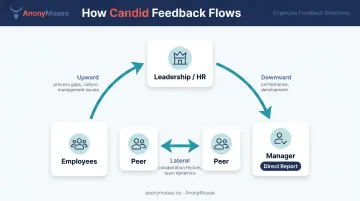
It flows in three directions:
- Upward — employees to leadership or HR (process gaps, culture concerns, management issues)
- Lateral — peer to peer (collaboration friction, team dynamics)
- Downward — manager to direct report (performance, development)
Those channels span a wide range of topics — workflow inefficiencies, DEI concerns, safety issues, ethics violations, compensation fairness, and communication breakdowns.
The distinction that matters most: candid feedback is not a venting exercise. It's organizational intelligence. When collected consistently and acted upon, it produces measurable improvements in engagement, retention, and decision quality. Organizations that treat feedback as data — not noise — make better decisions because they're working from an accurate picture of what's actually happening on the ground.
Key Advantages of Candid Employee Feedback
Each advantage below connects to outcomes organizations already track — engagement scores, attrition rates, decision quality, and compliance risk. These are not abstract culture goals.
Real-Time Operational Visibility
Employees closest to the work see problems before they appear on any dashboard. The front-line worker notices the process bottleneck in week two. The warehouse team knows about the safety risk before it becomes an incident report. The customer-facing rep knows exactly why the new policy is creating friction — while leadership is still reviewing rollout metrics.
ECI's 2023 Global Business Ethics Survey found that 65% of employees observed workplace misconduct — yet 46% of those who reported it experienced retaliation. When speaking up carries that kind of cost, the intelligent move for any employee is silence. Problems stay hidden. Leaders make decisions on incomplete information.
The operational cost of that gap is real. Gallup's meta-analysis links top-quartile employee engagement to 41% fewer quality defects and 64% fewer safety incidents. Those numbers aren't about culture programs. They're about whether employees are engaged enough to surface what they know. A SHRM Study (2020) further found that organizations cultivating candid feedback see a 34% boost in productivity through improved employee morale and trust — a direct return on building the conditions for honest communication.
KPIs this moves: Error rates, time-to-resolution on operational issues, safety incident frequency, cost of quality.
When it matters most: During rapid growth, organizational change, or new process rollouts — whenever the gap between leadership perception and ground-level reality is widest.
Higher Employee Engagement and Retention
There's a well-documented mechanism at work here: when employees see their feedback translated into visible change, they develop a sense of ownership over the organization's direction. That ownership is one of the strongest predictors of engagement and retention.
McKinsey's Great Attrition research illustrated how badly this dynamic can break down. Among employees who left, 54% cited not feeling valued by the organization, 52% cited not feeling valued by their manager, and 51% lacked a sense of belonging. Research by the American Psychological Association found that organizations with strong anonymous feedback cultures see a 30% increase in employees' sense of belonging at work — a concrete outcome that directly counters the belonging deficit driving so many departures.
Meanwhile, employers assumed the problem was compensation. They invested retention budget in the wrong places because they were operating on assumed feedback, not candid input.
The business cost of getting this wrong:
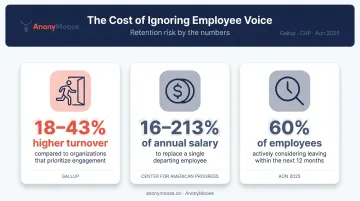
- Gallup links low engagement to turnover rates 18% to 43% higher than highly engaged teams
- The Center for American Progress estimates replacement costs at 16–21% of annual salary for most roles — rising to 213% for complex executive positions
- Aon's 2025 Employee Sentiment Study found 60% of employees were either actively seeking new employment or might do so within 12 months
Employees who feel heard don't just stay longer — they're less likely to leave without warning, which reduces both the disruption and the cost of backfilling roles.
KPIs this moves: Voluntary attrition rate, eNPS, employee satisfaction scores, absenteeism, productivity per employee.
When it matters most: In competitive talent markets, hybrid and remote environments, and post-restructuring periods when employee trust is fragile.
Better Decisions and Reduced Organizational Risk
Filtered feedback creates a specific failure mode: leaders see apparent support for decisions that are already failing on the ground. That's confirmation bias baked into every meeting, every report, every strategy review.
Strategies get doubled down on. Manager behavior problems go unaddressed. Policy decisions get made based on what HR thinks employees need, not what they've actually said.
The risk that accumulates without candid feedback doesn't stay internal. Stubben and Welch's 2020 research found that higher internal whistleblowing report volume is associated with fewer and lower government fines and material lawsuits. More internal reports signal a healthier reporting culture — not more problems. When those internal channels are absent or unsafe, concerns don't disappear. They migrate.
HBR's research found that a bad employer reputation costs organizations at least 10% more per hire. Glassdoor's own 2025 data shows that a 0.5-point rating improvement correlates with 20% more job clicks and 16% more apply starts. The math on fixing employer brand damage externally is significantly worse than building the internal culture that prevents it.
KPIs this moves: Quality of strategic decisions, internal vs. external issue resolution rate, Glassdoor ratings, compliance incident rates.
When it matters most: Organizations navigating DEI challenges, ethics concerns, rapid change, or industries with regulatory exposure.
What Happens When Candid Feedback Is Missing or Ignored
Feedback-deficient organizations don't notice the problem right away. That's what makes it dangerous.
The pattern typically looks like this: managers make decisions on incomplete information, performance issues go unaddressed until they're expensive, and employees gradually disconnect.
Gallup's 2022 quiet quitting analysis estimated that quiet quitters made up at least 50% of the U.S. workforce, with only 32% actively engaged. The Gallup State of the Global Workplace 2026 report estimates the global economy lost $10 trillion in productivity from low engagement in 2025 alone.
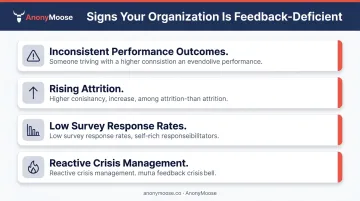
The specific failure modes to watch for:
- Inconsistent performance outcomes across teams with no obvious cause
- Rising attrition that HR can't explain through exit interviews alone
- Low survey response rates — a signal that employees don't believe anything will change
- Reactive crisis management replacing proactive culture-building
Each of these failure modes compounds the next, and eventually the cost spills outward. When employees don't trust internal channels, they turn to Glassdoor, Blind, Reddit, and LinkedIn to say what they couldn't say at work. It's the default behavior when the internal pressure valve doesn't work.
Platforms like AnonyMoose address this directly by giving employees a credible, anonymous internal channel before frustrations reach public forums. When employees have a trustworthy internal outlet, the pull toward external venting drops significantly.
How to Get the Most Value from Candid Employee Feedback
The single biggest barrier to candid feedback isn't a lack of willingness. It's a rational calculation that speaking up isn't safe. No open-door policy language, no "we value your input" messaging in the company newsletter, removes that fear structurally. The channel has to do it.
Build Psychological Safety First
Amy Edmondson's foundational 1999 research defines psychological safety as a shared belief that a team is safe for interpersonal risk-taking. Her research shows that safety supports learning behavior — asking for help, surfacing errors, experimenting — and that this behavior mediates the relationship between safety and team performance.
Organizations earn that safety through visible follow-through on prior input. Employees watch what happens after they or their colleagues speak up. If nothing changes — or worse, if the person who said something faces consequences — the signal is permanent and spreads fast.
Building that safety culture is necessary, but it's not sufficient. The operational practices around how you collect and act on feedback determine whether trust holds over time.
Run Listening Cycles That Close the Loop
- Move beyond annual surveys. SHRM's guidance supports more frequent listening cycles, with the practical constraint being action capacity. Quarterly pulse checks work when leadership can close the loop. Annual deep-dives plus targeted pulses is a practical default.
- Close the loop publicly. Employees need to see that their input led somewhere. This doesn't require identifying the feedback — it requires communicating what changed and why.
- Segment by team, role, or issue type. Generic organization-wide data rarely produces targeted action. Breaking feedback down by department, tenure, location, or role enables specific responses rather than broad, diluted initiatives.
Use the Right Channel
A 2025 peer-reviewed study by Liu, Yuan, and Luo found that employees were meaningfully more willing to speak up under conditions of technical anonymity than identified conditions. Research from the APA (2021) adds another dimension: employees are 70% more likely to disclose unethical practices in anonymous settings compared to traditional feedback methods — a finding that underscores how structural anonymity changes not just what employees say, but what they are willing to surface at all. The mechanism matters: promised anonymity isn't the same as structural anonymity. The SHRM Study (2020) quantified what this shift produces in practice: organizations that credibly guaranteed anonymity saw a 47% increase in actionable feedback related to management practices — the category of feedback that organizations most frequently lack and most need to act on.
This is the gap AnonyMoose addresses directly. As an anonymous employee communication platform, AnonyMoose is engineered so that neither the employer nor the platform itself can identify individual feedback submitters — by design, not by policy. Submissions are stored without any link to individual identities, which means genuine anonymity rather than just a confidentiality assurance.
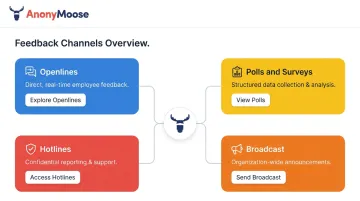
The platform replaces fragmented internal channels — emails, forms, phone hotlines, town halls, one-on-ones — with four structured paths for active listening:
- Openlines — permanent, anonymous two-way channels between employees and specific leaders, managers, or departments
- Polls & Surveys — real-time anonymous pulsing with push notification delivery and granular audience targeting
- Hotlines — structured anonymous incident reporting for ethics, safety, DEI, and compliance concerns
- Broadcast — instant one-to-many messaging that closes the feedback loop by pushing leadership responses directly to employee devices
Collecting feedback and not visibly responding is worse than not asking — it confirms the employee's suspicion that nothing will change. Broadcast lets leadership communicate back instantly, at scale, to the exact employee segments whose input prompted a given decision.
The Insights Dashboard ties it together, giving HR leaders aggregated analytics, trend tracking, and — for Hotlines specifically — AI-assisted pattern analysis across incidents, all without ever surfacing individual identities.
Conclusion
Candid employee feedback only works when the conditions for honest responses exist — and when systems ensure those insights translate into visible action.
Organizations that treat feedback as a continuous operational discipline — not an annual survey event — build something durable: cultures where employees surface problems early, where attrition is predictable enough to address proactively, and where strategic decisions are made on reality rather than filtered optimism.
That kind of culture doesn't happen through messaging or open-door policies. It happens when employees have a structurally protected channel — like AnonyMoose's anonymous Openlines — when leadership consistently closes the loop, and when the organization proves through repeated behavior that speaking up leads to real change.
Frequently Asked Questions
Is candid feedback good?
Yes. Research consistently links candid feedback cultures to better performance, lower turnover, and higher engagement. Gallup's meta-analysis ties top-quartile engagement to 23% higher profitability and 81% lower absenteeism — outcomes that trace directly back to whether employees feel safe enough to communicate honestly.
What are good examples of constructive feedback?
Effective constructive feedback is behavior-specific and forward-looking. For example: "The approval process creates a three-day delay; here's a shorter path that might work" addresses a process gap without attacking a person. It's behavior-specific, outcome-focused, and paired with a suggested fix.
What are the 3 C's of constructive feedback?
UNC Executive Development's 3C model defines them as Clarity (specific and unambiguous), Contextual Meaning (relevant to the situation), and Composure (delivered without defensiveness or emotion). All three must be present: missing any one of them produces either conflict or confusion.
What is the difference between candid feedback and constructive feedback?
Candid refers to the honesty of the input — not hiding uncomfortable truths. Constructive refers to how it's framed — solution-focused and actionable rather than blame-oriented. The best feedback is both simultaneously: honest about what's broken and clear about what improvement looks like.
How do you encourage employees to give honest feedback?
Two levers matter: demonstrate through past behavior that feedback leads to visible change (not punishment), and provide a structurally safe channel — such as an anonymous feedback platform — that removes the fear of identification before employees are ever asked to speak up. Policy statements without follow-through change nothing.
What happens when employees don't feel safe giving feedback?
They either disengage silently (quiet quitting) or vent externally on platforms like Glassdoor or Blind, creating brand, retention, and compliance risks. Both outcomes are far more expensive to address than building an internal feedback culture that prevents them.