Introduction
Construction consistently ranks among the most dangerous industries in the U.S. — and the numbers back that up. According to the Bureau of Labor Statistics, construction and extraction workers suffered 1,032 fatalities in 2024, with 389 of those deaths resulting from falls alone.
Those fatalities also carry a steep financial cost. OSHA's 2025 penalty schedule sets serious violations at $16,550 per citation and willful or repeated violations at $165,514 each. Across the construction industry (NAICS 23), federal OSHA has assessed over $109 million in penalties across 26,515 citations.
What many safety managers overlook is this: having a safety alert system isn't enough. OSHA requires that workers actually receive, understand, and can act on every alert. A system that exists on paper but fails in practice is still a compliance violation.
This guide breaks down what OSHA actually requires from safety alert systems — covering physical signage standards, digital notification tools, anonymous hazard reporting channels, and the documentation practices that hold up under inspection.
Key Takeaways
- OSHA's 29 CFR Part 1926 requires safety communication, hazard warnings, and emergency action plans on all qualifying construction sites
- Compliant alert frameworks combine five types: physical warnings, audible alarms, digital notifications, two-way communication, and anonymous reporting
- OSHA-compliant systems must be real-time, multi-channel, documented, and accessible in workers' native languages
- Hazard underreporting is a persistent compliance gap that anonymous digital reporting tools close by removing fear of retaliation
- Documentation and multilingual accessibility are often the two compliance requirements construction teams overlook most
What OSHA Requires for Safety Alert Systems on Construction Sites
There is no single OSHA standard titled "safety alert systems." Instead, compliance comes from satisfying multiple interlocking requirements across 29 CFR Part 1926 — each mandating a different piece of the communication infrastructure.
Emergency Action Plans (29 CFR 1926.35)
Every construction employer must have an emergency action plan. The key threshold: employers with more than 10 employees must have it in writing. Smaller operations may communicate the plan orally, but the plan itself is not optional for anyone.
A compliant EAP must include:
- Evacuation procedures and exit routes
- Employee roles during emergencies
- Alarm and alert procedures
- Assembly points and accountability methods
- Reporting procedures for employees who remain behind to operate critical systems
The alert system is what makes the EAP functional in practice — if workers can't receive or act on alarms in real time, every other element of the plan breaks down.
Fire Protection and Hazard Communication
Two additional standards create specific alert infrastructure requirements. Both establish legally mandated mechanisms, not optional supplements:
- 29 CFR 1926.24 and 1926.150 require a fire protection program and an alarm system (telephone, siren, or equivalent) capable of alerting site employees and the local fire department
- 29 CFR 1910.1200 (Hazard Communication) requires chemical hazard labels, Safety Data Sheets accessible to workers, and documented HazCom training
Recordkeeping and Reporting Timelines
These communication requirements don't stand alone — they connect directly to OSHA's recordkeeping obligations. Alert systems that support fast, accurate documentation help teams meet these mandatory deadlines:
| Requirement | Timeline | Standard |
|---|---|---|
| Fatal work injury reporting | Within 8 hours | 29 CFR 1904.39 |
| Inpatient hospitalization, amputation, or eye loss | Within 24 hours | 29 CFR 1904.39 |
| OSHA 300 Log maintenance | Ongoing | 29 CFR Part 1904 |
| Records retention | 5 years | 29 CFR 1904.33 |
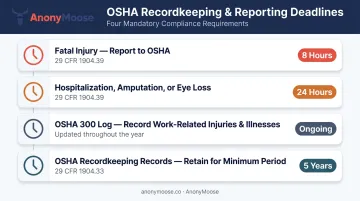
Alert systems that automatically log incident times and route severe events to the person authorized to contact OSHA directly support these mandatory reporting clocks.
The 5 Types of OSHA-Compliant Safety Alert Systems in Construction
A robust safety alert system combines five distinct system types, each serving a different communication function and tied to different OSHA requirements.
1. Physical Warning Systems
OSHA's Subpart G (29 CFR 1926.200) governs accident prevention signs and tags, with design alignment to ANSI Z35.1-1968 and ANSI Z535.2-2011. The five ANSI/OSHA sign classifications used in construction:
| Signal Word | Color | Hazard Level |
|---|---|---|
| Danger | Safety red | Will result in death or serious injury |
| Warning | Safety orange | Could result in death or serious injury |
| Caution | Safety yellow | Could result in minor or moderate injury |
| Notice | Safety blue | Important information, not injury-related |
| Safety Instruction | Safety green | General safety guidance or procedures |
Correct placement matters as much as correct sign type. A Danger sign in a low-risk zone or a Caution sign near an immediately lethal hazard is a Subpart G violation.
2. Audible Alert Systems
Several OSHA standards mandate specific audible alerts on construction sites:
- 1926.150 — fire alarm system capable of alerting workers and the local fire department
- 1926.602 — backup alarms on material-handling equipment with obstructed rear views
- 1926.555 — audible warning before starting conveyors
- 1926.909 — warning signals before blasting and all-clear after detonation
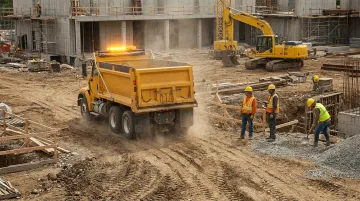
OSHA's struck-by eTool notes that approximately 75% of struck-by fatalities involve heavy equipment — backup alarms and spotter workflows are among the highest-consequence alert requirements on any active site.
3. Digital and Mobile Notification Systems
SMS and push notifications form the modern delivery layer for site-wide alerts. CTIA reports that text messages achieve a 98% open rate, making mobile delivery far more reliable than email for time-sensitive safety communications.
For deskless construction workforces, mobile-first delivery is essential. Workers on scaffolding, in excavations, or operating equipment need alerts on their personal devices — not on desktop dashboards they never see.
Digital systems must also support multilingual delivery. OSHA's communication requirements aren't satisfied by alerts that only a portion of the workforce can read.
4. Two-Way Communication Systems
Radios, digital chat, and voice translation tools create a feedback loop that one-way alerts cannot. Two-way capability matters for three specific reasons:
- Confirmation — supervisors can verify workers received and understood the alert
- Escalation — workers can report new hazards as conditions change
- Documentation — the exchange creates a timestamped record of communication for OSHA audits
5. Anonymous Hazard Reporting Systems
Anonymous digital reporting channels are the most overlooked component of a construction safety alert framework — and the most underused. OSHA's Section 11(c) legally protects workers who report hazards from retaliation, but that protection doesn't eliminate the fear of it.
Workers on tight-knit crews who depend on supervisors for assignments and hours will stay quiet even when they're legally protected.
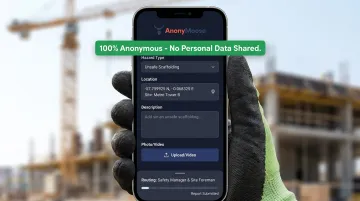
Anonymous systems remove that barrier entirely. Platforms like AnonyMoose let workers flag unsafe conditions, near-misses, and hazard concerns from their mobile devices with no risk of identification. The result: safety reporting shifts from a reactive incident log into a proactive detection system.
Key capabilities to look for in an anonymous reporting platform:
- Mobile-first access — workers report from the field, not a desktop form
- True anonymity — submissions untraceable by both the platform and the employer
- Real-time routing — hazard reports reach the right supervisor immediately
- Audit trail — timestamped records support OSHA documentation requirements
Key Features Every Construction Safety Alert System Must Have
Not all safety alert platforms are built to the same compliance standard. These functional capabilities determine whether a system actually supports OSHA requirements or just checks a procurement box.
Real-Time Speed and Automated Triggering
Alert latency is a life-safety issue — in a crane failure, gas leak, or trench collapse, seconds matter. Systems must trigger alerts automatically based on predefined conditions, without requiring a supervisor to manually initiate them. Common triggers include:
- Sensor threshold breaches (gas, temperature, structural load)
- Severe weather data feeds
- Worker-submitted incident reports
Full Audit Trail and Timestamped Documentation
Automated documentation is a hard requirement for OSHA compliance. An audit-ready system must capture:
- What alert was sent and the exact content
- Timestamp of transmission
- Which workers received it
- Acknowledgment confirmations
- Follow-up actions taken
This log directly supports OSHA 300 maintenance, inspection readiness, and the severe injury reporting clocks under 29 CFR 1904.39.
Multi-Channel, Multilingual Delivery
A single delivery channel creates a single point of failure. OSHA-compliant alert systems must push critical information across SMS, push notification, audible alarm, and visual signage simultaneously.
Channel diversity alone isn't enough if workers can't understand the message. The U.S. construction workforce is among the most linguistically diverse of any industry, and OSHA's communication requirements aren't satisfied by alerts workers cannot read. Every digital channel in your system should support translation into the primary languages present on your site.
Mobile-First Accessibility
Alert systems must be operable from personal mobile devices — not just control-room terminals or supervisor laptops. AnonyMoose's Broadcast feature delivers push notifications to every enrolled worker's phone the moment a message is sent, with granular targeting that lets site managers reach specific crews, shifts, or site locations rather than broadcasting to the entire organization.
How to Build and Implement a Safety Alert System on Your Jobsite
Step 1: Conduct a Site-Specific Hazard Assessment
Map your highest-risk zones before selecting any tools. Identify which OSHA standards apply to each zone:
- Trenching and excavation → confined space and cave-in alerts
- Scaffolding areas → fall protection communication
- Crane swing zones → 1926.1419 signaling requirements
- Chemical storage → HazCom labels, SDS access, and exposure alerts
- Electrical work areas → lockout/tagout notification
This assessment directly informs which alert triggers your system needs.
Step 2: Design a Layered Alert Architecture
Not every hazard calls for the same response. Match each hazard type to the communication channel workers will actually see, hear, or act on in that specific context:
| Hazard Type | Alert Channel |
|---|---|
| Zone boundary marking | Physical signage (Subpart G) |
| Evacuation/fire | Audible siren + digital broadcast |
| Equipment movement | Backup alarms + spotter protocol |
| Site-wide updates | SMS/push notification |
| Chemical hazard changes | HazCom labels + SDS + training |
| Ongoing hazard identification | Anonymous digital reporting channel (mobile app or hotline for near-miss and hazard reports) |
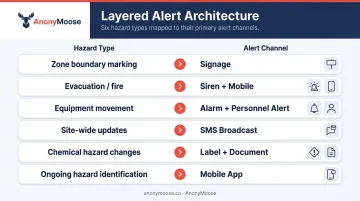
This architecture becomes the communication annex of your Emergency Action Plan under 29 CFR 1926.35.
Step 3: Train and Document
Per 29 CFR 1926.21, workers must receive training on how to recognize and respond to each alert type. During a site visit, OSHA inspectors typically request training records before anything else — documentation is your proof of compliance. Every training session should generate:
- Attendee sign-in records with dates
- Description of content covered
- Format of training delivered
- Name and qualification of the trainer
A worker who cannot identify what an alarm means will not respond correctly. That training gap is a citable violation under 29 CFR 1926.21, regardless of how well the rest of your system is built.
Why Anonymous Reporting Channels Belong in Your Safety Alert Framework
Research from the CDC confirms convincing evidence that occupational injury and illness rates in construction are underreported — particularly at smaller establishments. When hazards go unreported, safety alert systems become purely reactive. They respond to known risks while unknown hazards continue to accumulate.
OSHA's Section 11(c) anti-retaliation provision legally protects workers who flag safety concerns. But legal protection and psychological safety are different things. A worker who depends on a supervisor's goodwill for continued employment will not raise a hazard verbally or through any traceable channel — even knowing they're protected. Unreported hazards don't disappear — they compound until something fails.
Anonymous digital platforms eliminate this barrier by design. AnonyMoose's Hotlines feature allows construction workers to report unsafe conditions, near-misses, and safety concerns directly from their mobile devices the moment an incident occurs, with no technical mechanism capable of exposing who sent the message.
The anonymity is structural, not just stated policy. Neither AnonyMoose nor the employer organization can identify the author of any submission.
When a safety manager receives an anonymous report through a Hotline, they can:
- Ask follow-up questions within the same thread while maintaining full anonymity
- Attach policy documents or training materials in response
- Escalate the case with urgency flags and status updates
- View AI-analyzed pattern summaries across all reported incidents on a specific channel
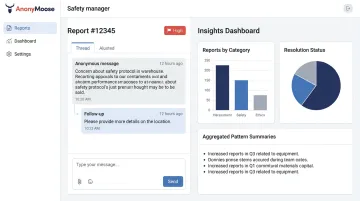
AnonyMoose's Openlines feature extends this further with configurable open channels where workers can report ongoing concerns specific to their site's hazard categories. A construction company can establish dedicated channels for fall hazards, equipment safety, electrical risks, or any other classification relevant to their work, with each channel routed to the appropriate safety personnel.
The Insights Dashboard aggregates activity across channels, allowing safety leads to identify patterns across anonymous submissions without ever accessing individual identities. The result is a system that surfaces hazard trends before they escalate — not just after an incident forces a response.
Frequently Asked Questions
What are the 5 types of safety signs in construction?
The five ANSI/OSHA classifications are Danger (immediate, life-threatening hazard), Warning (serious but potentially avoidable hazard), Caution (minor or moderate hazard), Notice (policy or informational content), and Safety Instruction (general safety guidance). OSHA's Subpart G under 29 CFR 1926.200 governs correct placement and design requirements for each type.
How much does a safety alert system cost?
Costs vary based on workforce size, site complexity, language needs, and included features. OSHA's 2025 penalty schedule puts the real cost of inaction in perspective: serious violations run $16,550 per citation, while willful violations reach $165,514. Cloud-based platforms typically require zero hardware investment, making them the most accessible entry point.
What are the 5 C's of safety?
The 5 C's are Competence, Control, Cooperation, Communication, and Compliance. A layered safety alert system directly strengthens Communication and Control — the two C's most dependent on fast, reliable information reaching the right people.
What is the OSHA standard for emergency action plans in construction?
29 CFR 1926.35 governs emergency action plans on construction sites. Written EAPs are required when OSHA standards mandate them, and must cover evacuation procedures, alarm systems, employee roles, and assembly points. Employers with 10 or fewer employees may communicate the plan orally.
What are the most frequently cited OSHA violations in construction?
According to OSHA's NAICS 23 data, the top citations are fall protection (1926.501 with 6,749 citations), ladders (1926.1053), scaffolding (1926.451), fall protection training (1926.503), and eye and face protection (1926.102). Any safety alert system should address fall-zone warnings and PPE compliance as priority communication functions.
How do you document safety alerts for OSHA compliance?
Records should capture the alert type, exact timestamp, recipients, and any acknowledgment confirmations. Digital systems that auto-generate these logs are the most reliable approach, directly supporting OSHA 300 Log maintenance and the severe injury reporting requirements under 29 CFR 1904.39.