Introduction
Organizations spend significant budget on benefits packages, yet employee satisfaction surveys routinely reveal a disconnect: employees don't feel their actual needs are being addressed. Most of the time, the problem isn't the benefits themselves — it's that HR is working from incomplete information.
Traditional feedback channels, whether town halls, named surveys, or one-on-ones, systematically suppress honest responses. Employees edit themselves. They avoid signaling financial stress, mental health struggles, or caregiving responsibilities when their names are attached. What HR receives is a filtered version of employee preferences — shaped more by what feels safe to say than by what employees actually need.
Anonymous surveys change this dynamic. When employees trust that their identity is genuinely protected, the requests that surface are consistently different — and give HR something concrete to act on.
This article covers the most frequently requested benefits revealed by anonymous surveys, why anonymity is essential to capturing accurate data, how to design surveys that draw out honest answers, and what to do with those insights once you have them.
Key Takeaways
- Flexible work and mental health support top anonymous surveys — but rarely surface in named or open formats
- Social desirability bias and fear of retaliation cause employees to suppress genuine preferences in traditional feedback settings
- Anonymous surveys expose systemic gaps — especially for caregivers, underrepresented groups, and employees with financial stress
- Ignoring survey results causes more disengagement than not surveying at all — acting on what you hear matters as much as asking
- Employees without internal outlets turn to Glassdoor, Blind, and Reddit — creating reputational risk that's hard to reverse
Why Anonymous Surveys Reveal the Truth About Employee Benefits
The Social Desirability Problem
In named surveys and HR-led focus groups, employees don't answer honestly — they answer safely. Requesting therapy coverage signals mental health struggles. Asking for financial counseling hints at money problems. Neither feels safe to disclose when a manager might see the response.
This is social desirability bias in action: people give the answers they believe will be positively received rather than the ones that reflect their actual needs. The result is that HR collects data that skews toward conventional, low-sensitivity requests while genuinely pressing needs stay invisible.
The fear-of-retaliation layer compounds this. Employees with medical conditions, caregiving responsibilities, or financial stress know that disclosing these circumstances — even indirectly through benefit requests — can be read as a signal of reduced capacity or commitment. Research published in PMC found that estimates of sensitive personal experiences varied from 13.6% to 33.3% depending on the privacy condition of the survey — a difference that reflects how dramatically disclosure rates shift when anonymity is credibly guaranteed.
What Anonymity Actually Unlocks
When employees trust that their identity is protected at the technical level, benefit preferences shift noticeably. The American Psychological Association's 2023 Work in America Survey found that 43% of workers worried that disclosing a mental health condition would negatively affect their career. That concern shapes every answer in a named survey. It doesn't disappear — it redirects.
Genuine anonymity does more than improve candor on individual questions. It surfaces systemic patterns HR cannot see from one-on-ones or open forums:
- Caregivers requesting schedule flexibility at disproportionate rates
- Women requesting equal parental leave in far higher numbers than voluntary disclosures suggest
- Financial wellness requests that cluster around specific tenure groups or pay bands — pointing to structural compensation gaps
These patterns give HR teams strategic intelligence, not anecdotes. That's the difference between reacting to one employee's complaint and redesigning a policy that affects dozens.
Platforms like AnonyMoose are built around this principle. The platform's architecture makes individual survey responses technically untraceable — structurally impossible to attribute to a specific employee by either the platform or the employer. That structural guarantee is what produces the candid, actionable data named surveys cannot. The SHRM Study (2020) confirms the scale of the difference: 82% of employees are more likely to share critical feedback when they know their anonymity is preserved, and research from buildempire.co.uk shows anonymous surveys yield 58% more honest feedback than their non-anonymous counterparts — a gap that maps directly onto the accuracy of the benefit preferences HR teams try to measure.
The Most Requested Employee Benefits Revealed by Anonymous Surveys
Anonymous benefit surveys across industries repeatedly surface the same clusters of high-priority requests. These categories rarely emerge through traditional HR channels — because they touch topics employees avoid raising openly.
Flexible Work and Schedule Autonomy
Requests for hybrid options, flexible start and end times, and compressed workweeks rank among the highest-frequency categories across industries and job levels.
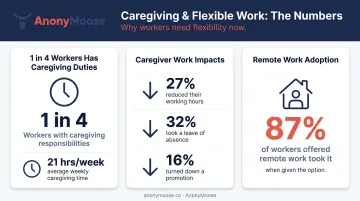
The numbers behind this preference are substantial. McKinsey research found that 87% of workers offered at least some remote work took the option, averaging three days per week at home. Gallup's hybrid work data shows that 6 in 10 exclusively remote workers said they would be extremely likely to seek another job if remote flexibility were removed.
The caregiver dimension is worth examining closely. S&P Global research found that about one quarter of workers have caregiving duties, spending an average of 21 hours per week on caregiving alongside full-time work. AARP data shows 67% of family caregivers had difficulty balancing jobs with caregiving, with impacts including reduced hours (27%), leaves of absence (32%), and turning down promotions (16%).
These employees are among the most likely to request schedule flexibility and the least likely to do so in non-anonymous settings — where requesting accommodation risks being perceived as less committed.
Mental Health and Emotional Wellbeing Support
Mental health benefits are systematically under-requested in open forums for one clear reason: stigma. Employees avoid disclosing therapy needs or burnout in front of managers. But when anonymity is guaranteed, mental health support — including therapy coverage, enhanced EAPs, and formal mental health days — routinely surfaces as one of the top benefit categories.
SHRM data shows 82% of employers offer an EAP, yet 26% of employees don't know whether their employer offers mental health benefits, and only 53% know how to access them. Gallup separately found 30% of workers don't know how to access their company's EAP.
This is a hidden demand problem. Employees who would benefit from mental health support often don't know it's available, and those who do know are reluctant to request enhancements openly.
Financial Wellness Benefits
Personal finances are among the most socially awkward topics for employees to raise with HR — so financial wellness requests get suppressed in named formats at a higher rate than almost any other category.
PwC's 2026 Employee Financial Wellness Survey found 59% of employees are stressed about their finances, with 71% of Gen Z workers reporting that financial strain reduced their productivity. Nearly half (49%) said compensation isn't keeping pace with the cost of living.
The most commonly requested financial benefits in anonymous surveys include:
- Emergency savings matching programs
- Student loan repayment assistance (SHRM data shows 77% of employees with student debt are more likely to accept a job offer that offers this)
- Access to financial planning or coaching sessions
- Compensation reviews tied to inflation
Financial stress is a productivity problem with a benefits-side solution — and anonymous surveys are often the only channel where employees feel safe saying so.
Career Growth and Development Opportunities
Mid-tenure employees frequently want learning stipends, tuition reimbursement, internal mobility programs, and structured mentorship. But many withhold these requests in open forums, worried they'll appear dissatisfied with their current role or seem to be signaling departure.
LinkedIn's 2024 Workplace Learning Report found that companies with strong learning cultures see 57% higher retention compared to those with minimal learning investment. Among organizations concerned about retention, providing learning opportunities ranked as the number one retention strategy.
Development benefits are cost-effective relative to their retention impact — particularly because employees who see a path forward within the organization are less likely to look for one elsewhere.
Inclusive and Equity-Forward Benefits
Gender-neutral parental leave, reproductive and fertility health coverage, caregiver support stipends, and ERG funding show up at disproportionately high rates in anonymous surveys — particularly from underrepresented employees least likely to advocate for themselves publicly.
Current provision still lags behind stated DEI commitments:
- Only 6% of women say their employer provides equal paid parental leave for both parents, though 60% consider it very important (Deloitte Women @ Work 2025)
- 47% of large employers offer IVF coverage; for smaller organizations the figure drops substantially
- Only 25% of working caregivers have access to paid leave specifically for adult caregiving
Anonymous surveys translate stated inclusion values into specific, measurable gaps. When a disproportionate share of a particular demographic requests the same benefit category, that pattern tells HR exactly where to focus.
How to Design an Anonymous Survey to Capture Honest Benefit Preferences
Survey design determines whether you get honest data or socially safe answers — regardless of the platform.
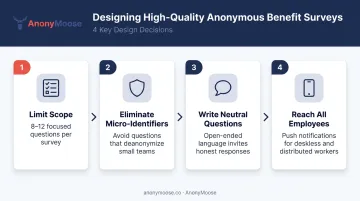
Four design decisions consistently separate high-quality benefit data from noise:
Limit scope to 8–12 questions per survey, organized around a single category (wellness, financial support, work arrangements). Survey fatigue pushes respondents toward low-effort, non-committal answers. Focused surveys protect completion rates.
Eliminate micro-identifiers. In small teams, overly specific questions can effectively deanonymize respondents. Referencing a named internal program, a recent team event, or demographic combinations that apply to only one or two people undermines anonymity even when it's technically guaranteed.
Write neutral questions. "Do you appreciate our current mental health offerings?" suppresses honest feedback even with anonymity in place. Questions should be open-ended enough to invite critical responses.
Reach deskless and distributed employees. Email-based surveys structurally exclude warehouse workers, delivery drivers, hospitality staff, and others without regular laptop access. AnonyMoose's Polls & Surveys feature delivers push notifications directly to employees' personal phones the moment a survey goes live, enabling single-tap responses from anywhere. That mobile-first reach drives participation rates well above typical benchmarks — The participation data is consistent: research on employee feedback shows anonymous surveys achieve 90% participation rates versus 30% for non-anonymous surveys, and the SHRM Study (2020) found that 82% of employees are more likely to share critical feedback when they know their anonymity is preserved. Both figures reflect the same underlying dynamic: structural anonymity changes what employees are willing to disclose, not just whether they respond at all.
Strong design means nothing if employees doubt the anonymity behind it. AnonyMoose's architecture is built so that no individual response can be traced back to a specific employee — by the platform or by the HR team reviewing results. When employees trust that constraint, they stop self-censoring and start answering the questions that actually matter.
Turning Survey Insights Into a Benefits Strategy That Retains Talent
Collecting data is the easy part. What organizations do next determines whether the effort builds trust or destroys it.
The Closed-Loop Requirement
Employees who submit anonymous benefit feedback and hear nothing in response become more cynical about leadership than those who were never surveyed at all. The expectation of response is set the moment the survey is launched — failing to meet it actively harms engagement.
Communicate a response timeline before the survey closes. Employees should know when they'll hear something, even if that something is "here's what we're still evaluating."
Prioritizing What to Act On
Triage incoming requests against three criteria:
- Frequency — what proportion of respondents raised this issue?
- Feasibility — what's the cost, vendor availability, and implementation timeline?
- Retention risk — which benefit gaps correlate most directly with intent to leave?
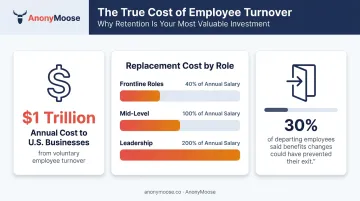
The financial stakes for inaction are significant. Gallup research estimates voluntary turnover costs U.S. businesses $1 trillion annually, with replacement costs running from 40% of salary for frontline roles to 200% for leadership positions. Compensation and benefits account for 30% of the actions employees said could have prevented their departure.
Communicating Results Back
When sharing what you found, be specific and inclusive:
- Share aggregate findings with the full workforce, not just HR
- Commit to 2–3 concrete changes for the near term
- Be transparent about which requests are under evaluation and which aren't currently actionable
Honesty about constraints builds more trust than vague commitments.
AnonyMoose's Broadcast feature supports this directly, allowing HR to push survey result summaries and benefit change announcements to the full workforce or targeted segments via push notification. This ensures the message reaches everyone, including employees without regular email access.
What Happens When You Ignore Employee Benefit Feedback
When employees submit anonymous feedback and hear nothing back, they draw one of two conclusions: their anonymity wasn't truly protected, or leadership doesn't care. Both outcomes suppress future survey participation and accelerate disengagement.
The organizational costs compound quickly:
- Gallup data shows 42% of voluntary leavers said their organization could have done something to prevent their departure
- 45% of voluntary leavers reported that no manager or leader proactively discussed their job satisfaction in the three months before leaving
- 51% of U.S. employees are actively seeking or watching for new job opportunities

When internal channels consistently fail to produce visible change, employees don't stay silent — they move to external platforms. Glassdoor reviews, Blind threads, and LinkedIn comments become the default outlet for unmet needs. That public commentary damages employer brand, complicates recruiting, and makes it harder to attract the same people the company is losing.
The fix is giving employees a trusted internal channel before frustration pushes them outward. AnonyMoose's Openlines feature does this through continuous, two-way anonymous communication between employees and specific leaders or departments. When that outlet exists and is visibly responsive, the pressure to post publicly drops. Maintaining an internal feedback channel costs considerably less than managing the reputational fallout from a wave of negative public reviews.
Frequently Asked Questions
What are the benefits of anonymous surveys?
Anonymous surveys increase response rates, eliminate social desirability bias, and surface honest feedback — especially on sensitive topics like mental health, compensation, and caregiving — that employees won't share when their name is attached to the response.
What should be included in an employee survey?
A well-designed employee survey should cover the essentials:
- Role clarity and manager effectiveness
- Compensation and benefits satisfaction
- Work-life balance and psychological safety
- Growth opportunities
Include a mix of rating-scale items and at least one open-ended question.
What is the most commonly requested employee benefit in anonymous surveys?
Flexible work arrangements, mental health support, and financial wellness benefits consistently rank highest, though priority order shifts by industry, workforce demographics, and current economic conditions.
How often should organizations survey employees about their benefit preferences?
Run a comprehensive benefit-focused survey annually, supplemented by pulse surveys quarterly or timed to benefits renewal cycles. This cadence captures how preferences shift over time without causing survey fatigue.
How do I convince leadership to act on benefit survey results?
Frame benefit investments in terms of retention cost savings (replacement costs range from 40% to 200% of salary depending on the role). Present anonymous survey findings alongside industry benchmarks, and propose a phased plan starting with low-cost, high-demand improvements like schedule flexibility or EAP enhancements.