That gap between experiencing harassment and formally reporting it is exactly where incidents go unresolved.
This guide covers what a workplace harassment reporting form actually is, which fields it needs to include, how to fill one out step by step, and what happens after you submit. It also addresses the barrier that stops most people from reporting in the first place.
Key Takeaways
- A harassment reporting form captures incident details, parties involved, and evidence in a structured, legally defensible way
- Every effective form includes complainant info, incident description, harassment type, witness details, and desired resolution
- Filing internally is the first step; the EEOC or California Civil Rights Department (CRD) are options if internal resolution fails
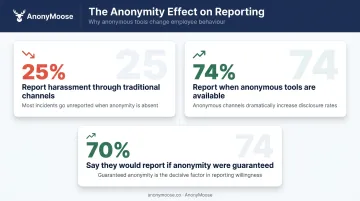
- Roughly 75% of harassment victims never report, and anonymous reporting channels are one of the most effective ways to change that
What Is a Workplace Harassment Reporting Form (and Why It Matters)
A workplace harassment reporting form is a structured document — paper or digital — used to formally record an incident of harassment so that HR or a designated compliance officer can review, investigate, and act on it.
The difference between an informal complaint and a formal written complaint matters more than most employees realize:
| Type | Format | Legal Weight | When to Use |
|---|---|---|---|
| Informal complaint | Verbal report to a supervisor | Low | Minor, first-occurrence issues |
| Formal written complaint | Completed reporting form | High | Any serious, repeated, or unresolved incident |
A submitted form triggers an employer's legal obligation to investigate. EEOC guidance states that once an employer has actual or constructive notice of potential harassment, it must take "reasonable corrective action, including a prompt and adequate investigation." Without a written record, that obligation is harder to enforce.
That legal protection runs both ways. Standardized forms ensure key details aren't omitted, create a consistent paper trail, and give investigators the same starting point no matter who handles the complaint.
Types of Workplace Harassment
Protected Class Harassment
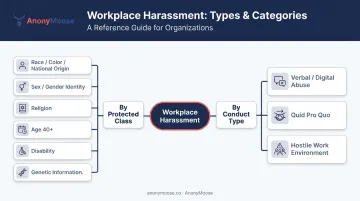
Under federal law, harassment is unlawful when it targets a protected characteristic. The EEOC defines covered categories as:
- Race, color, and national origin
- Sex (including sexual orientation, gender identity, and pregnancy)
- Religion
- Age (40 and older)
- Disability
- Genetic information
Harassment tied to one of these categories carries greater legal weight under Title VII, the ADEA, the ADA, and GINA.
Quid Pro Quo vs. Hostile Work Environment
These two legal categories require different types of evidence:
Quid pro quo — A supervisor conditions job benefits (promotion, continued employment, favorable assignments) on an employee's compliance with unwelcome demands. A single incident can be sufficient.
Hostile work environment: Conduct that is severe or pervasive enough that a reasonable person would find the workplace intimidating or abusive. This typically requires a pattern of behavior, though one extreme incident can qualify.
What Counts as Harassment
Harassment doesn't require physical contact. The EEOC's 2024 enforcement guidance recognizes a wide range of conduct, including:
- Verbal abuse and offensive comments
- Threatening or demeaning digital messages
- Social exclusion and retaliatory behavior
- Conduct on personal social media that crosses into the workplace
- Harassment via email, instant messaging, and video conferencing platforms
Capturing the correct type on a reporting form matters — it determines how the complaint is categorized and routed for investigation.
What Should a Workplace Harassment Reporting Form Include
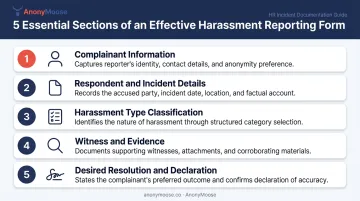
Every effective harassment reporting form covers the same core categories — here's what each one should contain and why it matters.
Complainant Information
- Full name, job title, and department
- Contact number and preferred contact method
- Supervisor's name and contact information
This section establishes who is filing and the reporting chain — important if the supervisor is the respondent.
Respondent and Incident Details
- Name(s) of the accused and their title/relationship to complainant
- Date(s), time(s), and location(s) of each incident
- Free-text narrative describing exactly what occurred
The narrative section should capture exact words or actions — not general summaries. Include how the behavior affected your ability to work: emotional impact, changes in duties, avoidance behavior. Specific detail is what establishes severity during review.
Harassment Type Classification
Good forms include a checklist covering:
- Sexual harassment
- Racial or ethnic harassment
- Disability-based harassment
- Religious harassment
- Harassment based on sexual orientation or gender identity
- General hostile work environment
- Options for single serious incident vs. repeated pattern
This categorization helps investigators route the complaint to the right reviewer and apply the applicable legal standard.
Witness and Evidence Section
| Field | What to Include |
|---|---|
| Witness details | Full name, position, contact info |
| Digital evidence | Emails, texts, chat logs, screenshots, voicemails |
| Physical evidence | Notes, documents, records of any tangible items |
Evidence should be preserved as-is — do not edit, summarize, or paraphrase digital records before submission.
Desired Resolution and Declaration
The form should ask what outcome the complainant is seeking. Common options include:
- Mediation between parties
- Formal internal investigation
- Mandatory training for the respondent
- Disciplinary action or termination
- A combination of the above
This helps HR prioritize and sequence actions appropriately. Close with a declaration and signature section, which authenticates the complaint and establishes the submission date — relevant for EEOC filing deadlines (180 days from the last incident in most states, 300 days where a state agency enforces equivalent law).
How to Fill Out a Workplace Harassment Report: Step-by-Step
Filing a report accurately is what turns an incident into a documented, actionable record. Follow these steps to make sure nothing falls through the cracks.
Step 1: Gather documentation before touching the form
Compile incident notes (dates, times, locations, who was present), save digital evidence to a personal device or external storage, and write out a clear account while memory is fresh. The sooner you document, the more accurate and credible the record.
Step 2: Complete complainant and respondent sections accurately
Use full legal names and accurate titles. If the harasser is your direct supervisor or someone in HR, state that clearly — it determines who conducts the investigation and may require escalation to an external party.
Step 3: Write the incident description in factual, specific language
Describe observable behaviors and direct quotes rather than interpretations:
- ✅ "On [date], [name] said: '[exact words]' in front of [witness name]"
- ❌ "He was disrespectful and made me uncomfortable"
If there were multiple incidents, document each one separately with its own date, time, and description. Don't compress them into a single paragraph.
Step 4: Attach and reference all supporting evidence
Reference each piece of evidence by exhibit on the form:
"Exhibit A: Screenshot of Slack message sent [date] at [time] — attached as PDF"
This allows the investigator to cross-reference without hunting through attachments.
Step 5: Submit through the correct channel and keep copies
Typical submission channels include:
- HR department (in person, email, or portal)
- Designated compliance officer
- Online intake system (if available)
- Anonymous reporting platform (covered in the next section)
Retain a copy of everything — the completed form, all attachments, and confirmation of receipt. If you submitted by email, save the sent message.
What Happens After You Submit a Harassment Report
The Internal Investigation Process
After receipt, a typical internal process runs:
- Acknowledgment: HR or the compliance officer confirms receipt
- Investigation opens: Parties and witnesses are interviewed confidentially
- Findings documented: Investigation notes and conclusions are recorded
- Resolution communicated: Outcome shared with the complainant
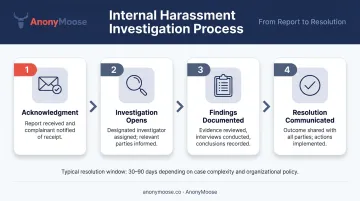
There is no federal mandate for a specific number of days, but EEOC guidance requires the process to be "prompt and adequate." California's FEHA requires "immediate and appropriate corrective action" once an employer knows or should have known about harassment. Most organizations target 30–90 days for resolution.
Possible Outcomes
- Corrective action against the respondent (warning, demotion, termination)
- Mandatory training or policy updates
- Mediation between parties
- A finding of unsubstantiated complaint
If Internal Resolution Fails
Employees can escalate to:
- The EEOC: File a charge within 180 days of the last incident (300 days in states with equivalent laws). The EEOC notifies the employer within 10 days; average investigations take ~10 months, while mediation typically resolves in under 3 months.
- California Civil Rights Department (CRD): Complaints must be filed within 3 years of the last incident of harm.
- Right-to-sue notice: If the EEOC hasn't completed its investigation within 180 days, request this notice and file in federal court within 90 days of receipt.
After submission, keep documenting. Any new incidents, retaliatory behavior, or employer failure to respond belong in your records — they matter if the case escalates.
Why Employees Don't Report (and How to Remove the Barriers)
The underreporting problem is severe. The EEOC's Select Task Force found that roughly three out of four individuals who experienced harassment never told a supervisor, manager, or union representative. Only 6–13% of those who experienced harassment ever took formal action.
The reasons are consistent:
- Fear of retaliation or being labeled a troublemaker
- Distrust that HR will handle it fairly
- Uncertainty about whether the behavior "qualifies"
- Not knowing how or where to report
The Anonymity Factor
Anonymity shifts the calculation entirely. Survey data from a Lehigh University study of nearly 2,000 employees found that 70% said they would report if they could do so anonymously, and 74% of incidents were reported when anonymous reporting tools were available — a dramatic shift from baseline rates.
This is where platforms like AnonyMoose serve a meaningful role. AnonyMoose's Hotlines feature is a secure, anonymous incident reporting channel where employees select the relevant Hotline (sexual harassment, discrimination, ethics violation, etc.) and submit a report directly from their phone — no phone call required, no awkward conversation, no risk of being overheard.
The conversation thread stays open for follow-up, and both parties can attach screenshots, documents, or other evidence throughout. The anonymity is structural by design: neither AnonyMoose nor the employer can identify who submitted a report — not by policy, but by architecture.
What Employers Can Do Structurally
- Make the reporting process visible — employees can't use a form they don't know exists
- Train managers specifically on how to receive and handle complaints without discouraging reporters
- Use tools like AnonyMoose's Broadcast feature to push anti-retaliation policy reminders directly to employees' phones
- Communicate clearly that retaliation is illegal under both federal EEO laws and FEHA, and that participating in a complaint process is protected under all circumstances
Frequently Asked Questions
What evidence do I need to report harassment?
Written records (dates, times, locations, incident descriptions) and digital evidence (emails, texts, screenshots) are most valuable. Witness names strengthen a complaint, but a thorough personal account alone — with specific dates and details — still carries weight in an investigation.
What should I do when a coworker is harassing me?
Document each incident with dates and details, then file a formal complaint with HR using a written form. If no action is taken within a reasonable timeframe, escalate to the EEOC or your state civil rights agency, and consider consulting an employment attorney.
What is considered harassment by a manager?
Managerial harassment includes any unwelcome conduct tied to a protected characteristic — quid pro quo demands, hostile comments, intimidation, or unfair treatment. Employers can be vicariously liable when a supervisor's harassment leads to a tangible employment action like demotion or termination, which gives these cases additional legal weight.
What are the five types of harassment at work?
The main categories are sexual harassment, racial or ethnic harassment, disability-based harassment, religious harassment, and general hostile work environment harassment. Any severe or pervasive behavior targeting a protected characteristic qualifies — it doesn't have to be physical.
Can I report workplace harassment anonymously?
Formal EEOC charges require a signed statement with your identity. However, many organizations offer anonymous internal reporting channels. Platforms like AnonyMoose's Hotlines feature allow employees to report incidents and exchange follow-up information without their identity ever being revealed — to the employer or the platform.
What should I do if HR doesn't respond to my harassment report?
Document the lack of response with dates, send a written follow-up, and keep copies of both. If there is still no action, escalate to the EEOC or your state civil rights department — and if retaliation has occurred, consult an employment attorney promptly.