The data on this is stark: according to Catalyst's 2024 eight-country survey, 75% of employees doubt the sincerity of their organization's racial equity efforts. That's not a perception problem that better messaging will fix. It's a credibility problem that only genuine, consistently demonstrated commitment can address.
This article breaks down 10 key elements of an effective DEI communication strategy — grouped by theme, from leadership authenticity to accountability — and what separates organizations that earn employee trust from those that don't.
Key Takeaways
- Employees judge DEI by visible action, not announcements — what's said means nothing without measurable follow-through
- Regular DEI progress communication makes employees 11x more likely to view DEI policies as genuine
- Only 23% of organizations currently measure DEI progress through quantifiable impact metrics
- Anonymous feedback channels surface DEI concerns that formal channels routinely overlook
- Honest accountability — tracking and reporting on DEI commitments transparently — is what gives every other element its credibility
Why DEI Communication Often Misses the Mark
Performative DEI communication follows a recognizable pattern: announcements without follow-through, one-off statements timed to external events, plans that get announced and never revisited. The intentions behind the messaging rarely matter if the behavior doesn't change.
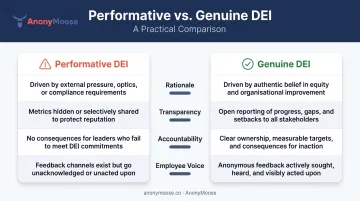
Genuine DEI communication looks different across four dimensions:
| Dimension | Performative | Genuine |
|---|---|---|
| Rationale | Business case framing only | Values-based + measurable goals |
| Transparency | Positive metrics shared selectively | Progress and shortfalls both disclosed |
| Accountability | Goals announced | Goals tracked and reported publicly |
| Employee voice | Surveys with no visible follow-up | Feedback loops with visible responses |
When employees see a gap between what leadership says and what they experience daily, the result isn't skepticism — it's cynicism. Harvard Business Review's research on workplace cynicism describes the failure mode clearly: demotivation, disengagement, and employees who stop believing organizational change is possible.
That cynicism is what the 10 elements ahead are designed to prevent. Each one assumes the underlying DEI work is real — because no communication strategy can substitute for it.
Building the Foundation: Authenticity, Transparency, and Leadership Alignment
Element 1: Authenticity from the Top
Authentic DEI leadership means leaders can articulate a genuine personal commitment to inclusion — including where they're still learning — not just recite the right talking points.
A few markers of authentic versus performative leadership voice:
Authentic leaders:
- Share specific personal DEI priorities and connect them to organizational values
- Acknowledge the organization's current gaps alongside its aspirations
Performative signals:
- Leading primarily with the business case for diversity, which positions inclusion as a means to an end rather than an intrinsic commitment
- Using polished corporate language that sounds like it was written by committee
One practical step: develop an equity statement written in the leader's own voice, not drafted entirely by communications. The goal is to articulate the organization's genuine "why" — where it's heading and why inclusion is non-negotiable to getting there.
Framing DEI purely through the business case risks signaling to underrepresented employees that their inclusion is contingent on profitability.
Element 2: Transparency About Where You Are and Where You're Going
Authentic leadership creates the conditions for transparency to work — but transparency requires its own discipline. It means naming current gaps honestly, not curating a version of the data that makes the organization look good.
Most organizations haven't cleared even a basic bar here. Deloitte's 2023 Global Human Capital Trends report found that only 23% of organizations measure DEI progress through quantifiable impact metrics. PwC reports that roughly 80% of organizations have not implemented data analysis for compensation, hiring, or performance to reduce bias. That gap represents a real opportunity for organizations willing to move first.
Transparency operates at different levels:
- Baseline: Share workforce representation data by gender, race/ethnicity, and role level
- Intermediate: Share promotion and internal hiring rates by demographic group
- Advanced: Share pay equity audit results, including corrective actions taken
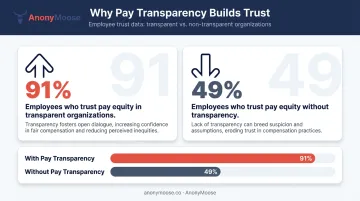
The trust payoff is significant. SHRM research found that 91% of employees in transparent organizations trust that pay is equal across race and gender, compared to just 49% where transparency is lacking. Pay equity disclosure is one of the highest-credibility proof points available.
One caution: transparency means disclosing accurately, not selectively. Sharing only favorable progress data is a form of curation — and employees notice.
Getting the Words and Visuals Right: Inclusive Language and Imagery
Element 3: Inclusive Language
Language choices in job postings, internal memos, town hall scripts, and DEI reports all carry bias risk. This isn't about policing vocabulary — it's about choosing words that signal belonging to all readers, regardless of background.
Foundational research from Gaucher, Friesen, and Kay demonstrated that masculine-coded wording in job advertisements makes positions less appealing to women and reduces anticipated belonging. That's a recruiting pipeline problem with a language-level fix.
Practical audit frameworks organizations can apply:
- Gender-coded language scan: Flag wording that skews toward masculine-associated traits ("dominate," "aggressive") vs. communal traits
- Plain-language review: Eliminate jargon that disadvantages applicants unfamiliar with insider terminology
- The flip test: Read the message substituting a different demographic group. If the message reads differently, the language carries unintended bias
- Accessibility review: Ensure language is clear for non-native English speakers and employees with cognitive differences
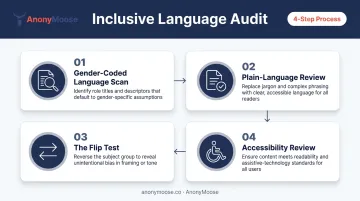
The key point from HBR's 2022 guidance: inclusive language is an ongoing organizational audit process, not a one-time copy edit. Language choices appear across HR, leadership, product, and communications — treating it as a single revision misses most of the risk.
Element 4: Inclusive Imagery and Visual Representation
Visual language communicates who belongs before a single word is read. The imagery on a careers page, in an annual report, or on an internal intranet tells employees — and candidates — whether they can picture themselves succeeding in the organization.
Critical questions for auditing organizational imagery:
- Are underrepresented groups shown in positions of leadership and agency, or predominantly in supporting roles?
- Does representation reflect the full diversity of the workforce — including disability, age, and gender identity — or only surface-level demographic diversity?
- Is the visual storytelling authentic (real employees in real work contexts) or does it rely on stock photography that reads as staged?
Catalyst's guidance for recruiting women of color recommends auditing websites, social channels, and recruitment materials specifically for diverse images and for whether employees across races, genders, and identities are visibly showcased. Authentic storytelling beats stock photography every time. A single genuine employee spotlight — someone in their actual workspace, doing real work — carries more credibility than a banner image featuring a diverse group of people who don't work there.
Making It Stick: Consistency, Intentionality, and Proactivity
Element 5: Consistency Across Channels and Over Time
One of the most common credibility killers in DEI communication is inconsistency. Leaders communicate actively around DEI during a PR moment or awareness month, then go silent for months. The silence is itself a signal — that DEI is reactive, not embedded.
PwC's Global DEI Survey captures the perception gap precisely: only 11% of business leaders believe they are not communicating frequently about DEI, while 17% of employees and 20% of HR professionals perceive DEI communication as infrequent. Leaders are measuring their communication by how many messages they send. Employees are measuring it by what they can recall and see changing.
What consistent communication looks like in practice:
- Quarterly: DEI progress metrics updates (including shortfalls, not just wins)
- Ongoing: ERG spotlights, policy change announcements, employee stories
- Real-time: Acknowledgment of relevant social moments when they intersect with the organization's workforce
The goal isn't volume — it's reliable, substance-rich updates delivered on a cadence employees can anticipate.
Element 6: Intentionality in Every Communication
Intentional DEI communication means every piece of content serves a specific purpose: advancing a DEI goal, addressing a known gap, or bringing employees along with real information.
Announcements that name an initiative without explaining what changed, what it means, or how progress will be tracked fill the communication calendar without building credibility. Transparency is what earns trust — not frequency.
Build a DEI communication calendar that maps each communication to a specific strategic objective. Every entry should answer:
- What DEI goal does this serve?
- What does the audience need to know or do?
- How will we follow up?
Element 7 (Element 9 in Outline): Proactivity — Having a Voice Before You're Asked
Organizations that only speak about DEI when forced to by external events signal that DEI is about risk management, not values. Proactive organizations share data voluntarily, take positions on social issues relevant to their workforce, and don't wait for a crisis to demonstrate commitment.
Allstate provides a documented example of a predefined approach. CEO Tom Wilson has publicly described the decision criteria Allstate uses to determine when leadership should weigh in on social issues — assessing whether the company is positioned to speak credibly, has relevant expertise, and can genuinely effect change. Having that framework in place before an issue emerges is what allows leadership to respond on principle rather than under pressure.
The employee expectation for this is real. Edelman's research found that 34% of employees have left a job because their employer stayed silent on a societal or political issue. Research from Axios HQ, based on LinkedIn studies, reinforces the broader communication stakes: 42% of employees left an organization due to poor internal communication — a reminder that how organizations communicate about DEI commitments is as consequential as the commitments themselves. An internal framework for leadership advocacy — defining when to speak, how, and through which channels — is a foundational communication decision. Organizations that build it proactively retain more credibility when moments of pressure arrive.
Creating a Two-Way Dialogue: Engagement, Diverse Voices, and Accountability
Element 8: Engagement Through Active Listening
Effective DEI communication is not a broadcast. It's a conversation, and that requires organizations to build mechanisms where employees can speak honestly — not just be spoken to.
The psychological safety problem here is documented. PwC's 2025 Global Workforce Hopes and Fears Survey reports that workers with the highest psychological safety are 72% more motivated than those with the lowest. Catalyst connects silence directly to DEI credibility: preventing a climate of silence makes employees 4x more likely to perceive DEI policies as genuine.
The barrier isn't willingness — it's fear of identification. When employees believe their feedback can be traced back to them, they self-censor. This is where anonymous communication infrastructure matters. The SHRM Study (2020) found that 82% of employees are more likely to share critical feedback when anonymity is preserved — and research from Quantum Workplace found that anonymous communication in organizations drives a 35% increase in employees' sense of belonging, making anonymity not just a data quality tool but a foundational DEI investment.
AnonyMoose addresses this through its anonymous-by-design architecture, with three distinct channels:
- Openlines: Permanent, two-way feedback channels where employees can surface DEI concerns, microaggressions, or patterns of exclusion — with anonymity neither the platform nor the employer can override
- Hotlines: Structured case management for sensitive incident reporting, including discrimination, bias, and harassment
- Insights Dashboard: Lets DEI leaders identify patterns across submissions without accessing individual identities
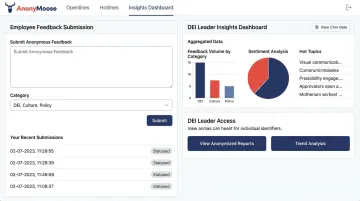
Technical anonymity, rather than a policy promise, is what actually shifts employee behavior. The architecture makes it structurally impossible to trace submissions back to individuals.
Element 9: Amplifying Diverse Voices
Leadership voice alone is insufficient. DEI communication that only flows from executives reinforces the very hierarchy it's trying to address.
Amplifying diverse voices means:
- Inviting personal narratives from employees across levels and functions — not just ERG leadership
- Creating platforms for storytelling that give employees real agency in shaping the message
- Spotlighting employees who model allyship in specific, concrete ways
- Ensuring diverse contributors are shaping DEI communications, not just asked to validate messages already written
The critical nuance: token representation in communication mirrors token representation in imagery. Asking underrepresented employees to validate pre-written DEI content isn't amplification — it's co-option. Genuine amplification means those voices shape the message from the start, not after the draft is done.
Element 10: Accountability — Closing the Loop on Commitments
Accountability is what makes every other element credible. Without it, DEI communication is a series of intentions that employees have no reason to believe.
The disclosure gap reveals how rare genuine accountability is. JUST Capital's 2022 tracker of the 100 largest U.S. employers found:
- 91% disclosed basic workforce diversity data
- 23% disclosed specific diversity targets by race/ethnicity
- 22% shared actual pay equity results
- 7% disclosed internal hire or promotion rates by race/ethnicity
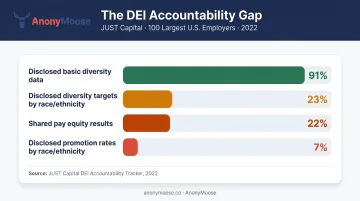
Publishing diversity data is now table stakes. Real accountability requires disclosing promotion rates, pay equity results, and progress against stated goals — including where goals weren't met. In practice, that looks like transparent annual DEI reports with goal-by-goal tracking, visible diversification at the senior leadership level (not just entry-level hiring), demonstrated follow-through on employee-reported concerns, and willingness to bring in outside expertise when internal gaps persist.
The most effective DEI communication strategy is ultimately the one that reflects the tangible outcomes of genuine DEI work. Accountability closes the loop between what organizations say and what employees experience.
Frequently Asked Questions
Who are the primary beneficiaries of DEI initiatives?
All employees benefit. Underrepresented groups gain equitable access, voice, and protection from discrimination — while every employee gains from a more psychologically safe, innovative workplace. Inclusion improvements consistently correlate with stronger performance across the board.
What is the difference between DEI communication and a DEI strategy?
DEI strategy is the overall framework of goals, policies, and commitments an organization makes. DEI communication is how that strategy is expressed, shared, and reinforced — both internally with employees and externally with stakeholders. Without communication, even a well-designed strategy fails to build the trust required to sustain it.
What makes DEI communication feel authentic rather than performative?
Authenticity comes from alignment between words and visible action — leaders who are demonstrably committed, honest data that includes gaps, and communications backed by concrete policy changes. When employees see their feedback heard and acted on, the communication earns credibility.
How often should organizations communicate about DEI?
Annual reports and awareness months signal a campaign, not a commitment. A consistent cadence — quarterly progress updates, ERG spotlights, and acknowledgment of relevant social moments — embeds DEI into everyday organizational communication.
How do you measure the effectiveness of a DEI communication strategy?
Measure both reach (are employees seeing and engaging with DEI communications?) and impact (are perceptions of inclusion, psychological safety, and belonging improving?). Anonymous pulse surveys, engagement data, and representation metrics tracked quarter over quarter provide the clearest signal of whether communication is driving real change in employee experience.