This scenario is far more common than most leaders realize. According to the Institute of Business Ethics 2024 Ethics at Work Survey, one in three employees who knew about misconduct did not report it. That's a fraction of the full picture — the survey also found 25% of employees were aware of conduct violating law or organizational ethics in the past year alone.
The cost of that silence is real: in compliance failures, missed innovations, and employees who eventually stop investing in organizations that never seem to listen.
This post defines what a speak-up culture actually is, explains why it matters across multiple dimensions of business performance, identifies the barriers that keep employees quiet, and walks through concrete steps to build one.
Key Takeaways
- A speak-up culture is a workplace where every employee feels safe to voice concerns, share ideas, and report misconduct — without fear of retaliation.
- The two biggest barriers to speaking up are fear of consequences and belief that nothing will change.
- Building this culture takes visible leadership commitment, accessible feedback channels (including anonymous ones), and consistent follow-through on what employees raise.
- Anonymous tools significantly lower the barrier to speaking up, especially where trust is still developing.
- Organizations that prioritize speak-up cultures see measurable gains in engagement, retention, compliance, and innovation.
What Is a Speak-Up Culture?
A speak-up culture is an organizational environment where employees at every level feel genuinely safe to voice concerns, share ideas, flag risks, and report misconduct — without fear of retaliation, ridicule, or being dismissed.
That definition cuts both ways. The goal isn't to encourage constant dissent or relitigate every decision — it's to ensure no important insight goes unheard because someone feared the consequences of sharing it.
The Opposite: Cultures of Compliance and Fear
In organizations without a speak-up culture, employees learn quickly to do what they're told and suppress observations that could improve — or protect — the organization. Silence in these environments isn't agreement. It's self-protection.
A quiet workforce is not a satisfied one.
The Two-Way Requirement
A speak-up culture has two sides that must both function:
- Employees who feel safe enough to raise concerns without fear of consequences
- Leaders who actively listen, respond, and follow through on what they hear
- Systems that close the loop — so employees can see their input led to action
Without the listening side, speaking up becomes pointless. Employees try once, get no response, and stop trying. Leadership interprets the silence as satisfaction — and the real problems go unaddressed.
Why a Speak-Up Culture Matters
Risk Management and Organizational Integrity
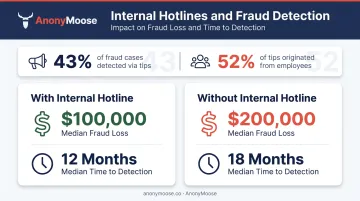
When employees feel safe reporting early, organizations catch problems before they become crises. The data here is direct: according to the ACFE's 2024 Occupational Fraud Report, tips detected 43% of occupational fraud cases — more than internal audit (14%), management review (13%), and external audit (3%) combined. Employees originated 52% of those tips.
The financial gap is significant. Organizations with internal hotlines had a median fraud loss of $100,000 compared to $200,000 without them, and detected schemes in 12 months versus 18 months. Early reporting doesn't just feel better — it measurably cuts losses.
Innovation and Competitive Advantage
Employees closest to daily operations often carry the most actionable insights about what's breaking, what customers actually need, and where the next opportunity sits. When their voices are suppressed, decisions get made in an information vacuum.
Google's Project Aristotle studied 180 teams and found that teams with high psychological safety were rated effective twice as often by executives. That safety doesn't emerge from perks or policies alone — it comes from employees knowing their honest input shapes real decisions.
Employee Engagement and Retention
Gallup's Q12 engagement framework includes a direct voice item: "At work, my opinions seem to count." Top-quartile engagement business units show 78% less absenteeism and 23% higher profitability. The connection between voice and belonging is real — when people feel heard, they invest more of themselves in their work.
That expectation has teeth. The 2024 Edelman Trust Barometer Special Report found 82% of employees say the ability to give management feedback is a dealbreaker or strong expectation — meaning organizations that ignore it are actively losing talent to those that don't. Research from Axios HQ, based on LinkedIn studies, underlines the retention stakes: 42% of employees have left an organization due to poor internal communication — making the quality of organizational listening a direct driver of attrition, not just a culture metric.
Reputational Risk Reduction
When internal channels are absent or mistrusted, employees don't simply go silent. They take frustrations to Glassdoor, LinkedIn, or Blind. Glassdoor data shows 83% of job seekers research company reviews before deciding where to apply. One bad public narrative, written by an employee who never felt heard internally, can affect recruiting for years.
Robust internal channels keep those conversations where they belong — inside the organization, where they can actually be addressed.
Better Decision-Making
Decisions made with diverse, unfiltered input consistently outperform those made inside leadership echo chambers. A speak-up culture delivers that by:
- Reducing groupthink by introducing perspectives leadership doesn't naturally encounter
- Surfacing candid feedback early, before small problems compound into costly ones
- Giving decision-makers an accurate read on ground-level reality
Why Employees Stay Silent: The Real Barriers
The barriers to speaking up aren't always visible — but the data makes them hard to ignore.
Fear of Retaliation
The IBE 2024 survey found 34% of employees cited fear of jeopardizing their job as a deterrent to speaking up. Even watching a colleague face subtle social consequences after raising a concern is enough to silence others — the fear doesn't need to be personal to be effective.
And it's not purely perceived risk. NAVEX's summary of ECI's 2023 Global Business Ethics Survey reported that 46% of employees who reported misconduct experienced retaliation. For employees aged 18–34, that figure climbed to 52%. The fear is grounded in experience.
Belief That Nothing Will Change
Employees who've raised concerns and seen them ignored, dismissed, or met with empty acknowledgment stop trying. Every instance of unacknowledged feedback reinforces the same lesson: silence is the more rational choice.
IBE found 34% of employees cited concern that corrective action would not be taken as a deterrent. This is the futility barrier: not "what will happen to me?" but "why bother?"
Lack of Safe or Accessible Channels
Many organizations rely on open-door policies or direct manager conversations as their primary feedback mechanism. Both require employees to identify themselves and risk the relationship. Employees with the most sensitive concerns are the least likely to use visible, personal channels.
Anonymous, mobile-accessible channels close this gap. AnonyMoose's Openlines feature enables full back-and-forth conversations with leadership or HR with no identity exposed — by design, not just by policy. The SHRM Study (2020) found that organizations with this level of structural anonymity see a 47% increase in actionable feedback related to management practices — exactly the high-stakes input that speak-up cultures are built to surface but that traditional channels consistently fail to capture. There's no technical mechanism in the platform that can trace a message back to its sender, so anonymity is structural rather than promised.
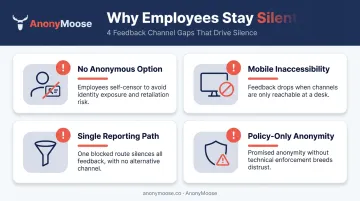
Common channel gaps that push employees toward silence:
- No anonymous option — all paths require self-identification
- Mobile inaccessibility — feedback tools only available on desktop or during work hours
- Single reporting path — one channel (usually a direct manager) for all concern types
- Policy-only anonymity — "we won't tell anyone" without technical enforcement
Cultural and Hierarchical Norms
In organizations with strong top-down hierarchies, employees internalize the message that dissent is unwelcome. These unspoken rules carry more weight than any formal policy. No amount of "my door is always open" language counteracts a culture where the first person who challenged a decision got visibly shut down.
How to Build a Speak-Up Culture
Start With Leadership Commitment — and Make It Visible
Policy alone won't build this culture. Leaders must demonstrate, not just declare, that they value honest input. That means:
- Asking for feedback proactively, not waiting for it
- Responding constructively when they receive critical input (not defensively)
- Publicly acknowledging employees who surface useful concerns
- Talking openly about organizational challenges and their own mistakes
Employees watch closely how leaders respond the first few times someone speaks up. Those responses set the cultural tone more than any policy document ever will.
Establish Multiple Feedback Channels
Different employees have different comfort levels. Providing only one feedback channel — especially one that requires identification — guarantees certain voices never reach leadership.
Effective organizations offer a range:
- Run anonymous hotlines for sensitive incident reporting
- Deploy pulse surveys and polls to gather regular sentiment
- Host open forums for idea sharing and non-urgent concerns
- Maintain direct reporting paths for employees who prefer identified channels
AnonyMoose consolidates these into a single mobile-first platform, replacing fragmented email chains, suggestion boxes, and scheduled town halls with Openlines, Polls & Surveys, Hotlines, and Broadcast messaging, all accessible from anywhere, at any time.
Institute and Enforce a Zero-Tolerance Non-Retaliation Policy
A non-retaliation policy is only as strong as the organization's willingness to enforce it visibly. Employees need to see that those who retaliate face real consequences — not just a reminder email.
Communicate this policy clearly and repeatedly:
- During onboarding, not just in the employee handbook
- In manager training, with specific behavioral expectations
- Through regular reinforcement at team and leadership levels
Actively Solicit Feedback — Don't Just Wait for It
There's a real difference between "my door is always open" and deliberately asking for input. The act of asking signals that feedback is genuinely wanted. Build active solicitation into regular operations:
- Schedule structured check-ins with specific feedback prompts
- Run anonymous pulse surveys before and after major changes
- Use team retrospectives to surface what's working and what isn't
Close the Loop: Respond, Act, and Communicate
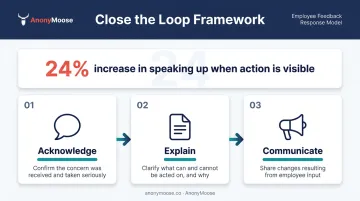
One of the fastest ways to destroy a speak-up culture is to collect feedback and never visibly respond. HBR research found a 24% increase in speaking up when employees believe managers take action on their input. The inverse is equally true: silence from leadership after feedback teaches employees that the system isn't real.
Closing the loop means taking three concrete steps:
- Acknowledging that the concern was received and taken seriously
- Explaining what can and can't be acted on, and why
- Communicating changes that resulted from employee input
AnonyMoose's Broadcast feature supports this directly — leadership can push a targeted message to every employee's phone the moment a decision is made or a change is implemented, ensuring the response reaches the people who raised the concern rather than getting buried in an email inbox.
Embed Speaking Up in Daily Operations
Building that loop only works if speak-up behavior is routine — not something reserved for ethics investigations or annual surveys. Embed it in daily operations:
- Build "what's working / what isn't" discussions into regular team meetings
- Recognize employees who surface useful concerns (even when the concern is uncomfortable)
- Integrate feedback reviews into project cycles, not just performance cycles
When raising a concern feels like a routine behavior rather than a high-stakes act, more employees will do it.
The Role of Leadership in a Speak-Up Culture
Gallup reports that managers account for 70% of the variance in team engagement. That same leverage applies to speak-up behavior — the manager's reaction when someone raises a concern is the most powerful signal in the environment.
What Good Leadership Looks Like
Receptive leadership means actively inviting feedback, staying genuinely curious about concerns, and following through visibly when issues are raised. Leaders who model this behavior see higher psychological safety on their teams — and problems surface early, before they compound.
Common Leadership Mistakes That Undermine Speaking Up
- Dismissing ideas quickly without genuine engagement, signaling that input isn't actually welcome
- Over-relying on email instead of real dialogue, which flattens nuance and discourages honest exchange
- Confusing listening with agreeing, which leads leaders to become defensive rather than curious
- Creating such controlled environments that employees only raise pre-approved topics
The Middle Manager Problem
The mistakes above don't just happen at the top. C-suite commitment to speak-up culture means little if front-line managers bury concerns before they travel up. Middle managers are the first point of contact for most employee concerns, and they have an outsized influence on whether those concerns get escalated or dropped entirely. McKinsey found only 43% of respondents reported a positive team climate in their research on psychological safety.
Equipping and holding middle managers accountable for psychologically safe team environments is where the culture actually takes root — or quietly collapses.
How to Measure If Your Speak-Up Culture Is Working
Key Metrics to Track
NAVEX's 2026 benchmark analyzed 2.37 million reports from 4,052 organizations covering approximately 77 million employees. The median internal reporting volume reached 1.65 reports per 100 employees — a useful baseline for benchmarking your own organization.
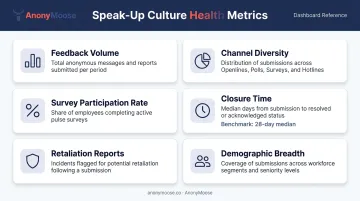
Track these signals across your organization:
- Feedback volume: Are reports-per-employee rising over time?
- Channel diversity: Are employees using multiple reporting paths, or clustering in one?
- Survey participation rates: Anonymous surveys should have substantially higher participation than identified ones
- Closure time: NAVEX's 2025 median was 28 days; significant delays signal bottlenecks
- Retaliation reports: Are they declining? Are substantiated cases being acted on?
- Demographic breadth: Are concerns coming from across levels, functions, and demographics — or only from senior or majority employees?
These numbers reveal patterns — but what employees aren't saying can be just as telling.
Treat Silence as a Warning Sign
Many organizations assume their speak-up culture is healthy because they haven't heard complaints. Low feedback volume is more likely to indicate suppressed voices than a contented workforce.
If employees aren't raising concerns, ask what's preventing them from speaking up — not whether everything is fine.
Frequently Asked Questions
How do you create a speak-up culture?
Start with visible leadership commitment — leaders must respond constructively when feedback arrives, not just say they welcome it. Pair that with accessible and anonymous reporting channels, a zero-tolerance retaliation policy that gets enforced, and a consistent habit of actively asking for input and responding to what you receive.
What are the key elements of a speak-up culture?
The four foundations are psychological safety, multiple feedback channels (including anonymous ones), non-retaliation protections with real enforcement, and leadership behaviors that model openness. Each element reinforces the others — gaps in any one will undermine the rest.
What is the difference between a speak-up culture and an open-door policy?
An open-door policy is passive; it waits for employees to initiate. A speak-up culture is active: it deliberately creates conditions, channels, and norms that make raising concerns easy, safe, and worthwhile for every employee, no matter their seniority or confidence raising concerns.
How does anonymity help employees speak up at work?
Anonymity removes the fear of personal consequences — retaliation, career risk, social friction — which is the primary reason most employees stay silent. When identity is protected by design, not just by policy, organizations receive more honest and representative input.
How do you know if your speak-up culture is working?
Track quantitative signals: feedback volume per employee, survey participation rates, declining retaliation reports, and faster case closure. On the qualitative side, look for concerns flagged before they escalate, broader participation across levels and demographics, and employees expressing genuine trust in the channels available to them.