That's an extreme case, but the underlying dynamic — people withholding truth because the environment punishes honesty — plays out in organizations every day at a smaller scale.
This guide covers what ethical communication actually means in practice, the principles that define it, the barriers that undermine it, and the concrete steps organizations can take to make honest dialogue the norm rather than the exception.
Key Takeaways
- Ethical communication is grounded in honesty, respect, transparency, and accountability — encompassing both the content of messages and the manner in which they are delivered
- It operates at two levels: individual behavior and organizational structure
- Psychological safety is the foundation — without it, policies and training accomplish little
- Retaliation fear is the top barrier — organizations must close that gap through structural safeguards, not just policy statements
- Visible follow-through on feedback — backed by clear reporting channels — is what makes ethical communication stick
What Is Ethical Communication in the Workplace?
The National Communication Association's Credo for Ethical Communication defines it as "fundamental to responsible thinking, decision making, and the development of relationships and communities within and across contexts, cultures, channels, and media." The NCA advocates for truthfulness, accuracy, honesty, and reason — and explicitly condemns communication that degrades people through distortion, intimidation, or coercion.
Ethical communication is a framework of behavior grounded in honesty, transparency, respect, and accountability. It's not just about what is said, but how, to whom, and with what intent. Effective communication gets a message across; ethical communication also asks whether the message serves the truth and respects the recipient. It operates at two levels:
- Individual level — how employees and managers speak, listen, and respond
- Organizational level — the policies, norms, and culture that either enable or suppress honest dialogue
Younger workers have made this a non-negotiable expectation. AICPA-CIMA's 2023 survey found that 36% of workers aged 20–30 identified "taking action when faced with an ethical dilemma" as the most meaningful evidence of business ethics — while only 6% pointed to CEO statements.
Deloitte's 2025 research reinforces this: 44% of Gen Zs and 45% of millennials had left a role they felt lacked purpose, with around 40% of both groups rejecting assignments or employers based on personal ethics. For organizations competing for talent, how they communicate is now as scrutinized as what they pay.
Ethical vs. Unethical Communication
The contrast is not always obvious — and that's exactly what makes it dangerous.
| Ethical Communication | Unethical Communication |
|---|---|
| Complete, accurate information | Selective omission of inconvenient facts |
| Consistent messaging across audiences | Different stories for different stakeholders |
| Respects the listener's autonomy | Manipulative framing or coercive pressure |
| Acknowledges uncertainty and error | Downplays or conceals problems |
| Invites honest feedback | Punishes or dismisses dissenting voices |
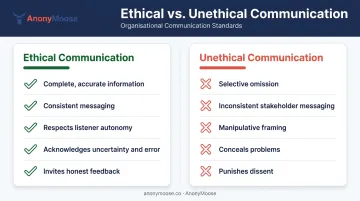
The most common forms of unethical communication in workplaces are subtle: incomplete information shared with employees, concerns dismissed or deprioritized, or silence maintained on matters that directly affect the workforce. None of these require intent to deceive — but all of them erode trust.
Key Principles of Ethical Communication in the Workplace
Several principles anchor ethical communication in practice. Organizations and individuals that internalize these aren't just being polite — they're building the conditions for better decisions, fewer crises, and stronger cultures.
Honesty and Transparency
Honesty means conveying complete, factual information with no intent to mislead — including uncomfortable truths. Transparency goes further: it requires sharing context, rationale, and even errors openly with those who need them.
A manager who discovers a budget overrun and discloses it immediately to stakeholders — with the cause and a proposed fix — is practicing both. A manager who buries the same news until it becomes a crisis has broken trust even if they never technically lied.
Respect and Non-Judgment
Respect is more than courtesy. It means:
- Recognizing cultural differences in communication style
- Avoiding dismissive or judgmental language
- Acknowledging other perspectives as legitimate even when you disagree
- Listening without formulating your response while someone is still speaking
For people in leadership roles, respect carries extra ethical weight. Power imbalances mean that dismissiveness from a manager lands differently than the same behavior from a peer.
Active Listening
Hearing and listening are not the same thing. Ethical communication requires genuinely engaging with what someone is saying — asking clarifying questions, suspending assumptions, and demonstrating through your response that the message was understood.
When active listening breaks down, the effects accumulate quickly. Misunderstandings compound, employees disengage, and the feedback that could prevent larger problems stops reaching the people who need it most.
Accountability and Responsibility
Active listening only creates value when it leads somewhere — and that's where accountability comes in. Ethical communicators own the consequences of what they say: admitting mistakes, correcting misinformation, following through on commitments. It's one of the clearest markers of leadership credibility. Teams notice quickly whether leaders hold themselves to the same standards they articulate.
Inclusivity and Equity in Communication
Not every employee has equal access to information or equal comfort speaking up. Ethical communication accounts for:
- Language fluency and accessibility needs
- Frontline or remote workers who may lack email access
- Power dynamics that make upward feedback feel risky
- Jargon-heavy messaging that inadvertently excludes
This last point is more structural than it appears. Research estimates approximately 2.7 billion workers globally are deskless or frontline — many without company email access. Platforms like AnonyMoose address this gap directly, using mobile-first design so frontline employees can submit feedback through the same channels as their desk-based counterparts.
Confidentiality and Privacy
What's shared in confidence must stay there — whether that's a client matter, an employee's personal situation, or a sensitive business issue. Gossip, oversharing, and information leaks are ethical breaches, not just social missteps. Once employees see that confidences are broken, they stop sharing — and the honest, early-warning communication organizations depend on dries up at the source.
Why Ethical Communication Matters for Organizations
This isn't a soft-skills conversation. Ethical communication has measurable business consequences.
The data makes the stakes concrete:
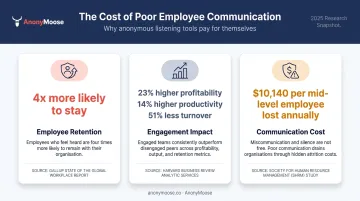
- Retention: SHRM's 2024 research found that employees who feel safe giving feedback without fear of retaliation are almost 4x more likely to stay with their employer.
- Engagement and performance: Gallup reports that highly engaged business units show 23% higher profitability, 14% higher productivity, and 51% less turnover than bottom-quartile units. The SHRM Study (2020) adds a direct mechanism: organizations with genuine anonymity in their feedback systems see a 34% boost in productivity through improved employee morale and trust — a return that connects ethical communication practices directly to bottom-line performance.
- Communication cost: Axios HQ's 2025 research estimates that ineffective internal communication costs $10,140 per year per mid-level employee and $54,860 per year per senior employee earning over $200,000. Separate research from Axios HQ, based on LinkedIn studies, found that 42% of employees have left an organization due to poor internal communication — making ethical, transparent communication one of the most financially consequential practices an organization can invest in. Further context from Axios HQ (based on LinkedIn studies): 42% of employees have left an organization due to poor internal communication — a figure that reframes communication ethics from a soft management concern into a quantifiable retention risk.
- Anonymous disclosure: The American Psychological Association (APA, 2021) found that employees are 70% more likely to disclose unethical practices in anonymous settings compared to traditional feedback methods — meaning the channel design directly determines whether ethical concerns surface internally or migrate externally to regulators and public platforms.
When ethical communication breaks down, the damage extends beyond internal metrics. 86% of job seekers research company reviews on platforms like Glassdoor before deciding where to apply.
Employees who feel silenced, dismissed, or deceived don't stop at disengaging quietly. They leave reviews, warn candidates away, and surface internal dysfunction publicly. A communication culture problem quickly becomes a talent acquisition problem.
The Volkswagen emissions scandal illustrates this at scale: an autocratic culture where subordinates were afraid to report bad news produced software that enabled emissions up to 35 times regulatory limits, a stock collapse, and a CEO resignation. The communication failure didn't follow the crisis — it caused it.
Common Barriers to Ethical Communication at Work
Understanding what gets in the way is as important as knowing what to build toward. The barriers are both structural and behavioral.
The most significant barrier: fear of retaliation. The Institute of Business Ethics' 2024 Ethics at Work Survey found that 1 in 3 employees who witnessed misconduct did not report it. Among those who didn't report, 34% cited fear of jeopardizing their job and 34% believed no corrective action would be taken. Among those who did raise concerns, 46% reported personal disadvantage or retaliation.
A separate study of over 100,000 U.S. employees found that **34% don't speak up due to fear of retribution**. These employees haven't abandoned their values. They've simply done the math on what honesty costs them in their specific environment. The APA (2021) quantifies what organizations lose from that calculation: employees are 70% more likely to disclose unethical practices in anonymous settings than through traditional feedback methods — meaning the difference between a named and anonymous channel is not merely one of preference, but of whether critical organizational intelligence reaches decision-makers at all.
Other common barriers include:
- Hierarchical power imbalances that make upward feedback feel career-limiting
- Cultural and language differences that create communication inequities across diverse teams
- Information silos that leave employees without the full picture needed to communicate accurately
- Management-level tolerance for gossip or selective truth-telling that sets a poor standard
The direct antidote is psychological safety — researcher Amy Edmondson's term for a team's shared belief that it's safe to take interpersonal risks. Google's Project Aristotle research reinforced this: team effectiveness depended less on who was on the team and more on how they worked together, with psychological safety as the top differentiator.

Without it, ethics training and communication policies become decorative. Employees won't speak honestly when honesty carries professional risk, regardless of what the handbook says.
How Organizations Can Foster Ethical Communication
Building a culture of ethical communication requires more than a policy update or a one-off training session. It requires embedding honest communication norms into leadership behavior, hiring criteria, team rituals, and feedback infrastructure.
Start with Leadership Behavior
Leaders set the standard through what they do, not what they say. A manager who acknowledges their own mistakes publicly, shares bad news proactively, and responds to criticism without defensiveness creates visible proof that honest communication is safe. A manager who punishes candor — even subtly, through body language or delayed responses — demonstrates the opposite.
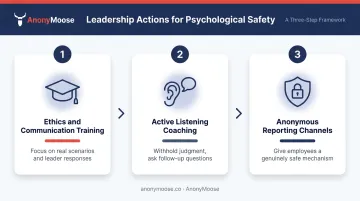
Three immediate actions organizations can take:
- Run ethics and communication training that focuses on real scenarios, not abstract principles — with particular attention to how leaders respond when they hear things they don't want to hear
- Coach managers on active listening — specifically on withholding judgment, asking follow-up questions, and separating the message from the messenger
- **Deploy anonymous reporting and feedback channels** that give employees a genuinely safe mechanism for raising concerns
Build Structural Safety, Not Just Cultural Safety
Traditional mechanisms — open-door policies, anonymous suggestion boxes, one-on-ones — often fall short because they don't guarantee genuine anonymity or ensure feedback is acted upon. Employees are right to be skeptical: writing style, timing, and context can often identify an "anonymous" submission in practice.
AnonyMoose is built to close that gap. The platform provides technically anonymous, mobile-first communication channels where employee identities are untraceable by design — built into the infrastructure, not simply promised by policy. Its four features work together to cover the full range of ethical communication needs:
- Openlines — two-way anonymous dialogue between employees and leaders
- Polls & Surveys — real-time sentiment measurement across teams
- Broadcast — direct leadership-to-workforce messaging
- Hotlines — structured anonymous incident reporting
The practical result: employees who would never respond candidly on a named survey — or walk into an HR office — will raise concerns and share honest feedback when they know their identity is protected at the infrastructure level.
Close the Feedback Loop Visibly
Soliciting feedback without acting on it — or without explaining why action wasn't taken — does more damage than not asking at all. It confirms the belief that speaking up is pointless.
Organizations that respond visibly to employee input send a clear signal that honest communication produces results. AnonyMoose's Broadcast feature is built for exactly this: leadership can communicate directly to the entire workforce, or specific subgroups, acknowledging what was heard and what's changing as a result.
A responsive feedback loop does three things:
- Confirms that input was received and taken seriously
- Explains what action is being taken — or why it isn't
- Builds the trust that makes future candor more likely
When employees see that their input drives decisions, speaking up stops feeling risky and starts feeling worthwhile.
Frequently Asked Questions
What are the key principles of ethical communication in the workplace?
The core principles are honesty, transparency, respect, active listening, accountability, inclusivity, and confidentiality. These require both individual practice and organizational reinforcement — neither works well without the other.
What are examples of ethical communication in the workplace?
Examples include a manager who honestly discloses a project setback rather than minimizing it, an HR professional who maintains confidentiality during a workplace investigation, and a team member who addresses conflict directly in a one-on-one conversation instead of venting to colleagues.
Why is ethical communication important in the workplace?
It builds trust, sharpens decision-making, and directly influences engagement and retention. Poor ethical communication creates measurable financial risk: turnover costs, legal exposure, and reputational damage when internal failures become public.
What are common barriers to ethical communication at work?
Fear of retaliation is the primary barrier, followed by power imbalances, low confidence that concerns will be acted on, cultural and language differences, information silos, and absence of genuinely safe reporting channels. The IBE's 2024 research found 46% of employees who raised concerns experienced personal disadvantage afterward.
How can managers promote ethical communication in their teams?
By modeling honest and transparent communication themselves, creating regular structured opportunities for feedback, actively listening without defensiveness, and ensuring team members have a genuinely safe channel — not just a nominally anonymous one — for raising concerns.
What is the difference between ethical and unethical communication?
Ethical communication is honest, complete, respectful, and accountable. Unethical communication involves deception, selective omission, or manipulation, even when it appears polite. The real distinction is intent: does this serve the truth and the listener, or protect the speaker at the listener's expense?