Introduction
Picture this: a serious harassment complaint surfaces on Glassdoor before HR has heard a single word about it. Or a cybersecurity breach hits, and employees are getting their information from Twitter rather than leadership. Both scenarios are crisis communication failures — and they happen more often than leadership expects.
According to a 2023 Capterra survey, fewer than half of U.S. companies have a formal, documented crisis communications plan. That gap is costly. Crisis communication breakdowns happen on two fronts: external emergencies requiring rapid mass alerts, and internal organizational failures where issues fester undetected until they explode publicly.
The right tools address both dimensions. This guide covers 10 crisis communication and collaboration tools — from mass notification systems to anonymous employee reporting platforms — so you can match the right solution to each type of crisis before one catches you unprepared.
Key Takeaways
- Crisis communication tools help organizations send rapid alerts, coordinate teams, and keep employees informed during emergencies
- Top tools deliver multi-channel messaging, real-time updates, and analytics that keep response teams aligned when it matters most
- Anonymous internal platforms like AnonyMoose catch workplace issues early — before they escalate into public crises
- Choose tools based on your crisis type: external emergencies, internal HR/safety issues, or a combination of both
- The 10 tools below span anonymous reporting, mass notification, incident management, and team collaboration
What Is Crisis Communication & Collaboration Software?
Crisis communication software helps organizations detect, respond to, and communicate during critical events. The category spans two very different problem types:
- External crises — natural disasters, cyberattacks, public safety incidents requiring rapid outbound alerts
- Internal crises — ethics violations, harassment, safety concerns, or morale breakdowns that need safe inbound channels
Most organizations invest heavily in the first category and neglect the second. The BCI/F24 2025 Emergency & Crisis Communications Report found that 60.3% of organizations use emergency notification or crisis management tools. Yet according to HR Acuity, while anonymous reporting tools are nearly universal, only 56% of employees even know those options exist.
That gap between outbound alerting and inbound listening is where internal crises slip through — often undetected until the damage is done. The 10 tools below address both sides of that equation.
10 Best Crisis Communication & Collaboration Tools
These tools were selected for reliability, feature depth, ease of deployment, and fit across different crisis communication scenarios — from mass alerts to anonymous employee reporting.
AnonyMoose
AnonyMoose is a SaaS-based anonymous employee communication platform built to surface internal workplace concerns — harassment, ethics violations, safety issues, and morale problems — before they escalate into public crises or external whistleblowing events.
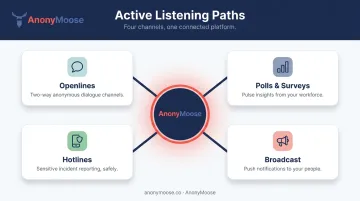
The platform offers four active listening paths:
- Openlines — two-way anonymous channels for ongoing dialogue between employees and leadership or HR
- Polls & Surveys — targeted pulse surveys with anonymous aggregated results in the Insights Dashboard
- Broadcast — one-to-many push notifications for critical announcements or emergency alerts
- Hotlines — structured channels for sensitive incident reporting (harassment, discrimination, compliance violations)
The architecture enforces anonymity at a technical level, not just through policy. No mechanism exists within the platform to trace a submission to an individual — neither AnonyMoose nor the employer can identify authors. Employees share honestly rather than staying silent until problems surface on Glassdoor or Blind.
This makes AnonyMoose the only tool in this list that directly addresses the inbound side of internal crisis communication — intercepting issues before they escalate, not responding after the fact.
| Category | Details |
|---|---|
| Best For | Organizations seeking to prevent internal HR, ethics, or safety crises through anonymous employee communication |
| Key Features | Openlines, Polls & Surveys, Broadcast, Hotlines; mobile-first; fully anonymous by design; two-way conversation threads; AI-powered pattern analysis in Insights Dashboard |
| Pricing | SaaS-based; contact AnonyMoose at anonymoose.co or info@anonymoose.co for pricing |
Everbridge
Everbridge is an enterprise-grade Critical Event Management (CEM) platform designed to coordinate mass notifications, incident response, and resource management during large-scale emergencies. It serves over 6,500 customers worldwide, including organizations managing geographically dispersed teams.
| Category | Details |
|---|---|
| Best For | Large enterprises managing complex, multi-location emergencies |
| Key Features | Multi-channel alerts (SMS, email, voice, push), pre-defined response plans, real-time dashboards, Visual Command Center |
| Pricing | Tiered (Core, Professional, Enterprise); contact Everbridge for a custom quote |
Slack
Slack functions as an internal crisis communication hub when configured with dedicated crisis channels, alert bots, and cross-department workflows. It requires employees to already be active Slack users to be effective, which limits its reach during sudden emergencies — but for teams already embedded in Slack, it enables fast coordination.
| Category | Details |
|---|---|
| Best For | Teams needing real-time internal coordination and cross-department collaboration during a crisis |
| Key Features | Dedicated channels, file sharing, third-party integrations, mobile app |
| Pricing | Free tier available; Pro plan at $7.25/user/month billed annually |
AlertMedia
AlertMedia is a unified risk intelligence and response platform combining mass notification with real-time threat monitoring. Its two-way communication feature lets employees confirm receipt or request help — a differentiator for field teams and high-safety-risk environments. AlertMedia reports that 81% of customers saw higher response rates after deployment.
| Category | Details |
|---|---|
| Best For | Organizations prioritizing employee safety alerts and real-time threat monitoring |
| Key Features | Multi-channel alerts, two-way communication, geolocation tracking, analyst-verified threat intelligence |
| Pricing | Contact AlertMedia for a quote |
Noggin
Noggin is an integrated resilience workspace that unifies crisis communication, incident management, business continuity, and operational risk in one platform. Verdantix has recognized it as the number one operational resilience software platform — making it a strong choice for organizations that need a single platform covering the full crisis lifecycle, not separate tools for each phase.
| Category | Details |
|---|---|
| Best For | Organizations requiring comprehensive, lifecycle-based crisis and incident management |
| Key Features | Integrated resilience workspace, multi-channel alerts, pre-defined playbooks, reporting and analytics, no-code customization |
| Pricing | Tiered; contact Noggin for a quote |
Zoom
Zoom serves as the live communication layer during a crisis — enabling company-wide briefings, stakeholder updates, and coordinated response sessions for distributed teams. High-capacity webinars, breakout rooms for sub-team coordination, and session recording for compliance review make it practical beyond everyday meetings.
| Category | Details |
|---|---|
| Best For | Organizations needing live, visual crisis briefings with large or distributed audiences |
| Key Features | Video conferencing, webinars, breakout rooms, screen sharing, session recording |
| Pricing | Free tier available; paid plans starting at approximately $14.16/user/month billed annually (verify current pricing at zoom.us) |
Veoci
Veoci is a cloud-based crisis communication platform built around pre-built templates, playbooks, and workflow automation. It's particularly strong in the public sector, with government agencies using it to unify operations from planning through response and recovery. The platform also supports social media integrations for monitoring external activity during an incident.
| Category | Details |
|---|---|
| Best For | Organizations needing customizable playbooks and structured crisis communication workflows |
| Key Features | Pre-built templates and playbooks, multi-channel alerts (SMS, email, voice), two-way notifications, automatic escalations, social media integrations |
| Pricing | Tiered; contact Veoci for a quote |
Crises Control
Crises Control combines a mass notification engine (PING), incident management tools, and an SOS panic button in one platform. Its July 2025 Microsoft Teams integration lets organizations send critical alerts, receive acknowledgments, and manage incidents directly within Teams — without switching applications.
| Category | Details |
|---|---|
| Best For | Organizations needing mass notification plus structured incident management in one platform |
| Key Features | PING mass notifications (SMS, email, push, IVR, web), incident manager, Teams integration, offline access, SOS panic button with GPS tracking |
| Pricing | Tiered; contact Crises Control for a quote |
Microsoft Teams
With over 320 million monthly active users across 181 markets, Teams is already the collaboration backbone for most enterprises. When integrated with specialized crisis tools — Crises Control, Pro-Sapien EHS, or Microsoft's own Emergency Operations Center template — it becomes a crisis command center without requiring teams to learn new software during a high-stress event.
| Category | Details |
|---|---|
| Best For | Organizations on Microsoft 365 that want crisis management embedded in their existing workflow |
| Key Features | Structured channels, Microsoft 365 integration, third-party crisis tool integrations, Power BI dashboards, mobile app, Remote Assist for field workers |
| Pricing | Included in Microsoft 365 subscriptions; Business Basic from $6.00/user/month, Business Standard from $12.50/user/month |
Dataminr Pulse
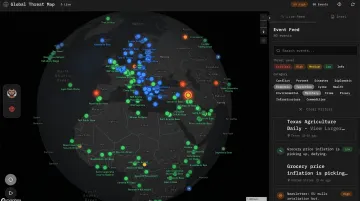
Dataminr Pulse is an AI-powered real-time alerting and collaboration workflow platform that detects emerging physical and cyber risks before most organizations are aware of them. Trusted by half of the Fortune 100 and over 100 U.S. government agencies, its audit trail and customizable playbooks support both real-time response and post-incident analysis.
| Category | Details |
|---|---|
| Best For | Corporate security and risk teams needing real-time threat detection combined with structured response workflows |
| Key Features | AI-powered real-time alerts, customizable playbooks, geovisualization, minute-by-minute audit trail, task assignment |
| Pricing | Contact Dataminr for a quote |
Key Features to Look For in a Crisis Communication Tool
Three capabilities determine whether a crisis tool holds up when it matters most — or creates new problems mid-response.
Multi-Channel Communication and Two-Way Capability
Effective tools send alerts across SMS, email, push notifications, and voice simultaneously. But one-directional alerting creates dangerous blind spots — you know you sent the message, but not whether anyone acted on it or whether employees have concerns that need surfacing.
Look for:
- Simultaneous multi-channel delivery
- Two-way communication for receipt confirmation
- Inbound channels for employee-initiated reporting (not just employer-initiated alerts)
Collaboration and Workflow Automation
Crises spiral in the gap between receiving information and taking coordinated action. Pre-built playbooks, task assignment, real-time dashboards, and audit trails close that gap.
Specifically prioritize:
- Pre-defined response playbooks that activate quickly
- Task assignment with accountability tracking
- Audit trails for post-incident review and compliance
- Real-time dashboards for situational awareness
Security, Anonymity, and Compliance
For external emergencies, end-to-end encryption and access controls are required. For internal workplace crises — harassment reports, ethics violations, safety concerns — anonymity protections matter equally.
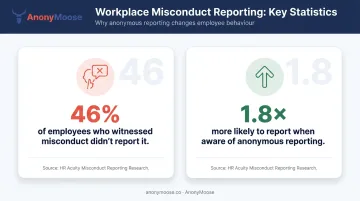
HR Acuity research shows that 46% of employees who witnessed misconduct didn't report it due to fear of retaliation. Employees aware of anonymous reporting options are 1.8x more likely to report — making anonymity the mechanism that determines whether inbound reporting functions at all.
How We Chose the Best Crisis Communication & Collaboration Tools
Tools were evaluated on:
- Breadth of communication channels — SMS, email, push, voice, and inbound reporting
- Ease of deployment under pressure — tools that require complex onboarding rarely get used correctly when a crisis hits
- Collaboration and workflow features — playbooks, task management, dashboards, audit trails
- Scalability — from small teams to global enterprises
- Coverage of both crisis dimensions — external emergency response and internal workplace crises
One mistake organizations consistently make: selecting tools exclusively for external emergencies while leaving internal communication channels unaddressed. Workplace crises — ethics violations, safety concerns, mental health issues — often surface on Glassdoor, social media, or in legal proceedings specifically because employees had nowhere safe to report them internally.
Beyond features, we weighted three practical factors that determine real-world adoption:
- Pricing transparency — hidden costs signal poor vendor trust
- Mobile accessibility — crises don't wait for desktop logins
- Integration fit — compatibility with Microsoft 365 and common HR platforms reduces deployment friction
A tool with a steep learning curve or clunky mobile experience will sit unused when it matters most. Adoption, not capability, is the final test.
Conclusion
A complete crisis communication strategy needs both outbound alerting and inbound listening. No single tool covers everything — the strongest approaches pair mass notification platforms like Everbridge or AlertMedia with internal communication platforms like AnonyMoose to capture what employees are experiencing before issues escalate.
Evaluate tools against your specific crisis scenarios, organizational size, existing tech stack, and whether you have blind spots on the internal communication side. Many organizations discover they've invested heavily in external emergency response while leaving workplace crises entirely unaddressed.
That gap is where internal crises tend to start. If your organization wants to catch problems before they go public, AnonyMoose's anonymous employee communication platform gives employees a safe channel to report concerns directly to leadership. Visit anonymoose.co or reach out at info@anonymoose.co to learn more.
Frequently Asked Questions
What is the difference between crisis communication software and collaboration tools?
Crisis communication software is purpose-built for emergencies — mass notifications, incident tracking, and coordinated response. Collaboration tools like Slack or Zoom support team communication but weren't designed for crisis scenarios. Effective strategies typically layer both.
What features are most important in a crisis communication tool?
The essentials: multi-channel alerting (SMS, email, push, voice), two-way communication for confirmation, real-time dashboards or collaboration workflows, pre-built response playbooks, and data security or anonymity features for sensitive internal communications. Tools missing two-way capability leave no way to confirm who actually received alerts.
How does anonymous reporting help prevent workplace crises?
Anonymous reporting channels allow employees to flag ethics violations, harassment, or safety concerns without fear of retaliation. Organizations can address problems early before they escalate to legal action or public reputation damage. Employees with access to anonymous options are 1.8x more likely to report misconduct.
Can small businesses use enterprise crisis communication tools?
Yes. Slack, Zoom, and Microsoft 365 all offer accessible free or low-cost tiers. Smaller teams should prioritize ease of use and multi-channel reach over feature complexity, and favor cloud-based platforms with no hardware requirements.
Are there crisis communication tools specifically for internal HR or workplace crises?
Most tools focus on external emergency response. AnonyMoose is specifically designed for internal workplace crises, providing anonymous channels for employees to report harassment, ethics violations, safety concerns, and cultural issues. It addresses the inbound side of crisis communication that most platforms overlook.
How do collaboration workflows improve crisis response times?
Pre-built playbooks and automated task assignment eliminate the "who does what" confusion that stalls emergency response. Teams move from risk detection to coordinated action in minutes, not hours.