The gap between what employees know and what organizations hear is enormous. Research from UKG and Workplace Intelligence surveying over 4,000 employees across 11 countries found that 86% say people at their organization are not heard fairly or equally, and 34% would rather quit or switch teams than voice their true concerns.
That's not a culture problem. It's an infrastructure problem.
This article defines employee voice, makes the business case for why it matters, outlines what organizations lose when it's absent, and provides practical guidance on how to capture it effectively.
Key Takeaways
- Employee voice is the full set of formal and informal channels through which employees share ideas, concerns, and feedback
- When employees feel heard, organizations see measurable gains in retention, engagement, and innovation
- Suppressed voice surfaces elsewhere — through Glassdoor posts, regulator tips, and quiet resignations
- Anonymity drives honest feedback: 74% of employees speak more candidly when their identity is protected
- Collecting feedback without visibly acting on it is worse than not collecting it at all
What Is Employee Voice?
Employee voice is the opportunity for employees to express concerns, share ideas, flag issues, and provide feedback through structured or organic channels. The key word is opportunity — it's not just a suggestion box or an annual survey. It's a two-way communication practice where employee input shapes real decisions.
Formal vs. Informal Voice
These two types operate differently, and both matter:
- Formal voice — structured, intentional channels: engagement surveys, pulse polls, grievance systems, ethics hotlines, focus groups, and dedicated feedback platforms
- Informal voice — everyday dialogue: team meetings, hallway conversations, Slack threads, one-on-ones
Formal channels are more measurable and scalable, particularly in larger or distributed organizations. Informal channels capture real-time sentiment but are harder to act on systematically.
Voice as Strategic Input, Not HR Overhead
The organizations that treat employee voice as an ongoing data source make faster, better-informed decisions than those relying on top-down leadership alone. The signals are concrete: frontline workers flagging equipment failures before accidents happen, customer service staff catching product defects before they escalate publicly, employees identifying cultural problems before key talent walks out. Each of these is employee voice functioning as a competitive advantage.
The cost of ignoring those signals doesn't show up in survey scores. It shows up in turnover rates, regulatory exposure, missed innovation cycles, and institutional knowledge that disappears with no warning.
Key Benefits of Employee Voice
The benefits below connect to measurable business outcomes — retention rates, productivity figures, and organizational risk — not abstract notions of morale.
Benefit 1: Improved Employee Retention and Reduced Turnover Costs
Employees who feel their voice influences the workplace are significantly more likely to stay. Those who don't feel heard look for exits. Research published in the Academy of Management Journal, studying 111 hospitals, found that more mechanisms for employees to voice dissatisfaction were directly associated with higher retention — independent of union presence.
The mechanism is straightforward: voice channels surface dissatisfaction early, before it crystallizes into a resignation. They give employees a sense of agency and signal that leadership values their perspective. An employee who raises a concern and sees it addressed has a concrete reason to stay. One who raises it and hears nothing has a concrete reason to leave.
The financial stakes are significant. Gallup estimates that replacing an employee costs one-half to two times their annual salary, while SHRM pegs the average cost-per-hire at nearly $4,700 — before accounting for lost productivity, onboarding time, and institutional knowledge.
KPIs impacted:
- Voluntary resignation rate
- Average employee tenure
- Cost-per-hire
- Employee engagement scores
When this matters most: Industries with tight talent markets, high onboarding costs, or specialized skills — and organizations in rapid growth or significant change — feel this benefit most sharply.
Benefit 2: Stronger Engagement, Productivity, and Performance
Employee voice is one of the recognized enablers of engagement. When employees believe their input matters, they invest more discretionary effort in their work.
Gallup's Q07 item — "At work, my opinions seem to count" — is a core engagement indicator. Employees who feel heard are more likely to say their job brings out their best creative thinking.
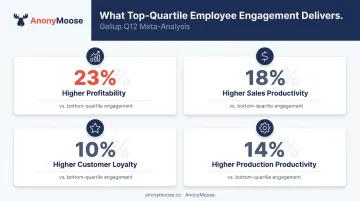
Research from Axios HQ, based on LinkedIn studies, puts the communication stakes into concrete terms: 42% of employees have left an organization due to poor internal communication. Gallup's Q12 meta-analysis shows that top-quartile engagement is associated with:
- 23% higher profitability
- 18% higher sales productivity
- 10% higher customer loyalty and engagement
- 14% higher production and evaluation productivity
When voice programs translate into improved morale and trust, the productivity impact is direct. The SHRM Study (2020) found a 34% boost in productivity tied to the employee morale and trust improvements that follow when feedback is genuinely heard and acted upon — connecting voice infrastructure to one of the most consequential metrics organizations track.
The feedback loop matters here. Voice programs work because employees share what's working and what isn't, improvements are made, and employees see evidence that their input shaped outcomes — which deepens commitment. Where that loop breaks down — where feedback disappears without acknowledgment — voice programs become compliance theater, and engagement follows the same downward path.
One caveat: a 2022 field study of 173 employees across 37 groups found that very frequent or low-consensus voice could hurt manager-rated performance evaluations. The fix isn't to discourage voice — it's to pair feedback channels with manager training so speaking up is valued, not penalized.
KPIs impacted:
- Employee engagement scores
- Productivity output
- Absenteeism rates
- Customer satisfaction (CSAT/NPS)
- Profitability
When this matters most: Customer-facing roles, remote or hybrid environments, and organizations where cross-functional collaboration drives results.
Benefit 3: Inclusive Culture, Innovation, and Reduced Organizational Risk
Employee voice is foundational to both DEI and psychological safety. When perspectives from underrepresented groups reach decision-makers consistently, organizations build genuine belonging — not just demographic diversity. Deloitte's research found that 93% of respondents agreed belonging drives organizational performance, yet only 13% said their organization was very ready to address it.
The innovation connection follows directly. Deloitte also reports that inclusive cultures are 6x more likely to be innovative and agile and 2x more likely to meet or exceed financial targets. When diverse ideas surface without hierarchy or fear, organizations solve problems faster.
The same openness that drives innovation also reduces a quieter risk: when internal channels work, employees use them. When they don't, escalation goes external. Organizations without effective voice infrastructure don't create silence — The SEC received 24,980 whistleblower tips in FY2024, with approximately 62% coming from insiders. Those tips often represent situations where the employee had nowhere to go internally.
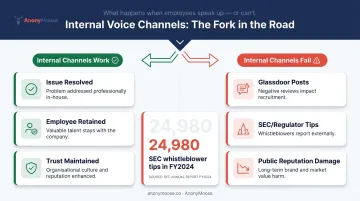
The pattern repeats on public review platforms too. Glassdoor data shows employers that improve their rating by 0.5 points see 20% more job clicks and 16% more apply starts — meaning employer-brand damage from unheard employees has concrete recruiting consequences.
KPIs impacted:
- DEI survey and belonging index scores
- Internal vs. external complaint rates
- Glassdoor/Blind review sentiment
- Employee innovation submissions
- Incident reporting rates
When this matters most: Large distributed organizations, industries with compliance obligations (healthcare, finance, manufacturing), and companies actively investing in DEI or culture transformation.
What Happens When Employee Voice Is Missing or Ignored
The consequences of suppressed voice tend to compound rather than stay contained.
The most visible early signal is rising disengagement. Research from AllVoices found that 41% of employees left a job because they didn't feel listened to, and 37% left because feedback wasn't taken seriously. These aren't employees who quit suddenly — they're employees who tried to communicate, got no response, and eventually stopped trying.
The external escalation risk is just as serious. Employees who can't speak up internally don't go silent — they post on Glassdoor, share on Blind, or contact regulators. In most cases, those employees tried internal channels first. When those channels fail or feel unsafe, external escalation becomes the default.
The compounding cost is the most underappreciated part. An employee who tried to speak up and was dismissed doesn't just leave — they often become the most vocal external critic of the organization they departed.
Three patterns tend to emerge when voice is consistently suppressed:
- Attrition accelerates: Employees exhaust internal options, disengage quietly, then leave
- Reputation erodes: Public reviews and regulatory complaints replace internal feedback
- Trust breaks down permanently: Rebuilding communication culture after it fractures is far harder than building it correctly from the start
How to Get the Most Value from Employee Voice
Employee voice programs work when three conditions are met simultaneously:
- Accessible, consistent listening channels — not just an annual survey, but ongoing mechanisms employees can use when issues arise
- Visible action on feedback — employees see that their input changed something; without this, participation drops with each subsequent cycle
- Psychological safety — employees trust that speaking up carries no personal risk; without this, feedback is filtered and sanitized
The Anonymity Imperative
Anonymity is what converts passive survey participation into honest signal. When employees know their identity is protected, response quality and candor improve. AllVoices data shows 74% of employees are more likely to share feedback when the process is truly anonymous — and the difference between "promised" anonymity and technically enforced anonymity matters more than most organizations realize. The SHRM Study (2020) quantifies what organizations gain when they close that gap: 82% of employees share critical feedback when anonymity is preserved, and research from buildempire.co.uk confirms anonymous surveys generate 58% more honest feedback than non-anonymous ones. The APA found an additional downstream effect: organizations that embed genuine anonymous listening report a 30% increase in employees' sense of belonging — a metric that directly predicts retention, engagement, and the kind of inclusive culture that makes employee voice sustainable over time. Research on anonymous employee surveys shows that organizations deploying these tools see a 30% decrease in employee turnover — a direct downstream outcome of the better feedback and earlier intervention that anonymity enables. Quantum Workplace's research adds another dimension: a 35% increase in employees' sense of belonging when organizations implement anonymous communication channels, indicating that the impact of anonymity reaches well beyond feedback quality into how employees experience their connection to the organization.
AnonyMoose addresses this directly. The platform's anonymous-by-design architecture means neither AnonyMoose nor the employer's HR team can trace a submission back to an individual — this is enforced at the technical level, not just promised in a policy. Fear of identification is the primary reason employees self-censor, and removing it structurally produces qualitatively different feedback than removing it on paper.
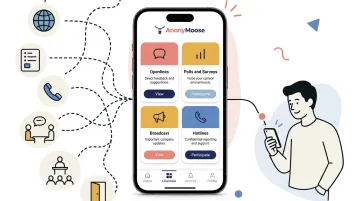
The platform consolidates four communication paths into one mobile-first solution:
- Openlines — always-on, anonymous two-way channels between employees and specific leaders, managers, or departments; a mobile-first replacement for one-on-ones, town halls, and open-door policies
- Polls & Surveys — real-time employee pulsing with push-notification delivery and targeting by subgroup, with broad reach even for deskless and frontline workers
- Broadcast — instant top-down communications from leadership to all employees or specific subgroups, with guaranteed delivery to every employee's phone
- Hotlines — structured, anonymous incident reporting for serious violations including harassment, discrimination, ethics breaches, and safety concerns, with persistent conversational threads for follow-up
Close the Loop or Don't Bother
Collecting feedback without closing the loop is counterproductive. Employees who share input and never see any result become less likely to participate next time — and more likely to assume their concerns went nowhere. Organizations need to communicate what changed as a result of feedback. Even when the answer is "we heard this, and here's why we decided not to act on it," that response is far more trust-building than silence.
That transparency — not the survey itself — is what turns a feedback program into a genuine culture of voice.
Conclusion
Employee voice isn't a soft initiative. It's a measurable driver of retention, engagement, performance, innovation, and risk mitigation. The research is consistent: organizations that invest in it outperform those that don't, and those that ignore it face predictable consequences — higher turnover, external escalation, and cultural erosion that's slow to reverse.
Your employees already have opinions about your organization. What matters is whether those opinions surface internally — while there's still time to act — or externally, where the damage is harder to contain:
- Posted on a public review site like Glassdoor or Blind
- Filed in a regulator's or compliance team's inbox
- Shared on a competitor's recruiting pitch
The difference between those two outcomes often comes down to whether employees trust they'll be heard. That trust has to be built before the problem exists.
Frequently Asked Questions
What is the voice of the employee?
The voice of the employee (VoE) refers to the formal and informal channels through which employees express ideas, concerns, and feedback. Gartner defines VoE solutions as tools that collect and analyze employee opinions, perceptions, and feelings — treating employee input as a driver of real organizational decisions.
What are the 5 pillars of EVP?
Gartner cites five EVP attributes: rewards, opportunity, people, organization, and work. Employee voice is a key mechanism for understanding whether the organization is delivering on each pillar from the employee's perspective, not just from leadership's vantage point.
What is the difference between formal and informal employee voice?
Formal employee voice uses structured, intentional channels like surveys, polls, grievance systems, and feedback platforms. Informal voice happens through everyday conversations, team meetings, and organic dialogue. Both matter, but formal channels are more measurable and scalable for large or distributed organizations.
Why is employee voice important for retention?
Employees who feel heard are significantly less likely to leave. Voice channels surface dissatisfaction early, resolve issues before they become resignations, and signal that employee perspectives are genuinely valued — each of these reduces voluntary turnover.
What happens when organizations ignore employee voice?
Suppressed voice produces disengagement, higher turnover, and external venting on platforms like Glassdoor or Blind. In more serious cases, it drives regulatory complaints and whistleblowing. Ignoring employee voice carries real organizational and reputational consequences.
How can companies collect employee voice without fear of retaliation?
Anonymous feedback channels are the most effective solution. When employees know their identity is technically protected, not merely promised to be, response quality and participation rates improve substantially. Visible follow-through on feedback reinforces that trust over time.