The cost of that gap is significant. The National Safety Council estimated preventable work injuries cost U.S. employers $181.4 billion in 2024, with an average of $48,000 per medically consulted injury. That's before legal exposure, reputational damage, or the organizational trust that quietly erodes when employees feel their concerns go nowhere.
This guide is for HR leaders, compliance officers, safety managers, and anyone responsible for organizational risk. It explains how incident reporting and case management work together, what a complete process looks like, and where most organizations fall short — starting at the reporting stage.
Key Takeaways
- Incident reporting captures what happened; case management determines what to do about it — related but distinct processes
- A formal process protects organizations legally, surfaces patterns, and shows employees that concerns are taken seriously
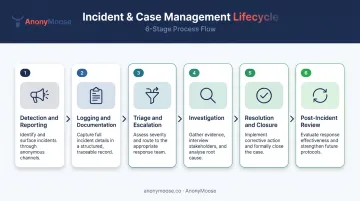
- The incident lifecycle has six stages: detection, intake, triage, investigation, resolution, and post-incident review
- Fear of retaliation keeps most employees silent — anonymous channels directly address this barrier
- Closing incidents without linking related events is among the most common — and costly — mistakes organizations make
What Are Incident Reporting and Case Management?
These two terms get used interchangeably — but they describe fundamentally different functions with different scopes.
Incident reporting is the structured process of capturing the key facts of a workplace event — who was involved, what occurred, when, where, and under what circumstances. It's event-level documentation: one event, one record.
Case management is the broader workflow used to track, investigate, document decisions, and close workplace matters. A single case may encompass multiple related incident reports, all the evidence gathered during investigation, communications with stakeholders, and the final resolution rationale.
The Key Distinction
| Incident Report | Case | |
|---|---|---|
| Scope | Single event | One or many linked events |
| Purpose | Capture what happened | Investigate and resolve |
| Relationship | One-to-one | One-to-many |
| Output | Documented record | Decision + corrective action |
A complaint about a manager, for example, might start as a single incident report. If a pattern emerges — repeat behavior, multiple complainants, escalating severity — those incidents should be elevated into a case that connects the underlying reports. Without that escalation path, organizations end up with isolated records that never surface the pattern — and the underlying risk goes unaddressed.
Why Every Organization Needs a Formal Process
Regulatory and Legal Obligations
Incident documentation isn't optional in most industries. A few examples:
- OSHA 29 CFR Part 1904 (U.S.): Employers with more than 10 employees must maintain Forms 300, 300A, and 301. Fatalities must be reported within 8 hours; in-patient hospitalizations within 24 hours. Records are retained for 5 years.
- UK RIDDOR: Responsible persons must report specified work-related deaths, injuries, diseases, and dangerous occurrences to the HSE.
- HIPAA (U.S. healthcare): Covered entities must document and respond to security incidents, with records retained for 6 years.
- GDPR (EU/EEA): Employee incident records containing personal data must follow data minimization, storage limitation, and access rights principles under Articles 5, 15, and 32.
Failure to maintain compliant records creates audit exposure and legal liability — not just regulatory fines, but difficult-to-defend positions in employment litigation.
The Operational Cost of Not Knowing
Without consistent documentation, organizations can't identify patterns. Every incident gets treated as isolated. A manager with three separate complaints over 18 months looks like three unrelated events rather than a systemic problem — until it becomes a lawsuit.
The Cultural Signal
A clear, accessible reporting process tells employees their concerns matter. Without one, employees who can't use internal channels don't stay quiet — they vent on platforms like Glassdoor or disengage entirely.
The Hidden Barrier: Fear of Retaliation
Even organizations with formal processes struggle with underreporting. A 2023 systematic review in BMC Public Health found that between 20% and 91% of workers did not report work-related injuries or illnesses — with fear of negative consequences cited as a primary reason.
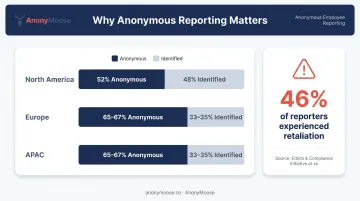
According to ECI's 2023 Global Business Ethics Survey, 46% of employees who reported misconduct said they experienced retaliation. When nearly half of reporters face retaliation, the decision to come forward becomes a risk calculation — not a civic one.
Anonymous reporting channels shift that calculation. The NAVEX 2025 Whistleblowing Benchmark Report — drawing on 2.15 million reports from over 4,000 organizations — found that anonymous reports represented 52% of North American submissions and 65–67% in Europe and APAC.
Platforms like AnonyMoose's Hotlines feature address this directly. Neither the platform nor the employer can trace a submission back to an individual, which means employees can report from their own desk without weighing who might find out.
How the Incident Reporting and Case Management Process Works
The process moves through six stages, each feeding the next. Case complexity, report volume, and the quality of intake channels all affect how efficiently each stage runs.
Step 1: Detection and Reporting
Incidents surface through hotlines, web forms, manager escalation, direct observation, or anonymous mobile apps. The intake channel matters — it directly determines what gets reported and by whom. Low-friction, confidential channels produce more complete data. A phone-based hotline that requires an employee to find privacy, call a stranger, and speak out loud creates barriers that a mobile app removes entirely.
Step 2: Logging and Documentation
A complete case record must be created at intake, capturing:
- Nature of the incident
- Date, time, and location
- Individuals involved (names, roles, departments)
- Witness accounts
- Immediate actions taken
- Severity classification
Inconsistent logging is the most common reason cases collapse during investigation or legal review. Incomplete fields aren't just a procedural gap — they're an audit risk.
Step 3: Triage and Escalation
Reports are reviewed for urgency, severity, and exposure, then routed to the right reviewer. Escalation criteria to configure in advance:
- Immediate safety risk
- Harassment, discrimination, or retaliation allegations
- Financial exposure or executive involvement
- Need for an unbiased investigator outside the reporting line
Routing rules should be established before incidents occur — not determined case by case when emotions and timelines are already pressured.
Step 4: Investigation and Evidence Gathering
This stage shifts from initial response to structured casework:
- Assign an investigator — someone without a conflict of interest relative to the parties involved
- Preserve evidence immediately — documents, emails, messages, personnel files — in an unadulterated state
- Conduct interviews — complainant, respondent, witnesses — with documentation of each
- Maintain chain of custody — record who accessed what evidence, and when
- Link related incidents — check whether other reports involve the same subject, location, or pattern
Evidence scattered across personal email, shared drives, or handwritten notes is legally indefensible — chain of custody only holds if it's documented.
Step 5: Resolution, Corrective Action, and Closure
A case is not closed when the immediate issue is contained. Closure requires:
- A documented decision rationale
- Completed follow-up actions (policy changes, disciplinary actions, safety updates)
- Communication back to the reporter where appropriate
Never close a case without a documented resolution. If it isn't written down with a clear rationale, it didn't happen as far as any audit or legal review is concerned.
Step 6: Post-Incident Review
The review cycle turns incident data into prevention intelligence:
- Audit the case timeline — did it move through each stage as designed?
- Confirm escalation rules were followed, not improvised
- What patterns appear across cases over time?
- What policy, training, or structural changes would reduce recurrence?
When case data is reviewed consistently over time, individual incidents stop being isolated events — they become a map of where your processes, culture, or oversight need work.
Key Components of an Effective Incident Report
Core Data Fields
Every incident report should capture:
- What happened — description of the incident in factual terms
- When and where — date, time, specific location
- Who was involved — names, roles, and departments of all parties
- Witnesses — names and contact information
- Severity classification — urgency level for triage
- Immediate actions taken — any steps already implemented at intake
OSHA Form 301, for example, requires all of the above plus healthcare information, body part affected, and object or substance involved — and must be completed within 7 calendar days of a recordable case. Missing required fields create direct compliance exposure during audits.
Documentation Standards and Chain of Custody
"Chain of custody" in a workplace investigation means a documented record of who accessed what evidence and when — so that no one can later claim a document was modified, tampered with, or selectively removed.
All notes, evidence files, and attachments must be stored in a controlled, auditable record. Evidence scattered across email threads and personal drives creates real legal exposure: cases become indefensible if challenged without a traceable, complete record.
Access Controls and Data Privacy
Not everyone should see every case. Role-based permissions protect the confidentiality of sensitive HR, compliance, and legal matters. Under GDPR Article 5, employee personal data must be adequate, relevant, and limited to what is necessary. Restricting access to incident records is a legal obligation, not just a best practice.
AnonyMoose handles this through a designated assignment model built into its Hotlines feature: each Hotline is assigned to specific individuals in HR, legal, or leadership, so sensitive reports reach only the appropriate personnel.
Common Pitfalls That Undermine Incident Reporting and Case Management
Underreporting Due to Friction and Fear
Organizations that rely on paper forms, non-mobile systems, or channels employees perceive as non-anonymous see reporting rates drop dramatically. When the process is cumbersome — or when employees doubt their identity is truly protected — incidents stay invisible.
A 2023 BMC Public Health systematic review identified three friction factors that directly suppress reporting: "cumbersome time and effort," "not knowing how or where to report," and "lack of perceived follow-up benefit." Effective reporting systems address all three — mobile access, clear channels, and visible action on submissions.
Treating Incidents in Isolation
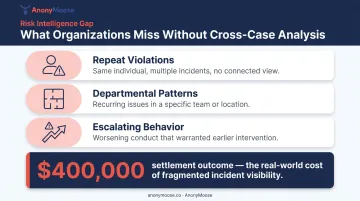
Closing incident reports without checking for connections to prior events is one of the most common and damaging mistakes in workplace management. Without cross-case analysis, organizations miss:
- Repeat policy violations by the same individual
- Recurring issues in a specific department or location
- Escalating behavior patterns that warrant earlier intervention
The EEOC's case against McDonald Oil Company — which resulted in a $400,000 settlement — alleged the company ignored frequent complaints from multiple female employees about ongoing sexual harassment. Individual complaints that were connected and acted on earlier would have changed the outcome entirely.
That pattern — isolated responses with no systemic view — leads directly to the next pitfall.
Confusing "Handled" with "Resolved"
Many teams believe incident management ends when the immediate situation is contained. It doesn't. Containment without root cause analysis, corrective action, and post-review means the same incident recurs — often worse.
Teams that confuse fast response with complete resolution revisit the same issues quarter after quarter, with nothing learned in between.
Conclusion
Incident reporting captures the facts. Case management transforms those facts into structured resolution and institutional learning. Together, they protect organizations legally, operationally, and culturally.
The effectiveness of both depends not just on having the right process, but on creating conditions where employees actually use it. That means low-friction access, documented follow-through, and genuinely anonymous reporting channels where identity protection is guaranteed by design — not just policy. Platforms like AnonyMoose are built specifically on this principle: submissions cannot be traced back to individuals by the employer or the platform itself, removing the fear that keeps most incidents unreported.
Frequently Asked Questions
What are the key components of an incident report?
Every incident report should capture who was involved, what happened, when and where it occurred, witness accounts, severity level, and immediate actions taken. Consistent capture of all fields makes reports actionable during investigation and audit.
What are the C's of incident management?
The 5 C's framework covers five sequential steps:
- Capture — collect all incident details immediately
- Classify — categorize by type and severity
- Communicate — keep relevant stakeholders informed
- Correct — resolve the immediate issue
- Confirm — verify resolution and implement preventive steps
What are the P's of incident management?
No single authoritative standard exists, but a practical workplace framework covers five areas:
- People — who reports, investigates, and decides
- Process — defined steps from intake to closure
- Policy — the rules that govern conduct and response
- Platform — the tools used to capture and manage reports
- Prevention — the learning cycle that reduces future incidents
What is the difference between incident management and case management?
Incident management handles the immediate response to a single reported event. Case management is the broader process of organizing, investigating, and resolving issues over time — a single case can include multiple linked incidents, all evidence collected, and a formal resolution record.
Why do employees fail to report workplace incidents?
The primary reasons are fear of retaliation, distrust of confidentiality, unclear reporting channels, overly complex processes, and uncertainty that anything will change. Anonymous reporting channels directly address the fear and confidentiality barriers.
How does anonymous reporting improve incident management outcomes?
Anonymity removes the fear of identification, which increases report volume and surfaces incidents that would otherwise go undocumented. Better data enables earlier pattern detection, faster intervention, and stronger employee trust — making the entire reporting process more effective and credible.